24 Luxury Staircase Storage Ideas Glass Wine Cellar Style
A staircase is one of the most architecturally significant features in any home — and for too long, the space beneath it has been treated as an afterthought. A coat cupboard with a broken hinge. A forgotten corner where hoovers go to retire. But when you approach under-stair storage the way a luxury designer would — with glass enclosures, precision lighting, and the visual drama of a glass wine cellar — that forgotten space becomes the single most impressive feature in the entire house.
The glass wine cellar aesthetic is built on a few simple principles: transparency, illumination, and order. Everything is visible. Everything is lit. Everything is arranged with intention. When those principles are applied to under-stair storage — whether you are housing wine, books, spirits, or curated objects — the result is a feature that commands attention from every angle of the room it inhabits.
These twenty-four ideas take the glass wine cellar concept and apply it to every kind of staircase, every kind of storage need, and every kind of luxury interior — from the grand entrance hall to the open-plan kitchen. Every one of them treats your staircase not as a structural necessity but as the design opportunity it has always been.
1. Full Glass Enclosed Under-Stair Wine Cellar
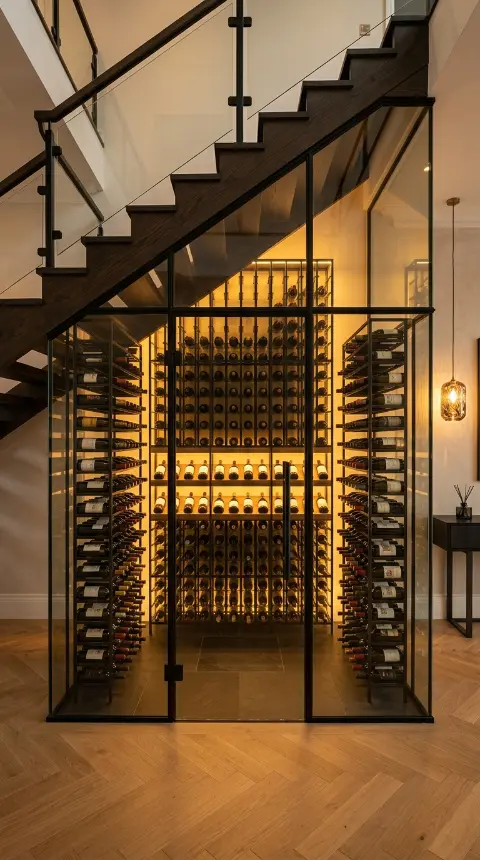
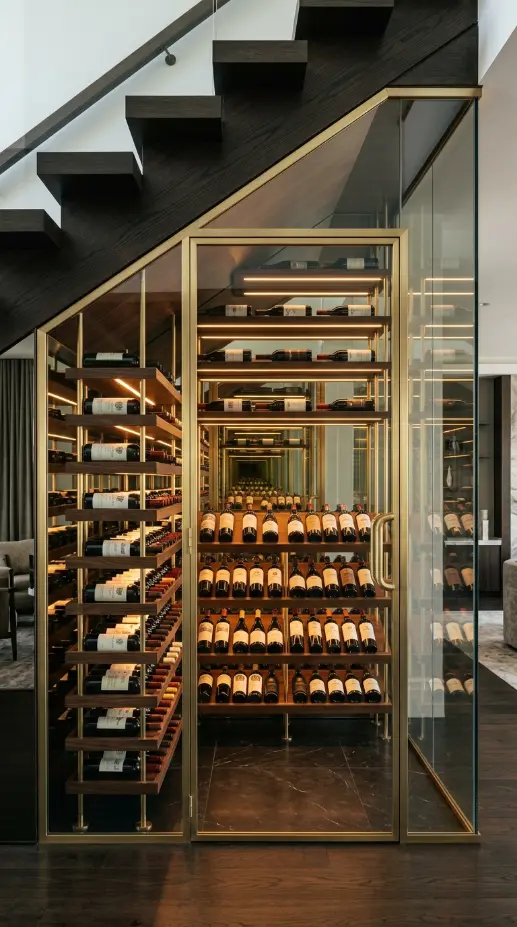
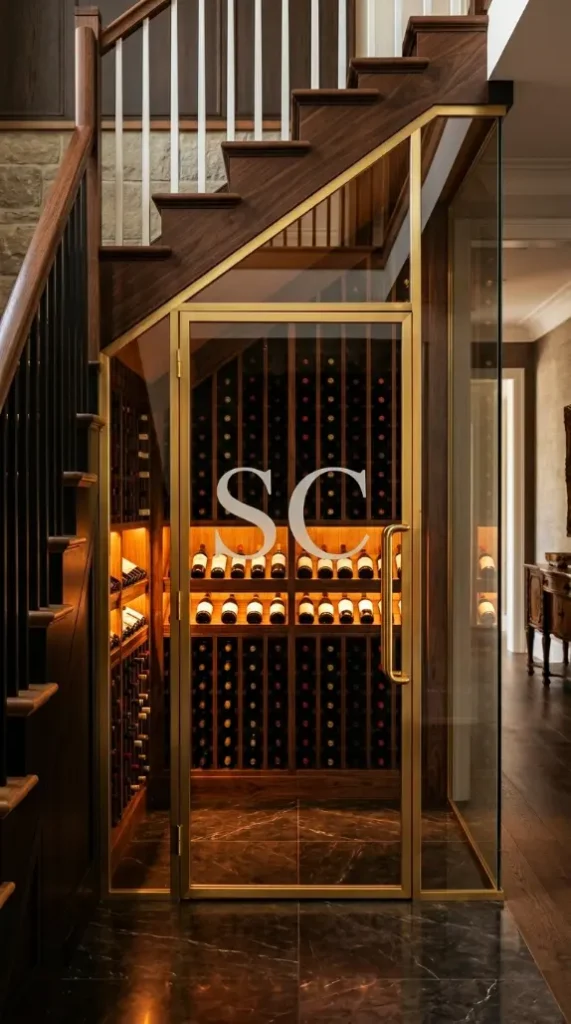
Build a fully enclosed glass wine cellar beneath your staircase using frameless glass panels and a black steel or brushed brass frame system — floor to ceiling glass on all visible sides, with a single glass door and black steel pull handle for access. Line the interior with a custom floor-to-ceiling wine rack in black steel or dark timber, with warm amber LED strip lighting recessed into every shelf level. The result is a cellar that glows from within — a backlit display of your wine collection that transforms the staircase into a focal point visible from every corner of the room.
2. Frameless Glass Spirit and Whisky Display Cabinet
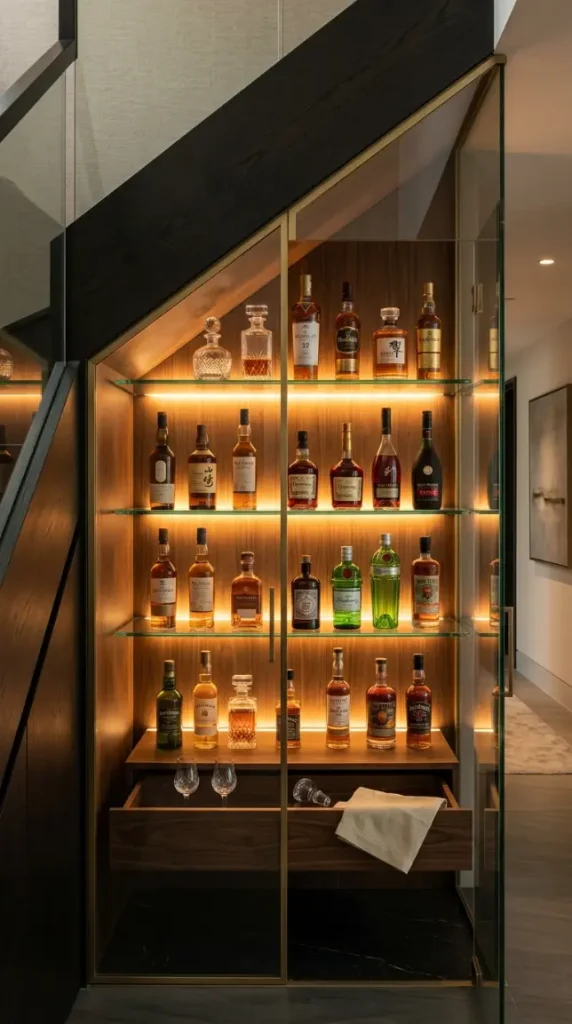
Create a frameless glass enclosed cabinet beneath your staircase dedicated entirely to a curated spirits collection — whisky, cognac, and premium bottles arranged on backlit floating glass shelves with warm amber LED underlighting on each shelf level. Space the bottles with gallery-level breathing room between each one, labels facing forward with precision. Add a small pull-out drawer beneath the bottom shelf in dark timber or black steel for accessories — stoppers, tasting glasses, and linen cloths. This is not a drinks cabinet. This is a collection, displayed with the same care and intention as art.
3. Temperature Controlled Glass Wine Cellar With Humidity Display
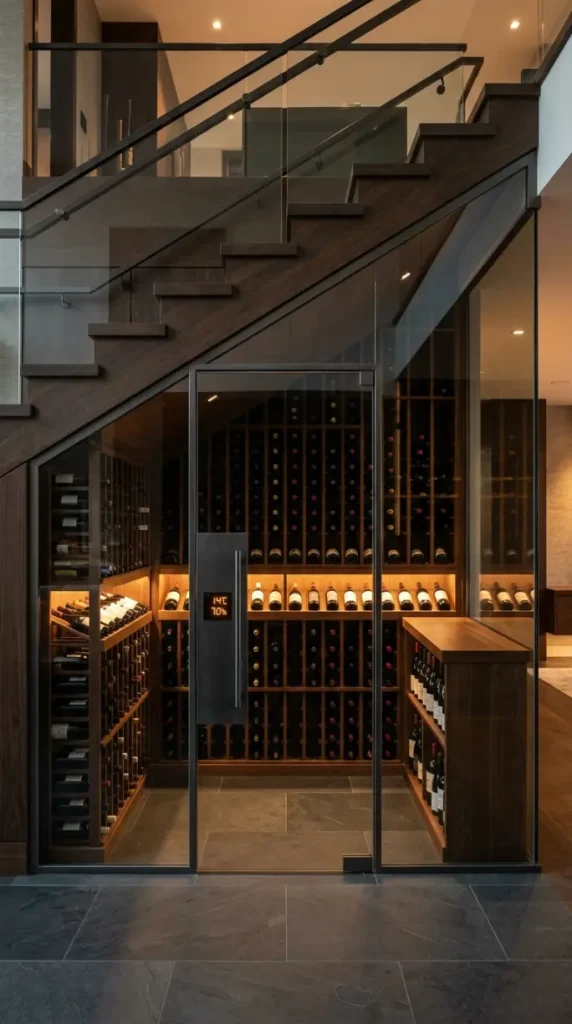
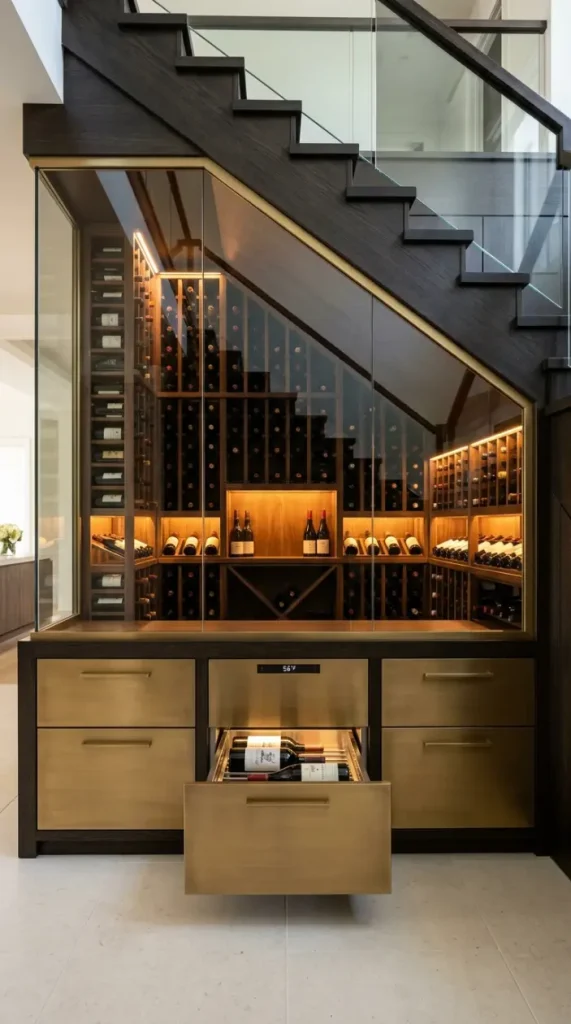
Install a fully climate-controlled glass wine cellar beneath your staircase — complete with a digital temperature and humidity display panel mounted flush into the glass door frame, visible from outside the cellar. The functional detail of the climate control panel adds a layer of technical luxury that elevates the entire feature: it signals to every person who sees it that this is not a display cabinet pretending to be a wine cellar — this is the real thing. Line the interior with dark timber wine racks, a single recessed tasting shelf at standing height, and warm amber cellar lighting throughout.
4. Glass and Brass Under-Stair Library Display
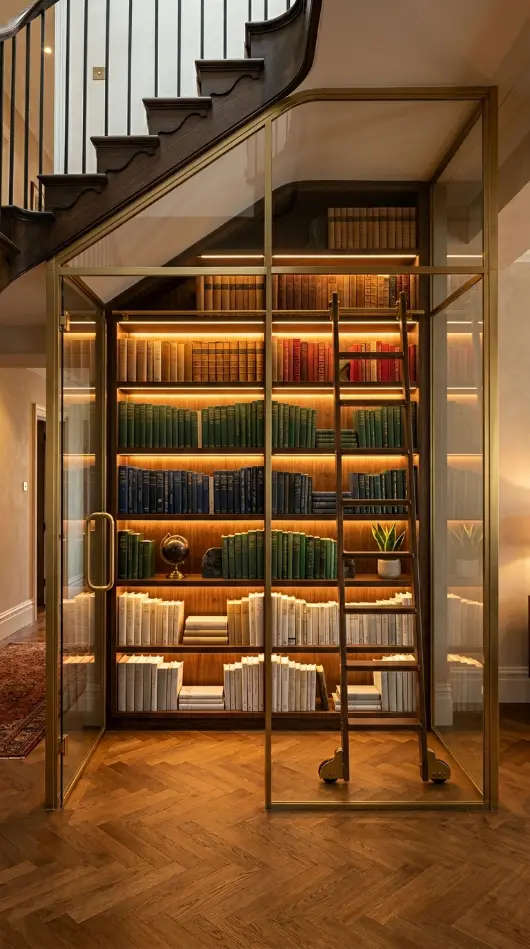
Enclose the under-stair space in glass with a brushed brass frame system and use it as a backlit personal library — floor to ceiling book shelves in dark walnut timber, books arranged by spine color in curated sections, with warm amber LED strip lighting recessed beneath each shelf level. Add a small rolling library ladder in dark timber with brass fittings that slides along a brass ceiling track inside the glass enclosure. The glass library beneath a staircase is one of those features that makes a home feel like it was designed by someone who takes beauty seriously — and who reads.
5. Under-Stair Glass Champagne and Sparkling Wine Cellar
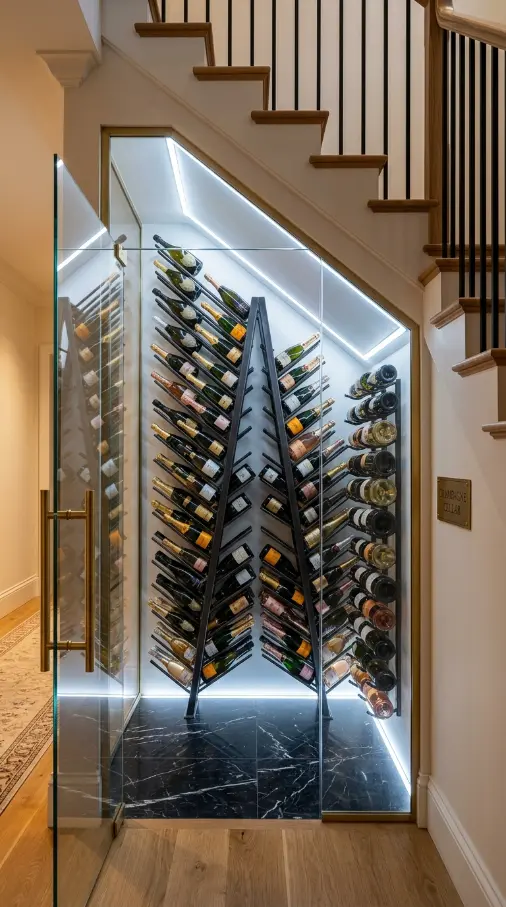
Dedicate the under-stair glass enclosure entirely to champagne and sparkling wine — bottles stored horizontally in a custom riddling rack system in dark steel, with each bottle at the classic champagne angle. Backlit with cool white LED lighting rather than warm amber — to complement the pale gold and rose tones of the bottles — and finished with a dark marble floor inside and a single engraved brass plate on the door reading “Champagne Cellar.” This is a feature that announces its single purpose with complete confidence, and that confidence is exactly what makes it feel so luxurious.
6. Under-Stair Glass Display Cabinet for Art and Sculpture
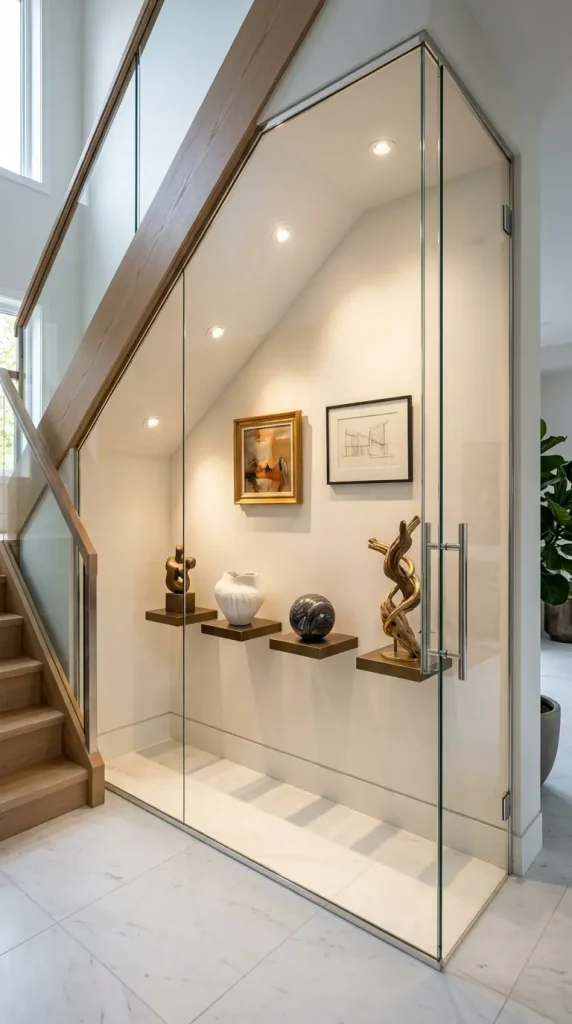
Use the under-stair glass enclosure not for wine or books but for art — a curated display of small sculptures, ceramic objects, and framed works mounted on the back wall, each individually spot-lit with recessed LED picture lights. A glass-enclosed art display beneath a staircase has the visual impact of a private gallery installation — the transparency of the glass makes the objects float in illuminated space, visible from every angle, lit with the precision of a museum. It transforms the staircase into a gallery wall that wraps around a three-dimensional display.
7. Under-Stair Glass Cellar With Tasting Nook
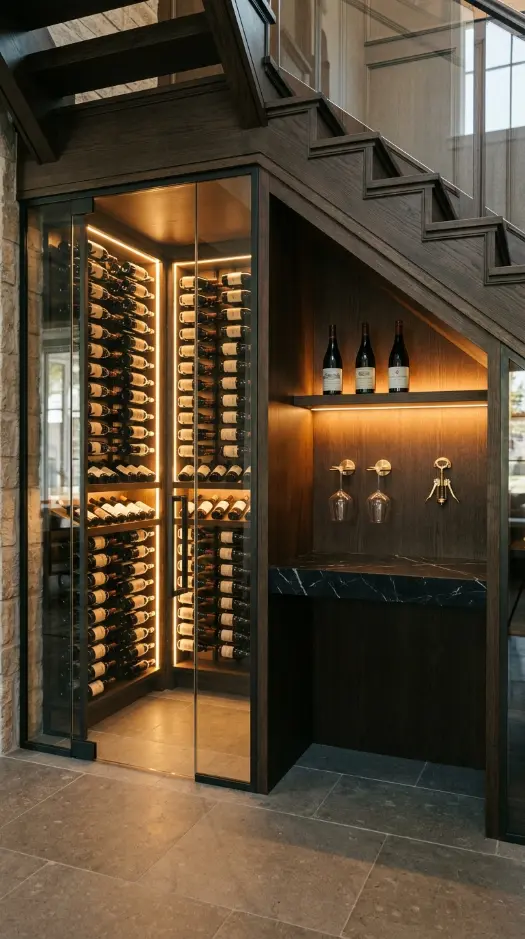
Extend the glass wine cellar concept beyond pure storage by carving out a small tasting nook within the under-stair space — one section enclosed in glass as the wine rack cellar, and an adjacent open alcove fitted with a slim dark marble counter at standing height, two wall-mounted brass wine glass holders above, and a brass wall-mounted bottle opener. The tasting counter creates a functional ritual space beside the cellar — a place to open, pour, and assess a bottle without walking it across the room. Storage and experience, designed together.
8. Mirrored Back Wall Glass Wine Display
Line the back wall of your under-stair glass enclosure with a floor to ceiling mirror — so that the wine rack and bottle collection reflects infinitely into the mirrored surface, doubling the visual depth and drama of the entire feature. A mirrored back wall inside a glass cellar creates the illusion of a space that extends far beyond the physical dimensions of the under-stair void — every bottle appears twice, the amber cellar lighting reflects and amplifies, and the whole feature takes on a depth that feels genuinely architectural rather than decorative.
9. Under-Stair Glass Cellar With Chalk Label Wall
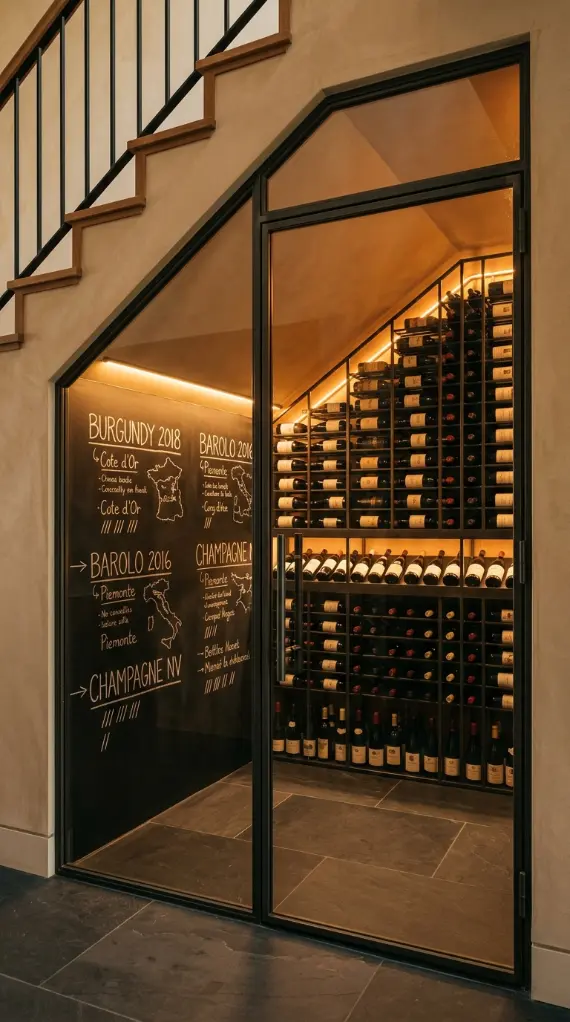
Paint one interior wall of your under-stair glass cellar with chalk paint — dark blackboard finish — so that you can write directly on the wall in chalk: vintage years, tasting notes, regions, and bottle counts. The chalk wall adds a working-cellar authenticity to the glass display — it says this is not a decorative prop, this is a functioning collection that is actively catalogued and curated. From outside the glass, guests can read the chalk notes on the wall, which turns the cellar into a conversation piece as much as a storage feature.
10. Under-Stair Glass Enclosed Cigar and Whisky Humidor
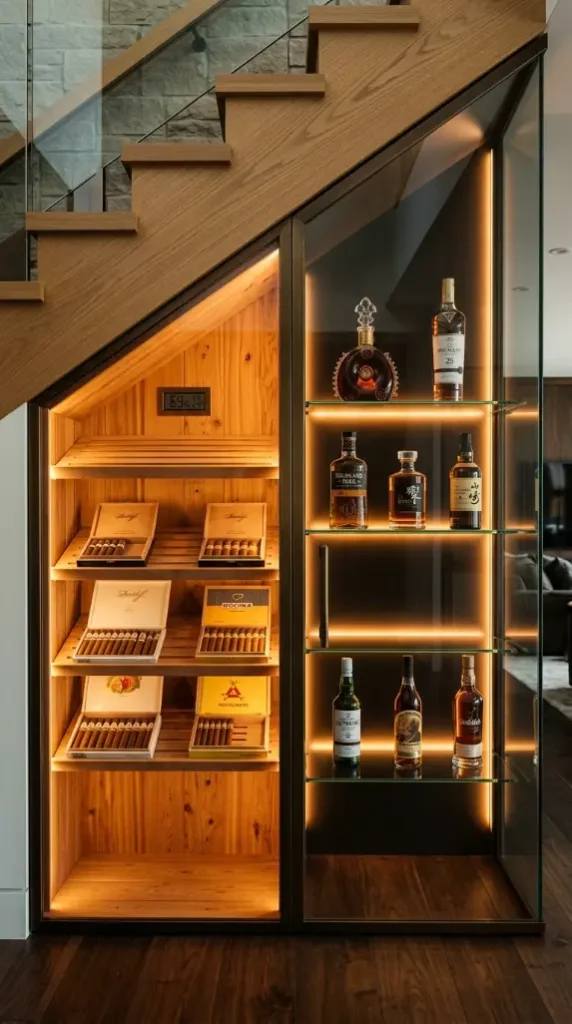
Build an under-stair glass enclosure as a combined cigar humidor and whisky display — one half of the interior fitted as a climate-controlled cedar-lined humidor with cigar boxes displayed on dark cedar shelving, the other half fitted with backlit floating glass shelves holding a curated whisky collection. The combined humidor and whisky cabinet beneath a staircase is a feature that belongs in a private members club — and when built with glass enclosure, precision lighting, and quality materials, that is exactly the atmosphere it creates in a residential home.
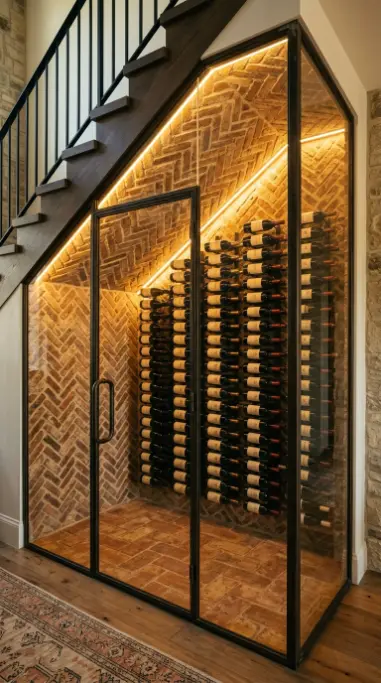
11. Under-Stair Glass Cellar With Herringbone Brick Interior
Line the interior walls of your under-stair glass enclosure with hand-laid herringbone brick — aged reclaimed brick in warm terracotta and charcoal tones — to give the glass cellar the visual character of a centuries-old European wine cave brought into a contemporary home. The brick interior visible through the glass panels creates a dramatic textural contrast — raw aged brick behind sleek frameless glass — that gives the feature a depth and authenticity that smooth plastered interiors can never match. Fit dark steel wine racks against the brick walls and light the interior with warm amber filament LED strips.
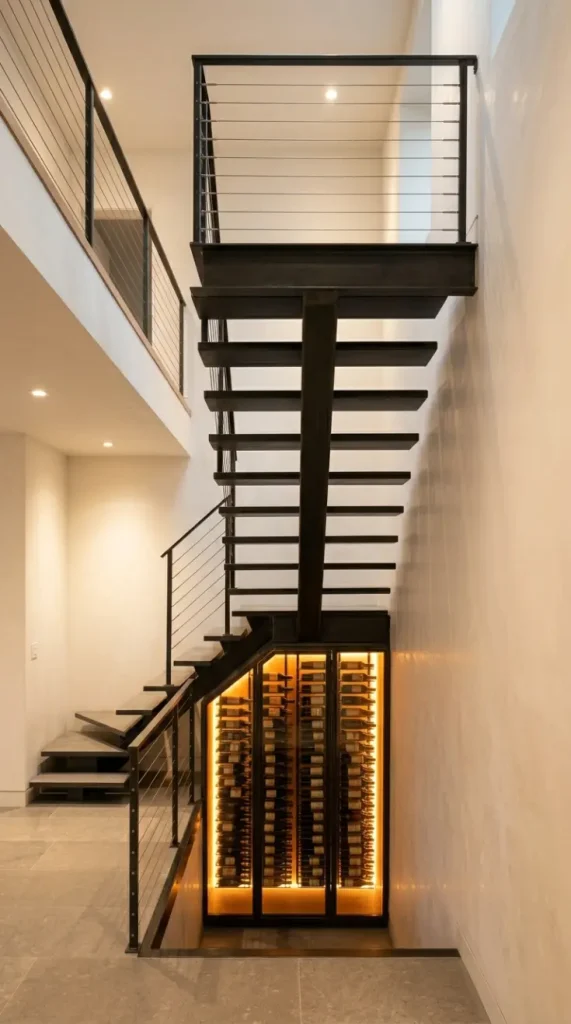
12. Floating Staircase With Glass Wine Cellar Below
Design a floating open-riser staircase with no solid risers — thin dark steel or timber treads cantilevered from a central spine — so that the wine cellar beneath is visible through the staircase itself as you ascend. The staircase becomes transparent, the cellar glows through the gaps between every tread, and the two features — staircase and cellar — become a single unified architectural object that is impossible to separate visually. This is the kind of feature that defines a home’s entire design language from the moment you enter.
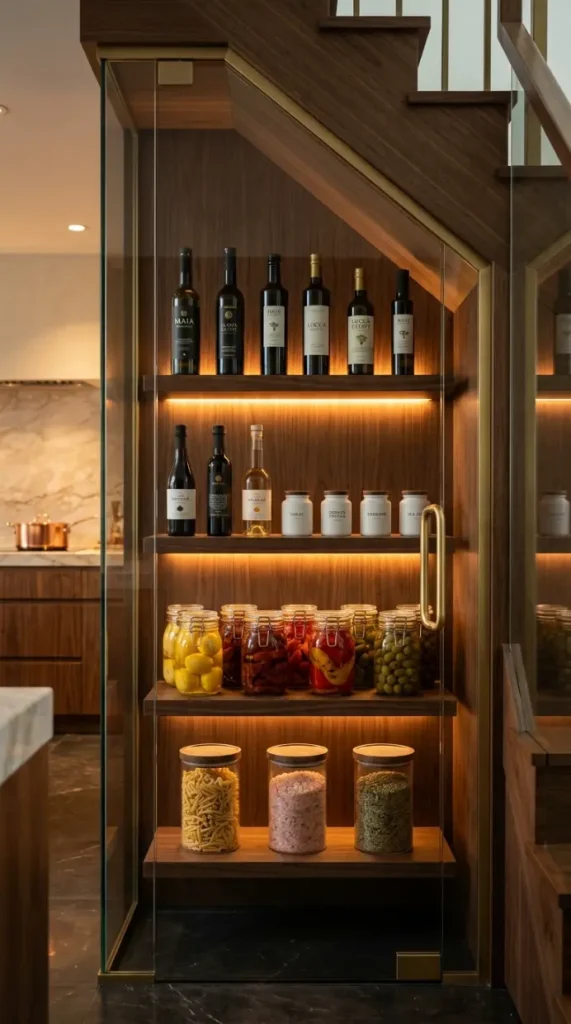
13. Under-Stair Glass Enclosed Olive Oil and Pantry Display
Apply the glass cellar concept to a luxury kitchen context — enclose a section of under-stair space adjacent to the kitchen as a glass-fronted pantry display: premium olive oils in tall dark glass bottles arranged by region on backlit floating shelves, specialty vinegars, ceramic spice jars in a uniform set, and a small row of preserved goods in clip-top glass jars. A glass-enclosed pantry styled like a wine cellar brings the same drama and intentionality to everyday kitchen storage — and signals that in this kitchen, ingredients are treated with the same respect as wine.
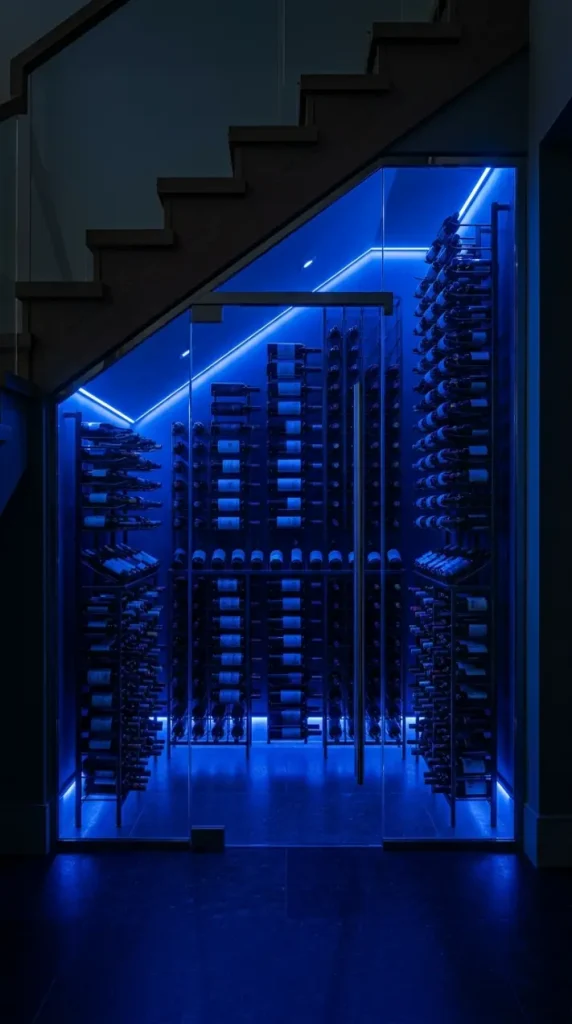
14. Under-Stair Glass Cellar With Integrated Lighting Scenes
Install a smart LED lighting system inside your under-stair glass cellar with multiple scene settings — a warm amber “display mode” for when guests are present, a cool white “working mode” for accessing the collection, and a deep blue “night mode” that gives the cellar a dramatic theatrical quality after dark. The ability to shift the cellar’s lighting scene transforms it from a static feature into a dynamic one — a feature that looks different in the morning, at dinner, and late at night, and that adapts to the mood of the room around it rather than imposing a single fixed aesthetic.
15. Under-Stair Glass Display With Integrated Wine Fridge Drawers
Combine a glass display cellar with two or three integrated wine fridge drawer units built into the base of the under-stair structure — the glass display section above showing the main collection at room temperature, the refrigerated drawers below maintaining serving temperature for bottles ready to open. The dual-temperature system is the functional detail that separates a luxury installation from a decorative one — it signals that this feature was designed by someone who understands wine, not just someone who wanted a beautiful storage wall.
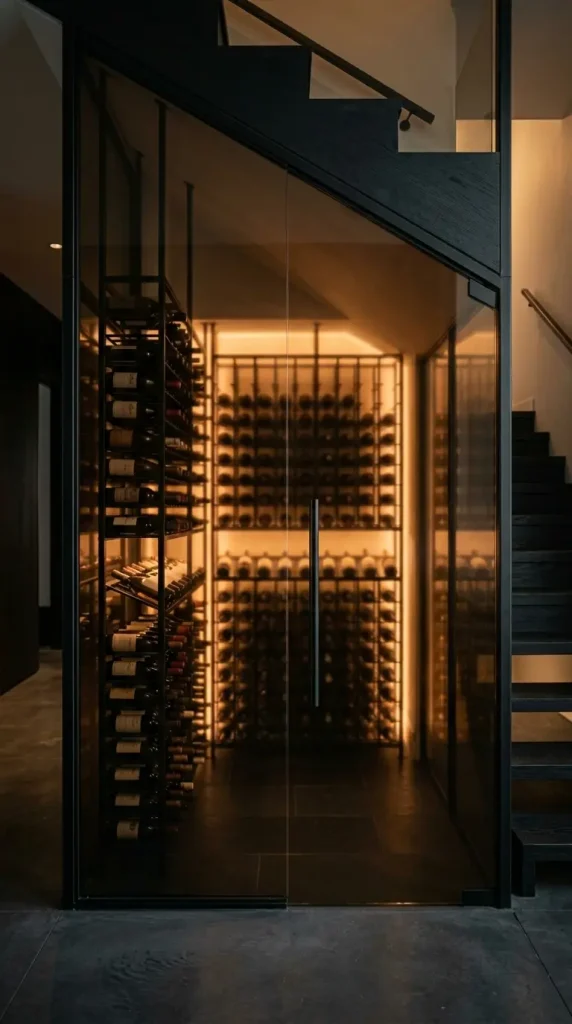
16. Under-Stair Glass Cellar In Black Steel and Smoked Glass
Build the under-stair glass enclosure using smoked or tinted glass panels rather than clear — so that the wine collection inside is visible but darkened, partially obscured, seen through a warm amber or deep grey tint. Smoked glass panels with a black steel frame give the cellar a dramatically different character from a clear glass installation — more private, more mysterious, more nocturnal. The bottles glow through the tinted glass as dark shapes in warm light rather than as fully legible labels, which gives the whole feature an atmosphere that feels more like a private club than a residential storage solution.
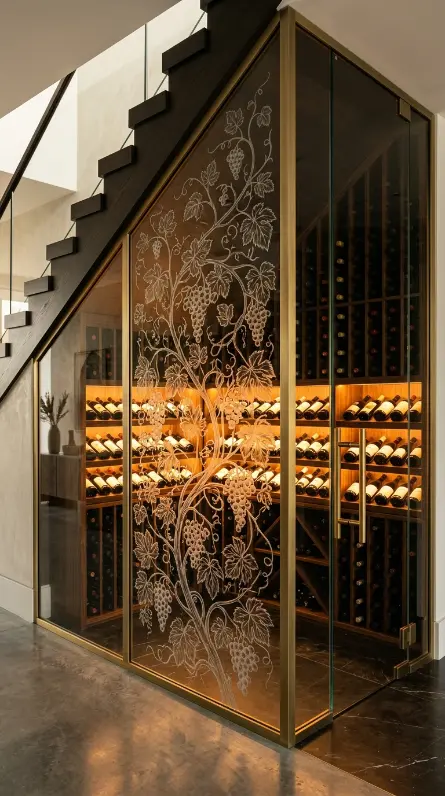
17. Under-Stair Glass Cellar With Engraved Glass Panel Feature
Commission a single panel of the under-stair glass enclosure to be engraved with a large-scale design — a detailed vineyard landscape, a botanical vine illustration, or a single oversized numeral representing a significant vintage year — so that the engraved glass becomes a decorative element layered over the wine rack interior. The engraved glass panel adds an entirely different dimension to the cellar front — the design is visible in all light conditions but changes dramatically as the interior LED lighting shifts, sometimes forward, sometimes receding, depending on the angle of view.
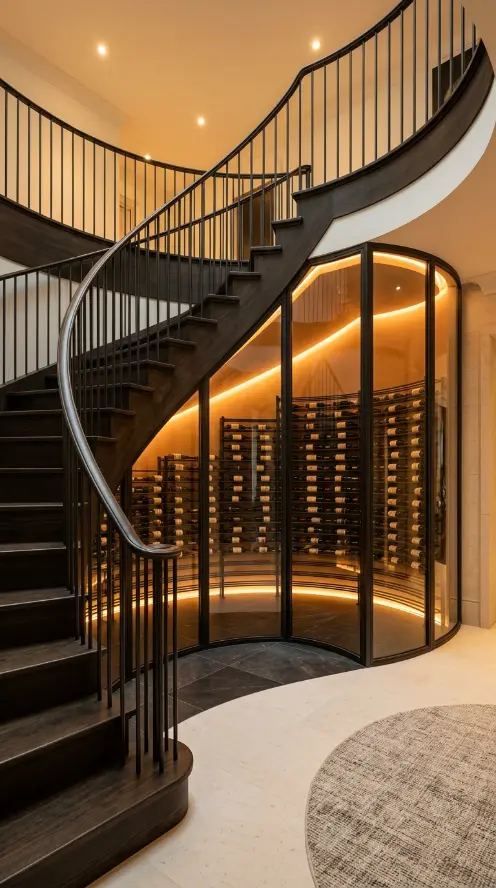
18. Under-Stair Glass Cellar in a Curved Staircase Recess
Design the glass wine cellar to follow the curved geometry of a sweeping curved staircase — curved glass panels following the arc of the staircase above, curved black steel or brass frame system, and curved interior wine racks custom built to follow the same arc. A curved glass cellar beneath a curved staircase is one of the most architecturally resolved features a home can have — every element following the same geometry, the glass cellar and staircase reading as a single unified sculptural object. It is the kind of detail that only happens when architecture and interior design are planned together from the beginning.
19. Under-Stair Glass Cellar With Wine Map Wallpaper Interior
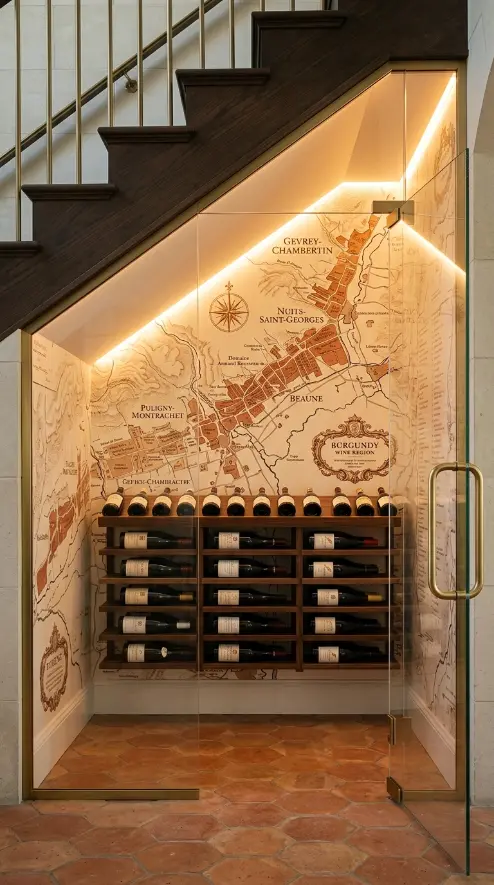
Paper the interior back and side walls of your under-stair glass cellar with a large-scale custom wine region map wallpaper — a detailed cartographic illustration of Burgundy, Bordeaux, Tuscany, or the entire wine world — visible through the glass panels from outside. The wallpaper interior adds a layer of graphic depth and personality to the cellar that a plain plastered or brick wall cannot achieve — it tells guests something specific about the collection it houses, and it makes the cellar interior as interesting to look at as the bottles themselves.
20. Under-Stair Glass Enclosed Vintage Record and Audio Display
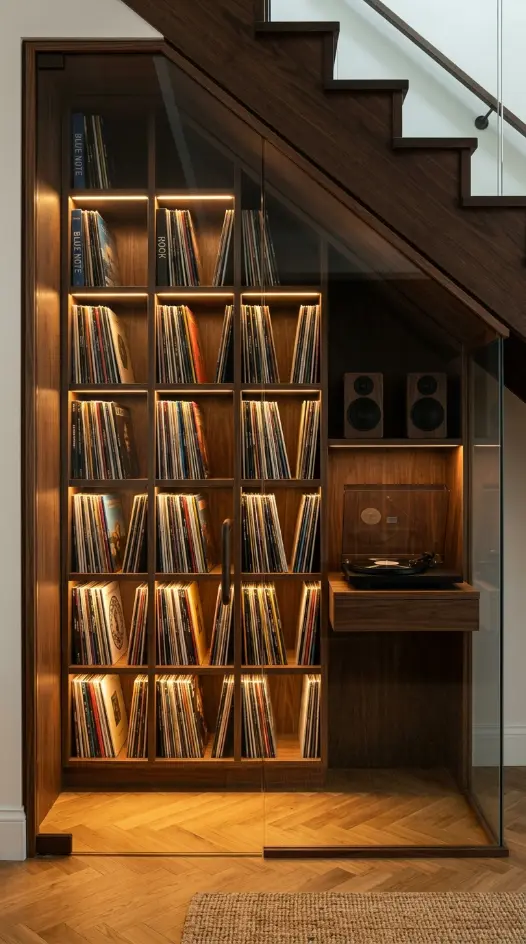
Apply the glass cellar concept to a vinyl record and high-end audio display — the under-stair glass enclosure housing floor to ceiling custom timber record storage with record spines facing outward in organised sections, a slim floating shelf at standing height holding a minimalist turntable, and warm amber LED lighting throughout. The glass-enclosed record library beneath a staircase treats vinyl with the same reverence that a wine cellar treats bottles — it signals that this collection is taken seriously, that it is curated, and that it deserves housing as considered as the music it contains.
21. Under-Stair Glass Cellar With Gold Leaf Ceiling Interior
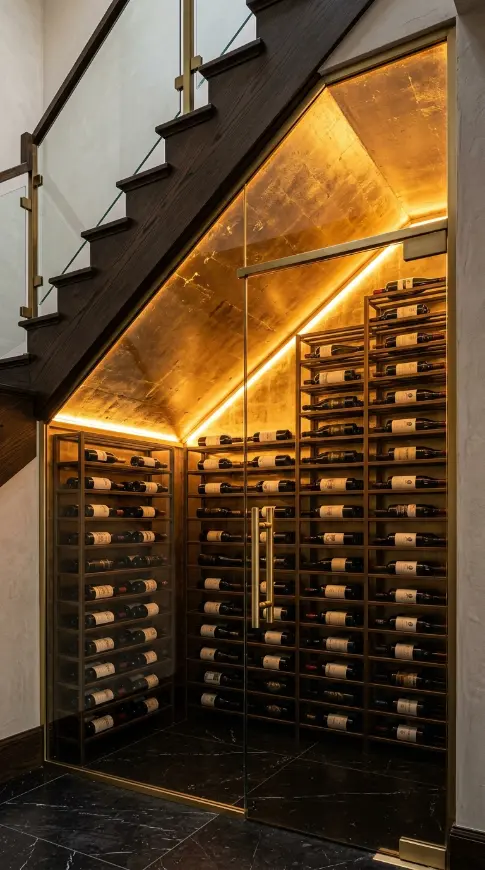
Finish the interior ceiling of your under-stair glass cellar with hand-applied gold leaf — so that the cellar ceiling glows with a deep warm gold that reflects the amber LED lighting back down onto the wine racks and bottles below. The gold leaf ceiling is invisible from outside until the cellar is lit — and when it is, the interior takes on a warmth and richness that no paint finish or material can replicate. It is a detail that only reveals itself slowly, that rewards looking closely, and that signals an investment in beauty at the level of the finest hotel bars and private members clubs.
22. Under-Stair Glass Cellar Extending Into a Full Feature Wall
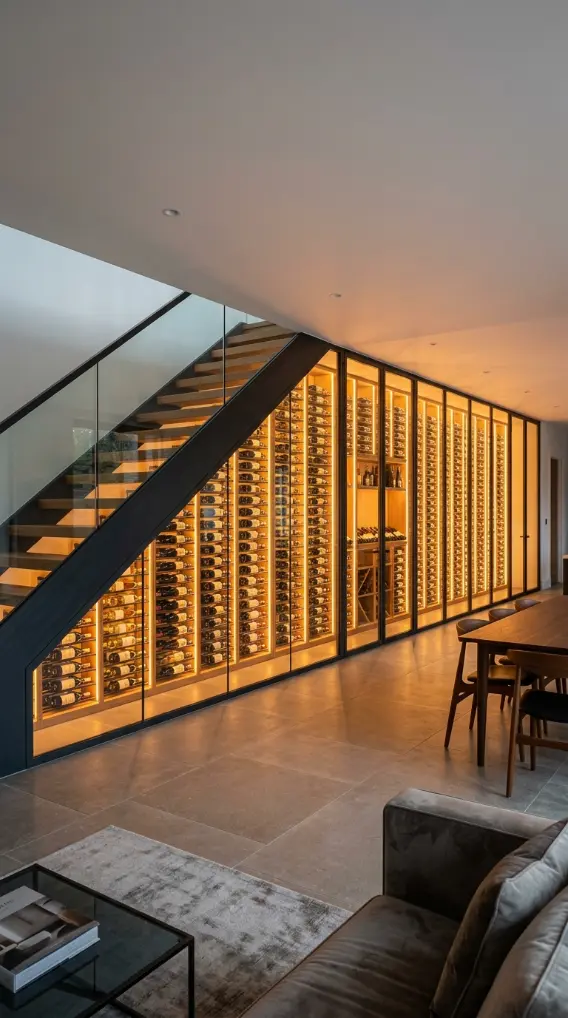
Extend the under-stair glass cellar concept beyond the staircase footprint and continue the glass wine rack display along the full adjacent wall — so that the under-stair cellar becomes the anchor of a full-length feature wall of glass-enclosed wine storage that runs from the staircase across the entire wall of the room. The staircase cellar is the beginning, the feature wall is the continuation, and the two together create a wine wall of a scale and drama that belongs in a world-class restaurant or private club — brought entirely into a residential home.
23. Under-Stair Glass Cellar With Personalised Monogram Door Panel
Have the glass door panel of your under-stair cellar sandblasted with a large personalised monogram — a single oversized initial or a two-letter monogram in a classical serif or bold geometric typeface — centered on the door glass so that it is the first thing visible when approaching the cellar. The monogram door panel transforms the cellar from an architectural feature into a personal one — it says this belongs to someone specific, this was made for this house and this family, and it carries the same quiet authority as a crest on a piece of silver or an initial pressed into wax.
24. Under-Stair Glass Cellar With Stone-Clad Exterior Surround
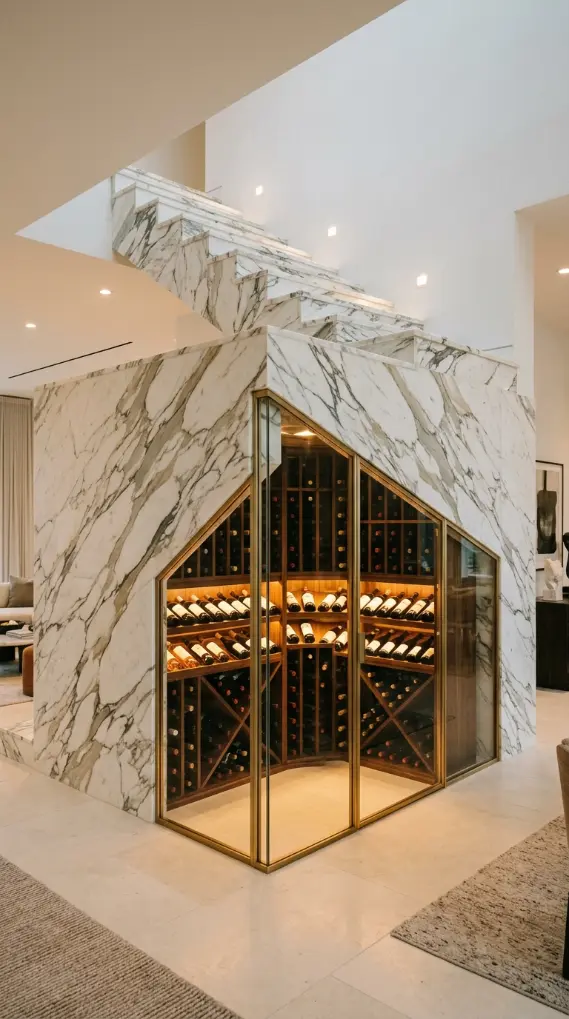
Clad the exterior staircase structure surrounding the glass cellar in a luxury stone finish — large format book-matched marble slabs, aged limestone, or rough-cut slate — so that the glass cellar panels are framed by a raw stone surround that gives the entire feature the visual weight and permanence of a built architectural element rather than a fitted cabinet. The contrast of raw stone against frameless glass creates a material tension that is one of the most compelling combinations in contemporary luxury interior design — ancient and modern, heavy and transparent, permanent and clear.