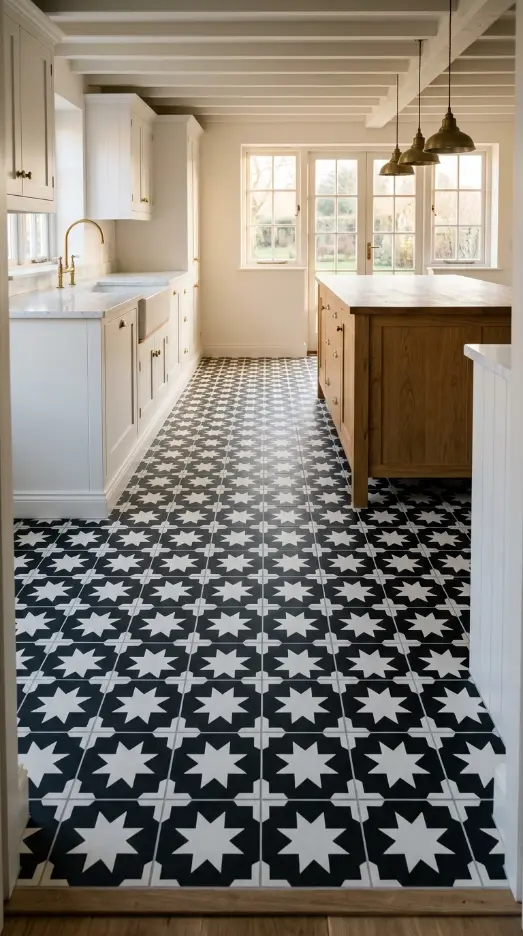
26 Kitchen Flooring Ideas for Farmhouse Black White Encaustic
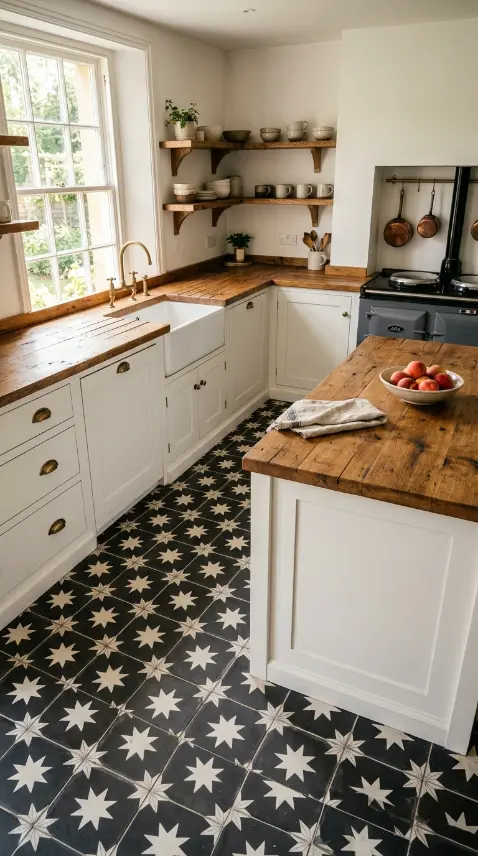
A farmhouse kitchen floor laid in black and white encaustic tiles is one of the most historically resonant and most visually powerful flooring decisions available in any domestic interior — and it achieves its power not through novelty but through the opposite quality: the sense that this floor has always been here, that it belongs to the bones of the house rather than to a decorating decision made last season, and that the pattern pressed into each individual cement tile by a craftsman’s mould will still be as beautiful and as characterful in fifty years as it is on the day it is laid. The encaustic tile’s defining quality — the inlaid colour pattern that runs through the body of the tile rather than being applied as a surface glaze — means that every scratch, every worn edge, every years-long patina of use makes the floor more beautiful rather than less, which is the quality that makes it the most honest and most enduring of all kitchen floor materials.
The black and white farmhouse encaustic kitchen floor works because it occupies the precise intersection of two design qualities that are individually powerful and together extraordinary: the graphic boldness of a strong geometric pattern in maximum contrast, and the chalky, matte, artisanal warmth of a hand-pressed cement tile surface that no porcelain reproduction can replicate. The pattern reads from a distance as a confident graphic statement — a diamond, a star, a quatrefoil, a simple chequerboard — and reveals at close range the natural colour variation, the slightly uneven surface, and the fine geometric line quality that are the marks of the encaustic tile’s handmade process. These 26 ideas cover every dimension of this flooring choice — from the pattern selection and tile format to the grout colour, the kitchen cabinetry pairings, the border treatments, the aged patina styling, and the complete farmhouse kitchen floor in its most fully realised form.
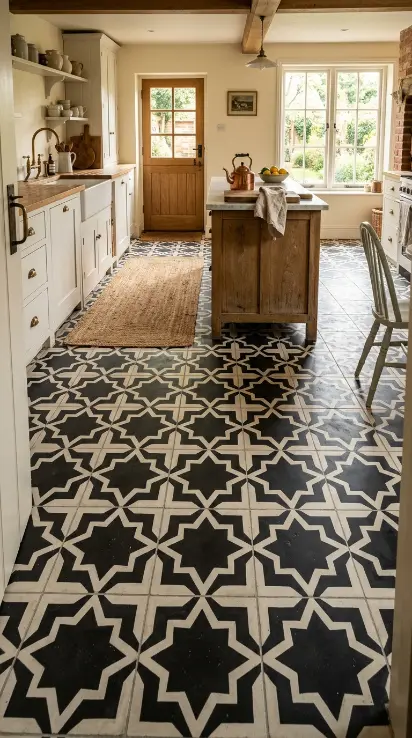
1. Classic Eight-Pointed Star and Cross Encaustic Pattern
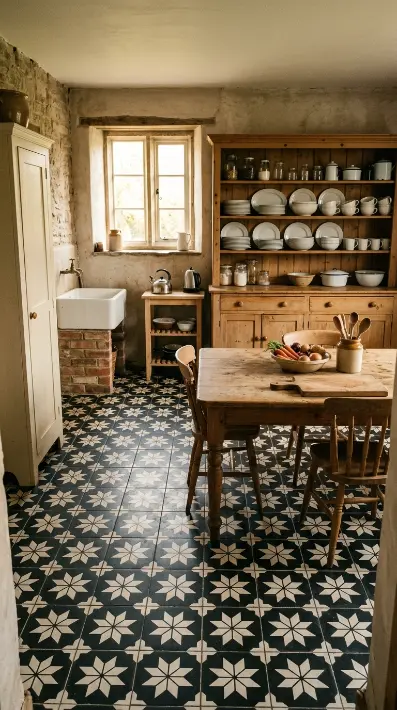
The eight-pointed star and cross is the most historically authentic and most architecturally serious of all encaustic tile patterns — a geometry that appears in medieval church floors, Moorish palace courtyards, and Victorian farmhouse kitchens with equal authority, and that in black and white achieves a graphic boldness that reads as both ancient and completely contemporary. Each tile unit in the star and cross pattern is composed of one eight-pointed black star on a white ground surrounded by four small white cross-shaped infill pieces — the units interlocking across the floor to create a continuous repeating geometry that reads differently at every viewing distance: as a field of bold stars from across the room, as an intricate interlocking geometry from standing height, and as a beautifully imperfect hand-pressed surface of natural colour variation from close range.
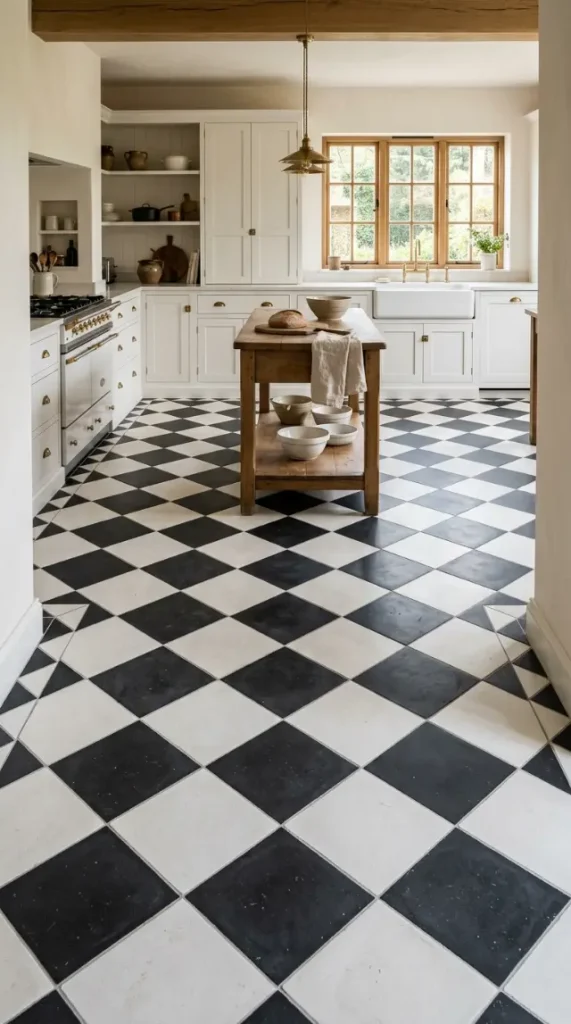
2. Bold Chequerboard Encaustic in Large Format
The black and white chequerboard is the most immediately legible and most classically powerful of all farmhouse kitchen floor patterns — a binary geometry so simple and so bold that it requires no design knowledge to read and no stylistic context to understand, and that in large format encaustic cement tiles achieves a scale and a graphic authority that small chequerboard ceramic or vinyl versions can never replicate. Large format encaustic chequerboard — tiles of 30cm by 30cm or 40cm by 40cm alternating black and white — laid on the diagonal so the pattern runs at 45 degrees to the kitchen walls, creates a floor surface whose bold diagonal geometry makes the kitchen feel wider, longer, and more architecturally serious than any other single flooring decision available.
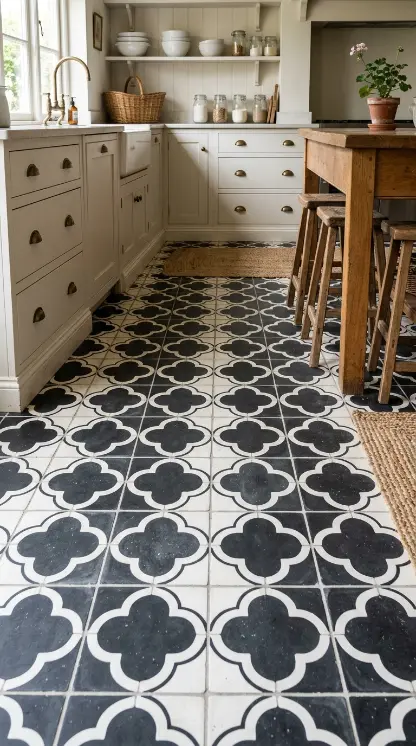
3. Quatrefoil Encaustic Pattern in Black and White
The quatrefoil — a four-lobed geometric form derived from Gothic architecture and found in the encaustic tile floors of medieval monasteries and Victorian country houses — is the encaustic pattern that most completely expresses the farmhouse aesthetic’s relationship to English decorative history, and in black and white chalky matte cement it achieves a graphic quality that is simultaneously ornate and bold, detailed and legible. The black and white quatrefoil encaustic floor reads as a field of overlapping circles from a distance — the black quatrefoil forms on white grounds interlocking to create a continuous curved geometry that softens the hard lines of the kitchen’s cabinetry and architecture with its organic, flowing pattern quality.
4. Encaustic Tile Floor With Dark Charcoal Border
A border treatment — a single or double row of plain deep charcoal or black encaustic tiles running the full perimeter of the kitchen floor, separating the patterned field from the skirting and the base of the cabinetry — is the detail that elevates a farmhouse encaustic kitchen floor from a flooring decision to an architectural feature. The border frames the patterned tile field within the kitchen space, gives the floor a defined edge that reads as intentional and considered, and creates a transition between the busy geometric pattern of the field tiles and the plain vertical surfaces of the cabinetry and walls. A dark charcoal border also slightly deepens and enriches the overall floor palette, pulling the black element of the black and white pattern through to the perimeter and grounding the entire floor in the kitchen’s architecture.
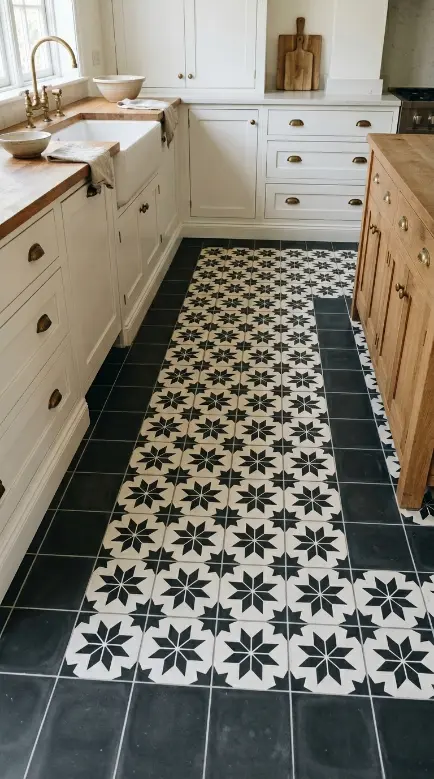
5. Encaustic Floor With White Shaker Cabinets and Aged Brass Hardware
The most classic and most completely resolved farmhouse kitchen combination pairs the black and white encaustic tile floor with white painted shaker cabinets and aged brass hardware — a material grouping whose three elements have been in conversation with each other in English and European farmhouse kitchens for over a century and that achieves its visual harmony through the way each element serves and enhances the others. The white shaker cabinets provide the neutral vertical surface that allows the encaustic floor pattern to read clearly without competition. The aged brass hardware pulls the warmth out of the encaustic tile’s natural cement tone and creates a warm metallic accent that prevents the black and white floor from reading as cold. The result is a farmhouse kitchen whose every material decision feels simultaneously historically grounded and genuinely current.
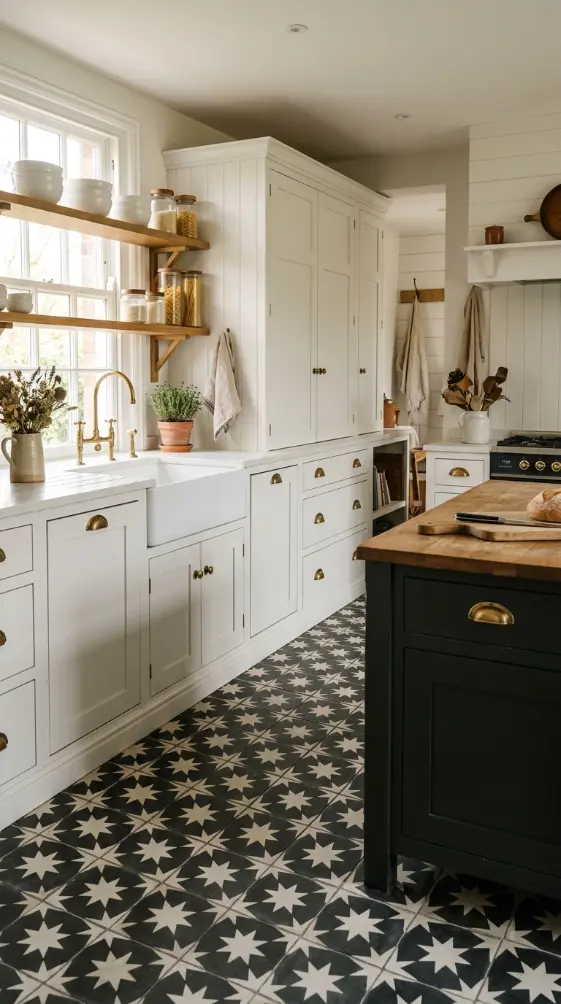
6. Encaustic Floor Running Under a Central Kitchen Island
The way the encaustic tile floor runs beneath and around the central kitchen island — rather than stopping at the island’s base or changing material beneath it — is one of the most important and most often overlooked details in the farmhouse encaustic kitchen floor installation, because the continuity of the pattern beneath the island proves the floor’s architectural seriousness and creates the visual impression that the island is sitting within the room rather than resting on the floor. When the bold black and white encaustic pattern runs continuously from the kitchen entrance beneath the island base and out the other side to the far wall, the floor reads as the room’s primary architectural surface and the island as a piece of furniture placed on top of it — which is the correct reading and the one that makes the farmhouse kitchen feel most genuinely considered.
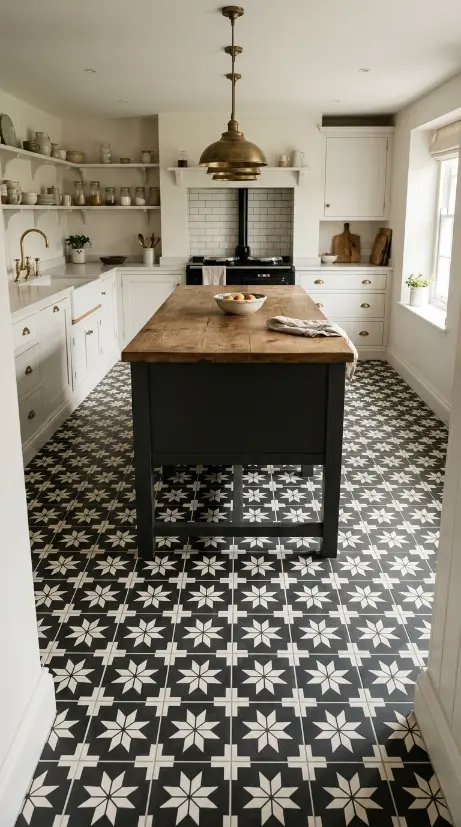
7. Aged and Worn Encaustic Tile Patina — The Beauty of Use
The aged encaustic tile floor — worn smooth at the most-walked paths from the kitchen entrance to the sink and from the sink to the island, slightly lighter in tone at those worn paths from decades of foot traffic and stone cleaning, with the occasional tile showing a hairline crack sealed by years of grime and wax, with the grout lines darkened by accumulated cooking patina — is the version of the black and white farmhouse encaustic floor that most completely justifies the material choice over every alternative. No glazed porcelain, no printed ceramic, and no vinyl reproduction can develop this quality of use-worn beauty, because it requires genuine cement, genuine pigment pressed into the tile body, and genuine years of a kitchen being lived in to produce it. The aged encaustic floor is the floor that makes visitors ask when the house was built.
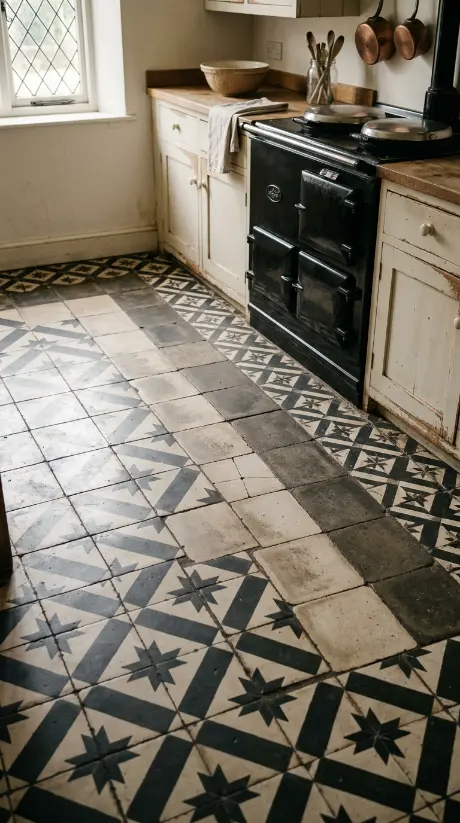
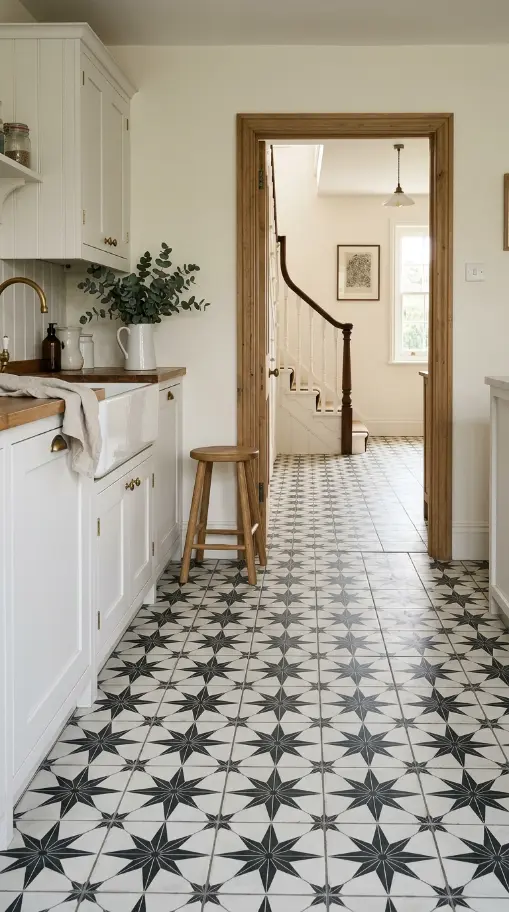
8. Encaustic Floor Transitioning From Kitchen Into Hallway
The encaustic tile floor running continuously from the farmhouse kitchen through the doorway and into the hallway beyond — the same pattern, the same tile, the same grout line, no threshold strip — is the detail that most powerfully communicates the floor’s status as a whole-house architectural material rather than a kitchen-specific flooring choice, and that creates the most coherent and most historically authentic interior floor treatment available in a period farmhouse. When the bold black and white encaustic pattern flows through the kitchen doorway and continues down the hallway, the floor tells the story of the house’s age and its material continuity in the most direct and most beautiful possible way.
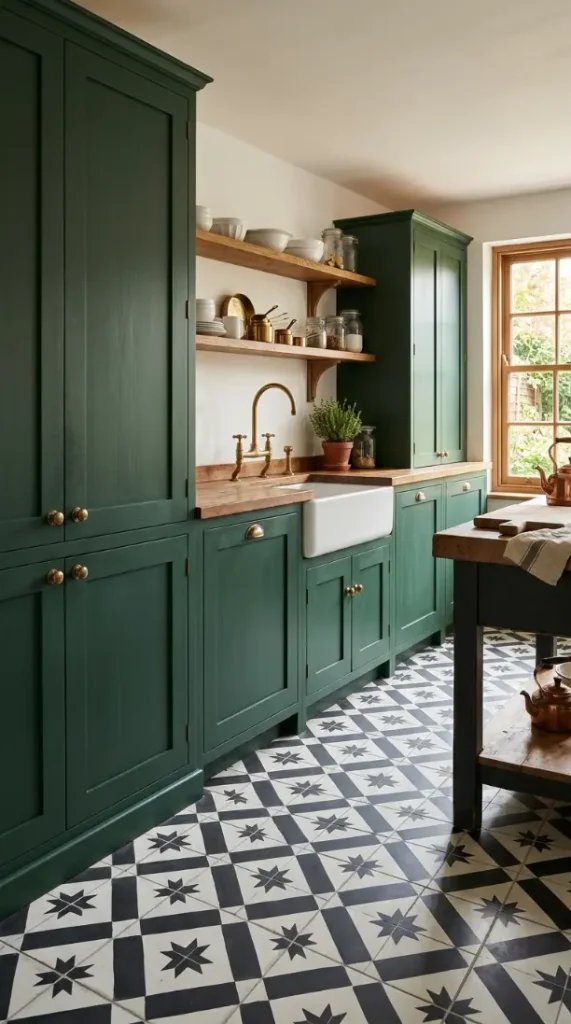
9. Encaustic Floor With Dark Green Cabinets and Unlacquered Brass
Deep forest green painted cabinetry — in a chalky matte or eggshell finish, in the same colour family as the encaustic tile’s black element — paired with the black and white encaustic tile floor and unlacquered or aged brass hardware, creates the most richly coloured and most dramatically atmospheric variation of the farmhouse encaustic kitchen combination. The dark green cabinets deepen and enrich the black and white floor’s contrast by adding a third dark tone that belongs to the same cool-dark family as the black tile but brings a natural, botanical warmth that pure black does not have. The unlacquered brass hardware develops a living patina over time that echoes the encaustic tile’s own developing patina, creating a kitchen whose every surface is more beautiful with age.
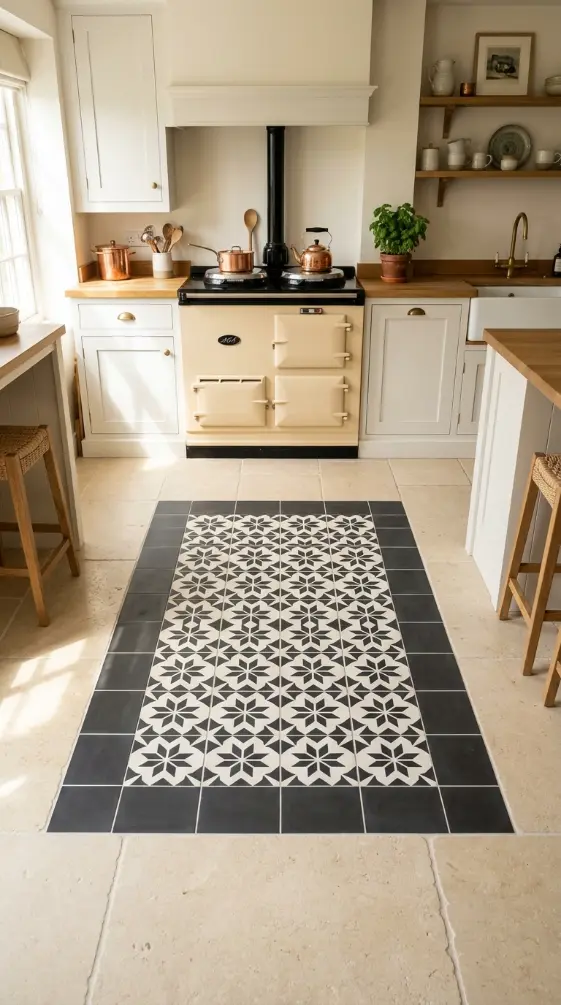
10. Encaustic Tile Inset Panel as Kitchen Floor Feature
Rather than tiling the entire kitchen floor in a single encaustic pattern, an inset panel treatment — a precisely bordered rectangular or square zone of decorative encaustic pattern set within a larger field of plain complementary tile — creates a kitchen floor feature that draws the eye to a specific zone, whether that is the area in front of the range cooker, the space beneath the central island, or the entrance zone at the kitchen doorway, and gives the encaustic pattern a frame and a context that makes it read as a deliberate decorative insertion rather than a uniform floor covering.
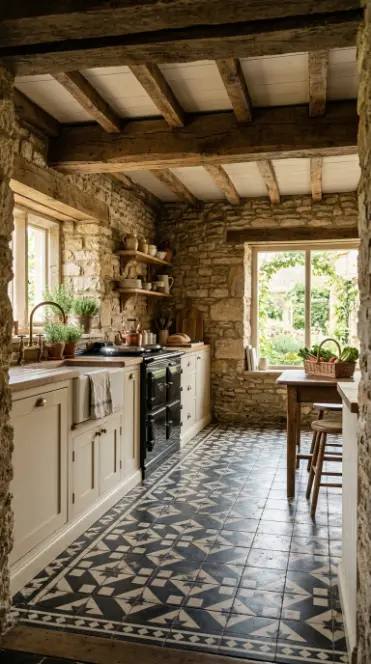
11. Encaustic Floor With Exposed Stone Walls and Timber Beams
The black and white encaustic tile floor in a farmhouse kitchen with exposed stone walls and heavy timber ceiling beams — the original architectural fabric of an old stone farmhouse — creates the most historically complete and most deeply atmospheric of all farmhouse kitchen material combinations, because the encaustic tile floor belongs to exactly the same period and the same artisanal tradition as the stone walls and the hand-hewn timber beams, and together the three surfaces create a kitchen interior whose every material element was made by hand from natural materials and whose accumulated age and texture makes the room feel as though it has existed in exactly this form for centuries.
12. Encaustic Tile Swatch Moment — Close-Up Pattern Detail
The encaustic tile at close range — the view that shows the natural colour variation across individual tile faces, the fine inlaid pattern line where the black and white pigment colours meet at the geometric boundary, the slightly uneven hand-pressed surface texture, the fine pale grey grout lines between tiles — is the view that most completely justifies the material choice over every printed or glazed alternative, because it reveals the qualities that only a genuine hand-pressed cement tile possesses and that no reproduction can replicate. A close-up detail shot of the black and white encaustic tile floor showing three to four tile units at very close range — where every surface quality of the genuine encaustic cement tile is visible in sharp detail — is the image that makes anyone who sees it understand immediately why this floor material is worth every additional pound and every additional week of lead time over a porcelain equivalent.
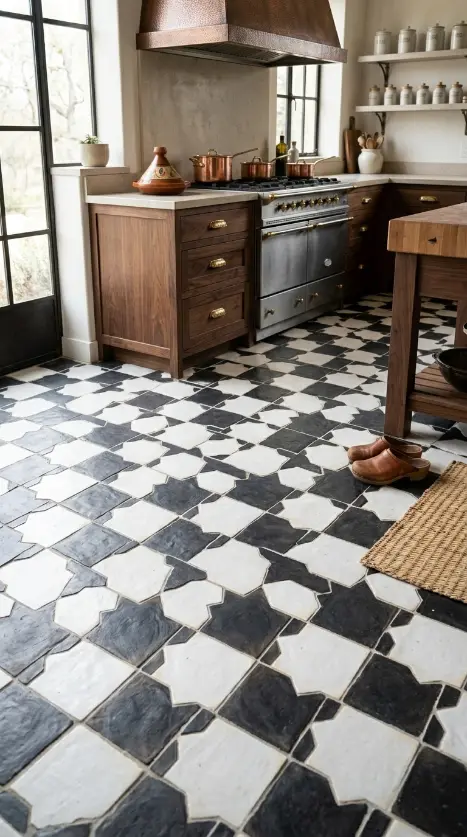
13. The Complete Farmhouse Kitchen — Encaustic Floor and Every Element
The complete farmhouse kitchen with a black and white encaustic tile floor — every element resolved and every surface in conversation with the floor that anchors the room — is the fullest expression of what the encaustic tile choice enables when it is allowed to be the room’s primary material decision and every other choice is made in response to it. The black and white encaustic floor beneath white shaker cabinets with aged brass hardware, a large ceramic Belfast sink with an unlacquered brass bridge tap, open timber shelving heavy with white ceramics and glass storage, a central worn oak island with aged brass pendant lights above, an original range cooker in cream enamel, exposed brick at the chimney breast, heavy timber ceiling beams, and warm morning light through deep-silled multi-pane windows — this is the farmhouse kitchen that the encaustic tile floor was always waiting to anchor.
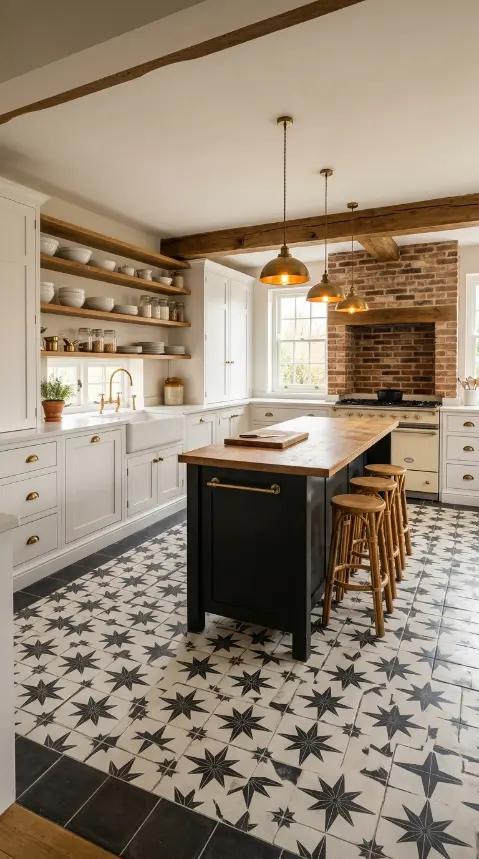
14. Encaustic Floor With Navy Blue Cabinets and Polished Nickel
Deep navy blue painted shaker cabinets — in a chalky matte or satin finish, the blue dark enough to read almost as a near-black in shadow and rich cobalt in direct light — paired with the black and white encaustic tile floor and polished nickel hardware, create the most nautical and most crisply resolved of all the farmhouse encaustic kitchen colour combinations. The navy cabinets respond to the black element of the encaustic floor in the same way the forest green does — deepening and enriching the floor’s contrast by adding a dark saturated colour — but where green reads as botanical and earthy, navy reads as architectural and precise, and the polished nickel hardware adds a clean silver-bright accent that lifts the navy and white and black palette into something simultaneously traditional and completely sharp.
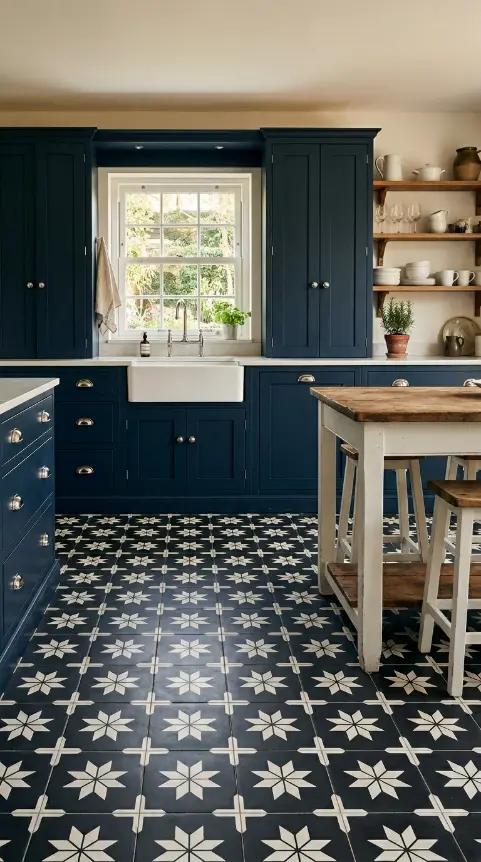
15. Encaustic Floor With Cream Aga and Original Farmhouse Range Alcove
The cream enamel Aga or range cooker set into an original farmhouse range alcove — the chimney breast recess that in working farmhouses housed the original open range and that in the modern farmhouse kitchen houses its most direct descendant — is the single kitchen element that most completely partners the black and white encaustic tile floor, because both the encaustic tile and the cast iron enamel Aga belong to the same period of English domestic material culture and share the same quality of manufactured permanence: objects built to last for generations rather than for a product cycle. The cream enamel Aga above the black and white encaustic floor, framed by the alcove’s exposed brick or limewashed plaster walls, with the encaustic tile running right to the Aga’s base, is the farmhouse kitchen image that the encaustic tile floor was designed to anchor.
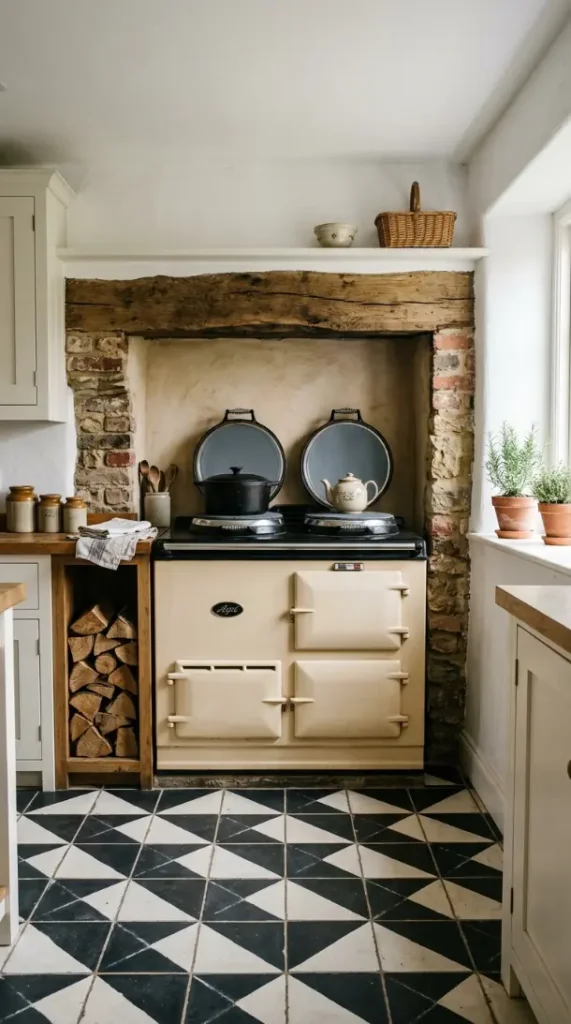
16. Encaustic Floor With Reclaimed Timber Worktops
Reclaimed timber worktops — in thick planks of genuinely aged and densely grained elm, oak, or pitch pine salvaged from old buildings, with their previous life visible in nail holes, saw marks, and patina of use sealed under food-safe oil — are the worktop material that most naturally and most honestly partners the black and white encaustic tile floor in a farmhouse kitchen, because both materials share the quality of genuine age and genuine use history that makes them more beautiful than any new material of the same type. The encaustic tile’s chalky matte black and white geometry below and the reclaimed timber’s warm honey and dark grain patina above create a vertical and horizontal material combination of complete farmhouse authenticity.
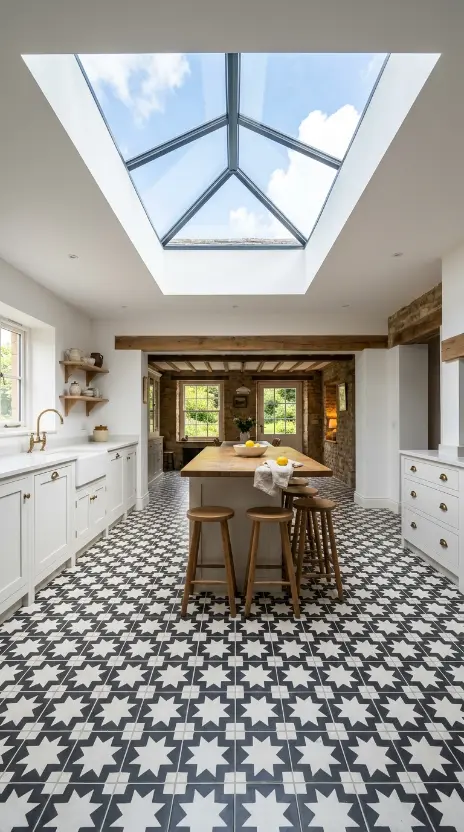
17. Encaustic Floor in a Farmhouse Kitchen Extension With Roof Lights
A contemporary farmhouse kitchen extension — a single-storey rear addition with a full-width glazed roof lantern or multiple flush roof lights set into a flat or low-pitched roof — brings a volume of natural overhead light into the farmhouse kitchen that the original structure’s small windows could never provide, and the black and white encaustic tile floor beneath this overhead light becomes something entirely different from the same floor in a conventionally lit kitchen. The overhead natural light falls vertically onto the encaustic tile surface and reveals the chalky matte texture and the natural colour variation of each tile from directly above — the angle at which the encaustic tile’s handmade surface qualities are most clearly and most beautifully visible — filling the entire floor plane with an even, warm, and completely flattering natural light.
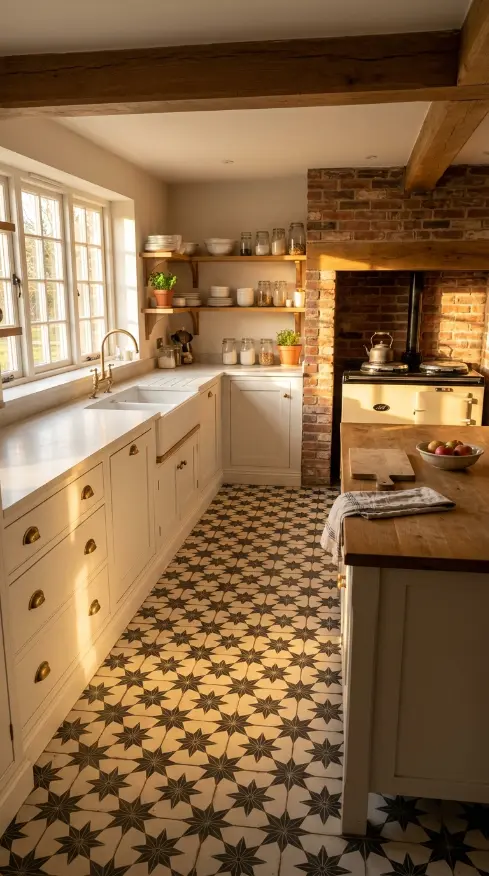
18. Encaustic Floor Morning Light — The Complete Atmosphere
The farmhouse kitchen with its black and white encaustic tile floor at the specific moment of warm early morning light — when the first sunlight from the east presses at a low angle through the multi-pane kitchen windows and rakes across the encaustic tile surface at a shallow angle that reveals every quality of the chalky matte hand-pressed surface, when the aged brass hardware on the white shaker cabinets catches the warm morning gold, when the kettle is on the cream enamel Aga and the morning is beginning, and the encaustic floor below all of it glows with a warmth and a depth that the same floor in cold or flat light does not possess — is the version of the farmhouse encaustic kitchen that most completely expresses the quality of life this floor material enables and the specific atmosphere that no other flooring choice can produce.
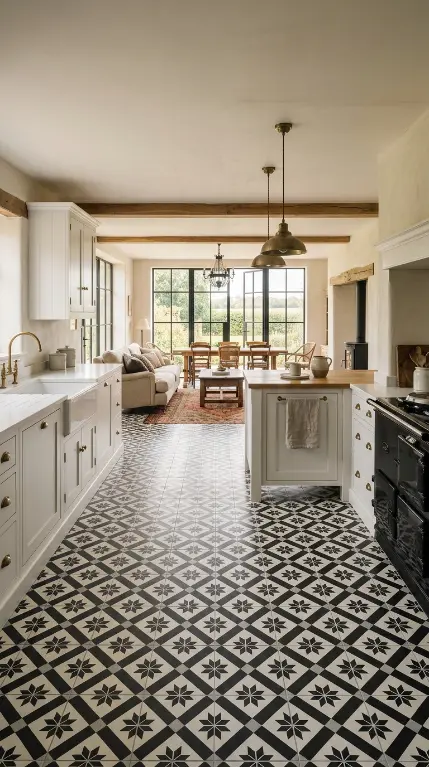
19. Encaustic Floor With Open Plan Kitchen and Living Zone
A black and white encaustic tile floor running continuously from the kitchen zone through an open plan space into a living or dining zone — the same tile, the same pattern, the same grout line, without interruption or material change — creates the most architecturally confident and most spatially generous version of the farmhouse encaustic floor, because the uninterrupted floor plane of bold black and white geometry running the full length of the open plan space reads as a single architectural surface that unifies every zone above it and gives the entire open plan interior a consistent and deeply characterful ground plane.
20. Encaustic Floor With Freestanding Furniture and No Built-In Cabinetry
A farmhouse kitchen with a black and white encaustic tile floor and entirely freestanding furniture — no built-in cabinetry, no fitted units, every storage and work surface piece a freestanding item: a large Victorian pine dresser, a painted timber freestanding larder cupboard, a scrubbed pine kitchen table used as the central work surface, an old butler’s sink on a brick plinth — is the version of the encaustic kitchen that most completely reveals the floor as the room’s single architectural decision, because without fitted cabinetry to define the room’s perimeter, the bold black and white encaustic pattern running to all four walls becomes the primary visual element that organises and characterises the entire space.
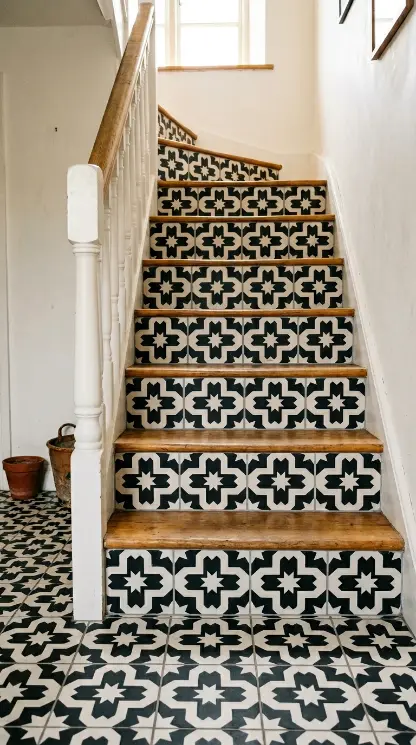
21. Encaustic Tile Stair Risers Continuing From Kitchen Floor
Encaustic tiles used on the stair risers of a kitchen or back stairs — the same black and white pattern that covers the kitchen floor applied vertically to each stair riser while the tread remains in natural timber — create the most complete and most unexpected continuation of the farmhouse encaustic floor surface into the vertical architecture of the house, and produce one of the most photographed and most characterful details in any farmhouse interior. The encaustic pattern on the stair risers connects the kitchen floor to the staircase above it in a single continuous decorative gesture and reveals the material’s versatility as an architectural surface beyond the floor plane.
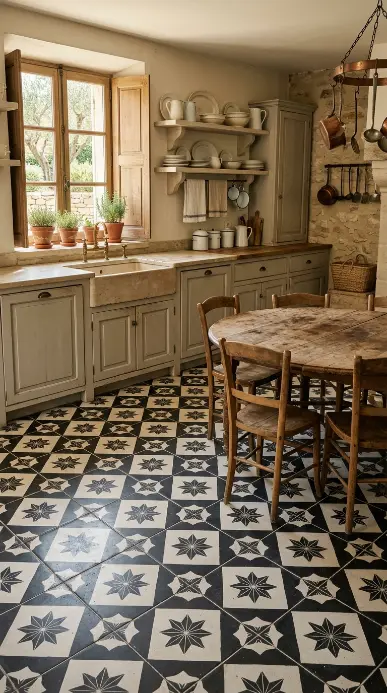
22. Encaustic Floor With Antique French Country Influence
A farmhouse kitchen floor laid in a black and white encaustic tile pattern with a distinctly French country heritage — the Provençal cement tile tradition that produced the same hand-pressed patterns as the English Victorian encaustic but in the warmer, more rustic material character of southern French farmhouse floors — paired with painted cabinetry in soft putty or aged grey-white, an apron front stone or fireclay sink, unlacquered brass faucets, open limestone shelving, and a worn limestone worktop, creates a farmhouse kitchen whose every material speaks a specifically French country language of honest, sun-warmed, and deeply aged domesticity.
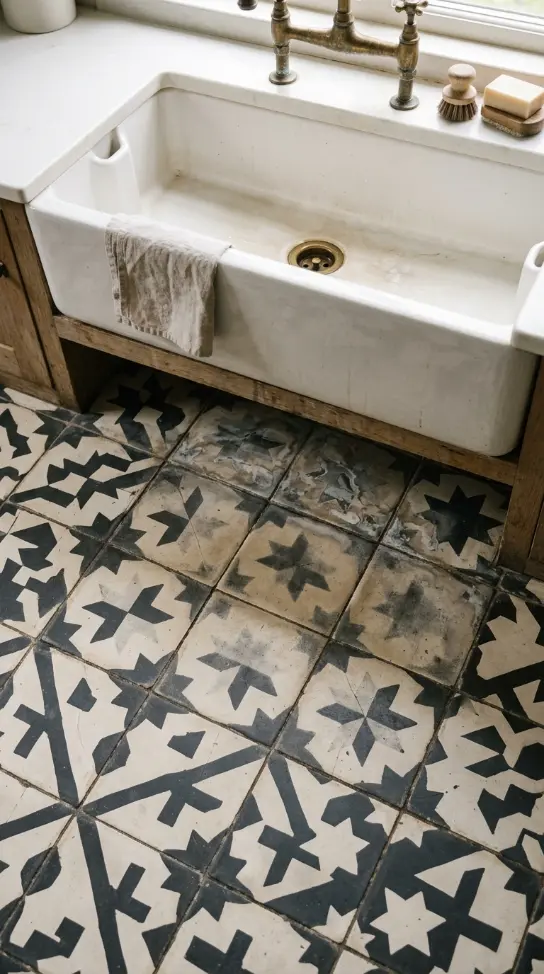
23. Encaustic Floor Detail at the Belfast Sink — Water and Wear
The section of the black and white encaustic tile floor directly in front of and beneath the Belfast farmhouse sink — the most-stood-at position in any farmhouse kitchen — develops a specific and beautiful wear character over years of use: slightly worn at the exact standing position, occasionally wet from sink splashes, with the grout lines in this zone slightly darker from the accumulated mineral deposits of hard water and the natural patina of daily cooking and washing. This worn, water-touched, and most-used section of the encaustic floor is the kitchen’s most intimate and most honest detail — the record of every morning’s washing up and every evening’s vegetable preparation recorded in the chalky matte surface of the cement tile.
24. Encaustic Floor With Pendant Lighting — Pattern in Light and Shadow
The black and white encaustic tile floor beneath a cluster of aged brass or iron pendant lights — when the pendants are the primary evening light source and their warm amber glow falls at a low angle across the encaustic tile surface below — develops a second layer of pattern on its surface: the circular warm light pools from each pendant, overlapping and fading across the bold geometric tile pattern below, create a shifting interplay of permanent geometric tile pattern and temporary warm light pattern that makes the encaustic floor more visually rich and more alive at evening than at any other time of day.
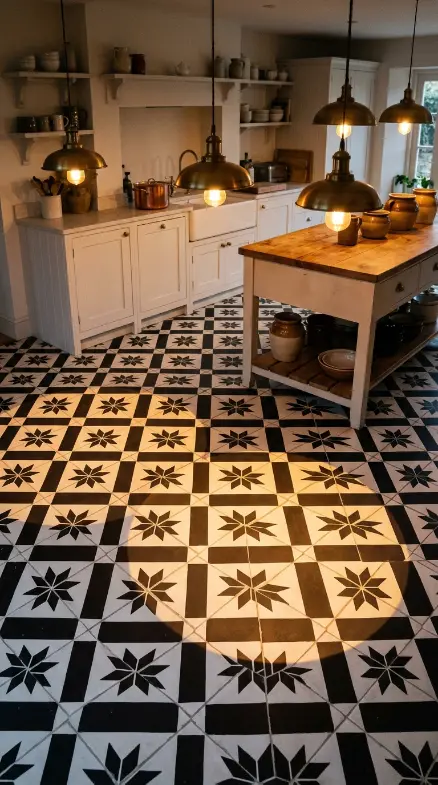
25. Encaustic Floor in a Small Farmhouse Kitchen — Maximum Impact in Minimum Space
The black and white encaustic tile floor in a small farmhouse kitchen — a narrow galley or compact cottage kitchen of perhaps 10 to 15 square metres — achieves a greater relative visual impact than it does in a large kitchen, because in a small space the bold geometric pattern fills the entire floor plane as a single composition rather than an expansive field, every tile is within close viewing range simultaneously, and the pattern’s graphic boldness makes the small kitchen feel larger and more architecturally serious than its dimensions alone would allow. A small farmhouse kitchen with a black and white encaustic floor is never a kitchen that apologies for its size — the floor makes it entirely itself.
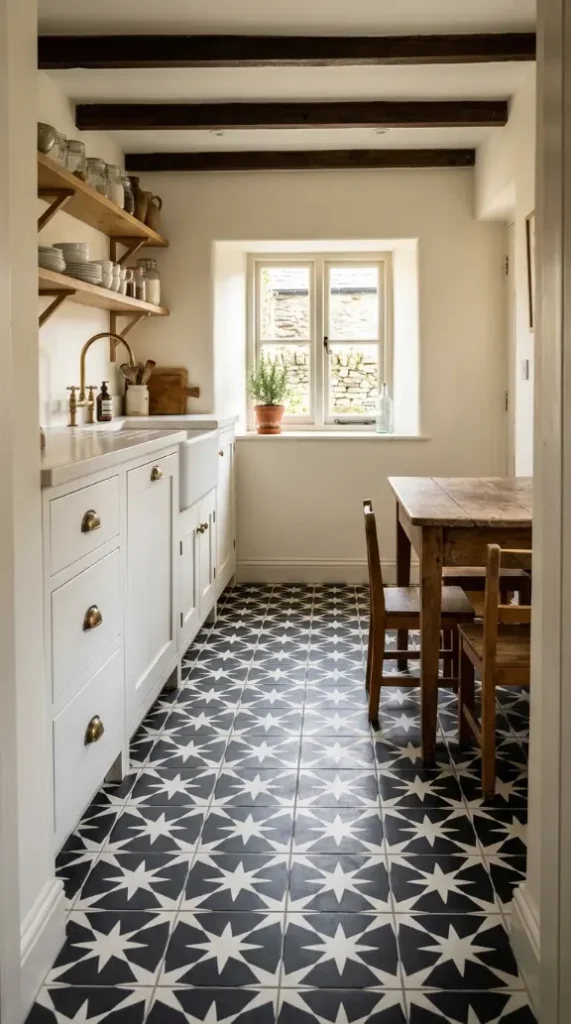
26. The New Encaustic Floor Laid — Before the Kitchen Lives In It
The newly laid black and white encaustic tile floor — freshly grouted, freshly sealed with a first coat of natural wax or penetrating sealer, not yet walked on, the grout lines bright pale grey and the chalky matte tile surfaces at their most uniform and most precise before the first years of use begin their slow and beautiful transformation — is the version of the farmhouse encaustic floor that reveals the pattern at its sharpest and the colour at its most graphic, and that makes the most complete visual case for why the encaustic tile’s bold geometry was the right choice for this kitchen before the more beautiful aged version has had time to develop. The new floor’s sharp pattern and bright pale grout are the beginning of a decades-long material journey that will only become more beautiful, and this is the image that shows where that journey starts.