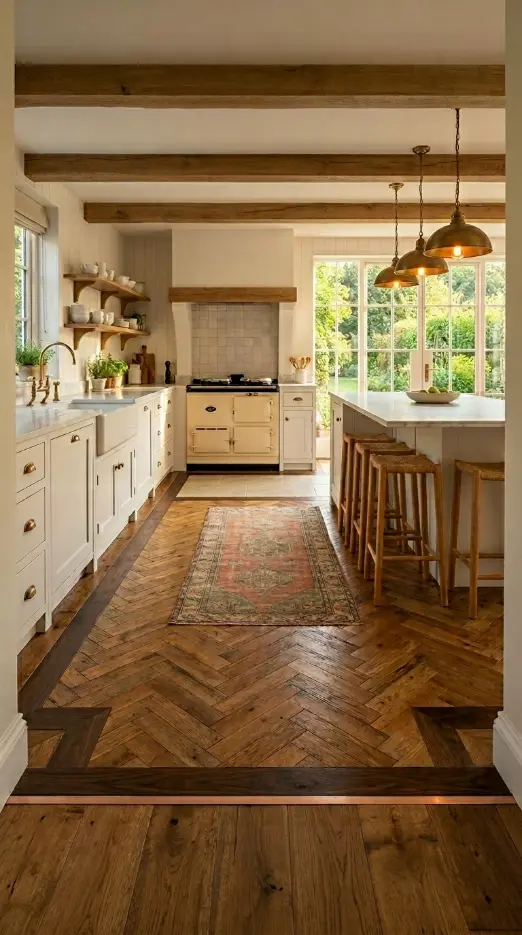
25 Kitchen Flooring Ideas for Farmhouse Herringbone Reclaimed
There is a particular quality of warmth that a farmhouse kitchen floor creates when it has been made from reclaimed timber in a herringbone pattern — a warmth that has nothing to do with underfloor heating and everything to do with the specific material history of the wood beneath your feet. Reclaimed timber carries the marks of its previous life: the nail holes from the barn it once stood in, the saw marks from the mill that cut it, the color variation from the decades of sunlight and shadow that fell across it before it was salvaged and given a second purpose. When that timber is laid in the precise geometry of herringbone, the pattern draws the eye through the kitchen in a direction that no straight-run floor can produce, creating a visual energy and a directional warmth that makes the kitchen feel simultaneously dynamic and deeply anchored.
The farmhouse kitchen floor is the largest single surface in the room and the one that most determines its character. A farmhouse kitchen with a reclaimed herringbone floor is a kitchen that has been designed from the ground up — a kitchen where the most fundamental decision about material and pattern has been made with the greatest possible care. The reclaimed timber herringbone communicates age, craft, sustainability, and natural beauty simultaneously, and it does so from the most humble position available: under your feet.
Herringbone as a pattern has been used for flooring in European farmhouses, manor houses, and civic buildings for centuries. Its characteristic V-form — each plank laid at 45 degrees to the perpendicular, its end butting against the face of the next plank in the opposing diagonal direction — creates a floor surface that is simultaneously geometric and organic, simultaneously regular and visually complex. The herringbone pattern catches light differently from every angle, making the floor appear to change its character throughout the day as the light moves. In the morning, the diagonal plank faces catch the low sun and glow. In the afternoon, the end-grain plank ends absorb the light and deepen. At evening, the whole pattern appears to shift direction in the warm amber of the kitchen lights.
These 25 ideas show every dimension of the kitchen flooring ideas for farmhouse herringbone reclaimed style — from the foundational reclaimed oak herringbone to the complete farmhouse kitchen where every floor material, every grout choice, every border detail, and every zone transition creates one unified vision of natural, characterful, genuinely beautiful farmhouse floor design.
1. Classic Reclaimed Oak Herringbone — Full Kitchen Floor
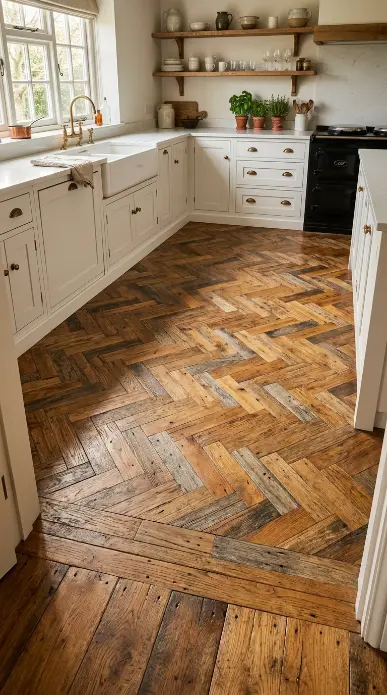
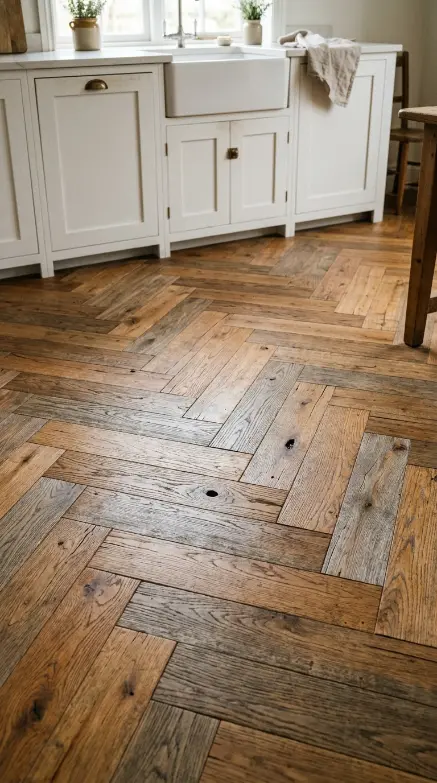
The foundational farmhouse kitchen herringbone floor is reclaimed oak in the classic 45-degree herringbone pattern covering the entire kitchen floor from wall to wall. Reclaimed oak planks — typically salvaged from old barns, warehouses, or period buildings — are narrower than modern flooring at approximately 8cm to 12cm wide and 40cm to 60cm long, their dimensions determined by the original timber stock rather than by contemporary flooring standards. This narrow plank dimension creates a tighter, more complex herringbone pattern with more V-repeats per square metre than wider plank herringbone, and the visual density of the tight herringbone in reclaimed oak creates a floor of extraordinary richness. The color variation between individual reclaimed planks — some warm amber, some grey-silver, some honey-brown, some darkened from old finish residue — makes the herringbone pattern appear almost woven rather than simply laid.
2. Reclaimed Herringbone with Natural Wax Finish
A reclaimed oak herringbone floor finished with natural beeswax or hardwax oil rather than polyurethane lacquer creates a floor of a completely different surface character from a modern sealed floor. The natural wax or hardwax oil finish penetrates into the timber rather than sitting on its surface — it feeds and protects the reclaimed oak while leaving its natural surface texture completely visible and tangible. A wax-finished reclaimed herringbone floor has a matte, slightly tactile quality when seen from any angle: no gloss reflection, no plastic film over the wood surface, just the natural aged oak grain and the herringbone pattern in their most honest and most naturally beautiful form. In the morning light, a wax-finished reclaimed herringbone floor appears to glow from within the timber rather than reflecting light from a surface coating.
3. Herringbone Reclaimed Floor with White Grout Lines
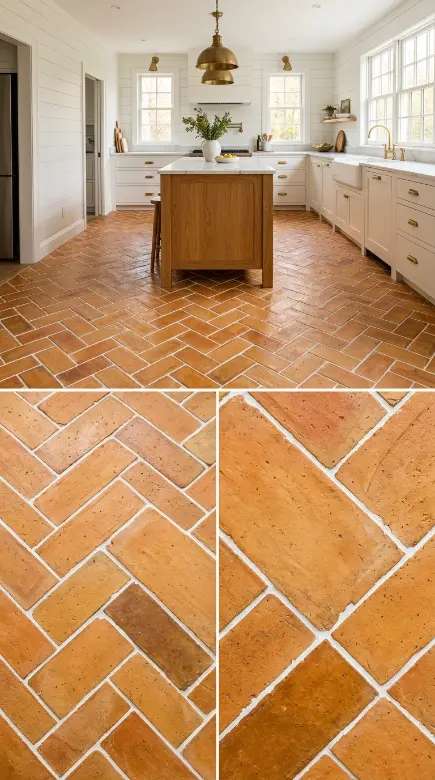
Reclaimed brick tiles or reclaimed terracotta tiles laid in herringbone pattern with crisp white grout lines create one of the most visually striking and most characteristically farmhouse kitchen floors available. The white grout lines in the herringbone reclaimed tile floor serve three simultaneous functions: they emphasize and clarify the herringbone pattern geometry, they provide a crisp clean contrast against the warm aged terracotta or reclaimed brick tones, and they make the floor easier to clean and more hygienic in the kitchen environment. The white herringbone lines on the warm aged terracotta tiles create a floor composition of complete geometric clarity and natural material warmth — the precision of the white lines and the richness of the reclaimed terracotta in perfect balance.
4. Wide Plank Reclaimed Herringbone — Chevron Variation
The chevron variation of the herringbone pattern — where each plank is cut at a 45-degree angle at both ends so the plank ends meet precisely at the chevron apex rather than butting at offset positions — creates a cleaner and more precise V-direction than classic herringbone while using the same reclaimed timber material. In wide reclaimed oak planks of approximately 15cm to 18cm width, the chevron pattern creates a more dramatic and more architecturally assertive floor direction than the classic herringbone, with each V pointing more emphatically toward one wall. In a farmhouse kitchen, the chevron direction can be oriented to point toward the kitchen island or toward the farmhouse range, drawing the eye to the kitchen’s primary feature.
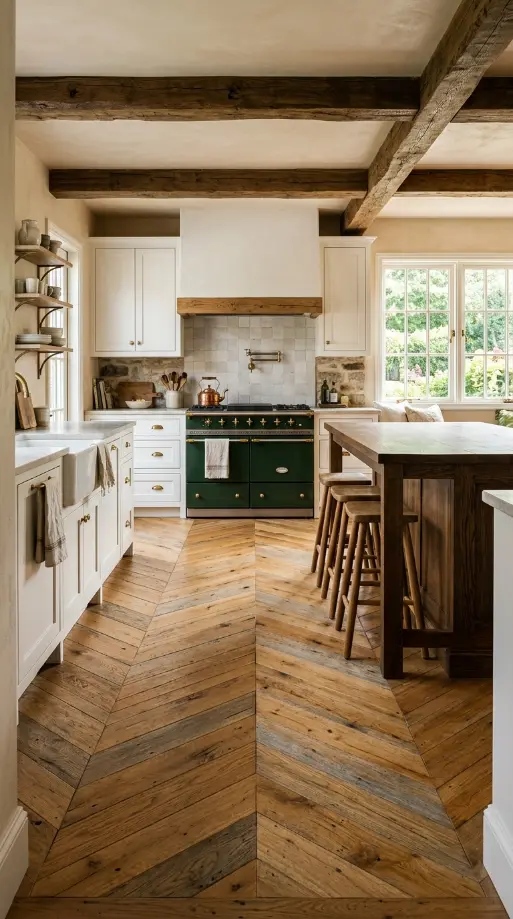
5. Reclaimed Herringbone Floor with Dark Border
A dark stained oak or aged walnut border — a continuous border of three to four plank widths running around the perimeter of the reclaimed herringbone floor — creates a floor composition of complete geometric formality that references the grand floors of European farmhouses and manor houses. The dark border frames the herringbone field like a picture frame, emphasizing the herringbone pattern as a composed central element rather than simply a continuous floor surface. The contrast between the warm natural reclaimed herringbone field and the deeper darker border planks creates a floor of extraordinary visual richness and formal beauty. In a farmhouse kitchen, the dark bordered reclaimed herringbone floor gives the room a quality of considered historic design that no plain floor can achieve.
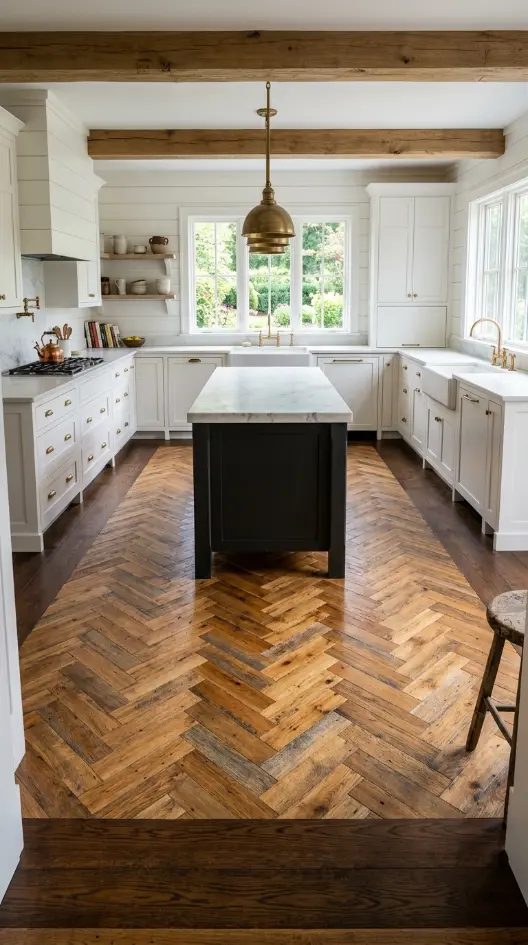
6. Reclaimed Pine Herringbone — Softer Farmhouse Character
Reclaimed pine — with its softer grain, its characteristic knots, its warm honey-amber to creamy white color range, and its more responsive surface that dents and marks slightly with use — creates a herringbone floor of softer, more casual farmhouse character than the denser reclaimed oak. Reclaimed pine herringbone has the quality of old French farmhouse and Provençal kitchen floors: the floor of a working kitchen that has lived, that has been scrubbed and worn and re-oiled over decades. Pine’s softness means the floor develops its own patina with use, and the herringbone pattern in pine has a more textile-like quality than oak — its lighter color and more open grain making the floor appear woven when viewed from a distance.
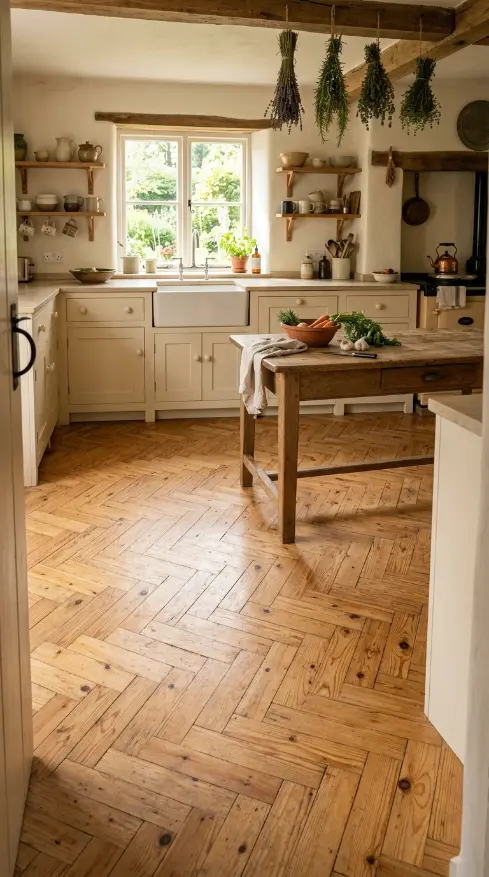
7. Reclaimed Herringbone in the Kitchen Island Zone Only
Using the reclaimed herringbone floor exclusively under and around the kitchen island — as a defined zone within a larger straight-run oak or stone tile floor — creates a kitchen floor composition of sophisticated zone definition. The herringbone island zone: a rectangular area approximately 280cm long by 160cm wide centered on the kitchen island, in reclaimed oak herringbone, surrounded by the straight-run or large format tile floor of the wider kitchen. A simple double-plank border or a slight color variation at the transition between the herringbone zone and the surrounding floor defines the island zone edge. This treatment identifies the kitchen island as a special zone within the kitchen through the floor pattern beneath it rather than through any overhead or vertical element.
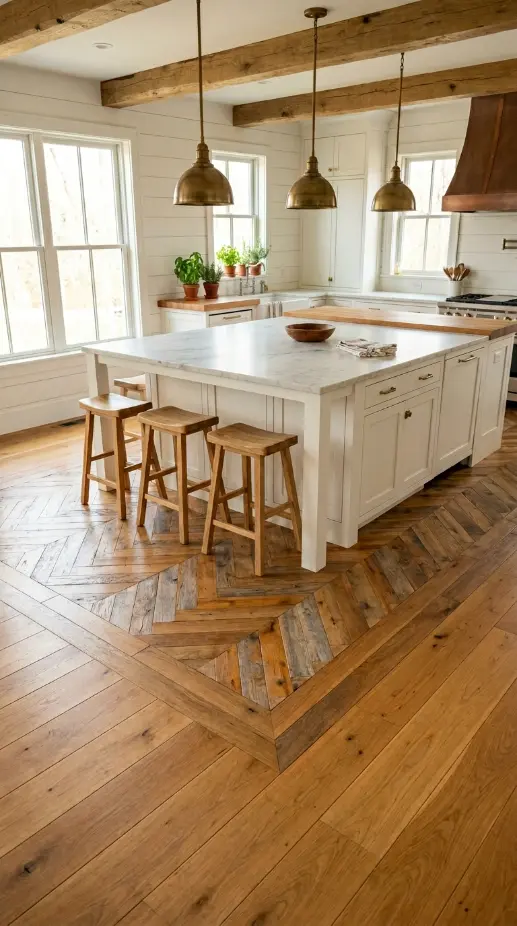
8. Reclaimed Herringbone with Natural Stone Inset
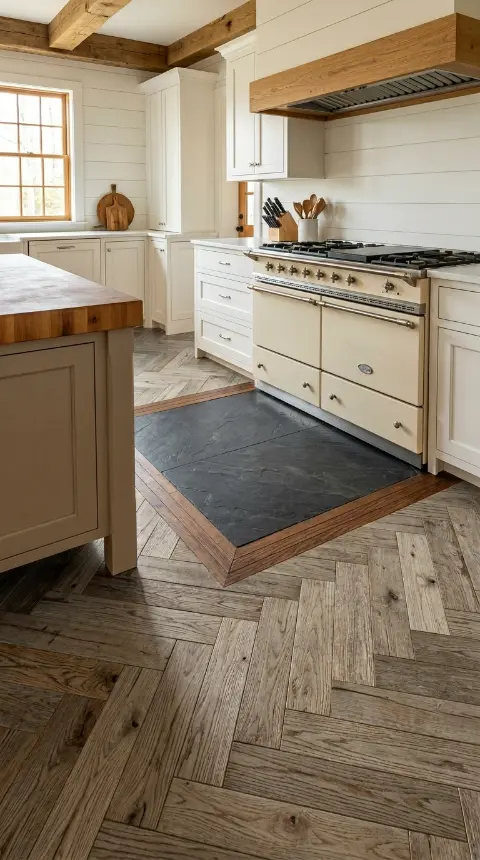
A natural stone inset — a simple rectangular area of honed limestone, slate, or dark basalt approximately 90cm by 90cm — set into the reclaimed herringbone floor directly in front of the farmhouse range or the farmhouse sink creates a practical and materially beautiful transition between the timber herringbone and the zones of highest water and heat exposure. The natural stone inset within the herringbone timber floor: the warm stone rectangle surrounded on all sides by the warm reclaimed herringbone timber, a simple transition border of narrow timber strips marking the stone edge. The stone inset in front of the range or sink provides a more robust and water-resistant surface at the kitchen’s primary work positions while the reclaimed herringbone continues across the remainder of the kitchen floor.
9. Bleached Reclaimed Herringbone — Pale Farmhouse Character
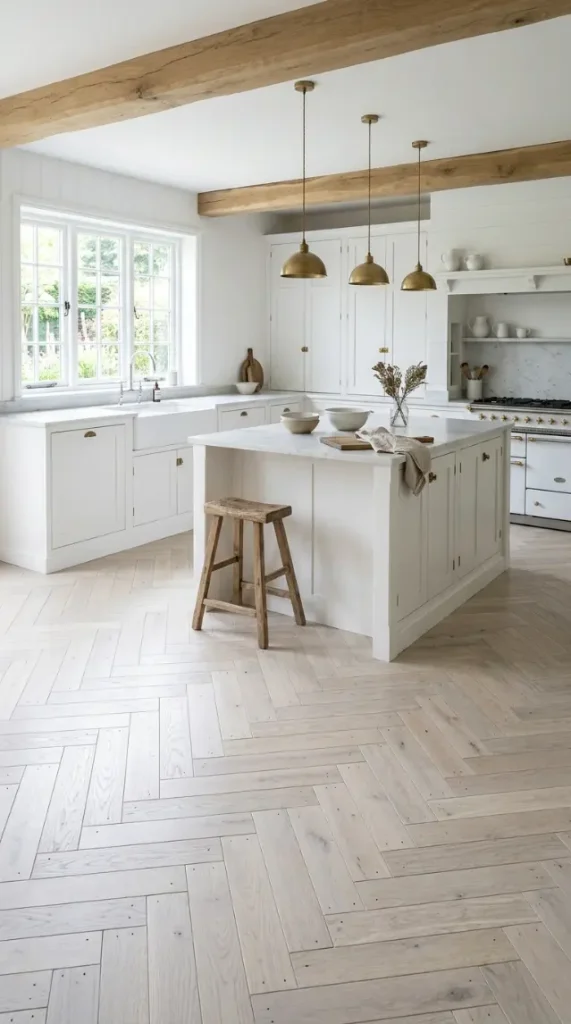
Reclaimed oak herringbone that has been lightly bleached or limed — the natural aging tones lifted slightly toward a pale silver-white while retaining the natural grain and reclaimed character — creates a farmhouse kitchen floor of the most calm and most Scandinavian-influenced character. The bleached or limed reclaimed herringbone: the timber retains its natural grain variation and its reclaimed surface quality — the nail holes and saw marks still visible — but in a paler, cooler, more silvery tone. The pale bleached herringbone in a white farmhouse kitchen creates a floor of such complete tonal harmony with the white walls and cabinets that the floor appears to extend the white interior horizontally, making the kitchen feel wider and lighter than any natural-toned floor could produce.
10. Reclaimed Herringbone with Integrated Heating — Morning Warmth Detail
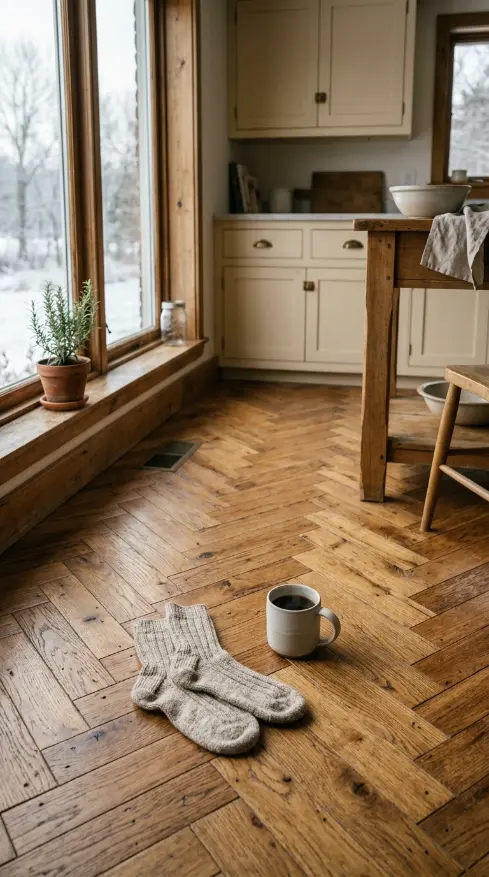
Underfloor heating beneath a reclaimed herringbone floor — specifically visible as a morning detail where the floor is warm to the touch before the kitchen has been entered, the warmth of the floor radiating upward through the reclaimed timber herringbone — creates the most complete modern farmhouse floor experience. The integration of contemporary underfloor heating with the historic character of reclaimed herringbone timber is the precise expression of what modern farmhouse design is: the comfort and infrastructure of the contemporary built into the material character of the traditional. A bare foot on the warm reclaimed herringbone floor in the farmhouse kitchen on a cold morning is the specific and complete domestic pleasure this floor design produces.
11. Reclaimed Herringbone Running Toward the Kitchen Window
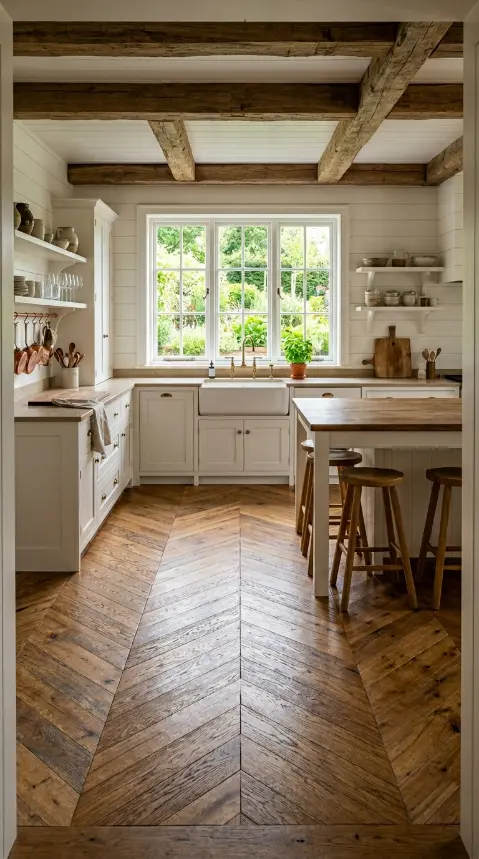
The direction of the herringbone pattern in the farmhouse kitchen floor — specifically orienting the V-direction to point toward the most important visual element in the kitchen — is one of the most important but least discussed decisions in farmhouse floor design. When the herringbone V-direction points toward a large kitchen garden window, the floor creates a visual vector that draws the eye from the kitchen entrance toward the window and the garden beyond, making the kitchen feel longer, making the garden view feel more central, and creating a floor-to-window spatial connection that makes the farmhouse kitchen genuinely connected to its landscape.
12. Reclaimed Herringbone Under an Aga or Range — Warmth and Pattern
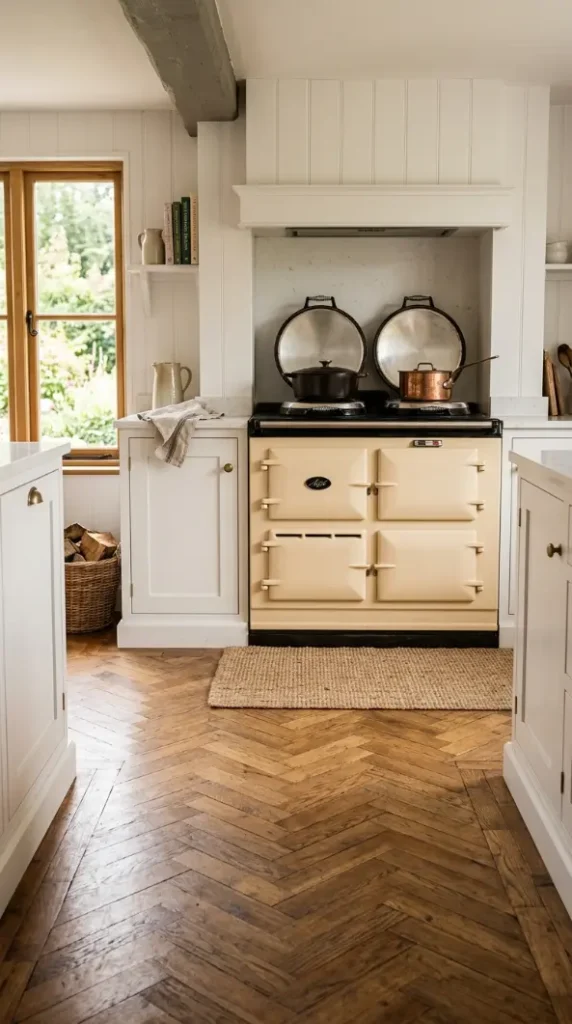
The Aga or professional farmhouse range sitting above the reclaimed herringbone floor creates the most iconically farmhouse kitchen composition available — the warm mass of the enamelled range above the warm reclaimed timber below, the V-pattern of the herringbone pointing toward the range from both sides. The range and the herringbone floor are the two primary heat-generating and warmth-communicating elements in the farmhouse kitchen, and their visual and physical relationship — the range sitting on and slightly above the reclaimed herringbone, the floor pattern directing toward the range — creates the kitchen’s most complete farmhouse moment.
13. Reclaimed Herringbone Continuing into Adjacent Dining Zone
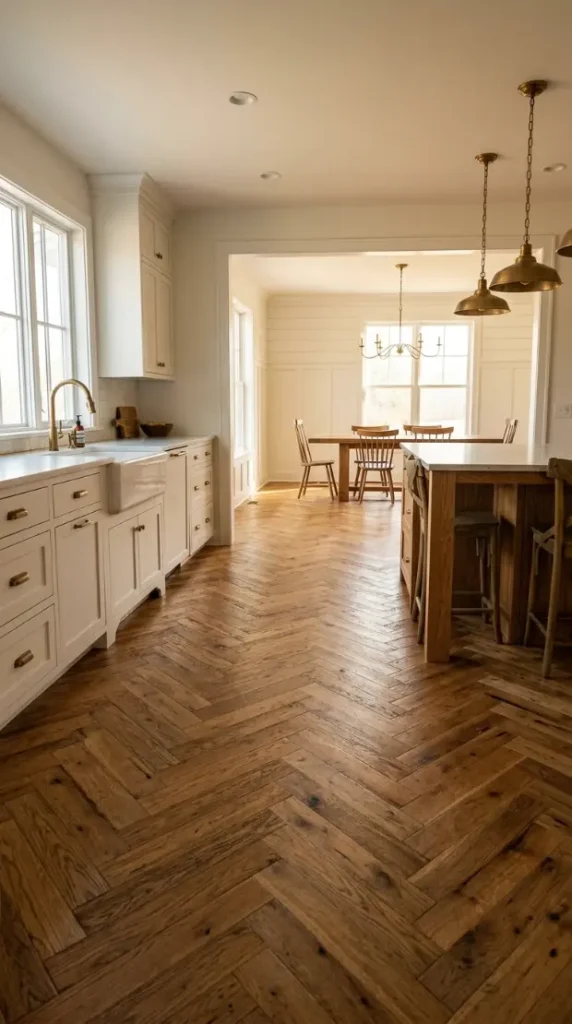
A reclaimed herringbone floor that continues from the farmhouse kitchen through an open or semi-open connection into the adjacent dining room — maintaining the same pattern direction and the same timber across both rooms — creates the most spatially unified and most materially coherent farmhouse kitchen-dining composition available. The herringbone floor running continuously from kitchen to dining room without a threshold or pattern interruption communicates both rooms as belonging to the same domestic space, connected by the same floor material and the same geometric pattern running through both.
14. Reclaimed Herringbone with Exposed Nail Detailing
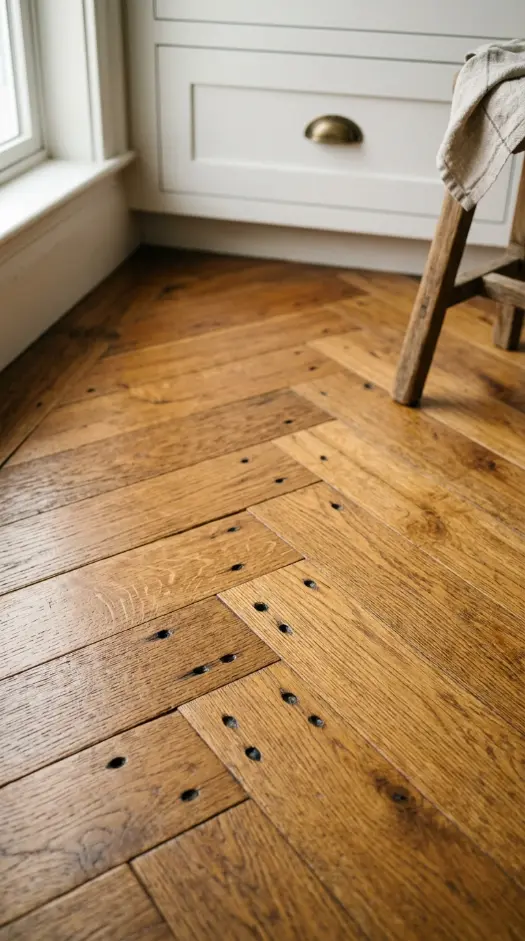
Reclaimed timber herringbone that celebrates rather than conceals its nail holes — with some planks showing multiple visible nail holes filled with natural dark wax to make them visible as design details rather than filled flush and invisible — creates a floor of the most honest reclaimed character. The exposed nail holes in the reclaimed herringbone are not imperfections but historical records: each nail hole tells the story of the timber’s previous structural life, the connection it once made in the barn or warehouse it came from. Filling the nail holes with dark wax rather than light filler makes them visible as small dark points in the warm timber surface, creating a visual texture of natural historic detail across the herringbone floor.
15. Reclaimed Herringbone at the Kitchen Entrance — Transition Detail
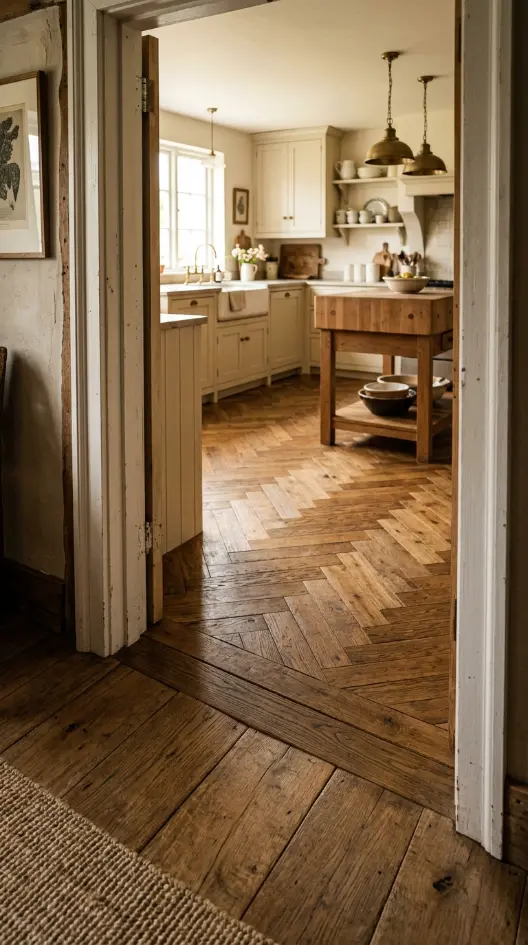
The kitchen entrance transition in a farmhouse home — the point where the hallway or living room floor meets the kitchen herringbone floor — is an opportunity for a specific and architecturally considered floor detail. A simple fan or compass rose inset — a circular arrangement of herringbone planks creating a single round medallion approximately 60cm to 90cm diameter centered on the kitchen entrance axis — set into the beginning of the herringbone field at the kitchen threshold marks the transition between spaces and welcomes the herringbone pattern with a formal beginning. Alternatively, a simple double border of straight planks running perpendicular to the kitchen entrance creates a clear architectural entry to the herringbone field beyond.
16. Dark Stained Reclaimed Herringbone — Dramatic Farmhouse Floor
Reclaimed oak herringbone in a deep dark stain — a warm dark walnut, a rich dark ebony-brown, or a deep charcoal-grey — creates the most dramatically atmospheric and most richly moody version of the farmhouse kitchen floor. The dark stained reclaimed herringbone floor under white shaker cabinets creates an extreme light-dark contrast that makes both the floor and the cabinets appear more dramatic and more beautiful than any same-tone pairing could. The dark herringbone: the V-pattern visible in the depth variation between different plank face directions catching light differently, the dark grain and occasional natural pore structure visible in the deep stain, the characteristic old reclaimed nail holes appearing as slightly lighter points against the dark surface.
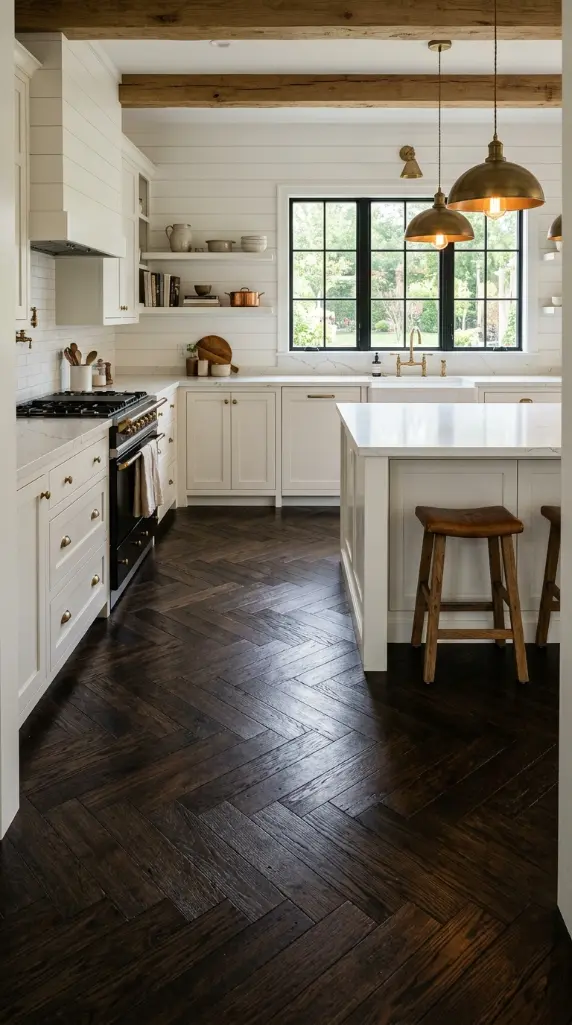
17. Reclaimed Herringbone with Underfloor Radiant Stone Zone
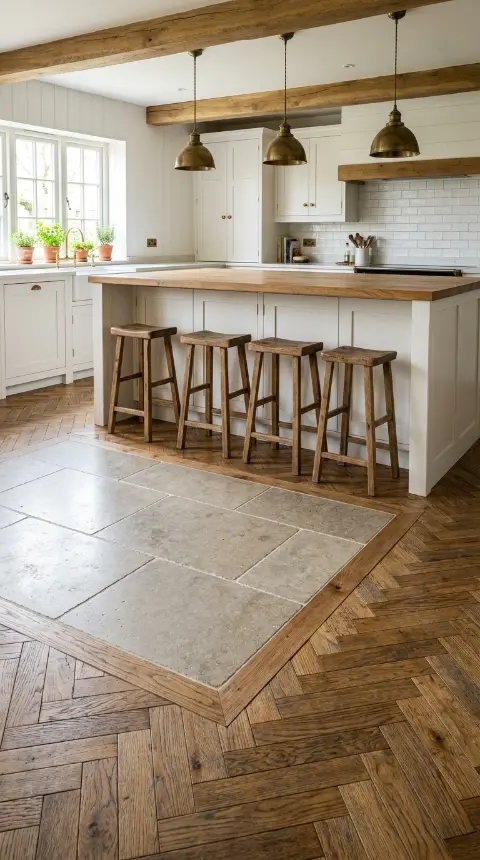
A farmhouse kitchen floor combining reclaimed oak herringbone with a natural stone slab zone — a large format natural limestone or sandstone slab section approximately 150cm by 200cm in front of the kitchen island or the Aga — where the stone zone has radiant underfloor heating provides a different underfoot thermal experience from the reclaimed timber: the stone warms slowly and holds warmth longer, creating the specific pleasure of stepping from the warm timber herringbone onto a warm stone slab in the kitchen’s primary cooking or working zone. The reclaimed herringbone surrounding the warm stone inset creates the most complete farmhouse kitchen floor material and thermal composition.
18. Herringbone Reclaimed with Vintage Persian Runner
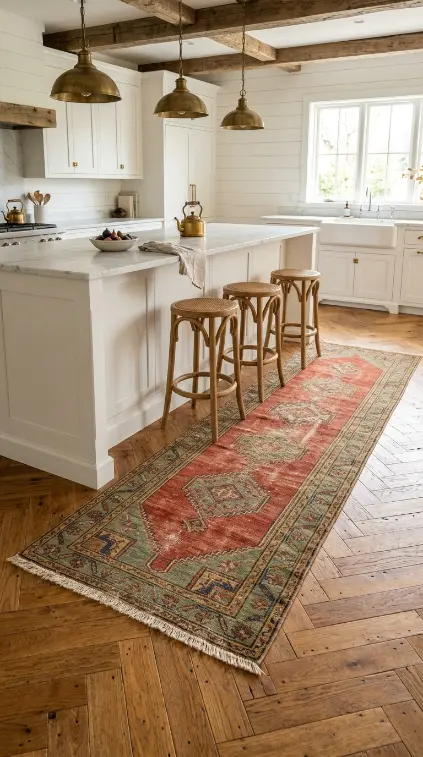
A vintage Persian rug runner — approximately 80cm wide by 250cm long, in the faded warm tones of a genuinely aged Persian kilim or runner, in aged terracotta-red, faded sage green, and warm gold tones — placed along the kitchen island social side or the kitchen passageway creates the most layered and most characteristically lived-in farmhouse kitchen floor composition. The vintage Persian runner sitting on the reclaimed herringbone floor: the aged Persian colors and the aged reclaimed timber together creating a layered floor material story of two different kinds of age and two different kinds of natural warmth — the textile and the timber, the woven and the laid, the faded red and gold and the warm amber and grey of the oak.
19. Reclaimed Herringbone in a Galley Farmhouse Kitchen
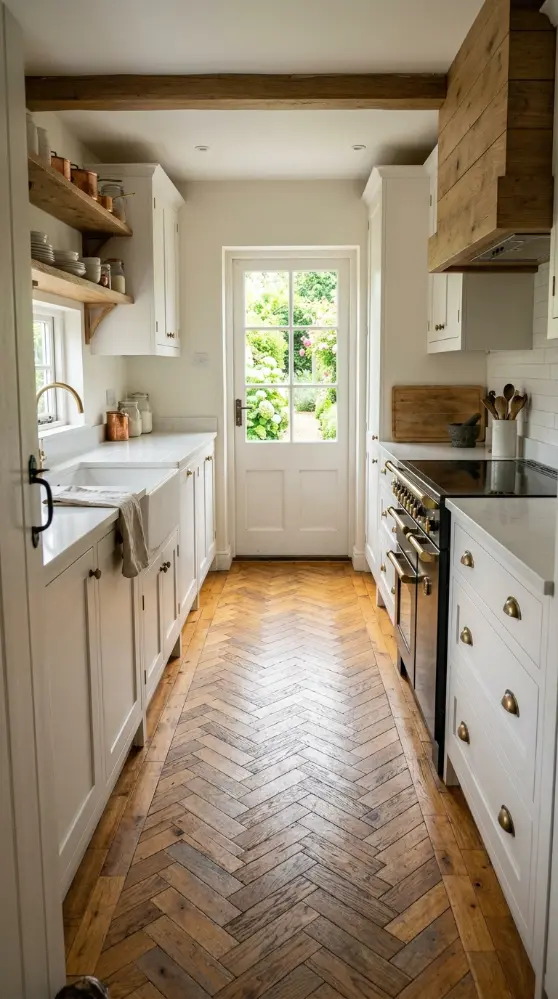
A galley farmhouse kitchen — two parallel runs of cabinets and counters approximately 110cm to 120cm apart with a connecting passageway between them — with a reclaimed herringbone floor creates a specific and extraordinary floor direction experience. In a galley kitchen, the herringbone V-direction can be oriented along the galley length, pointing from one end to the other and creating an emphatic directional pull from the kitchen entrance to the garden door or window at the far end. The narrow width of the galley and the reclaimed herringbone V-pointing along its length together create the most corridor-like and most directionally specific farmhouse kitchen floor composition.
20. Reclaimed Herringbone with Copper Inlay Detail
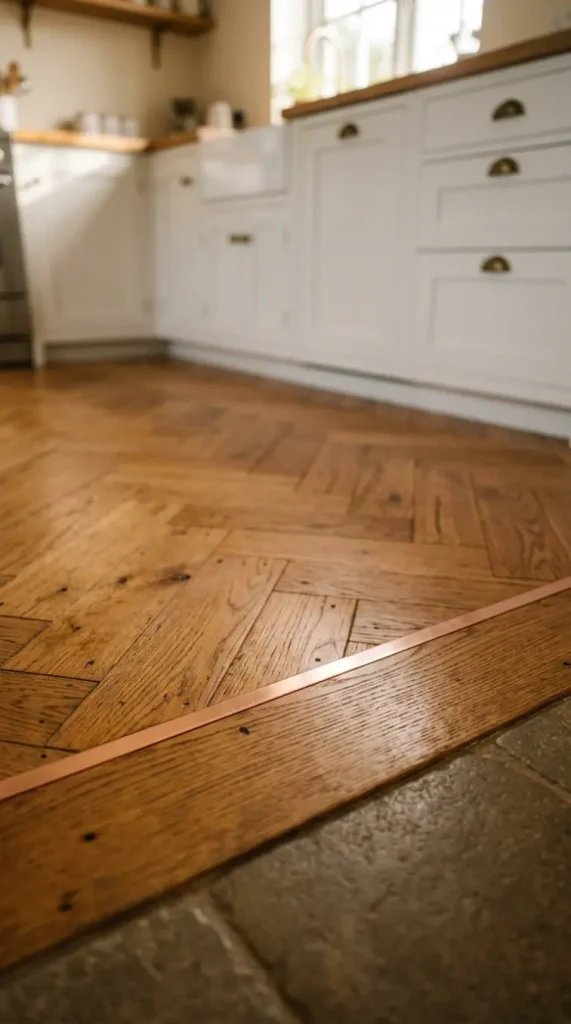
A single copper strip inlay — a thin copper bar approximately 5mm wide set flush into the timber at the transition between the herringbone zone and an adjacent material or at the kitchen entrance threshold — creates the most precious and most specifically artisan floor detail available in the farmhouse kitchen. The warm glow of a flush copper strip inlay in the reclaimed herringbone floor catches every light source in the kitchen — morning sun, afternoon light, evening pendant glow — and creates a warm metallic accent at floor level that connects to the aged brass hardware and fixtures above. The copper strip is a detail that only rewards close observation, communicating craft and material investment at the smallest possible scale.
21. Reclaimed Brick Herringbone — Red and Brown Farmhouse Warmth
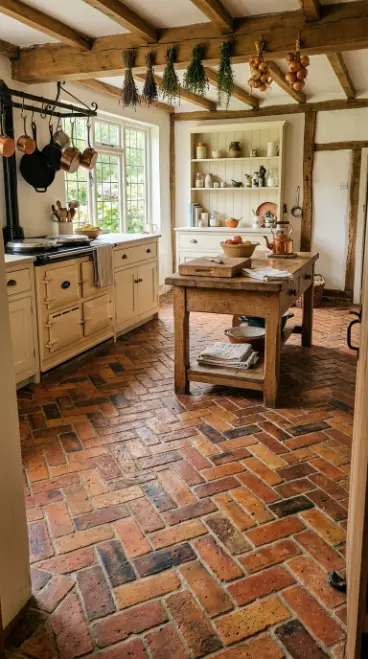
Reclaimed brick pavers in herringbone pattern — salvaged Victorian or Edwardian engineering bricks approximately 22cm by 10cm by 6cm thick, laid in classic herringbone on a bed of lime mortar — create the most genuinely historic and most thermally massive farmhouse kitchen floor available. The reclaimed brick herringbone: each brick in its own unique color within the warm red to amber to dark brown range of fired clay, the individual brick surface showing fired texture, some bricks with lime mortar residue from their previous use, some with historical marks. The reclaimed brick herringbone creates a floor of extraordinary color depth and natural warmth — the brick’s thermal mass holding warmth from underfloor heating or from the kitchen’s cooking activity and releasing it slowly into the kitchen environment.
22. Reclaimed Herringbone in a Large Open Plan Farmhouse Kitchen
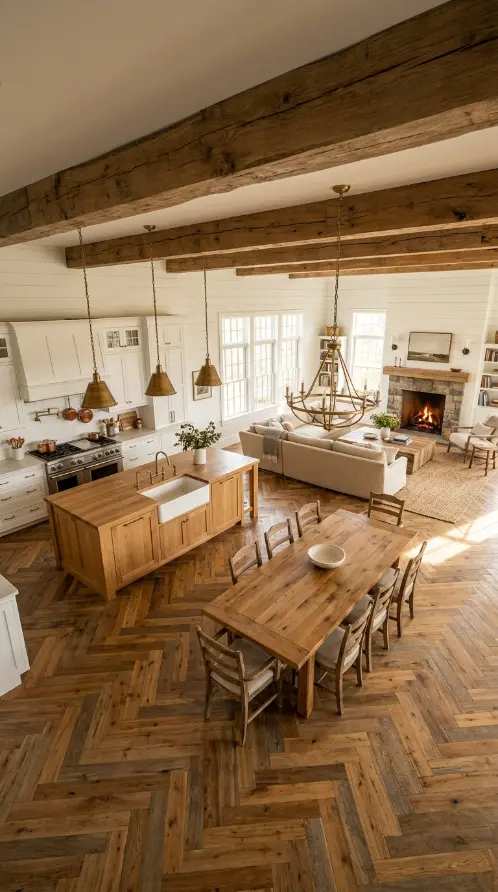
A reclaimed herringbone floor covering the full footprint of a large open plan farmhouse kitchen-dining-living space — approximately 8m by 10m of continuous reclaimed herringbone — creates the most ambitious and most spatially impressive version of the farmhouse herringbone floor project. At this scale, the herringbone pattern creates a floor of genuinely architectural presence — the V-pattern visible from every position in the open plan, the reclaimed timber’s color variation creating a floor of extraordinary visual depth across its full scale. The seamless reclaimed herringbone across kitchen, dining, and living zones without interruption makes the entire open plan feel like one historically grounded and warmly beautiful domestic space.
23. Reclaimed Herringbone with Lime Mortar Joints — Old Tile Character
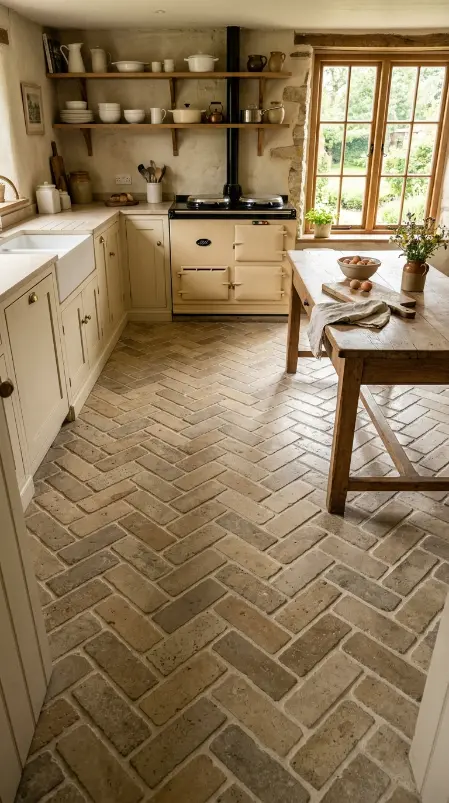
Reclaimed stone tiles — old limestone, old terracotta, or old slate — laid in herringbone with wide natural lime mortar joints of approximately 8mm to 12mm width create a floor of completely different character from tight-jointed modern tile herringbone. The wide lime mortar joints in warm grey-cream define the herringbone geometry clearly and emphatically, giving each tile its own frame within the pattern, and the irregular width and texture of hand-mixed lime mortar joints — slightly uneven, slightly textured, slightly variable in tone — adds a further layer of artisan quality and historical authenticity to the reclaimed tile herringbone floor.
24. The Reclaimed Herringbone Kitchen at Night — Candlelight Detail
The reclaimed herringbone farmhouse kitchen at night — lit by the warm amber glow of pendant lights above the island and a cluster of beeswax candles on the kitchen table and countertop — is when the reclaimed timber herringbone floor appears at its most richly beautiful. In warm amber candlelight and Edison pendant glow, the color variation of the reclaimed planks appears deeper and more jewel-like, the herringbone V-pattern visible in the warm directional amber light, each plank face catching the amber differently. The dark corners of the kitchen where the pendant light does not reach appear as rich dark reclaimed timber shadow zones in the herringbone pattern, creating a floor of extraordinary evening atmospheric depth.
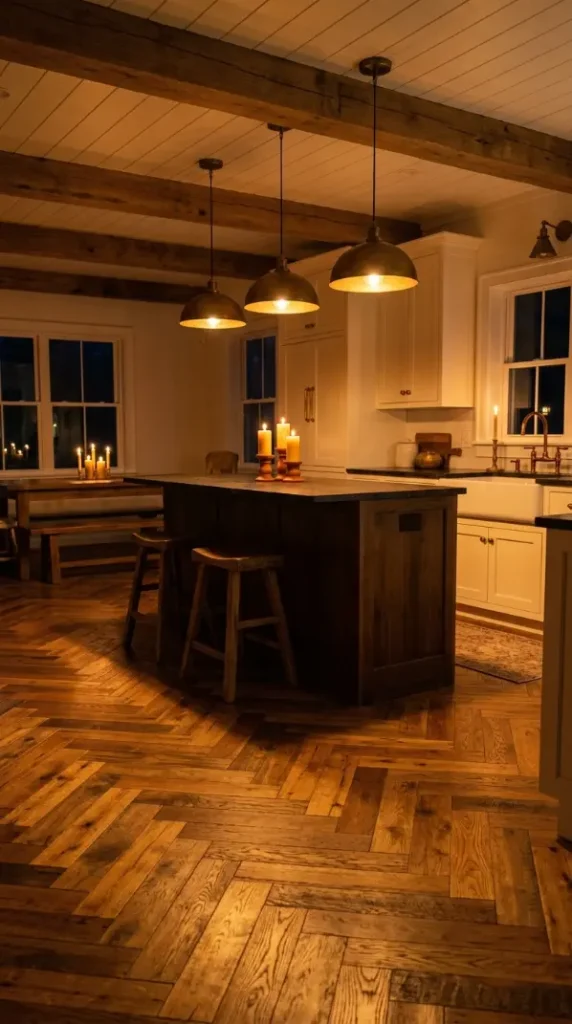
25. The Complete Reclaimed Herringbone Farmhouse Kitchen — All Elements Together
The fully realized farmhouse kitchen where every floor element — the reclaimed oak herringbone covering the full kitchen floor, the natural limestone inset in front of the Aga, the dark stained perimeter border, the copper strip entry threshold inlay, the vintage Persian runner along the island, the herringbone V-direction pointing toward the large garden window — works together with every kitchen element — the white shaker cabinets, the oak island, the aged brass hardware and pendants, the white farmhouse apron sink, the Aga above the stone inset, the rough-hewn ceiling beams, the white shiplap walls, the large garden window — to create one complete, warmly beautiful, and genuinely historic modern farmhouse kitchen of absolute floor and interior design integrity.