
30 Bathroom Plants Decor Japandi Minimal Hinoki Tub Style
There is a particular quality of stillness that certain bathrooms have — a stillness that has nothing to do with silence and everything to do with the deliberate reduction of everything unnecessary until only the most essential and the most beautiful remains. That quality is what the Japandi minimal bathroom with a hinoki tub is entirely about, and once you have experienced a bathroom designed around these principles, every other bathroom configuration feels like it is carrying too much weight.
Japandi — the design philosophy that emerges from the meeting of Japanese wabi-sabi and Scandinavian hygge — finds perhaps its most natural expression in the bathroom. Both traditions share a deep reverence for natural materials, for the beauty of objects that show their making and their aging, for the quality of light on a wooden surface and water on stone. In the bathroom, these values translate directly: raw timber, natural stone, unglazed ceramic, undyed linen, aged brass, and above all the living presence of plants that thrive in steam and low light and the particular humid atmosphere of a room built around water.
The hinoki tub is the anchor of the Japandi bathroom. Hinoki — Japanese cypress — is the wood that has been used for ceremonial bathing vessels, temple structures, and ritual objects in Japan for over a thousand years. It has a specific quality that no other timber possesses: a warm honey-gold tone that deepens with age and water contact, a tight vertical grain of extraordinary beauty, and a natural aromatic quality — a clean, faintly citrus-cedar scent — that releases with warmth and steam. Bathing in a hinoki tub is not merely bathing. It is a sensory experience that engages smell as completely as sight and touch, and that makes the act of bathing feel like a ritual rather than a routine.
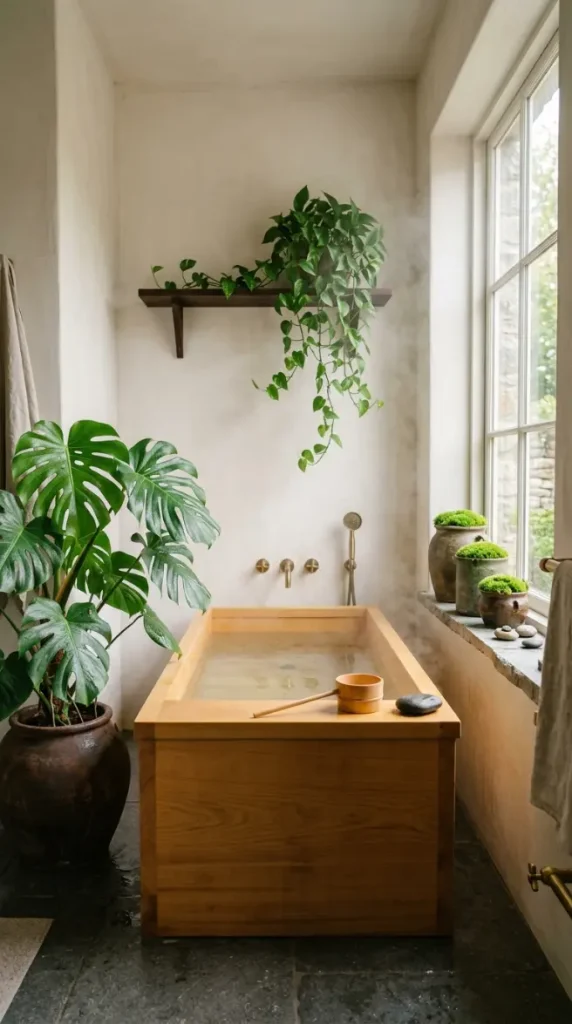
Plants in the Japandi minimal bathroom are not decorative additions — they are considered presences, each one chosen for its specific relationship with the bathroom environment and placed with the same intentionality as every other element in the room. A single large monstera in a dark clay pot in the corner. One trailing pothos on a natural wood shelf above the tub. Three small terracotta pots of moss on the stone windowsill. The plants are never many and never small-minded in their placement — each one occupies its position with the same quiet authority as the hinoki tub itself.
These 30 ideas show every dimension of the bathroom plants decor Japandi minimal hinoki tub aesthetic — from the foundational single-plant placement to the complete bathroom where every element from the raw plaster walls to the dark stone floor to the aged brass fixtures to the hinoki tub to the carefully chosen plants creates one unified vision of natural, meditative, genuinely restorative Japandi beauty.
1. Single Large Monstera as Bathroom Anchor Plant
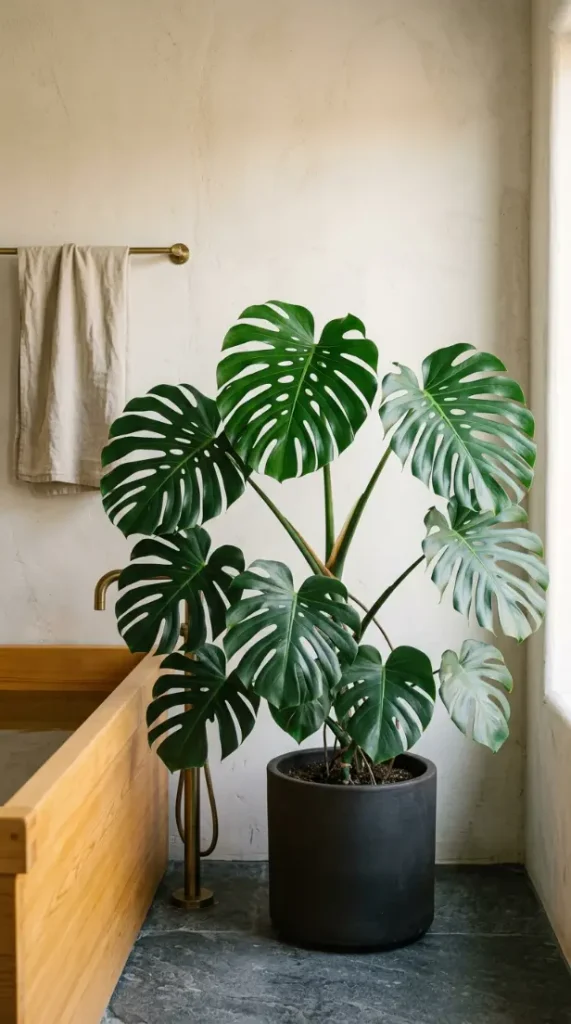
The single large Monstera deliciosa — placed with deliberate intention in the far corner of the Japandi bathroom where its large split leaves can be seen from the hinoki tub — is the most powerful single plant placement the aesthetic can produce. One large monstera in one dark matte clay or dark basalt pot is not a decoration but a presence: it occupies its corner with a quiet authority that makes the entire bathroom feel more alive and more complete. The monstera’s large glossy fenestrated leaves — each one a distinct natural form — create a specific kind of visual complexity against the raw plaster wall behind it that no other plant produces. In the steam and humidity of a functioning bathroom, the monstera grows visibly well, its leaves appearing richer and more glossy than in any other room.
2. Hinoki Tub Grain Detail — The Wood as Botanical Material
The hinoki tub is itself a botanical object — a vessel made from living wood that continues to release its natural aromatics with every use, whose grain patterns record the growth of the tree over decades, and whose surface changes and deepens with water and time in the same way that a living plant responds to its environment. The tight vertical grain of hinoki cypress — running the full height of each stave in the tub construction — has a quality of natural precision that makes looking at the tub surface as satisfying as looking at any carefully chosen plant. In the Japandi bathroom, the hinoki tub grain is as much a botanical display as the potted plants around it.

3. Trailing Pothos on a Dark Wood Shelf Above the Tub
A single dark wood wall shelf — minimal, approximately 60cm long by 15cm deep, in dark oiled walnut or dark stained oak — mounted on the raw plaster wall above the hinoki tub at approximately 160cm height, with one pot of trailing pothos or devil’s ivy sitting on the shelf and its stems trailing down toward the tub, creates the most elegant and most intentional plant placement in the Japandi bathroom. The trailing green stems and heart-shaped leaves of the pothos descending from the dark shelf toward the warm hinoki wood below create a living connection between the plant element and the bathing element — the plant appearing to reach toward the steam and warmth of the tub. In a dark ceramic pot on a dark wood shelf against a raw plaster wall, the pothos is the most quietly beautiful plant the Japandi bathroom can hold.

4. Living Moss Wall Panel Beside the Hinoki Tub
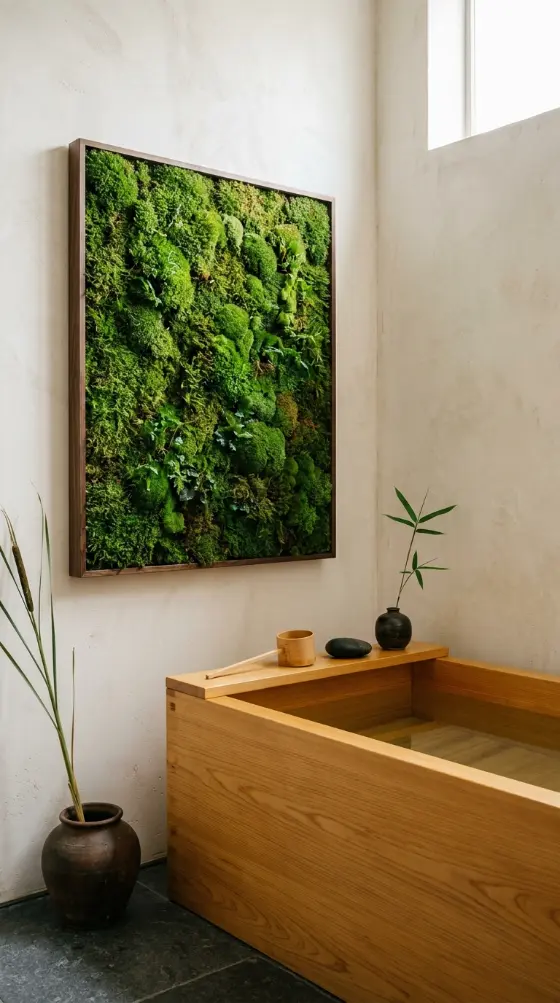
A living moss wall panel — a framed section of living preserved or active moss approximately 60cm by 80cm, mounted directly on the raw plaster bathroom wall beside the hinoki tub — brings the most specifically Japanese garden element into the Japandi bathroom. Moss in Japanese garden philosophy is not a ground cover but a primary presence — a living material of extraordinary textural beauty that creates the feeling of deep nature, of forest floor, of the ancient and the patient. A living moss panel beside a hinoki tub, in a bathroom with raw plaster walls and dark stone floor, creates a spatial composition of complete Japandi naturalism — the hinoki wood and the living moss and the stone together constituting the three elemental materials of the Japanese garden compressed into a minimal bathroom space.
5. Bamboo Stems in a Tall Dark Ceramic Vessel
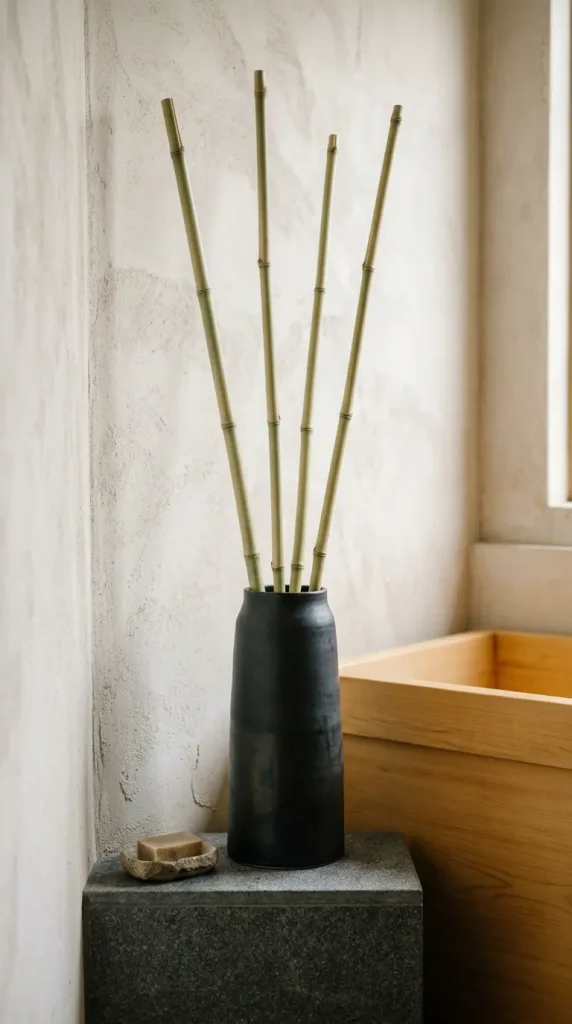
A single tall dark ceramic vessel — approximately 35cm to 45cm tall, simple cylinder or slightly tapering form, in a dark grey or near-black matte glaze — holding three to five straight bamboo stems in the corner of the Japandi bathroom or on a low stone shelf creates the most architecturally precise and most authentically Japanese plant placement in the entire bathroom. Bamboo stems are not flowers or trailing plants — they are vertical, structural, precise. Their tall straight lines against the raw plaster wall create a specific visual geometry that is entirely consistent with the Japandi aesthetic of beautiful simplicity. The dark ceramic vessel holding the pale green bamboo stems is a composition of complete material and formal beauty.
6. Dark Stone Windowsill with Moss and Stone Composition
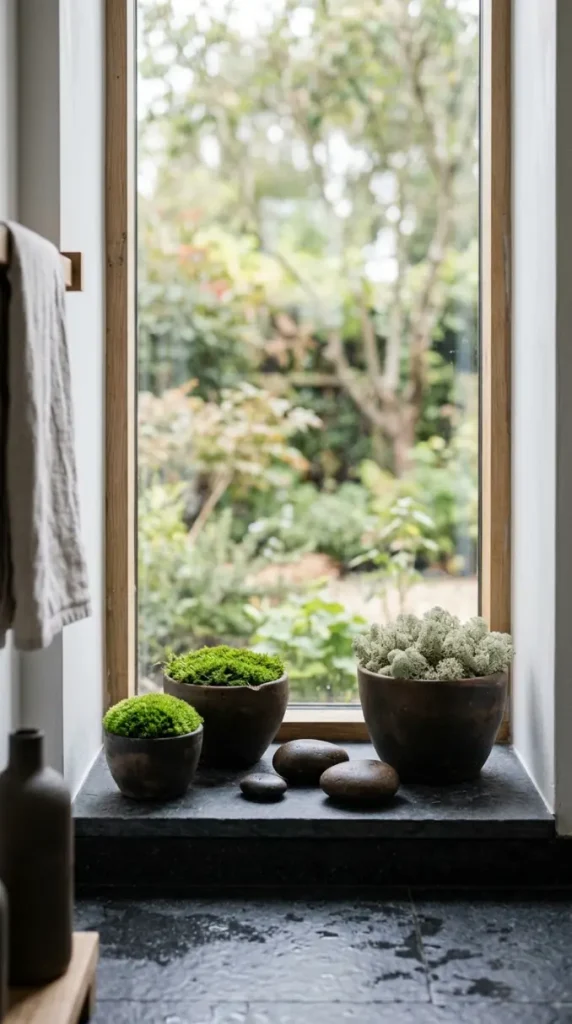
The bathroom windowsill in a Japandi minimal bathroom — particularly when it is deep-set in thick walls and made of the same dark stone as the floor — is a natural altar for a small moss and stone composition. Three small dark ceramic or unglazed clay vessels of different sizes, each holding a different variety of living or preserved moss — cushion moss, sheet moss, reindeer moss — arranged with two or three smooth dark river stones of varying sizes creates a miniature Japanese garden on the windowsill. The moss and stones in the natural light of the bathroom window, with the hinoki tub visible in the room beyond, create the most concentrated and most meditative botanical moment in the entire Japandi bathroom.
7. Hinoki Tub with a Single Botanical Floating on the Water
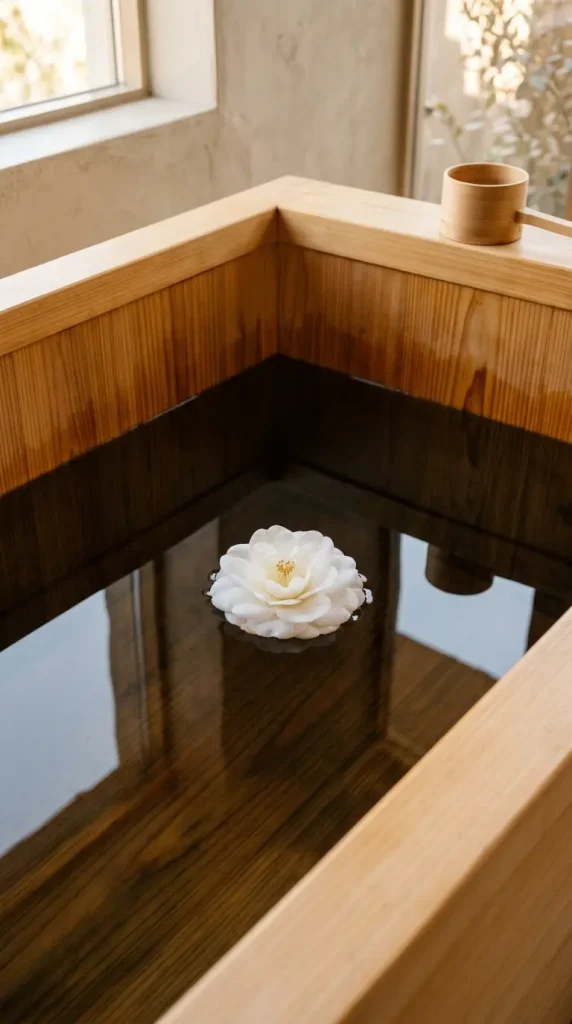
A single large camellia flower, a single lotus bloom, or a handful of fresh hinoki branch tips floating on the surface of the water in the hinoki tub creates the most purely Japanese bathing ritual detail available in the Japandi bathroom. The flower or branch floating on the still dark water surface in the deep hinoki tub, with the warm honey-gold of the tub walls surrounding the floating botanical, creates a still life of extraordinary natural beauty. This detail references the Japanese practice of hana-yu — bathing with floating flowers or botanicals — and connects the bathing ritual to a tradition of using water as a medium for botanical contemplation.
8. Fern on a Low Hinoki Wood Stool Beside the Tub
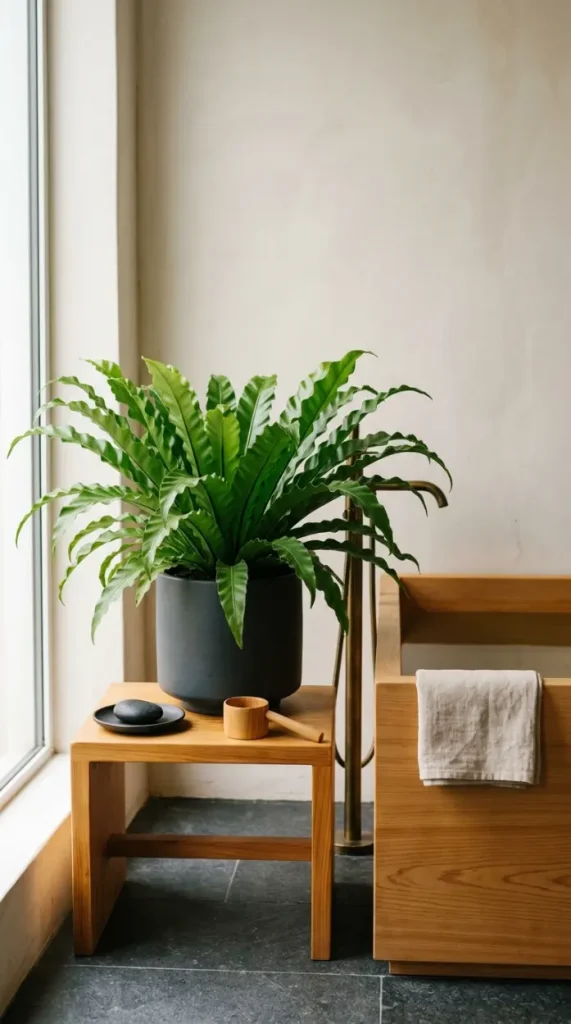
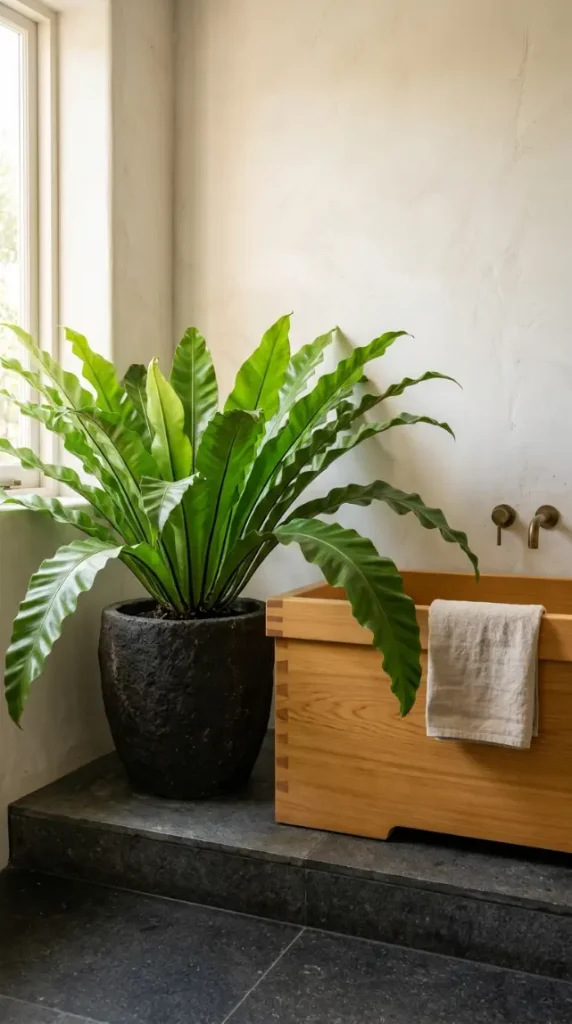
A single fern — a Boston fern, a bird’s nest fern, or an Asplenium — in a dark matte ceramic pot placed on a low flat hinoki wood stool or platform beside the soaking tub creates a plant composition of complete material harmony: the fern’s soft arching fronds above the warm hinoki stool surface, the dark ceramic pot between them, the hinoki tub beyond. The low stool serves both as a plant stand and as a bathing accessory surface — on it beside the fern pot: one small dark ceramic dish, one hinoki wood ladle, a folded natural linen face cloth. The composition of fern and hinoki stool and dark ceramic beside the hinoki tub is the Japandi bathroom at its most naturally serene.
9. Bathroom Plants on a Raw Stone or Concrete Shelf
A raw stone shelf — a slab of natural stone approximately 4cm thick by 20cm deep, projecting from the raw plaster wall on minimal hidden brackets or set into the wall itself — creates the most architecturally integrated and most materially authentic plant shelf in the Japandi bathroom. On the raw stone shelf: two or three small plants in dark clay pots — a small snake plant or Sansevieria for its architectural vertical form, a small trailing string of pearls for its delicate cascade, and one small dark ceramic vessel with a single dried branch. The stone shelf with its minimal plant arrangement against the raw plaster wall makes the plant display feel like a considered architectural feature rather than added decoration.

10. Hinoki Bathroom with Dark Pebble Floor Zone
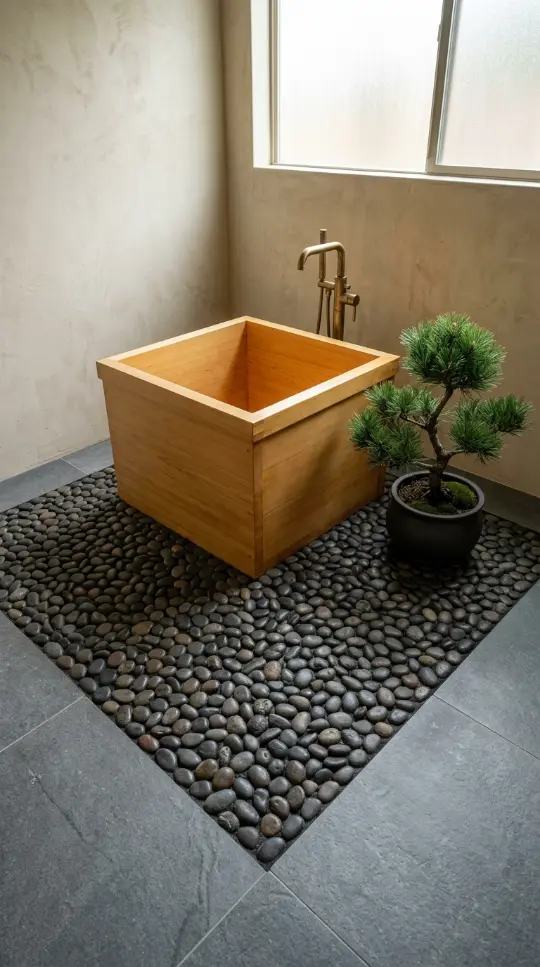
A floor zone of small dark river pebbles — a defined area of smooth dark grey and dark brown river pebbles set in mortar, creating a natural stone pebble floor section beneath and around the hinoki soaking tub — brings the most directly Japanese garden material into the Japandi bathroom floor. The dark pebble zone contrasts with the large format stone tile surrounding it, creating a clearly defined bathing zone where the natural variation of individual pebble surfaces underfoot creates a gentle foot massage texture. In the pebble zone beside the hinoki tub: one small dark matte pot with a single architectural plant — a small black pine, a dwarf bamboo, or a single Asplenium fern.
11. Aged Brass and Dark Ceramic Bathroom Accessory Composition
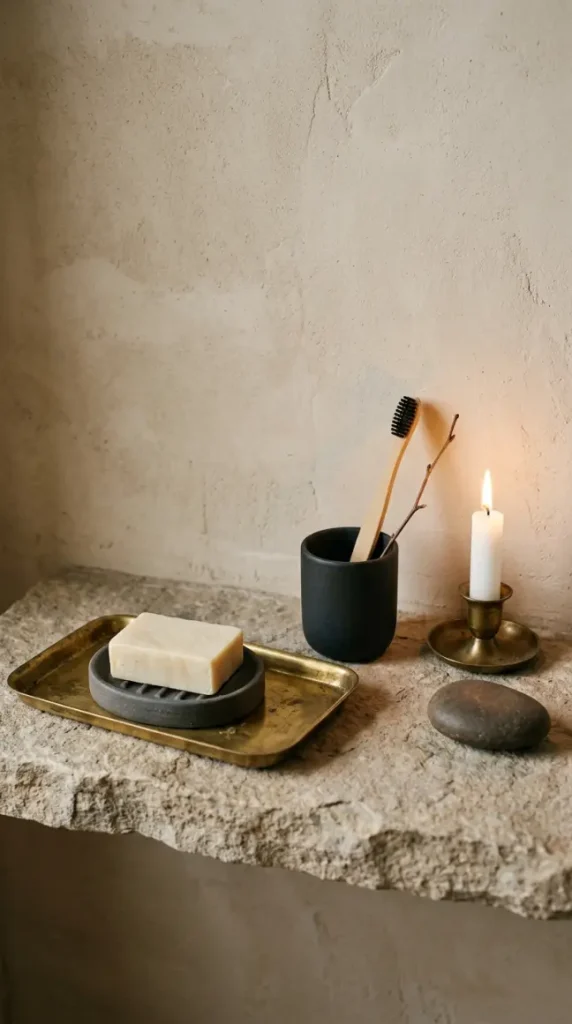
The accessories in the Japandi minimal bathroom — the soap dish, the small tray, the toothbrush holder, the candle, the small vessel — are each chosen with the same deliberate attention as the plants and the hinoki tub. The most naturally beautiful Japandi bathroom accessory composition centers on aged brass and dark unglazed ceramic: a small aged brass tray holding a small dark ceramic soap dish with a natural soap bar, a small dark ceramic cup with a single bamboo toothbrush, a small dark clay vessel with a dried twig. One white beeswax or unscented pillar candle in a simple aged brass holder. These objects together on a raw stone or dark wood shelf create an accessory composition of complete material restraint and genuine beauty.
12. Bird’s Nest Fern in a Dark Basalt Pot on the Tub Platform
The Bird’s Nest Fern — Asplenium nidus — is the single most perfectly suited plant for the steam and indirect light environment of a bathroom with a hinoki soaking tub. Its large, undivided, glossy fronds arch outward from a central rosette in a form that is simultaneously architectural and organic, and in the warm humidity of a functioning bathroom it grows with exceptional vigor, its fronds appearing increasingly rich and glossy with each bathing session. A large specimen in a dark basalt or dark lava stone pot on the low stone platform beside the hinoki tub — its glossy green fronds arching over the tub rim — creates one of the most naturally beautiful plant-and-tub compositions in the Japandi bathroom.
13. Raw Plaster Walls with a Single Botanical Shelf
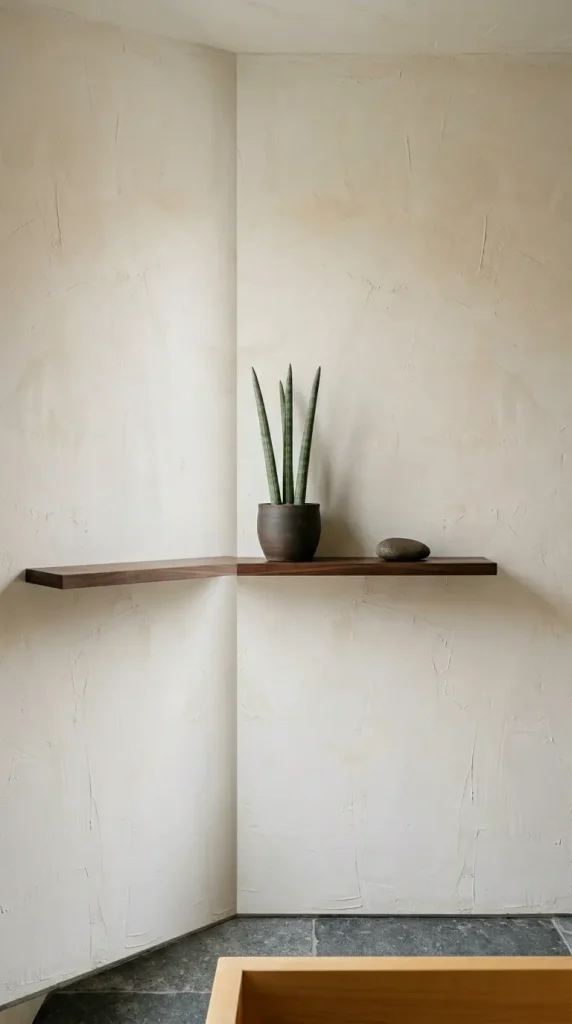
The raw plaster wall — warm off-white with natural trowel mark texture variation, the plaster not perfectly smooth but showing the human mark of its application — is the defining wall surface of the Japandi minimal bathroom. Against this wall, a single thin dark wood or raw iron shelf, mounted at a deliberate height with one or two carefully chosen plants, achieves the perfect Japandi wall composition. The raw plaster surface between and around the shelf objects is as important as the objects themselves — the negative space of the plaster wall is what gives each plant its presence. A raw plaster bathroom wall with one dark wood shelf and one dark ceramic pot with a single plant is a complete Japandi wall composition.
14. Hinoki Wood Ladle and Bathing Ritual Objects
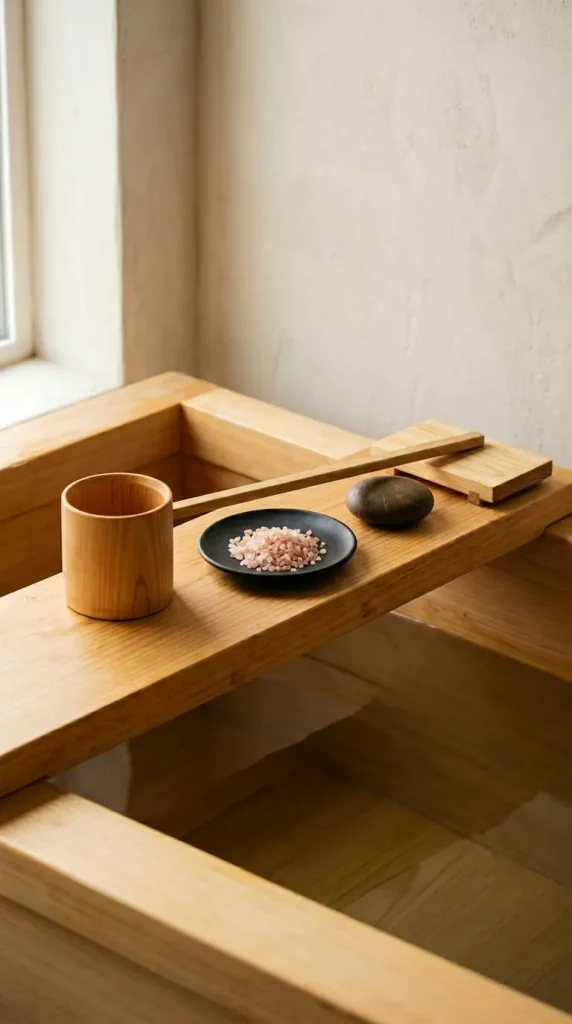
The hinoki ladle — a simple curved wooden ladle with a long handle in matching hinoki cypress — is the most specifically Japanese of all the hinoki bathroom accessories, used in the traditional bathing ritual to pour hot water over the body before entering the soaking tub. On the hinoki tub rim beside the ladle: one small dark ceramic dish holding a small amount of bath salts or dried botanicals, one smooth dark river stone, and one small hinoki wood trivet or rest. These four objects on the tub rim together create a complete bathing ritual still life that makes the bathroom feel like a serious bathing space rather than simply a room with a beautiful tub.
15. Tall Architectural Indoor Plant — Snake Plant in Dark Corner
A tall Sansevieria trifasciata — the classic snake plant in its most mature, tallest form at 80cm to 100cm — in a simple dark tall cylinder ceramic pot placed in a dark corner of the Japandi bathroom where the light is lowest and the humidity is highest creates the most architecturally dramatic and most practically resilient plant choice for this environment. The snake plant’s upright architectural leaf forms in their dark green with pale banding against the raw plaster corner, receiving the diffused light reflected from the bathroom’s primary window, create a plant placement of complete Japandi spatial precision. The snake plant thrives precisely in the conditions of low light and high humidity that challenge most other plants, making it the most honest and most low-maintenance choice.

16. Minimalist Japandi Bathroom Shelf Styling — Negative Space as Design
The most demanding and most pure expression of the Japandi bathroom plant shelf is the shelf that holds almost nothing — where the negative space of the raw stone or dark wood shelf surface is as deliberately considered as any object placed on it. On a 70cm long dark stone or dark wood shelf: one small dark ceramic pot with one small living moss ball, one smooth dark stone placed 20cm from the pot, and nothing else. The 50cm of empty shelf between the stone and the pot edge is not empty — it is occupied by the quality of the stone or wood surface itself, by the light that falls on it, by the shadow it casts on the plaster wall below. This is the shelf that the Japandi philosophy requires: not minimalism as aesthetic but emptiness as intention.

17. Hinoki Bathroom — Morning Steam and Plant Atmosphere
The hinoki bathroom at the moment of use — the tub filled with hot water, the steam rising from the water surface and drifting upward toward the ceiling, the hinoki wood releasing its warm citrus-cedar scent into the steam-filled air, the plants in the steam-filled atmosphere appearing more vivid and more alive than at any other moment — is the most atmospheric and most complete version of the Japandi bathroom plant experience. The morning steam in the bathroom creates a specific visual atmosphere: the soft focus of steam in the room’s light, the plants appearing slightly intensified in the humid air, the hinoki grain appearing warm and deepened by the steam contact.
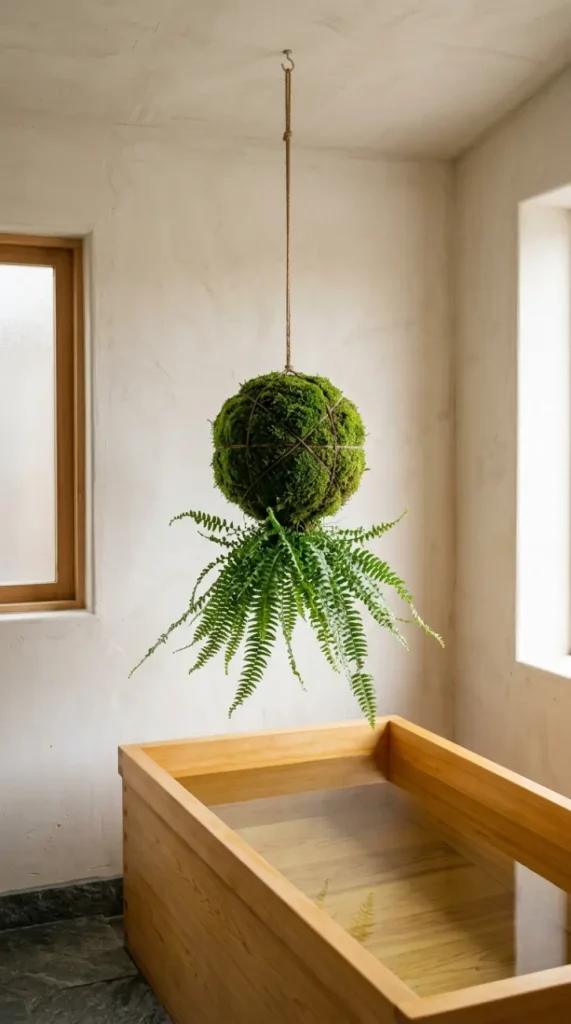
18. Kokedama Hanging Moss Ball Above the Tub
A Kokedama — the Japanese art of growing a plant in a ball of soil and moss bound with natural thread — hanging from the ceiling above or beside the hinoki tub on a simple natural jute or dark cotton cord creates the most directly Japanese botanical art form available in the Japandi bathroom. A single large Kokedama with a trailing Boston fern or a small Asplenium, its root ball wrapped in vivid living moss and bound with dark natural thread, hanging at approximately 160cm above the tub on a single cord from the ceiling, makes the ceiling of the bathroom botanically inhabited and creates a living pendant above the bathing space of extraordinary natural beauty.
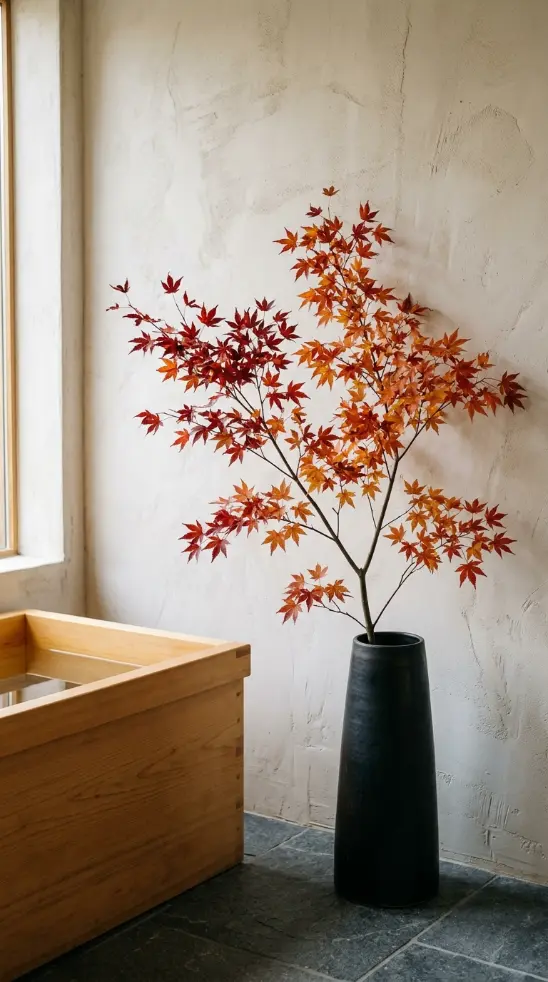
19. Japanese Maple Branch in a Dark Ceramic Vessel
A single branch of Japanese maple — cut in autumn when the leaves are at their most vivid orange-red, or in winter when the bare branch form is most architectural — in a tall dark ceramic vessel creates one of the most specifically Japanese seasonal decorations in the Japandi bathroom. The maple branch in its autumn color, its leaves in vivid red and orange against the raw plaster wall, beside the warm hinoki tub, creates a seasonal botanical still life of extraordinary Japanese aesthetic quality. In winter, the bare maple branch with its precise natural fork structure against the plaster wall is equally beautiful and more architecturally powerful.
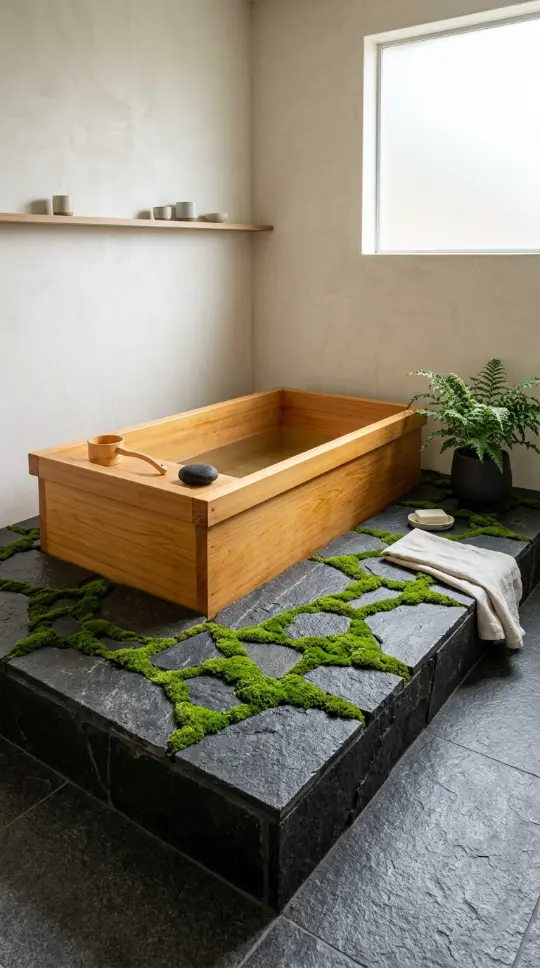
20. Dark Stone Tub Surround with Planted Moss Gaps
A hinoki tub set into or immediately adjacent to a low dark stone surround — with small gaps between the individual stone slabs deliberately left ungrouted and planted with living moss — creates the most architecturally integrated botanical detail in the Japandi bathroom. The moss growing from the gaps in the dark stone surround around the hinoki tub creates a ground-level botanical element that references the Japanese garden practice of allowing moss to colonize the spaces between stones, where stone and moss exist in a relationship that takes decades to develop in nature and that communicates deep time and patience. The hinoki tub above, the dark stone surround with moss-filled gaps, and the dark stone floor create a complete elemental composition of wood, stone, and moss.
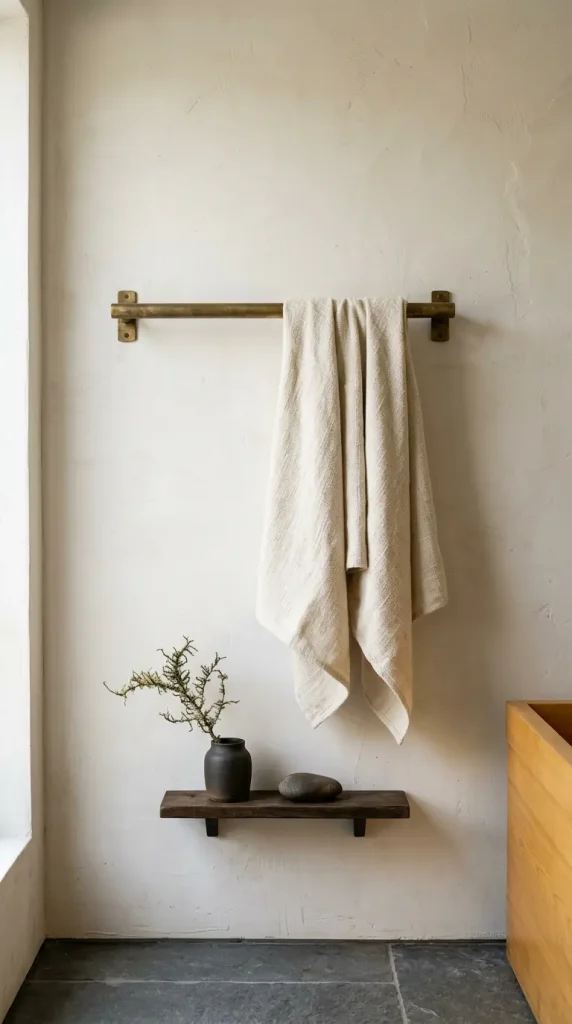
21. Japandi Bathroom — Natural Linen Towel and Plant Composition
The natural linen towel in the Japandi bathroom is not merely a functional object — it is a material participant in the overall composition, its undyed warm cream color and visible woven texture connecting it to the natural material language of the hinoki wood and the raw plaster and the dark stone. One large natural linen bath towel, loosely folded and draped over a simple aged brass towel rail mounted on the raw plaster wall, with one small dark ceramic vessel with a dried moss or botanical sprig on the small shelf below the rail, creates a towel and plant composition that is simultaneously functional and decorative in complete Japandi balance.
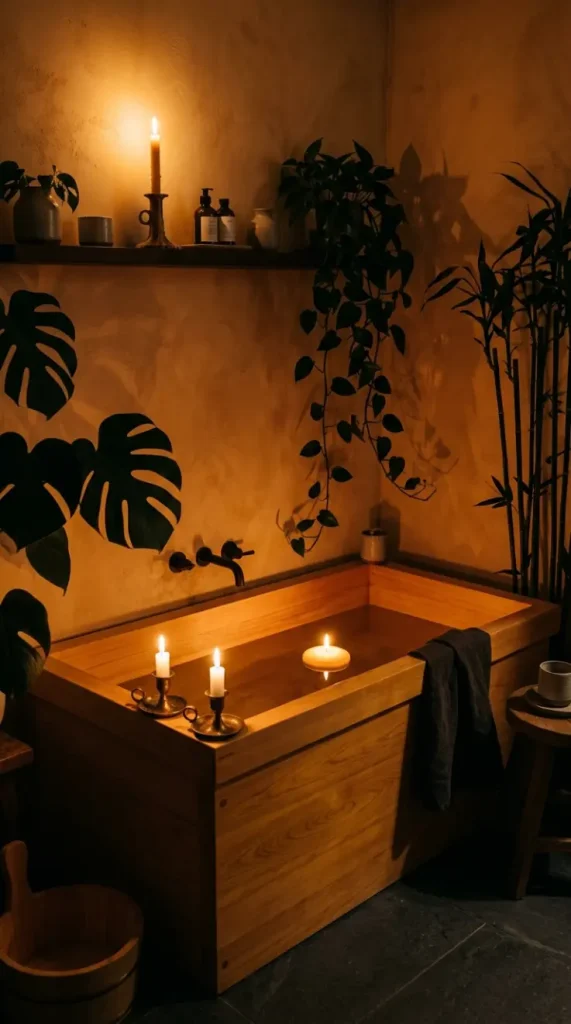
22. Japandi Bathroom at Night — Candlelight and Plants
The Japandi bathroom at night — the hinoki tub lit only by the warm amber light of beeswax candles placed on the tub rim and the stone shelf, the plants in the candlelit shadow zones appearing as dark silhouettes against the raw plaster walls, the warm hinoki grain glowing in the amber candlelight — is a completely different and equally beautiful version of the same space. The candlelit Japandi bathroom at night creates an atmosphere of such complete sensory depth — the warm amber light, the faint beeswax scent, the hinoki scent from the warm water, the plants as dark silhouettes — that the bathing experience becomes genuinely meditative.
23. Japandi Bathroom Floor-to-Ceiling Dark Tile with Single Plant
A bathroom where the walls are floor-to-ceiling dark grey or near-black matte large format tile — creating a completely dark interior envelope — with a single large plant in a dark pot in one corner and a warm honey-gold hinoki tub centered on a dark stone floor creates the most dramatic and most contrast-rich version of the Japandi bathroom aesthetic. The dark tile walls and the warm hinoki and the single large plant together create a spatial composition of extreme material contrast — the dark surrounding field making the warm wood and the living green of the plant appear almost luminously beautiful against the dark backdrop.

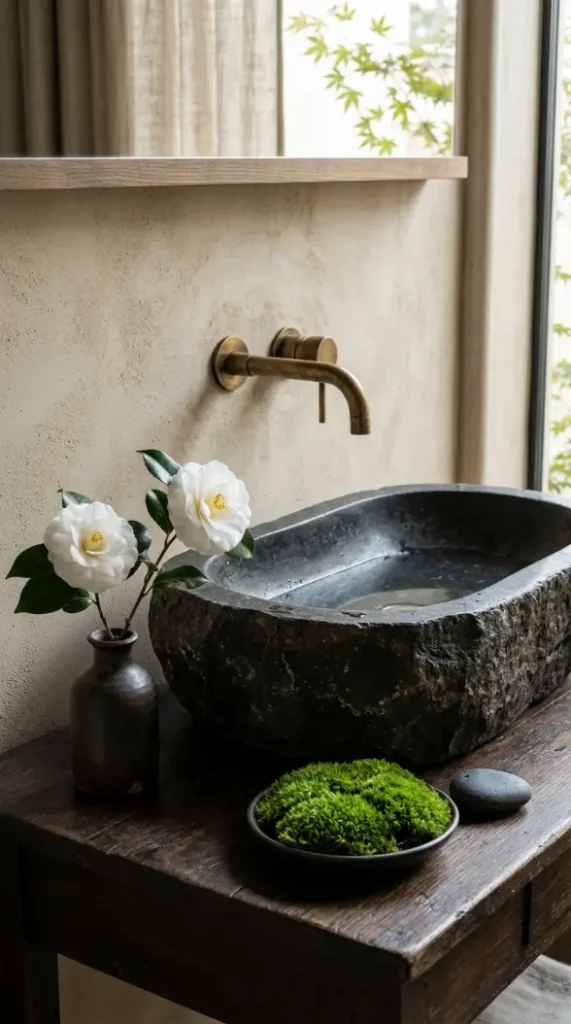
24. Japandi Bathroom Stone Trough Basin with Moss
A stone trough basin — carved from a single piece of natural stone, approximately 60cm long by 35cm wide by 20cm deep, in dark basalt or dark volcanic stone — placed on a minimal dark wood or raw concrete vanity surface creates the most naturally beautiful washbasin available in the Japandi bathroom. Beside the stone trough basin on the vanity surface: one small dark ceramic vessel with a single stem of fresh camellia or sakura, one small moss-filled dark ceramic dish, one smooth dark river stone. The aged brass wall-mounted tap above the stone trough basin. This bathroom sink zone is the Japandi bathroom in its most distilled — stone, water, moss, aged brass.
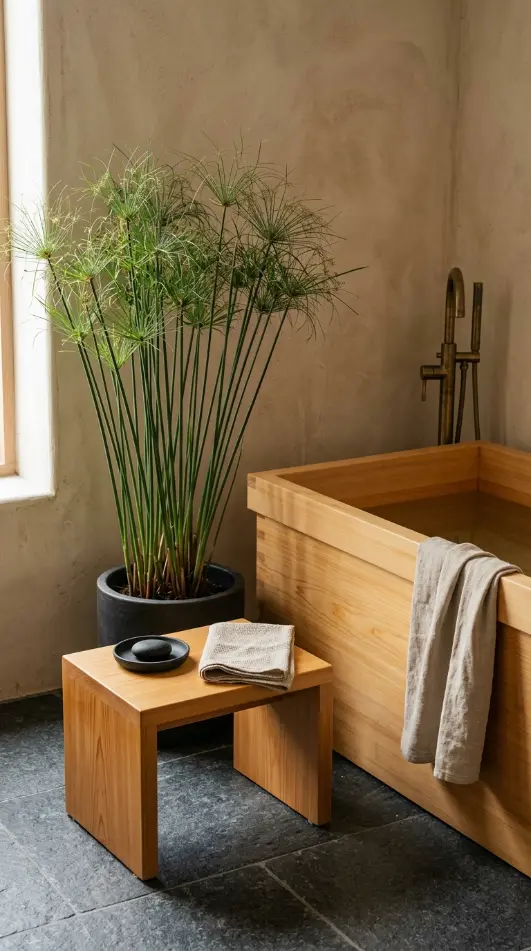
25. Japandi Bathroom — Hinoki Stool and Plant as Bathing Companion Objects
Two objects beside the hinoki soaking tub — a low flat hinoki wood stool and one plant in a dark ceramic pot — create a bathing companion still life of complete Japandi compositional beauty when selected and positioned with precision. The low hinoki stool at the same warm wood tone as the tub, holding one small dark ceramic dish with a smooth dark stone and a folded natural linen face cloth, placed directly beside a dark ceramic pot with a single upright Cyperus or papyrus plant — its fine upright stems creating a gentle vertical presence beside the tub — creates a bathing zone composition that reads as both functional and deeply considered.
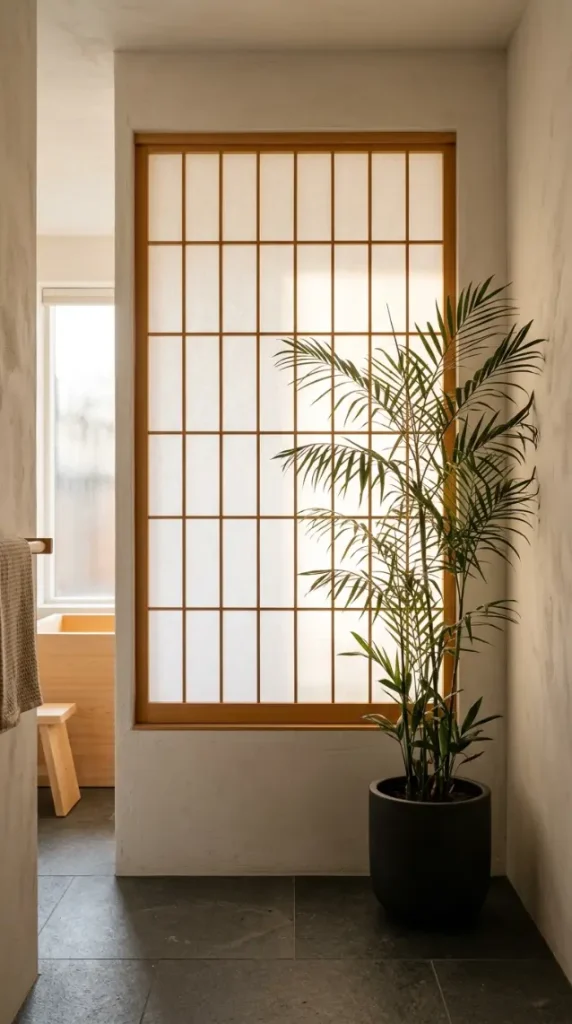
26. Japandi Bathroom Window — Shoji-Inspired Screen with Plant
A shoji-inspired bathroom window screen — a simple grid of natural wood and washi paper or frosted glass in a shoji grid pattern, mounted in the window opening to diffuse and filter the natural light while maintaining privacy — creates the most specifically Japanese architectural detail in the Japandi bathroom. The shoji screen filters the natural light into a soft, even, diffused quality that fills the bathroom with warm ambient light that has no direct shadow — the ideal light for a bathroom built around a hinoki tub. Immediately beside the shoji window screen: a tall bamboo palm or a Dracaena in a dark basalt pot, its leaves silhouetted against the soft light of the shoji screen behind it.
27. Japandi Bathroom — Cedar or Hinoki Shower Floor with Moss Border
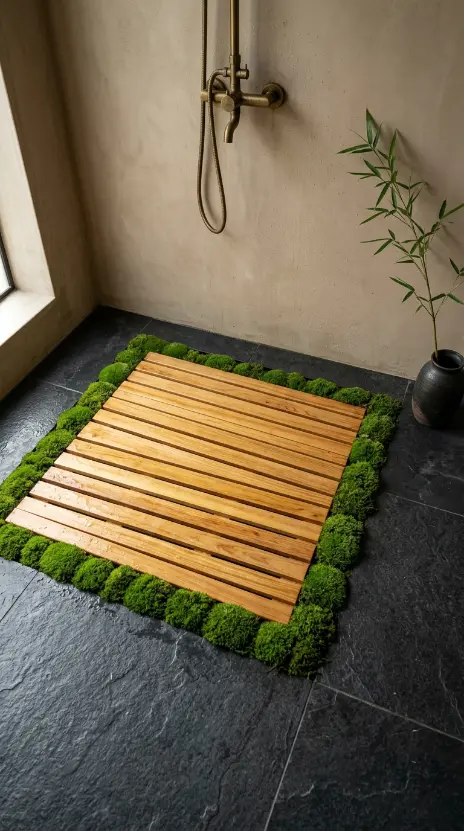
A shower floor of natural cedar or hinoki slat matting — thin horizontal slats of warm honey-gold hinoki or cedar wood allowing water to drain through the gaps — with a border of living moss planted in the grout gap between the wood shower mat and the stone tile floor surrounding it creates the most sensory and most Japanese bathing floor detail available. The warm wood slat floor underfoot, the living moss border around it, the dark stone floor surrounding — three floor materials in concentric zones creating a shower floor composition of complete natural material beauty.
28. Japandi Bathroom — The Complete Plant Ecosystem
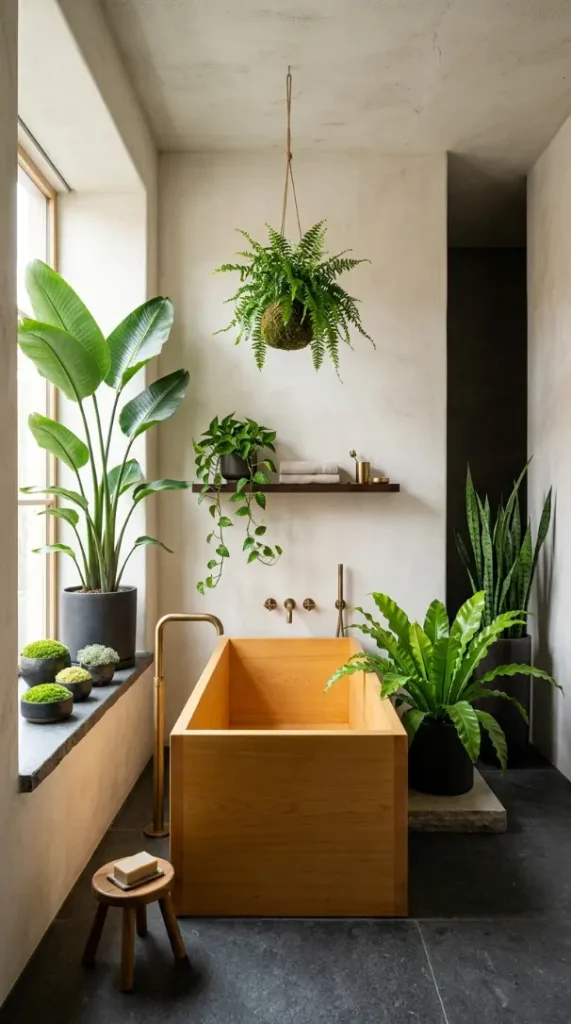
A Japandi bathroom where the plants are not individual objects but an ecosystem — different species at different heights, each in its correct position relative to the light and humidity of the bathroom — creates a plant environment of complete botanical intelligence. Near the window in the highest light: a tall Bird of Paradise. On the shelf above the tub: trailing pothos. On the low stone platform beside the tub: a large Bird’s Nest Fern in a dark basalt pot. In the dark corner: a mature snake plant. On the stone windowsill: living moss vessels. Hanging above the tub: a Kokedama. The plants together — at different heights, in different light conditions, in different pot materials — create a bathroom that feels genuinely inhabited by living green things rather than decorated with them.
29. Japandi Bathroom — Raw Concrete and Hinoki with a Single Ficus
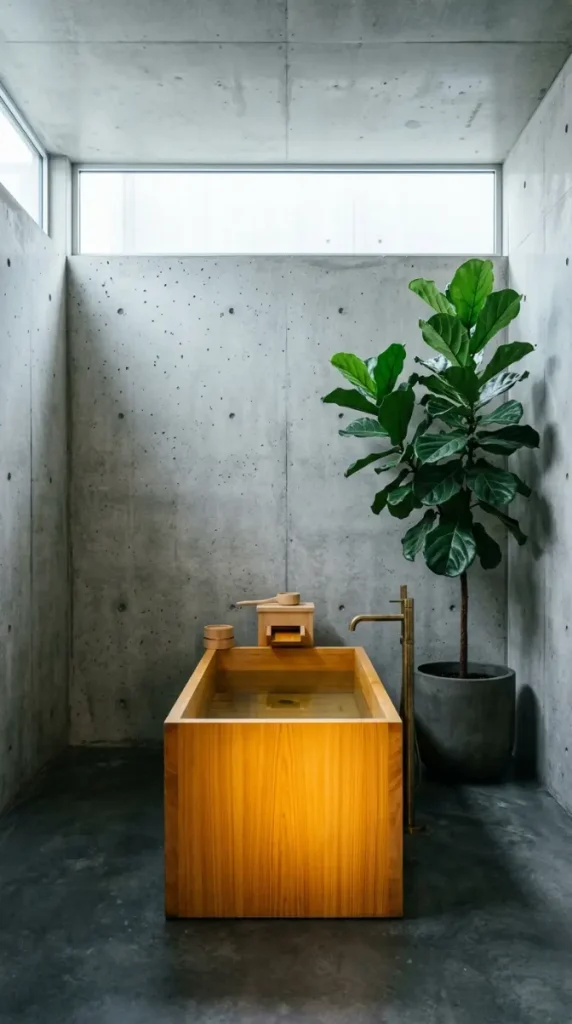
A bathroom where the walls are raw polished concrete — smooth, cool, grey, with the natural aggregate and pour marks of genuine concrete visible — creates a specifically harder-edged and more architecturally demanding version of the Japandi aesthetic than raw plaster. Against raw polished concrete walls, the warm hinoki tub appears even warmer and the single large plant — a tall Ficus lyrata or a Ficus elastica rubber plant — in a dark matte ceramic or concrete pot appears even more vividly alive. The concrete-hinoki-ficus combination is the most urban and most architecturally precise version of the Japandi bathroom plant aesthetic.
30. The Complete Japandi Minimal Hinoki Tub Bathroom — All Elements Together
The final idea is the complete vision — a fully realized Japandi minimal bathroom where every element from the raw plaster walls to the dark stone floor to the aged brass fixtures to the hinoki soaking tub with its floating camellia to the living moss wall panel to the trailing pothos on the dark wood shelf to the large Monstera in the corner to the stone windowsill moss composition to the shoji screen to the natural linen towel on the aged brass rail to the hinoki ladle and dark ceramic bathing ritual objects on the tub rim all work together as one unified, deeply serene, genuinely restorative Japandi meditation. Every material is natural. Every plant is chosen for its position. Every object earns its place through material quality and spatial necessity. Every light source is warm or natural. This is the bathroom that makes the act of bathing feel like the most complete ritual available in any ordinary day.


