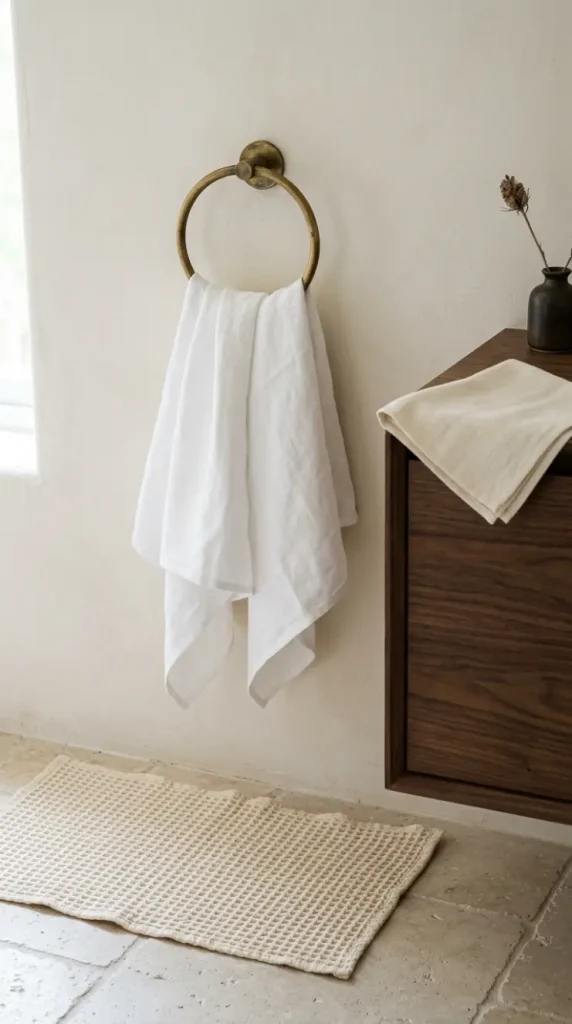
24 Modern Bathroom Plant Aesthetic Japandi Bonsai Minimal
A bathroom that contains a living plant is a fundamentally different room from one that does not — and a bathroom designed around the Japandi philosophy, where every object earns its place through both beauty and function and where the natural world is brought deliberately into the built environment, is the bathroom that most completely achieves the particular quality of calm that makes washing and bathing feel genuinely restorative rather than merely necessary.
Japandi is the design language that emerges from the intersection of Japanese wabi-sabi — the acceptance of imperfection, the beauty of natural materials aging honestly, the value of empty space — and Scandinavian hygge — the warmth of natural timber, the comfort of considered simplicity, the quality of light in a carefully arranged interior. In a bathroom context, this intersection produces a room of extraordinary quiet: pale plaster walls with natural texture variation, dark timber vanity with visible grain, matte black or aged brass hardware, white or pale stone basin, and living plants that bring the unpredictable organic beauty of the natural world into the most controlled room in the house.
The bonsai is the plant that most perfectly embodies the Japandi bathroom philosophy — it is a living object of extraordinary patience and craft, a miniature tree of genuine age and character that sits on a bathroom shelf or vanity surface and makes every other object around it appear more considered simply by being there. But the Japandi bathroom plant aesthetic extends beyond the bonsai to include trailing pothos in dark ceramic vessels, single stem arrangements in minimal vases, moss walls behind shower glass, and specimen ferns in washi-wrapped pots — every plant chosen and placed with the same deliberate intention that governs every other design decision in the room.
These 24 ideas cover every dimension of this aesthetic — from the foundational material choices of the Japandi bathroom to the specific plant selections, placement strategies, vessel choices, and the complete room where every element from the limewash walls to the aged brass tap to the bonsai on the timber shelf works together as one unified vision of quiet, living, genuinely minimal bathroom beauty.
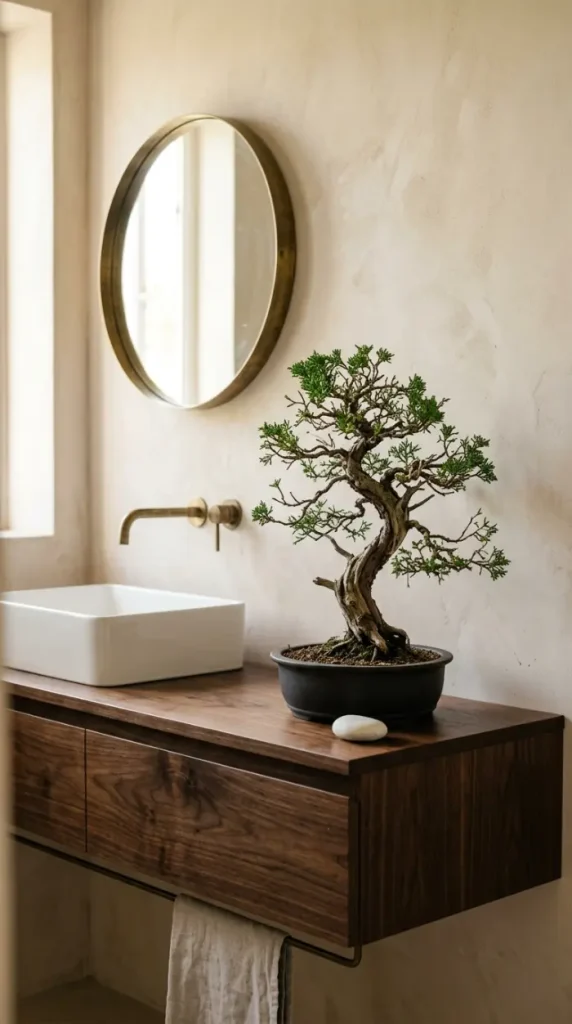
1. The Bonsai on a Dark Walnut Floating Vanity
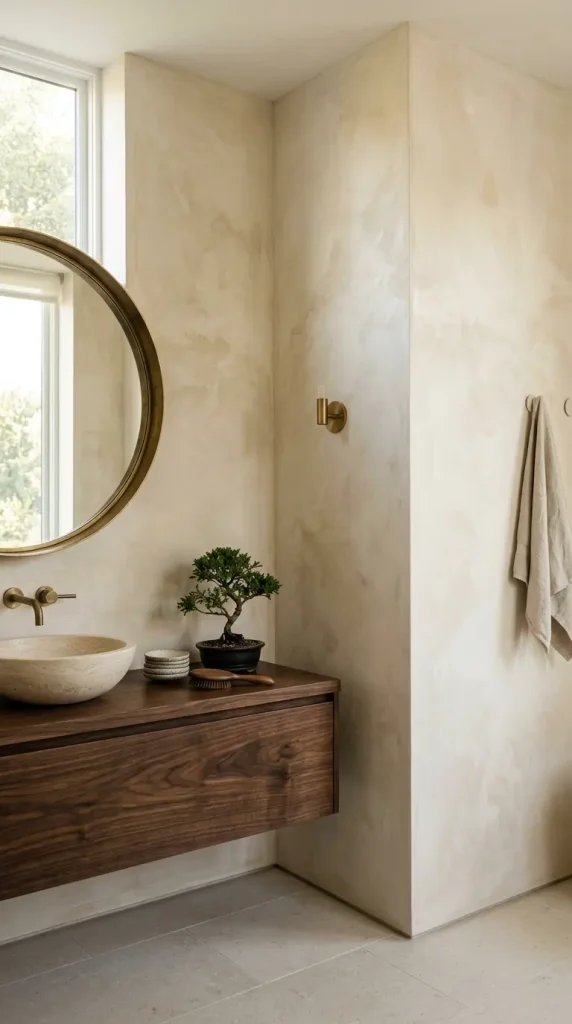
The bonsai is the single botanical element that most completely expresses the Japandi design philosophy in a bathroom — it is a living object of patience, craft, and natural character that has been shaped over years into a form of extraordinary quiet beauty. Placed on a dark oiled walnut floating vanity beside a simple pale stone basin, the bonsai creates an immediate focal point of organic complexity against the clean geometric forms of the minimal bathroom. Choose a juniper, Japanese maple, or ficus bonsai in a low dark ceramic pot — the shallow horizontal form of the bonsai pot sitting on the dark walnut surface creates a composition of layered horizontal planes that is fundamental to the Japandi aesthetic. The bonsai trunk, with its aged bark and its carefully trained branching structure, brings a quality of time and natural character to the bathroom that no purchased decoration could replicate.
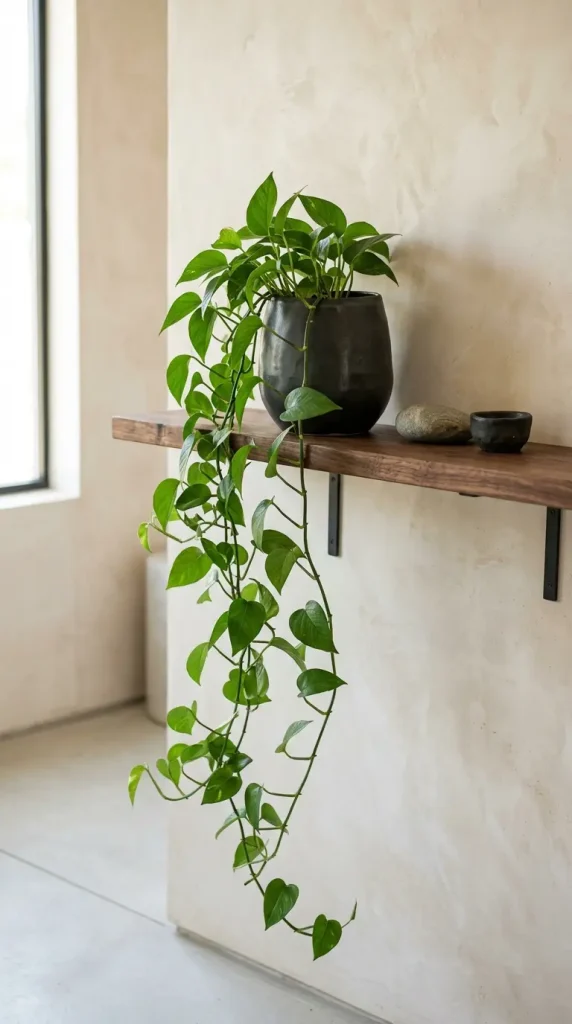
2. Trailing Pothos in a Dark Ceramic Vessel on a Bathroom Shelf
The trailing pothos is the easiest and the most forgiving bathroom plant — it tolerates the humidity, the variable light, and the occasional neglect that bathroom plants must endure better than almost any other species — and in a dark glazed ceramic vessel on a dark timber or pale stone bathroom shelf, its trailing vines create a cascade of vivid green that brings genuine organic movement to the Japandi bathroom’s otherwise still and considered composition. Place a mature pothos in a dark matte ceramic vessel at the end of a wall-mounted timber shelf so the trailing vines fall naturally below the shelf edge, reaching toward the floor in an unguided organic form that contrasts beautifully with the clean geometry of the shelf and the wall behind it.
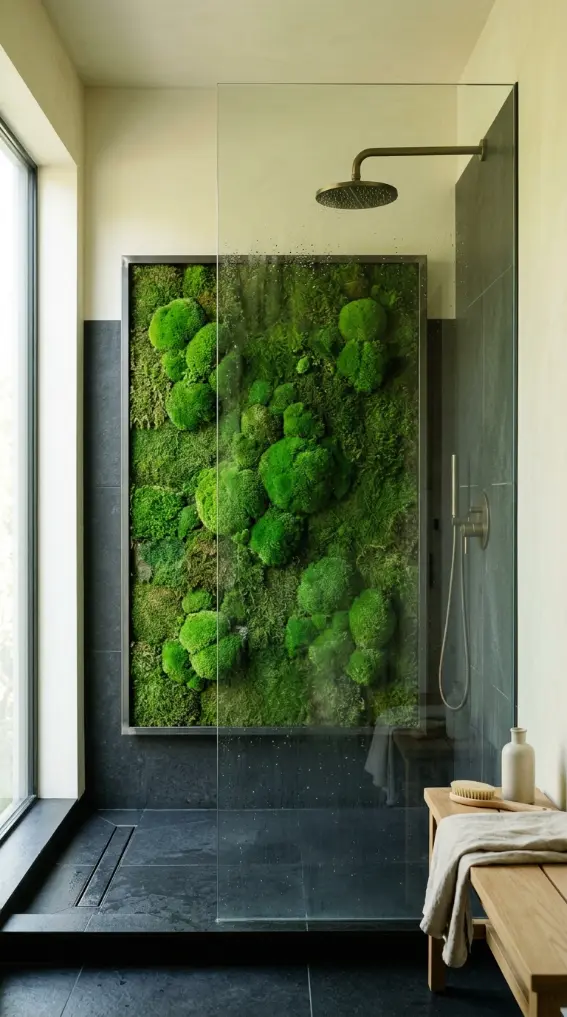
3. Moss Wall Behind Shower Glass
A living moss wall — a panel of preserved or living cushion moss, flat moss, and reindeer moss in varying green tones, mounted directly on the shower wall behind the glass screen — is the most immersive and most dramatically botanical element possible in a Japandi bathroom. The moss wall turns the shower into a genuinely forest-like experience — the steam, the warm water, the green moss visible through the glass creating a bathing environment of extraordinary naturalistic quality. For a Japandi bathroom, the moss panel should be framed simply in a dark timber or dark steel border and the moss varieties should be limited to two or three — cushion moss and flat moss in deep green and silver-green — never mixed with artificial elements or flowers.
4. Japandi Bathroom With Dark Timber Vanity and Pale Stone Basin
The material foundation of the Japandi bathroom is the relationship between dark natural timber and pale natural stone — two materials that have existed together in Japanese bathhouse and Scandinavian sauna traditions for centuries and that create, in a modern bathroom context, a material pairing of such natural completeness that almost nothing else is needed. The dark oiled walnut or dark stained oak floating vanity provides warmth, grain, and the particular quality of aged natural material that wabi-sabi values. The pale stone basin — in white marble, pale travertine, or light limestone — provides cool mineral simplicity that makes the dark timber beside it appear richer and warmer. Together they anchor the Japandi bathroom in materials of genuine natural honesty.

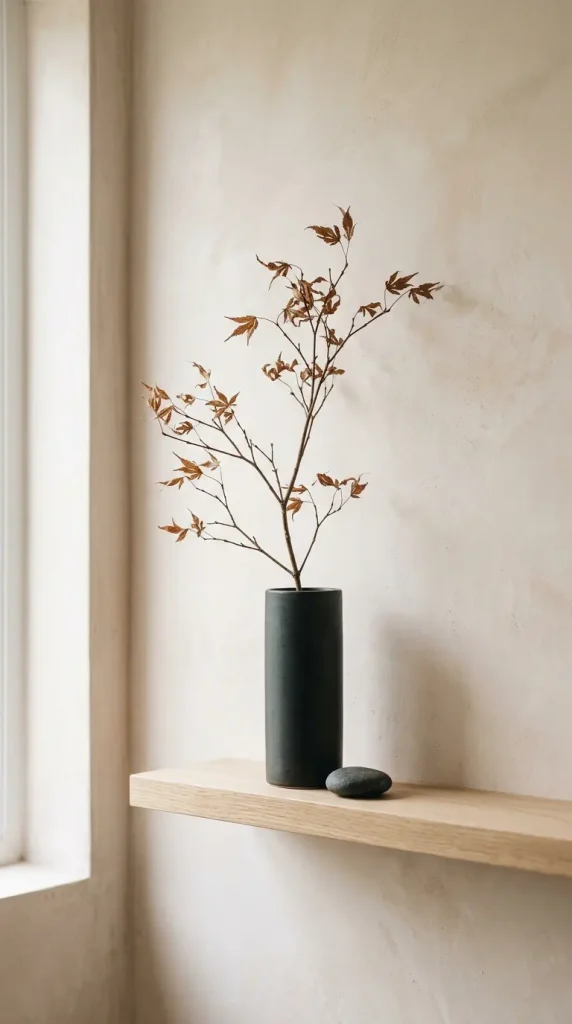
5. Single Stem Arrangement in a Minimal Bud Vase
The single stem arrangement — one branch of cherry blossom, one dried eucalyptus stem, one stem of Japanese maple, one dried pampas plume — in a minimal bud vase on a bathroom shelf or vanity surface is the most restrained and most characteristically Japandi botanical gesture available. It requires almost nothing and achieves almost everything — the single stem in a simple vessel communicates the wabi-sabi principle that one beautiful thing placed with intention is more powerful than many things placed without it. The vessel should be simple: a slim dark ceramic cylinder, a small pale stone vase, a handblown glass bud vase with slight imperfection. The stem should be chosen for its form rather than its color — branching structure, dried texture, natural movement.
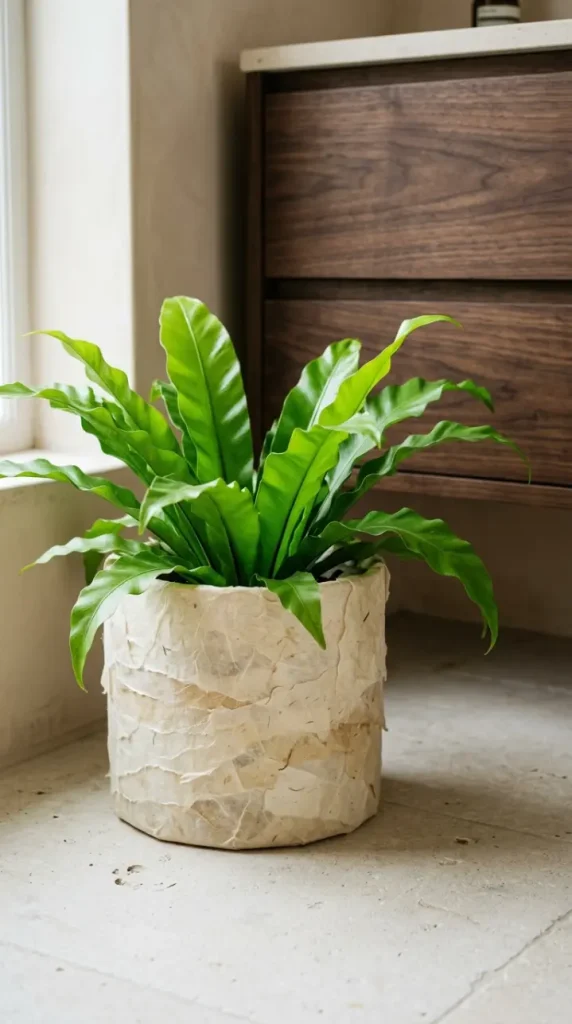
6. Specimen Fern in a Washi-Wrapped Ceramic Pot
A large specimen fern — a Kimberly queen fern, a bird’s nest fern, or a Boston fern — planted in a ceramic pot wrapped in natural washi paper or undyed jute creates a bathroom plant of extraordinary textural richness that brings both vivid living green and the craft traditions of Japanese paper and natural fiber into the same botanical object. The washi paper wrapping of the pot — applied in irregular torn layers, slightly translucent, warm cream in tone — creates a vessel of quiet handmade beauty that is simultaneously protective, decorative, and completely consistent with the Japandi philosophy of finding beauty in natural, imperfect, handcrafted materials. Place the wrapped fern pot directly on the bathroom floor beside the vanity or at the end of the bath.
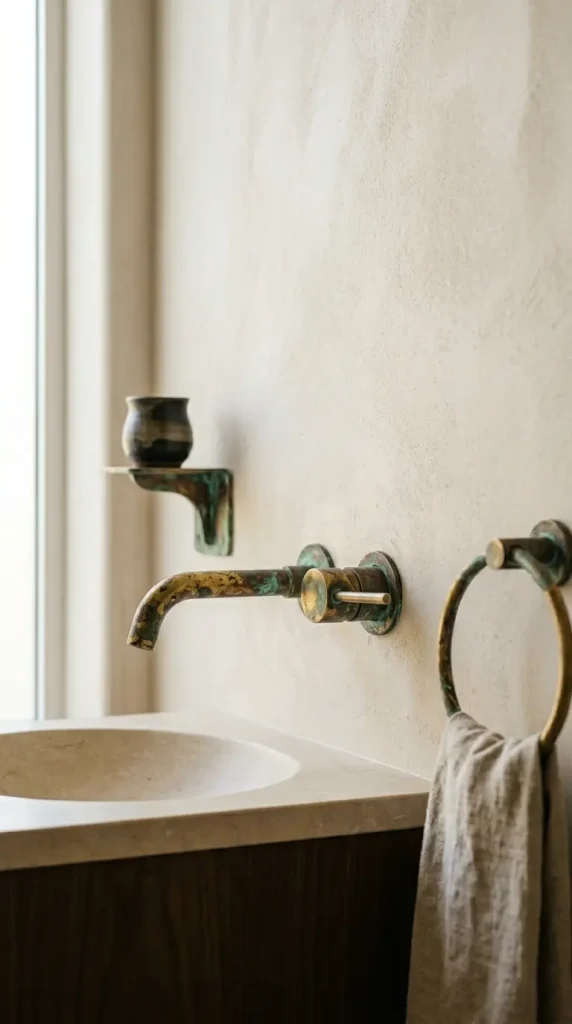
7. Aged Brass Tap and Hardware as Japandi Metal Accent
In a Japandi bathroom where every material is natural and every surface is matte and considered, the choice of metal hardware — the tap, the towel bar, the mirror frame, the shelf brackets — is the detail that most clearly communicates the warmth or the coldness of the entire room. Aged brass is the metal that belongs in the Japandi bathroom — not polished bright brass that shines aggressively, but warm antique brass with natural patina variation, slightly darker in recessed areas and warm gold-brown on raised surfaces, that catches natural light with a warmth that aged timber and pale stone amplify rather than compete with. Every piece of metal hardware in the Japandi bathroom should be in the same aged brass family — consistent warmth, consistent patina, the material thread that connects every element.
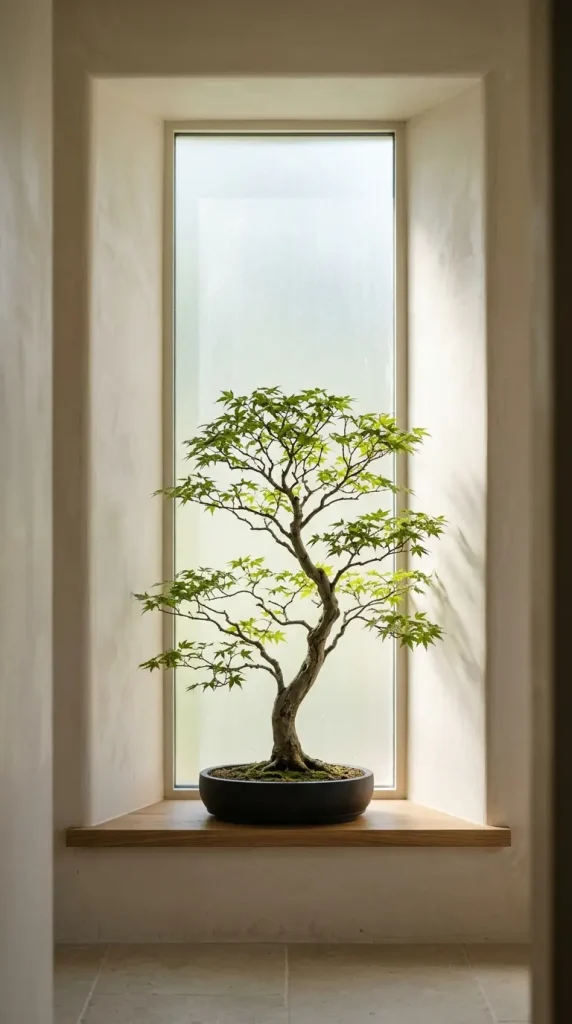
8. Japanese Maple Bonsai in a Bathroom Window
A Japanese maple bonsai placed directly in a bathroom window — on a slim timber window sill or a small timber shelf positioned in the window reveal — receives the natural light it needs to thrive while creating the most beautiful and most backlit botanical silhouette possible in the Japandi bathroom. The fine branching structure of the Japanese maple bonsai, seen against the light of a frosted or clear bathroom window, creates a shadow play of extraordinary delicacy on the pale plaster wall around the window — the silhouette of the miniature tree shifting through the day as the light angle changes. In autumn, the maple’s small leaves turn warm orange-red, bringing the only saturated color into the minimal Japandi bathroom palette.
9. Pale Limewash Walls as the Japandi Bathroom Envelope
The wall treatment that most completely creates the Japandi bathroom’s quality of quiet enclosure is pale warm limewash — applied in a tone of warm white, pale sand, or very pale warm grey, with all the natural color variation and chalky matte depth that limewash creates. The limewash wall in a bathroom absorbs natural light differently from any painted surface — it receives morning light with a warm glow and holds it, it reads as slightly different in color at every hour as the light changes, and it creates a surface of genuine depth and natural character that flat bathroom tile or flat paint never achieves. In combination with dark timber, pale stone, and living plants, the pale limewash wall is the envelope that makes the Japandi bathroom feel genuinely sheltering.
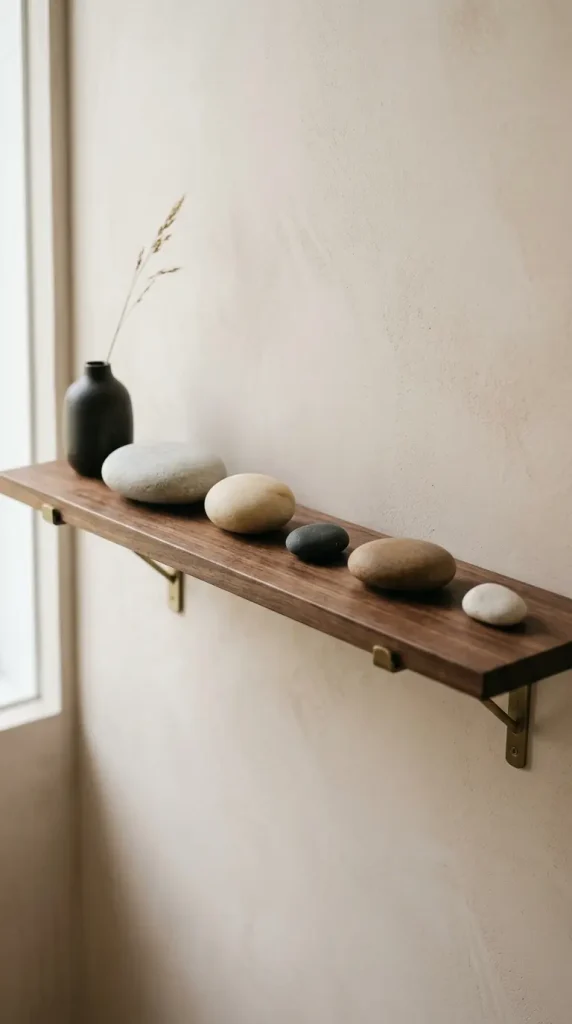
10. Bathroom Shelf Vignette — Stone, Ceramic, and One Dried Stem
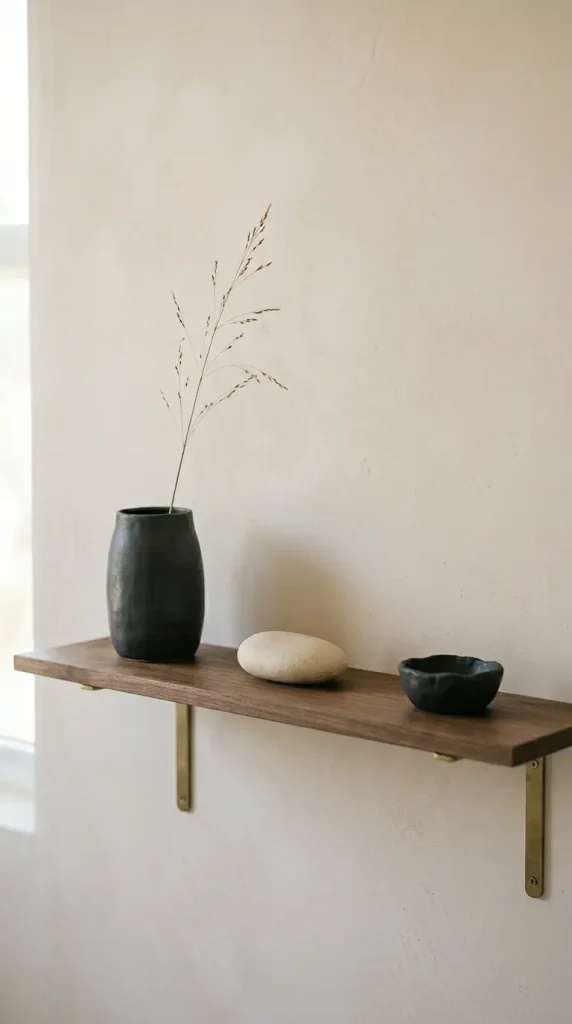
The bathroom shelf vignette in a Japandi bathroom follows the same principle as every other element in the room — restraint, intention, natural materials, empty space as an active design choice rather than an absence of decision. The perfect Japandi bathroom shelf holds three to four objects maximum: one dark ceramic vessel, one smooth pale stone, one small dried botanical stem, and one small handmade object. The objects are placed with deliberate spacing — not clustered, not touching — so that the shelf surface visible between them is as much a part of the composition as the objects themselves. The empty shelf space is not waiting to be filled. It is already doing its work.
11. Freestanding Soaking Tub With a Bonsai Beside It
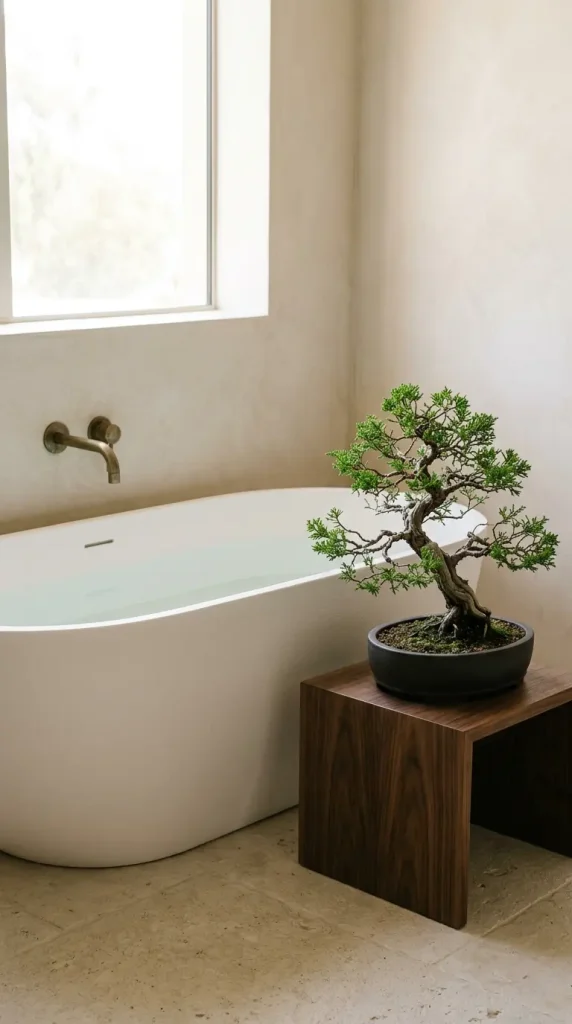
A freestanding soaking tub — in white cast iron, pale stone, or matte concrete — positioned beside a low dark timber platform or floor-level shelf that holds one mature bonsai creates the most contemplative and most genuinely spa-like bathroom composition available in the Japandi aesthetic. The relationship between the deep soaking tub and the bonsai beside it — the tub representing the ritual of bathing, the bonsai representing the practice of patient attention to living things — creates a bathroom zone of such philosophical coherence with the Japandi philosophy that the room feels genuinely considered at a level beyond mere styling. Place the bonsai at tub-side height so it is visible from within the tub — a living botanical companion to the bathing experience.
12. Dark Grout Lines as Japandi Bathroom Detail
The choice of dark grout — charcoal or near-black — in pale stone or pale tile bathrooms is one of the most underappreciated and most impactful detail decisions in the Japandi bathroom. Dark grout lines on pale tiles create a visible grid of dark lines across the bathroom floor and walls that reads as a deliberate graphic element — the grid adding visual structure and architectural intention to the otherwise quiet pale surfaces. The dark grout line is a form of wabi-sabi honesty — it does not try to disappear or to pretend that the tiles are a continuous surface. It acknowledges the individual tile and the joint between them as part of the design. Against pale stone tiles and dark timber and aged brass, dark grout creates a bathroom of extraordinary tonal coherence.

13. Bamboo as a Japandi Bathroom Plant
Bamboo — in a tall slim dark ceramic cylinder, a pale stone vessel, or directly in a dark timber container — is one of the most classically Japandi bathroom plants available, combining the vertical architectural form that works best in bathroom spaces with the deep cultural resonance of bamboo in Japanese design tradition. A cluster of three to five straight bamboo culms in a tall slim vessel, positioned in a bathroom corner or beside the shower screen, creates a vertical green architectural element that brings height, movement in any air current, and the specific vivid fresh green of young bamboo into the minimal bathroom palette. Choose lucky bamboo for a lower-maintenance indoor option or true bamboo culms in a soil-filled vessel for authenticity.

14. Japandi Bathroom Towel Storage — Dark Timber Ladder
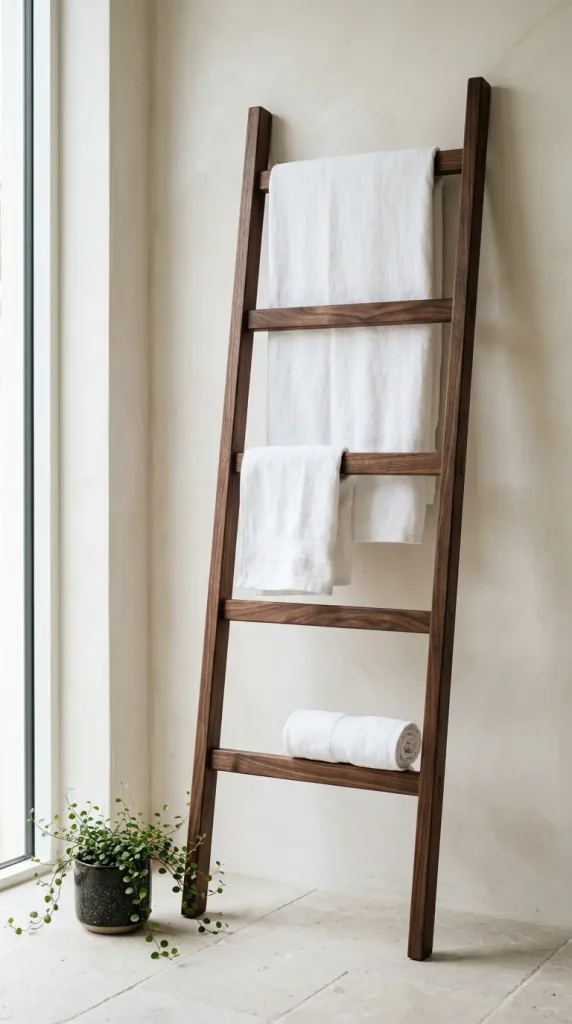
A simple timber towel ladder — four or five horizontal rungs on two vertical rails, in dark oiled walnut or dark stained timber, leaning against the pale limewash bathroom wall — provides towel storage in the Japandi bathroom in the most honest and most beautiful form possible. No towel rail mounted to the wall, no heated towel rail in chrome, no towel hooks — just the dark timber ladder leaning simply at its natural angle, holding two or three white linen towels draped over its rungs. The dark timber ladder leaning against the pale plaster wall with white linen towels is one of the most characteristically Japandi bathroom images available — the simplicity of the lean, the warmth of the timber, the clean white of the linen, the pale wall behind.
15. Air Plant Display in Minimal Dark Ceramic Forms
Air plants — tillandsia — require no soil and no pot, only air and occasional misting, and their sculptural forms and silver-green tones make them the most minimal and most architecturally interesting small bathroom botanical available. In a Japandi bathroom, display three to five tillandsia in individual minimal dark ceramic shallow forms — small dark ceramic dishes, shallow ceramic pinch pots, or dark stone slice bases — arranged on a slim bathroom shelf with the same deliberate spacing and the same respect for empty space between objects that governs every other shelf in the Japandi bathroom. The air plants in their dark ceramic vessels require nothing and ask nothing and are entirely beautiful for as long as they live.
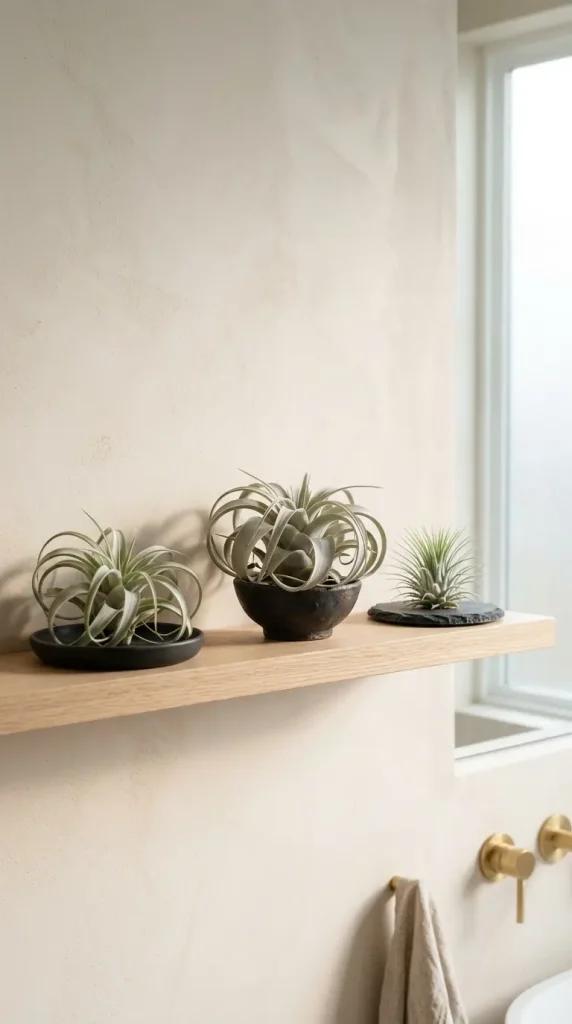
16. Frosted Glass Window With Plant Silhouette
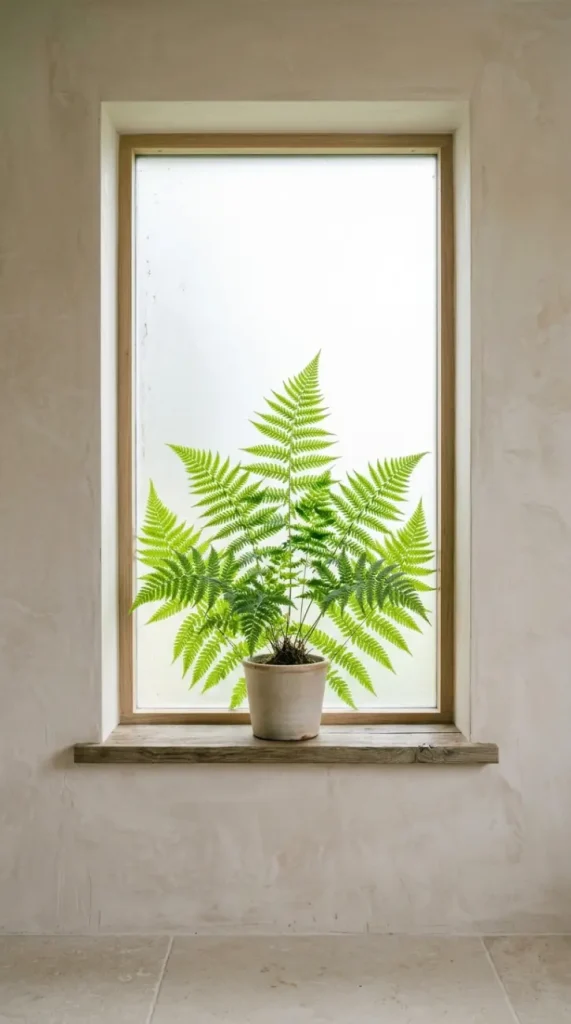
A frosted glass bathroom window with a plant positioned directly against it — a bonsai, a fern, a trailing vine, or an orchid — creates the most beautiful and most Japandi botanical effect possible through backlight: the plant silhouette pressed against the frosted glass, visible from inside the bathroom as a vivid green organic form glowing in natural light. The frosted glass diffuses the outdoor light into a soft even glow that illuminates the plant from behind, making every leaf and every branch appear as a graphic botanical illustration against the luminous white of the frosted glass surface. The plant-against-frosted-glass is the Japandi bathroom’s most effortless and most beautiful botanical installation.
17. Japandi Bathroom at Morning — Natural Light Ritual
The Japandi bathroom at early morning — when soft golden light comes through the frosted or clear window, falls across the pale limewash walls and the dark timber vanity and the bonsai on the shelf, and makes every natural material surface appear most warm and most honest — is the version of this bathroom that most completely expresses why the Japandi design approach is correct. The morning ritual in the Japandi bathroom — the quality of the light on the aged brass tap, the bonsai leaves catching morning sun, the white linen towels on the dark timber ladder, the pale stone basin holding cold clear water — is a sequence of sensory moments of such genuine quiet beauty that the room makes the morning feel genuinely worth inhabiting rather than merely enduring.
18. Orchid in a Minimal Ceramic Vessel as Bathroom Accent
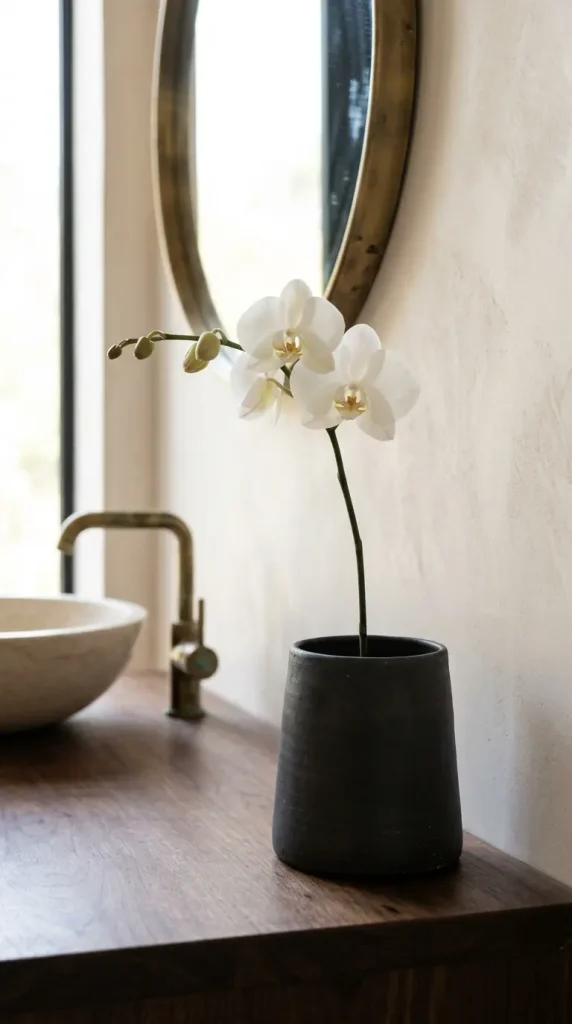
A single white or blush orchid — one stem, one or two open blooms and two or three buds — in a simple dark ceramic or pale stone vessel is the only flowering plant that belongs in a Japandi bathroom, because the orchid has the same qualities that govern every other Japandi design choice: simplicity of form, natural elegance, and a visual presence that is powerful precisely because it is restrained. One orchid stem in one dark vessel on the vanity or the bathroom shelf brings a quality of delicate floral beauty into the minimal space that no dried botanical can replicate — a living reminder that the natural world produces forms of perfection that no human craft can improve upon.
19. The Complete Japandi Botanical Bathroom — Every Element Together
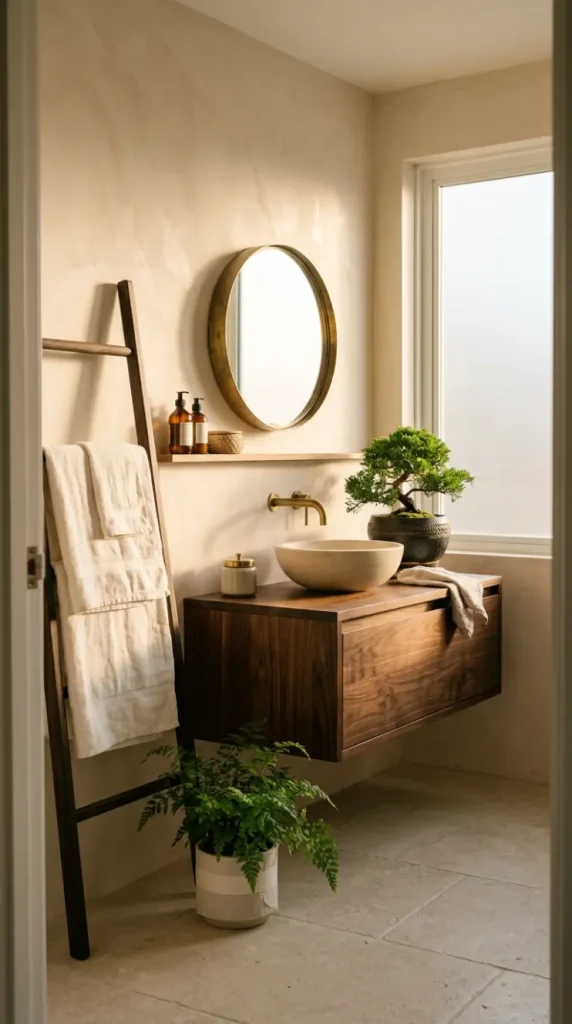
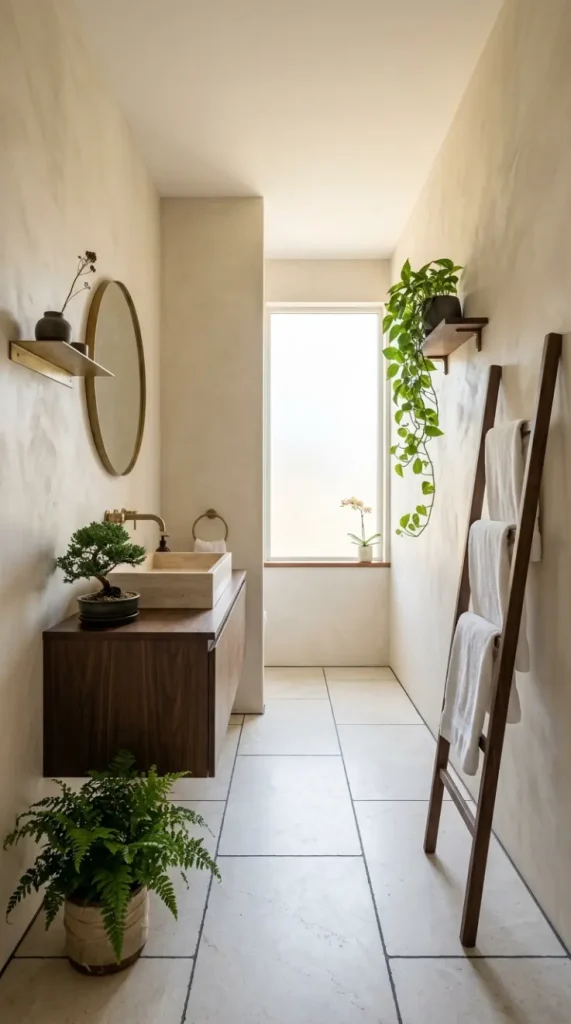
The complete Japandi botanical bathroom is the fully realized version where every material, every plant, every vessel, every hardware piece, and every surface work together as one unified vision of quiet living beauty. Pale warm limewash walls. Dark oiled walnut floating vanity with pale stone basin and aged brass tap. Mature bonsai on the vanity surface. Trailing pothos on the dark timber shelf above. Specimen fern in washi-wrapped pot at the vanity base on the pale stone floor. Dark timber towel ladder with white linen towels against one limewash wall. Single white orchid on the bathroom window sill. Aged brass circular mirror and aged brass shelf with a single dried stem arrangement. Dark grout lines in pale stone tile floor. Natural window light as the only light source. Every object earning its place. Every empty surface doing its work. The bonsai and the limewash and the aged brass and the white linen together making a bathroom that feels genuinely, quietly, completely alive.
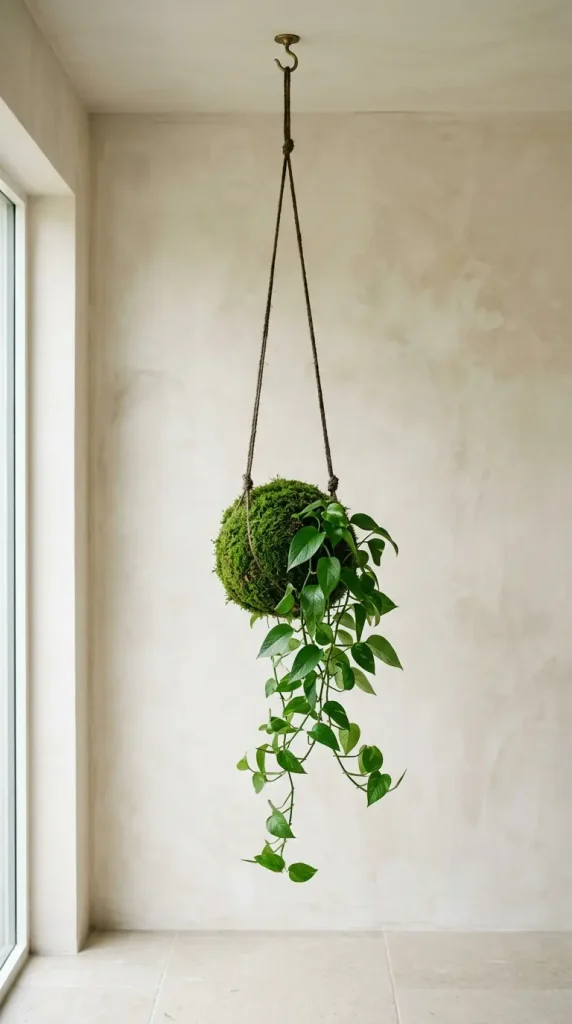
20. Hanging Kokedama as a Japandi Bathroom Botanical
Kokedama — the Japanese art of growing a plant in a ball of soil wrapped in moss and suspended by natural cord — is one of the most directly and most authentically Japandi botanical forms available for a bathroom space. A single kokedama hanging from a slim brass hook mounted in the bathroom ceiling or from a slim timber dowel mounted across a window reveal, holding a trailing pothos, a small fern, or a compact philodendron, creates a botanical installation of extraordinary quiet beauty — the moss-wrapped root ball suspended in mid-air, the plant trailing or arching naturally below it, the natural jute or linen cord holding everything with complete simplicity. The kokedama needs no vessel, no shelf, no surface — it exists entirely in space, which makes it the most minimal bathroom botanical of all.
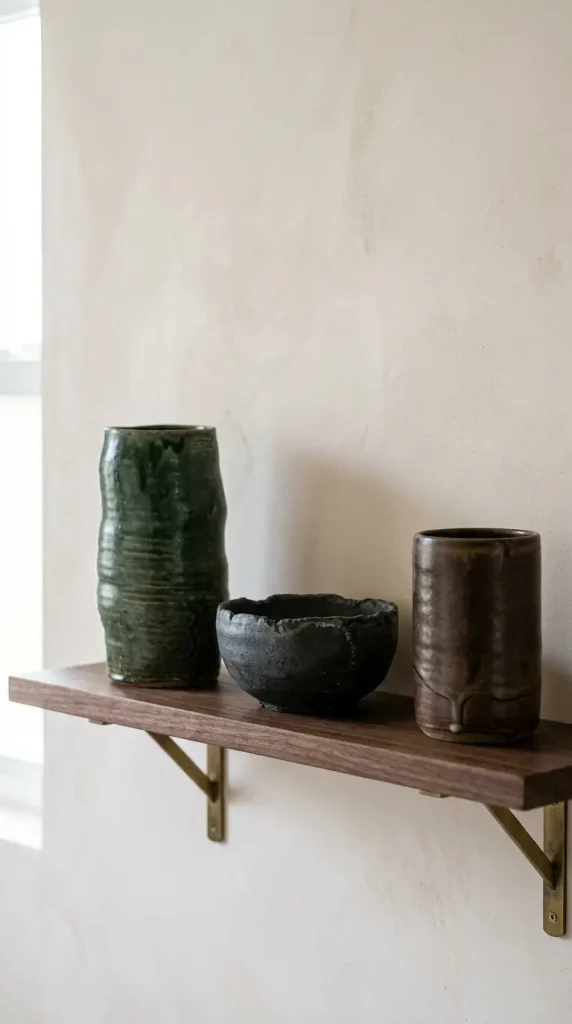
21. Wabi-Sabi Ceramic Vessels as Bathroom Objects
The ceramic vessels on a Japandi bathroom shelf are not merely containers for plants — they are objects in their own right, chosen for the particular quality of their handmade surfaces, their natural glaze variations, their slight imperfections of form, and the specific quiet beauty that well-made handmade ceramics carry in the same way that a well-chosen natural stone carries it. The wabi-sabi ceramic vessel — wheel-thrown, slightly irregular, with a glaze that shows natural color variation and surface character — is the material expression in a bathroom object of the entire Japandi philosophy: that beauty is found in the natural, the imperfect, the honest, and the simply made. Collect three or four individual handmade ceramic vessels in varying dark tones — dark charcoal, deep forest green, warm dark brown — and arrange them on a dark timber shelf with generous space between each.
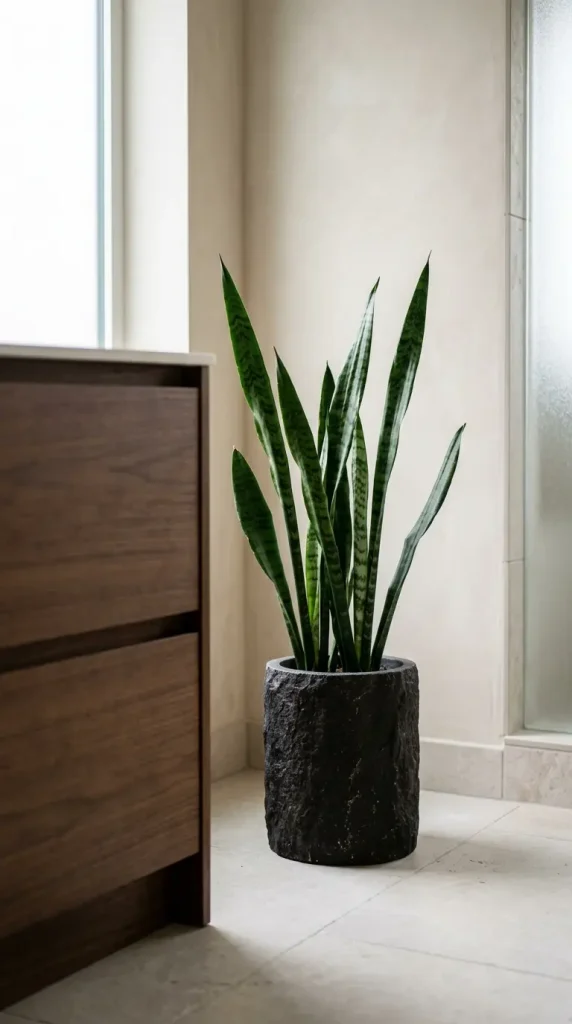
22. Snake Plant in a Tall Dark Stone Vessel
The snake plant — sansevieria, or more recently reclassified as dracaena trifasciata — is the Japandi bathroom plant that requires the least and delivers the most: it tolerates low light, high humidity, irregular watering, and temperature variation better than almost any other indoor plant, and its upright architectural sword-like leaves in deep green with pale green horizontal banding create a botanical form of genuine sculptural quality that suits the vertical emphasis of bathroom spaces naturally. In a tall dark stone or dark ceramic vessel, one compact snake plant at vanity side or in a bathroom corner becomes a botanical architectural element of complete minimal integrity — upright, structural, deeply green, requiring nothing.
23. Japandi Bathroom Shelf Styled With Smooth River Stones
Smooth river stones — collected from a riverbed or sourced from a stone supplier, in pale grey, warm cream, dark charcoal, and warm brown tones — are the most genuinely wabi-sabi bathroom object available because they are entirely natural, entirely formed by processes of time and water and geology that no human craft can replicate, and entirely beautiful in a quiet and unpretentious way that handmade objects aspire to but stones simply are. A small collection of three to five smooth river stones arranged on a dark timber bathroom shelf — placed with the same generous spacing and the same respect for empty surface that governs every other Japandi shelf arrangement — creates a shelf display of complete natural honesty that asks nothing of the viewer except to notice that these particular stones are beautiful.
24. Linen Hand Towels and Natural Fiber Bathroom Textiles
The textiles in a Japandi bathroom — the hand towels, the bath mat, the face cloth — are as much a part of the botanical and natural material aesthetic as the plants and the timber and the stone, because they are the surfaces that the body touches and the objects that the eye rests on most frequently in the daily use of the bathroom. In a Japandi bathroom, every textile should be natural fiber — undyed or naturally dyed linen, organic cotton waffle weave, or thick Turkish cotton — in tones of white, off-white, warm cream, or natural undyed linen. No pattern, no color, no synthetic fiber. Two white linen hand towels folded simply over an aged brass towel ring, a natural waffle-weave bath mat on the pale stone floor, and a single cream linen face cloth folded on the vanity edge complete the textile story of the Japandi bathroom with the same restraint and the same material honesty that every other element in the room embodies.