26 Bathroom Shelf Plants Decor Japandi Orchid Minimal
There is a particular kind of calm that a single orchid on a bathroom shelf creates — a calm that has nothing to do with emptiness and everything to do with the deliberate presence of one beautiful, living thing in exactly the right position. The Japandi minimal bathroom shelf, with its orchid and its dark ceramic pot and its generous negative space, is the bathroom equivalent of a Japanese ikebana arrangement: the beauty is not in the accumulation of things but in the considered relationship between each thing and the space around it.
Japandi — the meeting of Japanese wabi-sabi and Scandinavian simplicity — finds its most natural expression in the bathroom shelf precisely because the bathroom shelf is such a small, defined, intimate surface. Every object placed on it is visible and close. Nothing can hide behind quantity. The shelf demands that each object justify its presence through material quality, form, and its relationship to the objects beside it. A dark stone shelf with one orchid in a dark ceramic pot and one smooth river stone is not a bathroom shelf with decoration — it is a composition that communicates a complete aesthetic philosophy in three objects and the space between them.
The orchid is the ideal Japandi bathroom plant for several reasons that go beyond its beauty. It thrives in exactly the conditions that a bathroom provides: indirect light, warmth, and the elevated humidity that steamy morning showers create. Its root system tolerates the irregular watering that a busy bathroom schedule produces. Its architectural form — the clean stem, the precise spacing of flowers along the flower spike, the translucent quality of the petals in bathroom light — is perfectly consistent with the Japandi aesthetic of natural precision. And its color range — from pure white to pale blush to deep magenta to near-black — allows it to participate in any Japandi bathroom palette without imposing its own.
These 26 ideas show every dimension of the bathroom shelf plants decor Japandi orchid minimal aesthetic — from the single orchid on a raw stone shelf to the complete bathroom where every shelf and every surface has been considered as a botanical composition of complete natural restraint and genuine beauty.
1. Single White Orchid on a Dark Stone Shelf
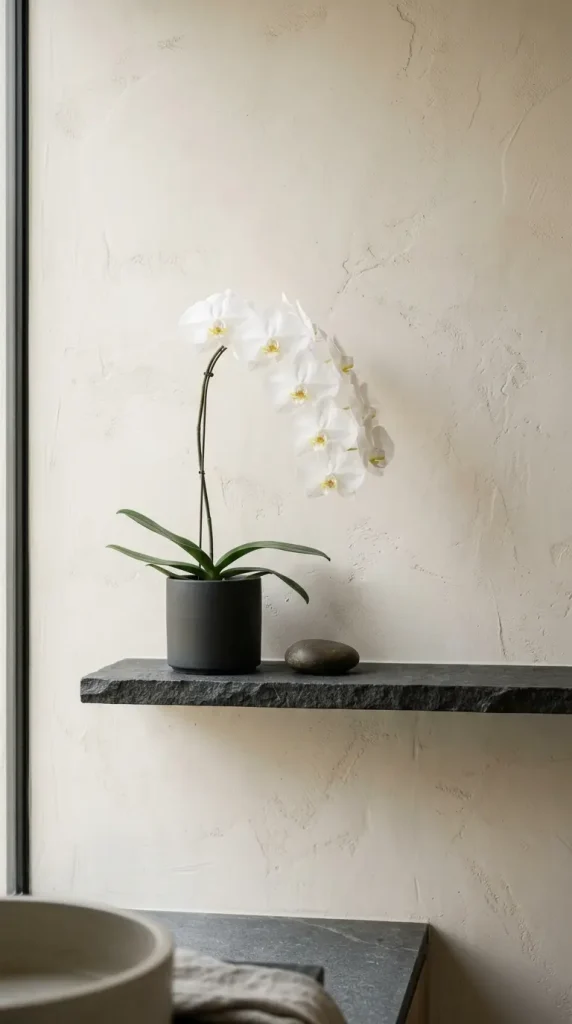
The most pure and most complete expression of the Japandi bathroom shelf is the single white Phalaenopsis orchid — one plant, one dark ceramic pot, one shelf, and the generous negative space around all three. A raw dark stone shelf approximately 50cm long, mounted on a raw plaster or dark concrete wall at eye height in the bathroom, holds one white Phalaenopsis in a dark near-black matte ceramic pot, the orchid’s single flower spike carrying five to seven pure white blooms in precise botanical spacing. One smooth dark river stone placed 15cm from the pot. Nothing else. The 30cm of empty stone shelf between the pot and the wall edge is not empty — it is the space that gives the orchid its presence.
2. Dark Walnut Floating Shelf with Phalaenopsis and Dried Branch
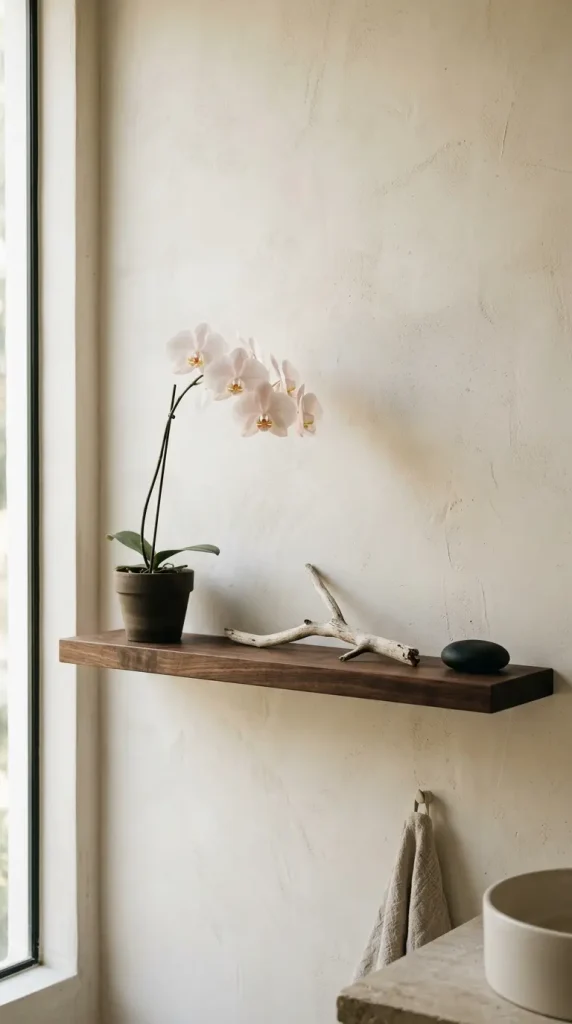
A single dark oiled walnut floating shelf — approximately 60cm long by 14cm deep, mounted on raw plaster wall with hidden brackets — creates a warm natural surface of complete material beauty before any object is placed on it. On this dark walnut shelf: one pale blush Phalaenopsis orchid in a small dark unglazed clay pot, the delicate pink-blush blooms catching the soft bathroom light. Beside the orchid: one single dried branch approximately 30cm long with a precise natural form — pale dried bark, two or three natural fork points — placed directly on the shelf without a vessel. The orchid and the dried branch together create a composition of living and dried botanical beauty that references the Japanese aesthetic concept of mono no aware — the poignant beauty of impermanence.
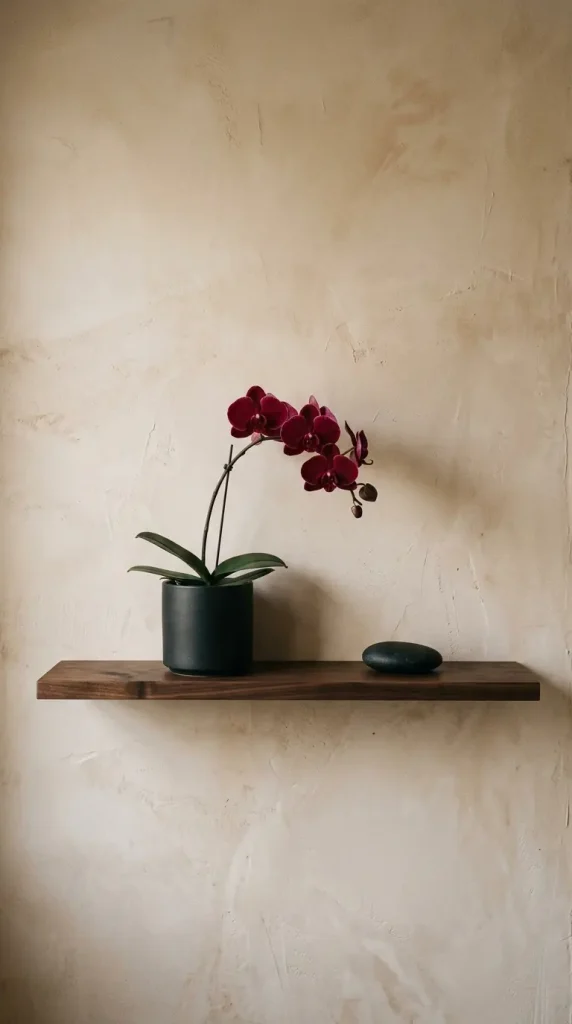
3. Raw Concrete Shelf with Deep Magenta Orchid
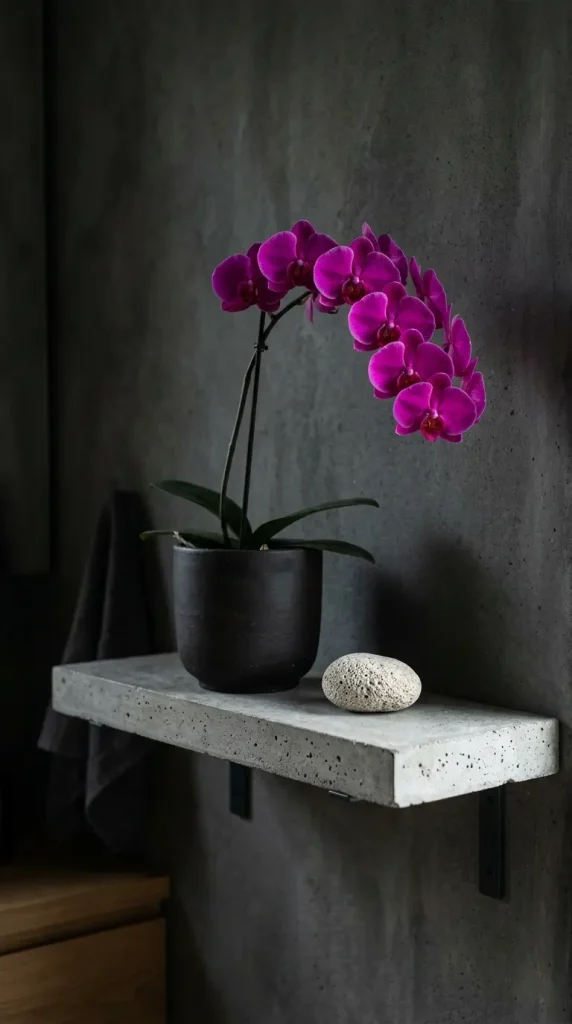
A raw concrete shelf — cast in place or a found concrete slab approximately 4cm thick — sitting on minimal dark steel brackets on a dark tile or raw concrete bathroom wall creates the most architecturally industrial and most dramatically material Japandi bathroom shelf. On the raw concrete shelf: one deep magenta Phalaenopsis orchid in a dark ceramic pot — the vivid magenta-purple blooms creating a single intense color note against the cool grey concrete. One small piece of raw pumice stone placed beside the pot. The deep magenta orchid against the raw concrete shelf and wall creates the most striking color contrast available in the Japandi bathroom shelf vocabulary.
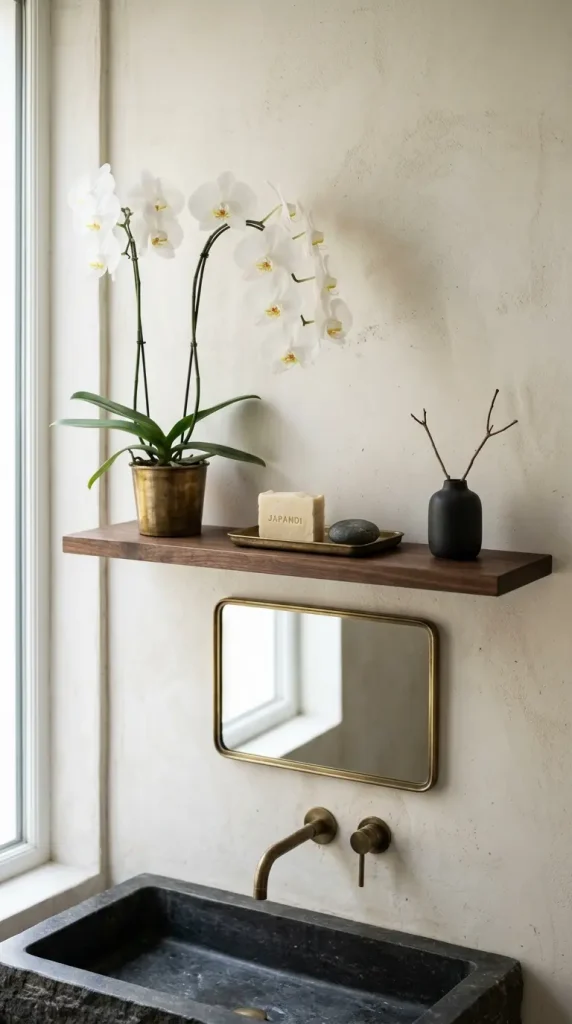
4. Shelf Above the Basin — Orchid and Aged Brass Composition
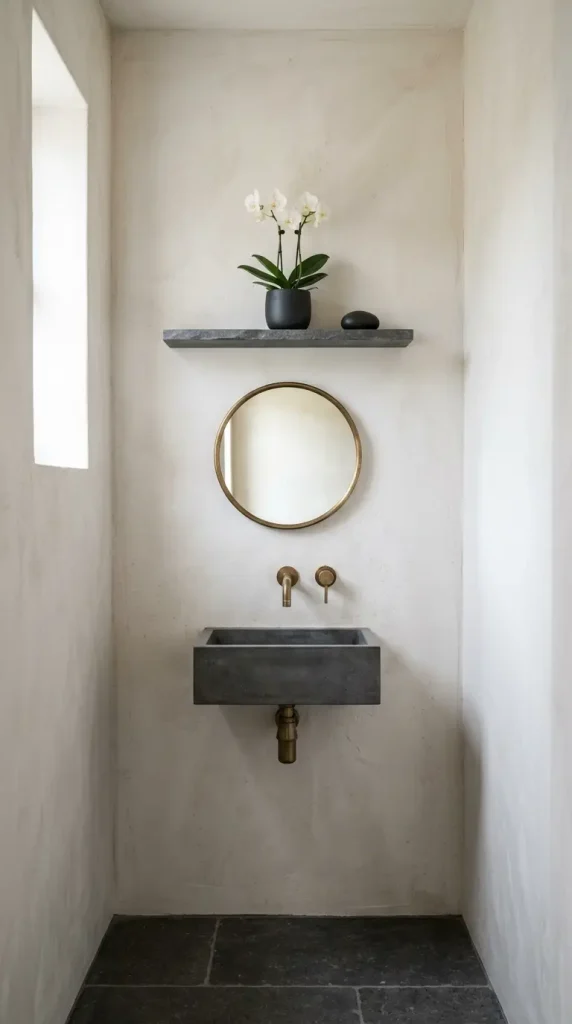
The shelf mounted directly above the bathroom basin — at approximately 160cm height above the floor, above the mirror or mirror-less wall space above the sink — is the most intimately observed bathroom shelf because it is looked at directly every morning and evening. On this shelf: one white or cream Phalaenopsis orchid in a small aged brass or dark ceramic pot, one small aged brass tray holding a natural soap bar and a smooth dark stone, and one small dark ceramic vessel with a single dried twig. The shelf above the basin in the Japandi bathroom is a morning ritual surface — the objects on it are seen at the closest range of any bathroom shelf and must be of the highest individual material quality.
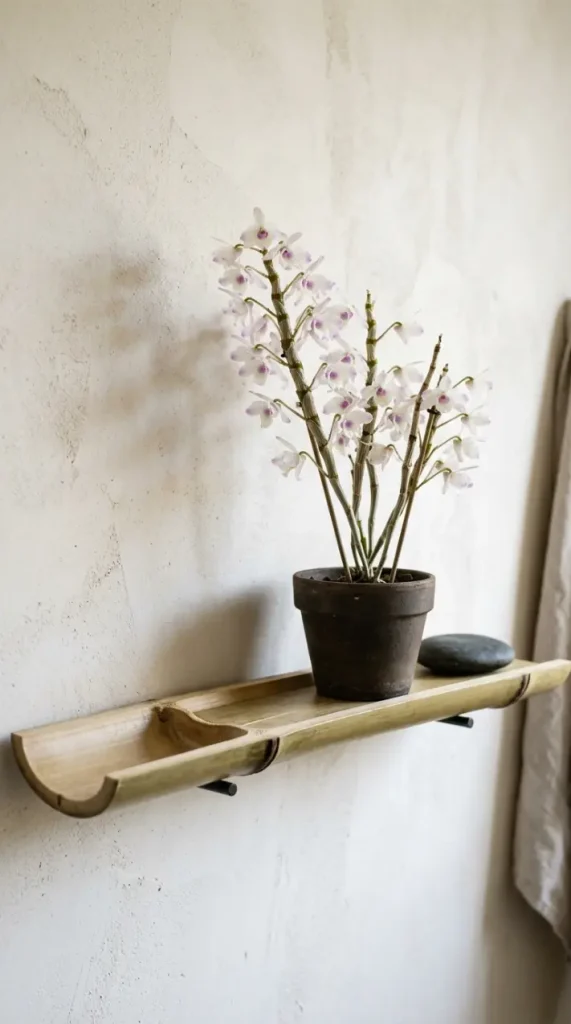
5. Dendrobium Orchid on a Bamboo Shelf
A bamboo shelf — a single length of mature bamboo culm split lengthwise to create a flat-bottomed shelf surface approximately 50cm long, mounted on the bathroom wall on simple dark steel pins — creates the most directly Japanese material shelf available in the Japandi bathroom. The bamboo shelf’s natural pale green-gold surface with its characteristic node rings creates a botanical shelf material that is itself a natural object as beautiful as any plant placed on it. On the bamboo shelf: one Dendrobium orchid in a small dark clay pot — the Dendrobium’s multiple small flowers on arching canes creating a softer, more cascading botanical form than the precise Phalaenopsis spike. The bamboo shelf and the Dendrobium orchid together create a composition of two botanical materials at the same natural temperature of beauty.
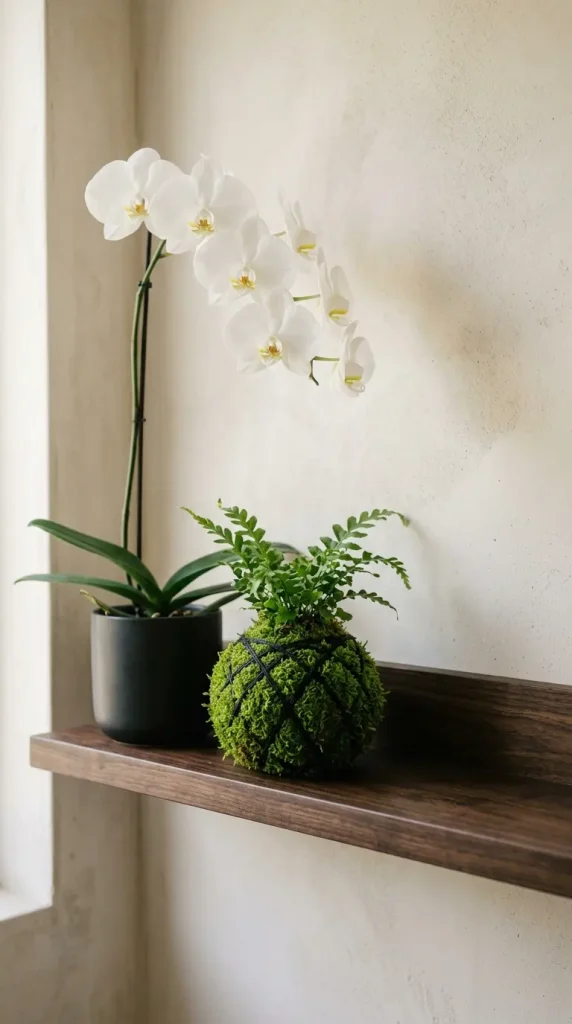
6. Dark Shelf with Orchid and Living Moss Ball
A dark wood shelf with a Phalaenopsis orchid in a dark ceramic pot and a Kokedama living moss ball placed beside it — the orchid’s aerial elegance and the moss ball’s grounded earthiness creating a botanical composition of complementary forms — creates the most complete Japandi bathroom shelf still life. The Kokedama beside the orchid: a root ball of a small fern or Asplenium wrapped in vivid living moss and bound with dark natural thread, placed directly on the dark shelf without a vessel — the moss ball sitting on the dark wood surface in its own organic form. The white orchid blooms and the vivid green moss ball together against the raw plaster wall create a composition of botanical opposites — vertical precision and horizontal earthiness, white flower and deep green moss.
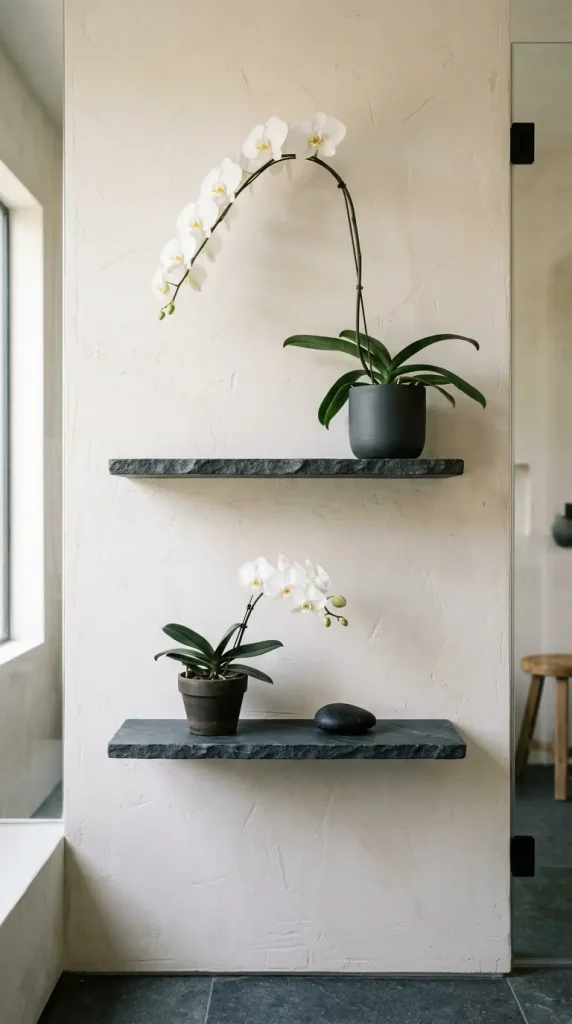
7. Stone Shelf with Orchid at Different Heights — Tiered Composition
Two shelves at different heights on the same bathroom wall section — one dark stone shelf at approximately 100cm and one dark stone shelf at approximately 140cm — each holding one orchid at a different scale create a tiered botanical composition of extraordinary Japandi spatial intelligence. Lower shelf: one small Phalaenopsis in a small dark clay pot, two flower buds just opening. Upper shelf: one tall mature Phalaenopsis with a single long arching flower spike in a dark matte ceramic pot, the flower spike arching to the left toward the lower shelf below. One smooth dark stone on the lower shelf only. The two orchids at different heights on the same wall, their visual relationship across the space between the shelves, create a composition that uses the plaster wall itself as the ground of the arrangement.
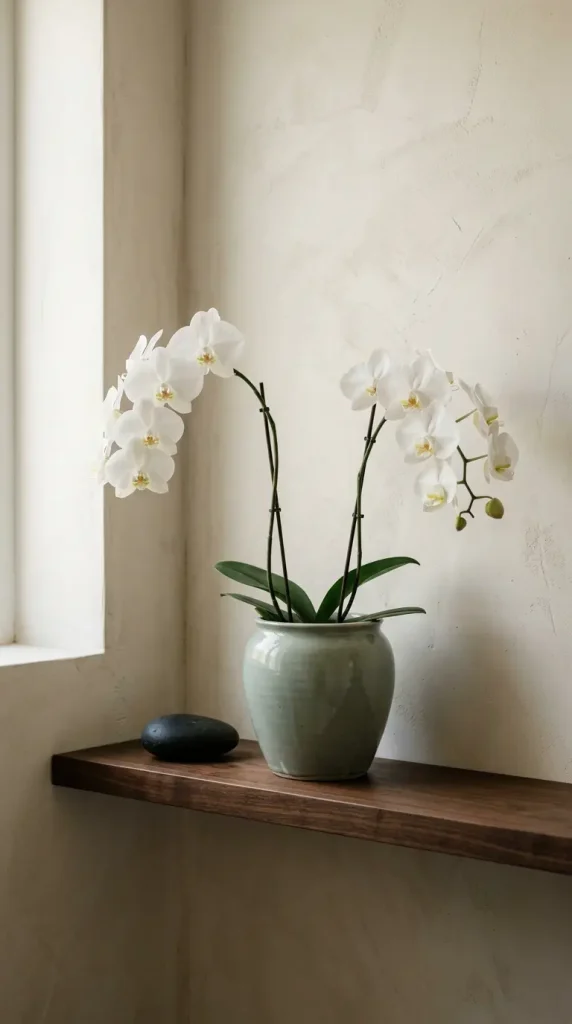
8. Pale Celadon Ceramic and White Orchid — Glaze Harmony
A Phalaenopsis orchid planted directly into a hand-thrown celadon ceramic pot — a pot in the pale grey-green celadon glaze of traditional East Asian ceramics, the glaze surface showing natural kiln variation and slight transparency — creates a pot-and-plant pairing of extraordinary ceramic beauty. The celadon glaze is the most specifically East Asian ceramic tradition — its pale grey-green tone is the color of jade, of new bamboo, of the earliest morning sky — and a Phalaenopsis with white blooms in a celadon ceramic pot on a dark stone or dark wood shelf creates a composition of such complete Japanese aesthetic refinement that every other orchid styling looks comparatively ordinary. The celadon pot is the shelf detail that communicates the deepest knowledge of the Japandi aesthetic.
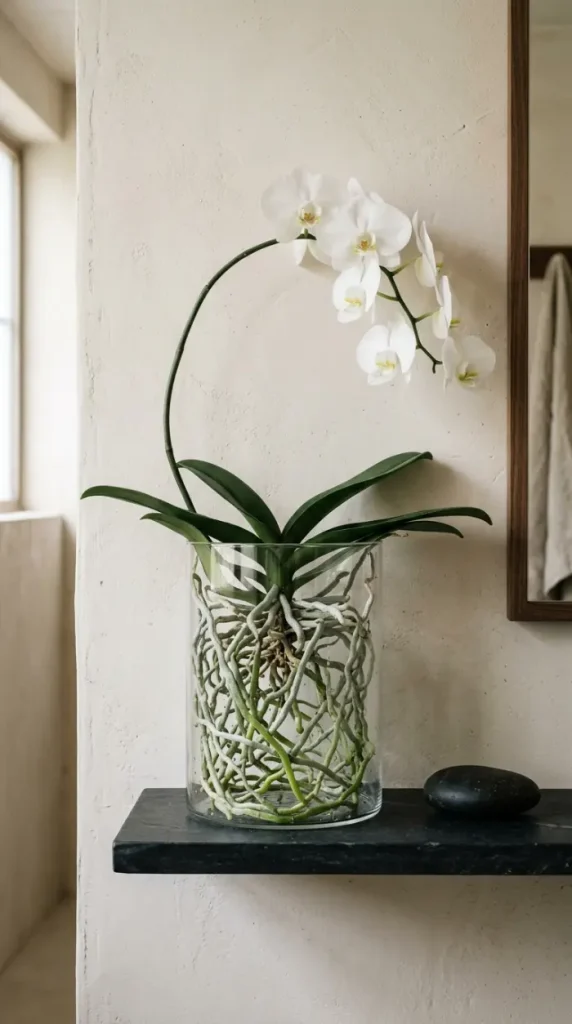
9. Shelf with Orchid Roots Visible in Clear Glass Vessel
Mounting a Phalaenopsis orchid in a clear glass cylindrical vessel rather than an opaque ceramic pot — so the orchid’s aerial roots are fully visible through the glass, their pale green and silver tones creating a living root sculpture within the vessel — creates the most botanically revealing and most unexpectedly beautiful Japandi bathroom shelf detail. The clear glass vessel showing the root system is a specifically scientific and specifically Japanese approach to botanical display — honoring the complete plant rather than simply its flowers. The orchid roots in glass, their tangled pale green and silver forms against the raw plaster wall, with the white blooms above the glass rim, create a shelf composition of complete botanical honesty.
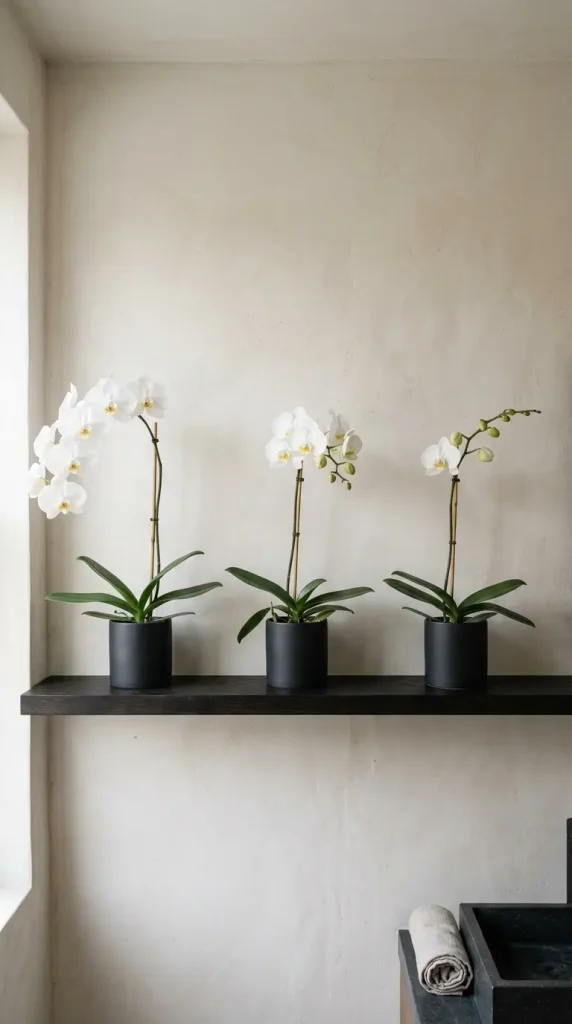
10. Long Dark Shelf with Multiple Orchids — Restrained Row
A long dark shelf — approximately 100cm to 120cm long in dark stained oak or dark stone — holding three Phalaenopsis orchids in matching dark ceramic pots of the same form but different heights, arranged in a restrained evenly spaced row with generous negative space between each pot, creates the most formally considered and most architecturally complete Japandi bathroom shelf composition. The three orchids in matching pots create a series rather than a collection — their visual relationship defined by the regularity of their spacing rather than by variety. The flower spikes at different stages of bloom — one fully open, one half open, one with closed buds — create a temporal narrative of botanical growth along the shelf length.
11. Dark Shelf with Orchid and Single Smooth Stone — Maximum Restraint
The most extreme expression of the Japandi bathroom shelf philosophy: one dark wood or dark stone shelf, one orchid in one dark ceramic pot, one smooth river stone — and that is everything. No tray, no vessel, no dried branch, no towel, no accessory of any kind. The shelf holds two objects and the space between them. The single smooth river stone is not decoration — it is a counterweight, a grounding presence, a material conversation partner for the living orchid. Together they constitute a complete Japandi composition, and adding a third object would diminish both.
12. Bathroom Shelf with Orchid and Folded Linen Towel
The folded natural linen towel as a shelf object in the Japandi bathroom is not merely functional — its undyed warm cream color, its visible woven texture, and its soft geometric folded form make it a material participant in the shelf composition. A dark stone shelf at 110cm height with one white Phalaenopsis orchid in a dark ceramic pot at one end and one neatly folded natural linen hand towel at the other end — the orchid and the linen as the two poles of a restrained composition — creates a bathroom shelf that is simultaneously decorative and functional in complete Japandi balance.
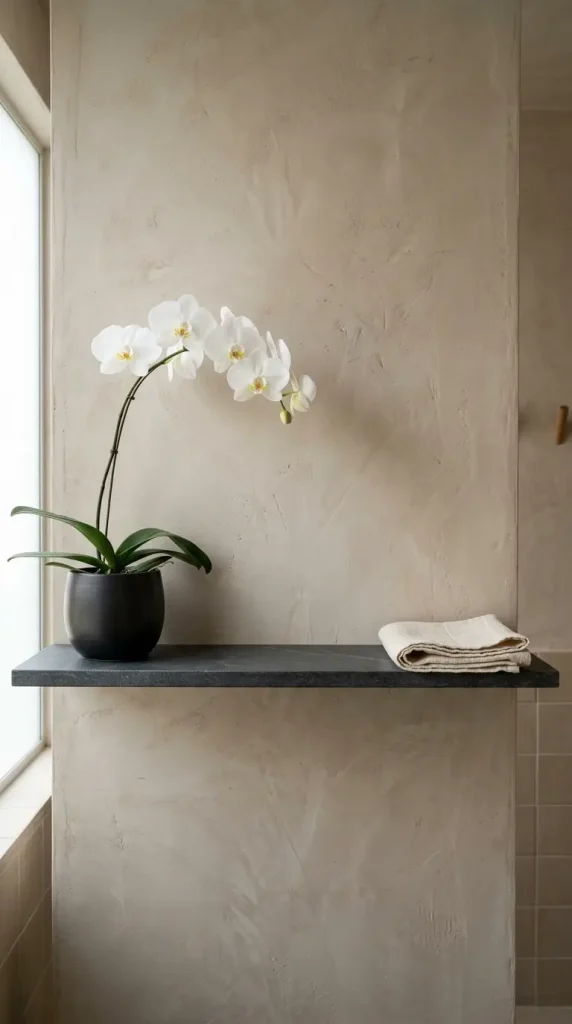
13. Shelf Orchid in Late Afternoon Raking Light
The bathroom shelf orchid in late afternoon raking light — when low warm sun enters the bathroom window at a shallow angle and crosses the shelf surface, casting the orchid’s flower spike as a shadow across the raw plaster wall behind, revealing every detail of the dark shelf surface grain and the petal translucency of the blooms — creates the most photographic and most poetically beautiful version of the Japandi bathroom shelf. The raking afternoon light on the orchid and shelf is the light that reveals the most about every material’s true nature.
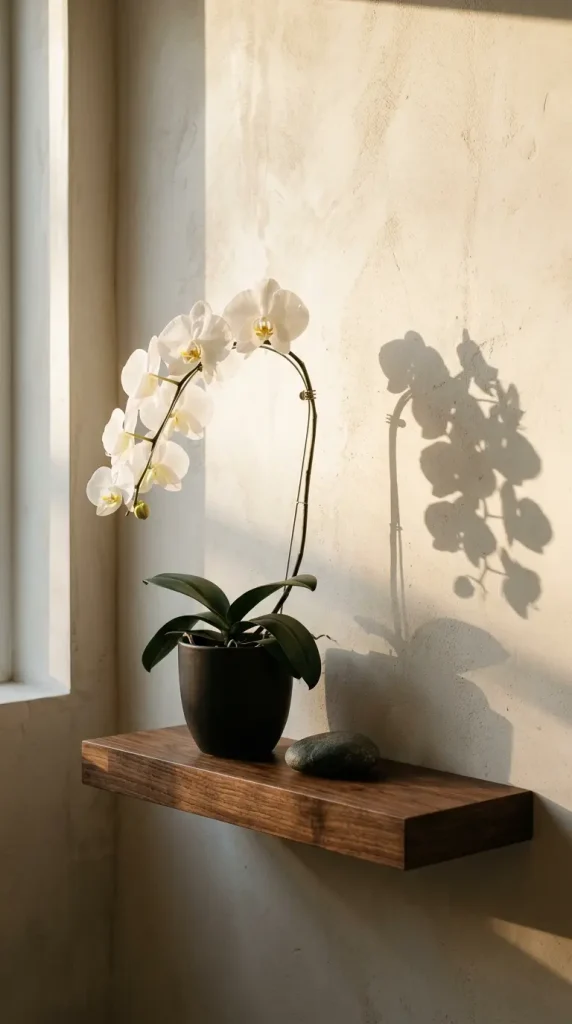
14. Slim Wall-Mounted Hinoki Wood Shelf with Orchid
A hinoki wood shelf — a single length of hinoki cypress approximately 4cm thick by 15cm deep, mounted directly on the bathroom wall on minimal aged brass wall pins at its two ends — creates a shelf of extraordinary material consistency with the Japandi bathroom philosophy: the same warm honey-gold timber, the same tight vertical grain, the same citrus-cedar scent as a hinoki soaking tub. On the hinoki shelf: one Phalaenopsis orchid in a small dark celadon or dark matte ceramic pot, the warm honey-gold grain of the hinoki shelf surface glowing around the dark pot. The hinoki shelf is both a plant shelf and a piece of the same botanical material as the tub — bringing the same wood to a different height and function.
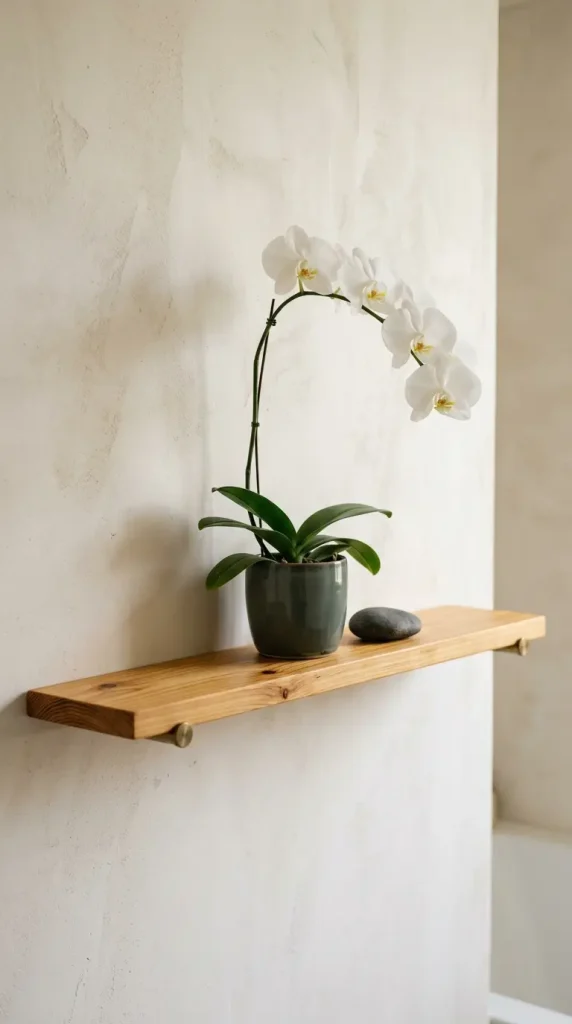
15. Shelf with Orchid and Bathroom Steam — Misty Morning
The bathroom shelf orchid in the first moments after a hot shower — the room still full of warm steam, the mirror fogged, the shelf surface slightly warmed and damp with condensation, the orchid blooms catching the diffused misty light of the steam-filled room — is one of the most atmospheric and most specifically Japandi bathroom shelf moments. The steam softens every edge and every surface, making the white orchid blooms appear as gentle presences in the warm mist rather than precise botanical forms, and making the raw plaster wall behind the shelf appear as a soft warm field against which the orchid floats.
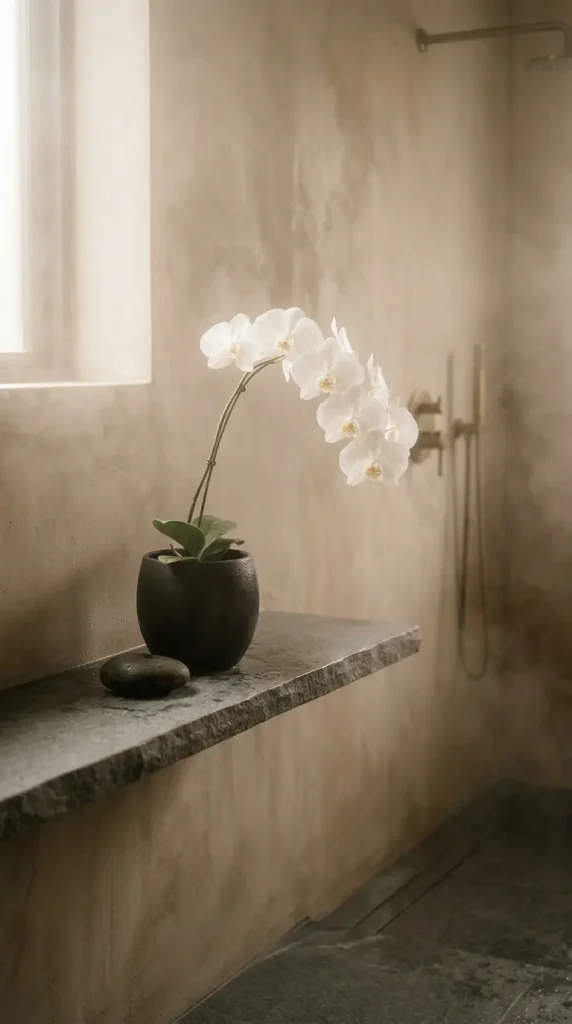
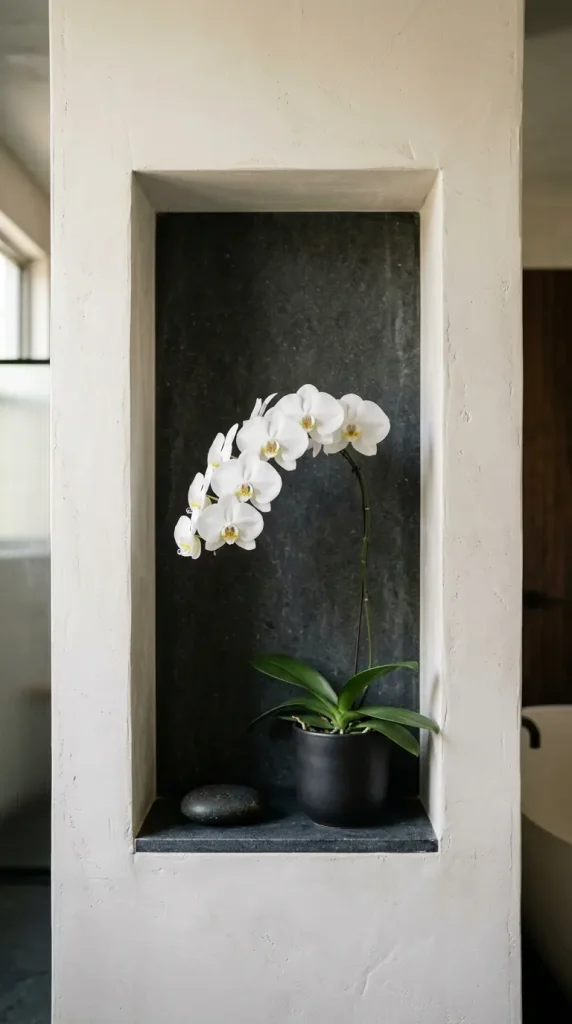
16. Orchid on Recessed Wall Niche Shelf
A recessed wall niche — a rectangular void cut into the bathroom wall approximately 50cm wide by 40cm tall by 15cm deep, with a dark stone or dark wood back panel, creating a framed alcove in the wall — holding one Phalaenopsis orchid in a dark ceramic pot creates the most architecturally integrated plant display available in the Japandi bathroom. The recessed niche frames the orchid with the wall’s own material — the niche back panel in dark stone, the surrounding wall in raw plaster — making the orchid the subject of a natural architectural frame. The niche protects the orchid from drafts, concentrates the bathroom humidity around it, and gives it the most considered and most precisely defined position in the room.
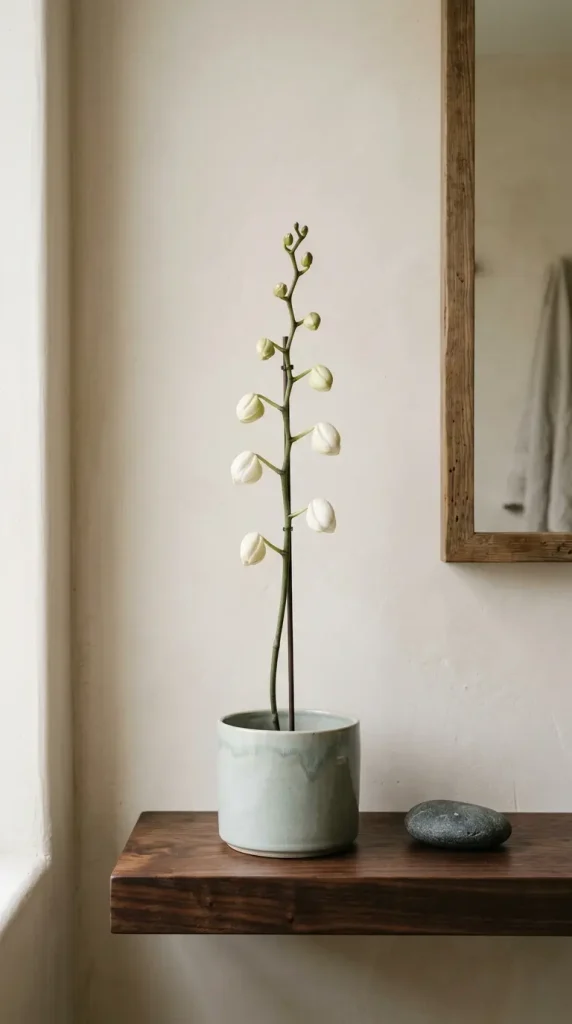
17. Japandi Bathroom Shelf — Moth Orchid in Bud
A Phalaenopsis orchid in bud — all flower buds tightly closed, the spike carrying eight to ten unopened buds in precise graduated spacing from the base to the tip of the spike, the bud forms pale and tightly furled — creates a bathroom shelf still life that is purely about potential and anticipation rather than full display. In the Japandi aesthetic, the bud is as beautiful as the open flower — it contains within it the promise of the complete bloom. A dark shelf with one orchid entirely in bud, in a dark celadon pot, against a raw plaster wall, is a composition that the Japandi philosophy values precisely for its incompleteness — the beauty of the not-yet-open, the patience of waiting for the natural unfolding.
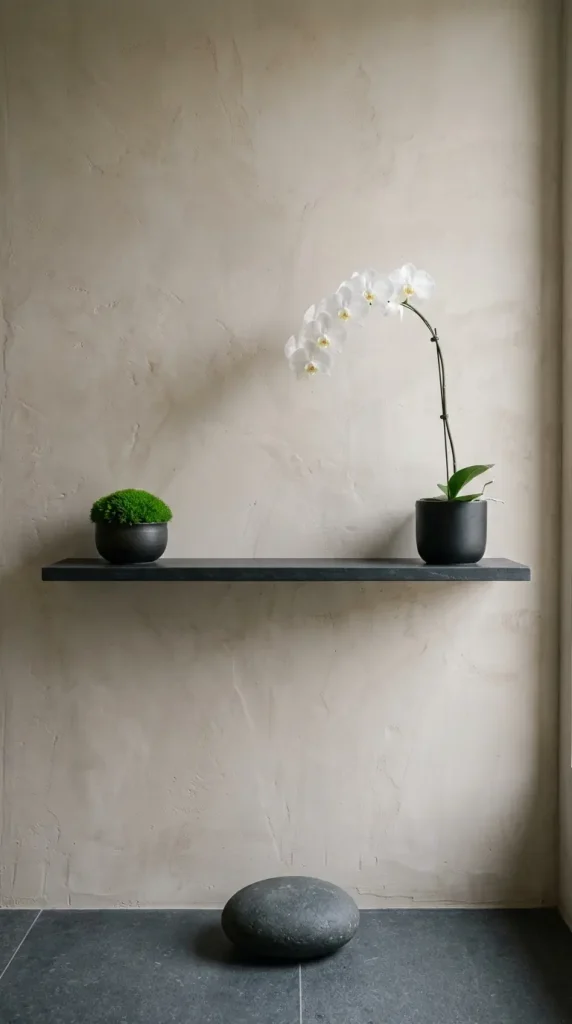
18. Orchid, Moss, and Dark Stone — Three Natural Elements
A bathroom shelf composition of exactly three natural elements — one orchid, one moss, one stone — creates the Japandi equivalent of a Japanese ikebana arrangement: a composition in which the number of elements, their material nature, and their spatial relationships to each other are all determined by a clear aesthetic philosophy. Dark wood shelf: LEFT — one small Kokedama or one small dark ceramic vessel with cushion moss — vivid green. CENTER — empty shelf. RIGHT — one Phalaenopsis orchid in a dark clay pot. The stone: not on the shelf at all, but on the dark stone floor directly below the shelf, sitting on the floor at the base of the wall. Three elements on three different planes — moss on the shelf, orchid on the shelf, stone on the floor — create a vertical composition that uses the full wall height.
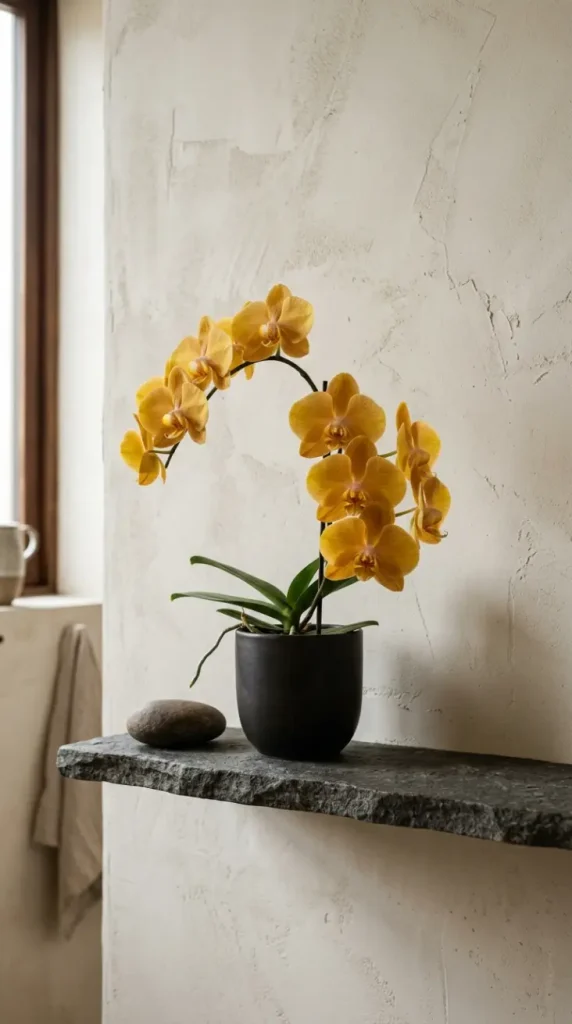
19. Shelf with Yellow Phalaenopsis — Warm Color Note
A yellow-gold Phalaenopsis orchid — in the warm honey-gold to amber-yellow range of Phalaenopsis color available, the petals catching warm bathroom light and appearing almost luminous — in a dark near-black ceramic pot on a dark stone shelf creates the warmest and most sun-like single color note available in the Japandi bathroom. The warm yellow-gold of the orchid blooms against the dark shelf and the raw plaster wall behind it creates a color contrast of profound natural warmth — the yellow of the orchid referencing the warm honey-gold tone of a hinoki tub, the warm yellow of morning light, the specific warm color of the Japanese aesthetic. One smooth dark river stone. No other objects.
20. Bathroom Shelf Plants at Night — Orchid by Candlelight
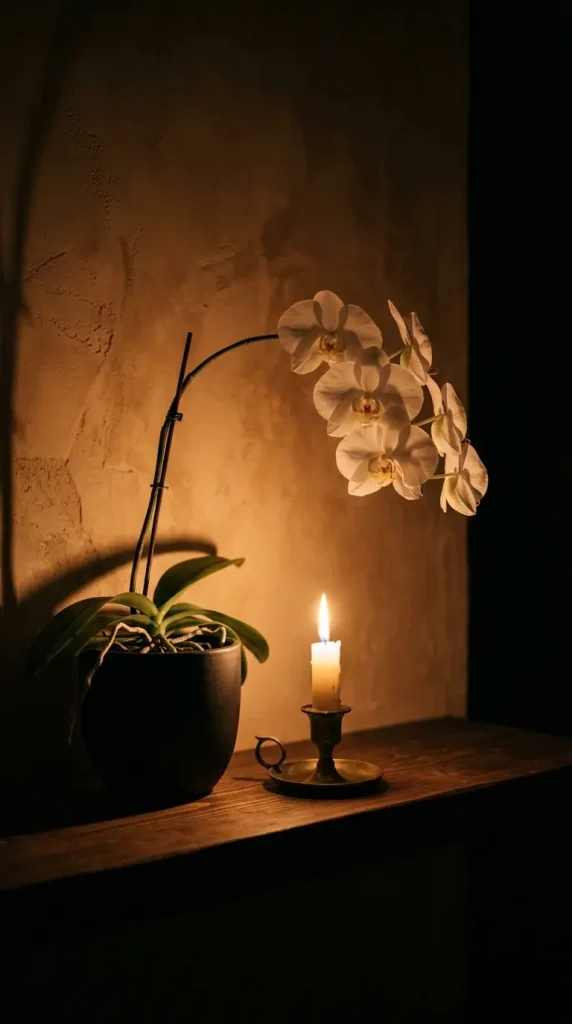
The bathroom shelf orchid at night — lit only by the warm amber flame of a single beeswax candle placed directly on the shelf beside the orchid pot — creates a completely different and equally beautiful version of the same object. In candlelight, the white Phalaenopsis petals lose their daytime precision and appear as warm ivory presences in the amber glow — the individual flowers becoming more painting-like and less botanical in the warm flickering light. The raw plaster wall behind catches the candle’s warm glow and becomes the most atmospheric surface in the bathroom.
21. Shelf Below a High Window — Orchid in Silhouette Light
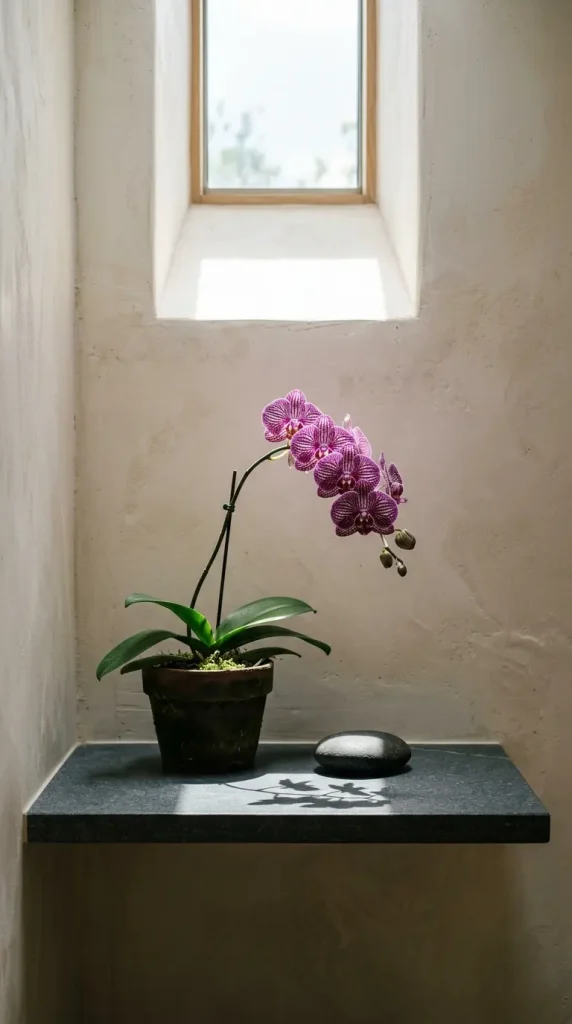
A bathroom shelf mounted below a high-set window — the window at approximately 190cm height, the shelf at approximately 110cm, so the window light falls from above directly onto the shelf surface — creates the most dramatically top-lit plant display available. In this light, the orchid on the shelf receives direct downward natural light from above: the top surfaces of the flowers lit, the undersides in shadow, the flower spike casting a long downward shadow on the shelf surface below. The raw plaster wall behind and below the shelf in the shadow zone below the window.
22. Minimal Japandi Shelf — Orchid With Exposed Aerial Roots
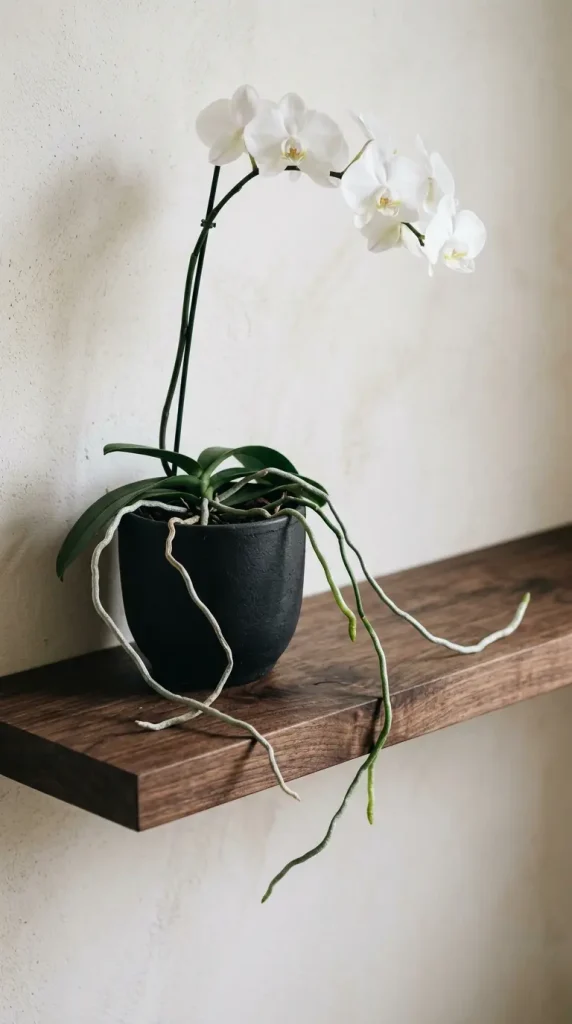
A Phalaenopsis orchid whose aerial roots have grown beyond the pot — several pale green and silver aerial roots extending over the pot edge and down the shelf surface, traveling naturally across the dark wood or dark stone shelf like living botanical calligraphy — creates the most honest and most botanically authentic orchid shelf display in the Japandi bathroom. Rather than tidying the aerial roots back into the pot, allowing them to travel where they will across the shelf surface honors the plant’s natural growth behavior and creates a living composition that changes over time as the roots extend further across the shelf.
23. Japandi Bathroom Multi-Shelf — Three Shelves One Wall
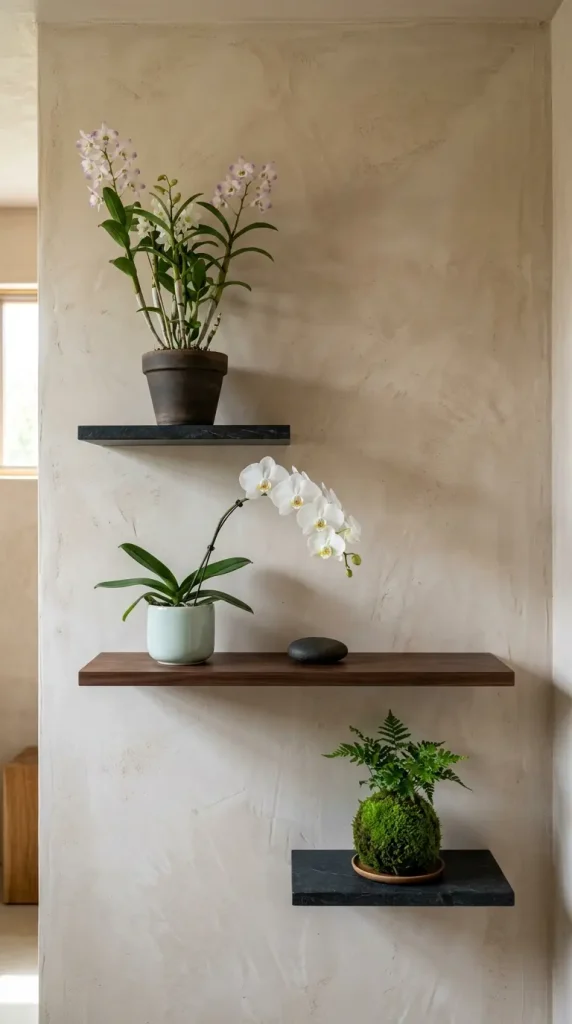
Three dark wood or dark stone shelves on the same bathroom wall — staggered at different heights and different horizontal positions rather than in a perfect vertical column — each holding one carefully chosen botanical element creates the most architecturally complex and most spatially composed Japandi bathroom shelf display. TOP SHELF at 160cm, offset left: one tall Dendrobium orchid in a dark clay pot. MIDDLE SHELF at 120cm, centered: one Phalaenopsis in a celadon pot with one smooth dark stone. LOWER SHELF at 85cm, offset right: one small Kokedama moss ball sitting directly on the shelf, no vessel. The three shelves at three heights and three horizontal positions make the raw plaster wall the negative space field of a complete Japandi wall composition.
24. Orchid Shelf in a Small Japandi Bathroom
A small bathroom — perhaps only 2m by 2.5m — presents the most demanding context for the Japandi bathroom shelf and the one where the philosophy of restraint is most critically important. In a small bathroom, one shelf and one orchid and one stone is not merely an aesthetic preference but an absolute spatial requirement: the small bathroom cannot accommodate anything more without becoming visually crowded. A single narrow dark stone shelf approximately 40cm long, holding one small Phalaenopsis in a small dark matte ceramic pot and one smooth dark stone, mounted on the raw plaster wall above the basin at 155cm in a small Japandi bathroom, creates a complete botanical presence in the smallest possible space with the largest possible visual effect.
25. Dark Shelf with Orchid Bark Medium Visible — Botanical Transparency
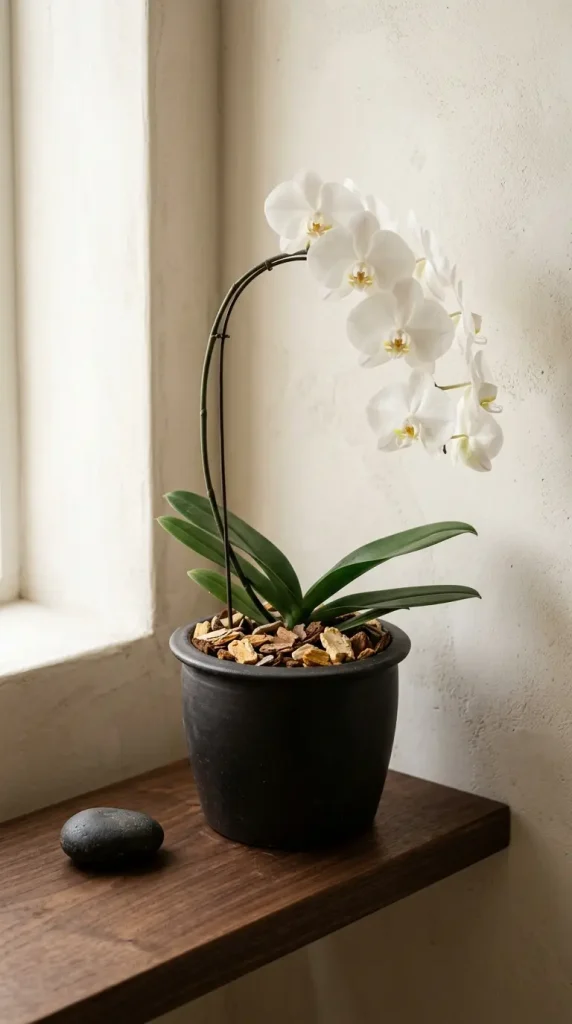
A Phalaenopsis orchid planted in a transparent or semi-transparent plastic nursery inner pot set inside a larger dark ceramic outer pot — with the orchid bark planting medium visible above the rim of the dark ceramic outer pot, a thin ring of natural bark chips showing between the orchid base and the pot rim — creates a planting display that includes the growing medium as a botanical element. The bark medium is not hidden but honored: the pale natural bark chips are a material of genuine natural beauty, the same color as driftwood, and their presence at the pot rim creates a botanical detail that communicates genuine horticultural knowledge and the Japandi respect for natural material at every scale.
26. The Complete Japandi Bathroom Shelf Vision — All Elements Together
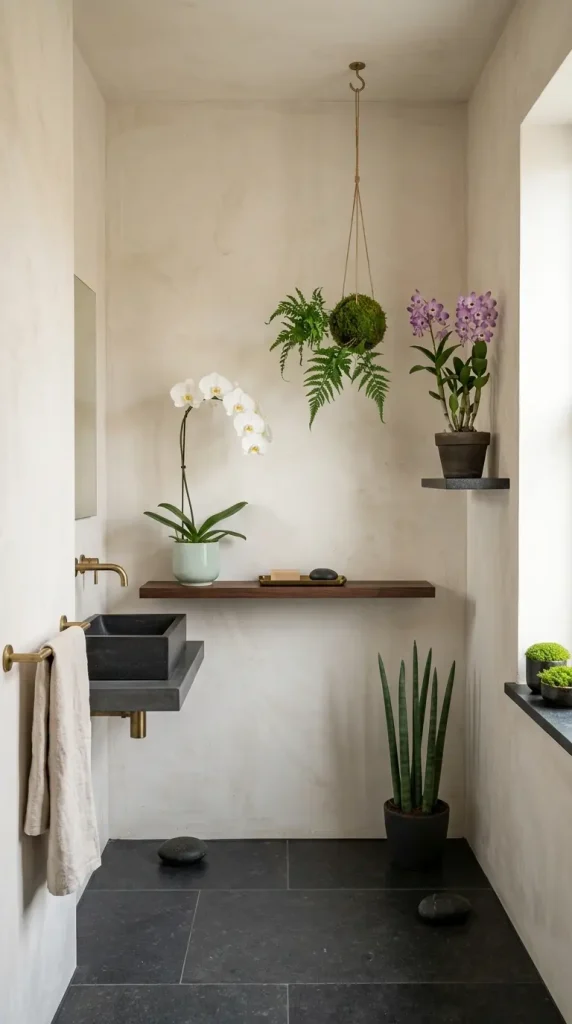
The complete vision of the Japandi bathroom shelf plants decor in its most fully realized form: a bathroom where every shelf surface has been considered as a botanical composition, where orchids at different heights and in different ceramic vessels participate in a complete botanical spatial narrative, and where every material — raw plaster, dark stone, dark wood, dark ceramic, aged brass, natural linen — works together as one unified Japandi world. The bathroom as a whole: one large white Phalaenopsis on a dark walnut shelf above the basin with aged brass accessories. One deep purple Dendrobium on a dark stone shelf at the side wall at 140cm. One Kokedama hanging from a simple aged brass ceiling hook above the small basin. One tall Sansevieria in a dark basalt pot on the floor beside the dark stone trough basin. On the stone windowsill: two small dark ceramic moss vessels in direct natural light. One smooth dark river stone on the raw stone floor below each shelf. Every botanical element chosen for its position, every surface holding only what it must, and every material earning its presence through natural quality and spatial necessity.