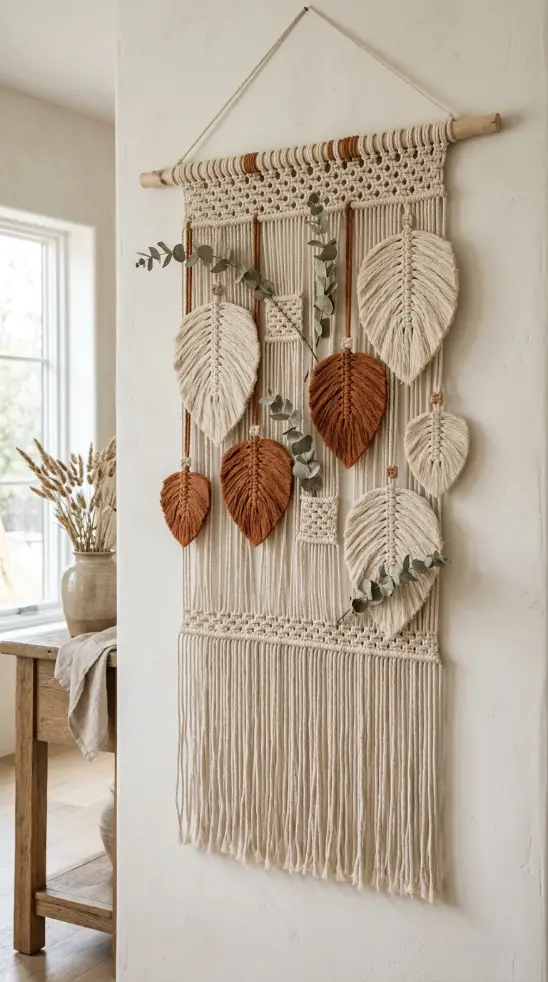
13 DIY Fall Home Decor Project Macramé Leaf Wall Hanging
A macramé leaf wall hanging is the fall DIY project that sits at the perfect intersection of genuinely achievable and genuinely beautiful — it requires no specialized tools, uses natural cotton rope that costs very little, and produces a finished piece whose organic leaf shapes and warm cream and rust tones suit the autumn season in a way that feels intentional and considered rather than holiday-themed. The finished piece reads as handmade in the most positive sense, and because it uses natural materials and neutral tones it works in a room year-round rather than disappearing into storage in November.
The macramé leaf form is achieved through a specific knotting sequence that creates a pointed oval shape mimicking the outline of a fall leaf — alternating half-hitch knots pulled tightly on the outside edges and loosely at the center create the leaf’s organic fullness, while the fringing technique at each leaf tip creates the specific textural quality that makes macramé leaves so visually rich. The projects here cover every variation of the basic leaf form and every way it can be combined, scaled, and styled into a complete wall hanging.
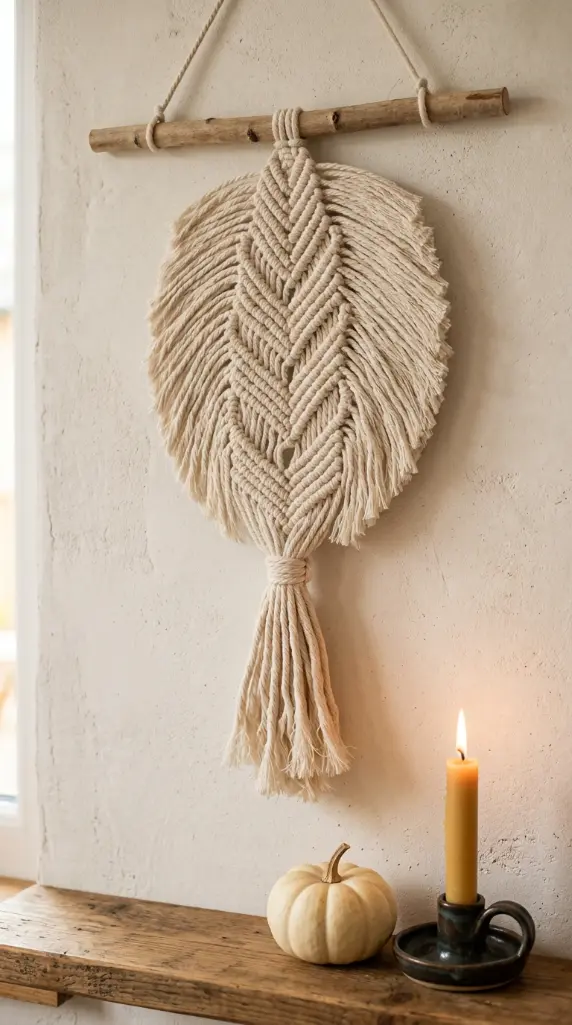
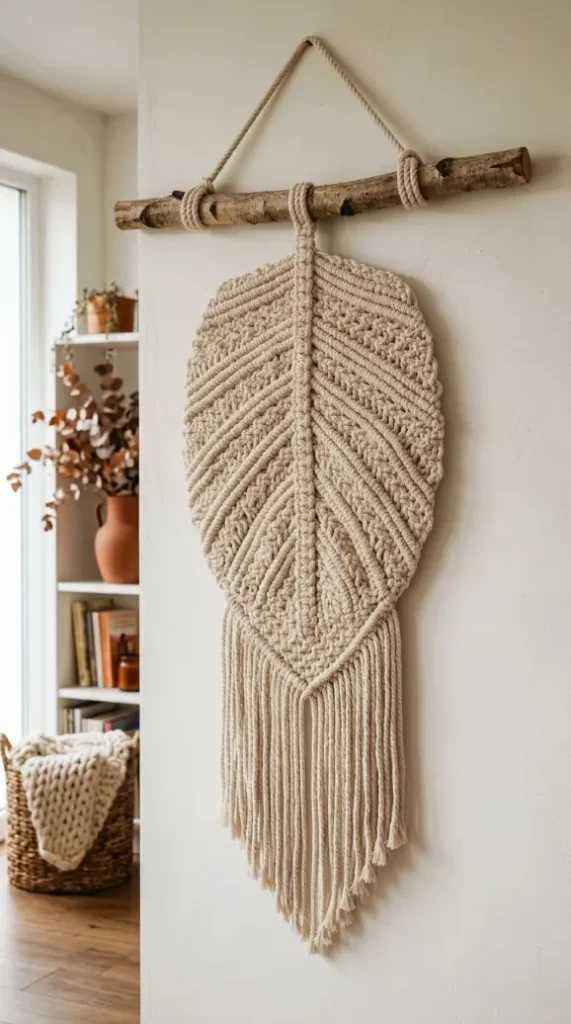
1. The Classic Single Large Macramé Leaf
What it is: One large standalone macramé leaf approximately 30cm long, knotted in natural cream cotton rope, mounted on a single slim dowel with long loose fringe strands at the leaf tip trailing downward — the simplest possible version of the macramé leaf form and the best starting project for anyone new to the technique.
How to make it: Cut sixteen lengths of 4mm natural cotton rope at 120cm each. Fold each length in half and attach to the dowel using lark’s head knots, giving you 32 working strands. Divide into two groups of 16. Using the outermost strand on each side as the carrying cord, work alternating half-hitch knots inward across each row, pulling the outer knots tight and leaving the center knots slightly looser to create the leaf’s natural oval fullness. Work 18 rows to build the leaf body, decreasing by two strands each side every three rows to taper the leaf toward its tip. At the tip, gather all remaining strands and tie one overhand knot to close the leaf point. Trim the trailing strands to approximately 10cm and unravel each strand for a soft fringe.
Styling tip: Mount on a 35cm bleached or natural birch dowel and hang on a limewash wall beside a reading chair with a cream pumpkin and beeswax candle below it for a complete fall corner moment.
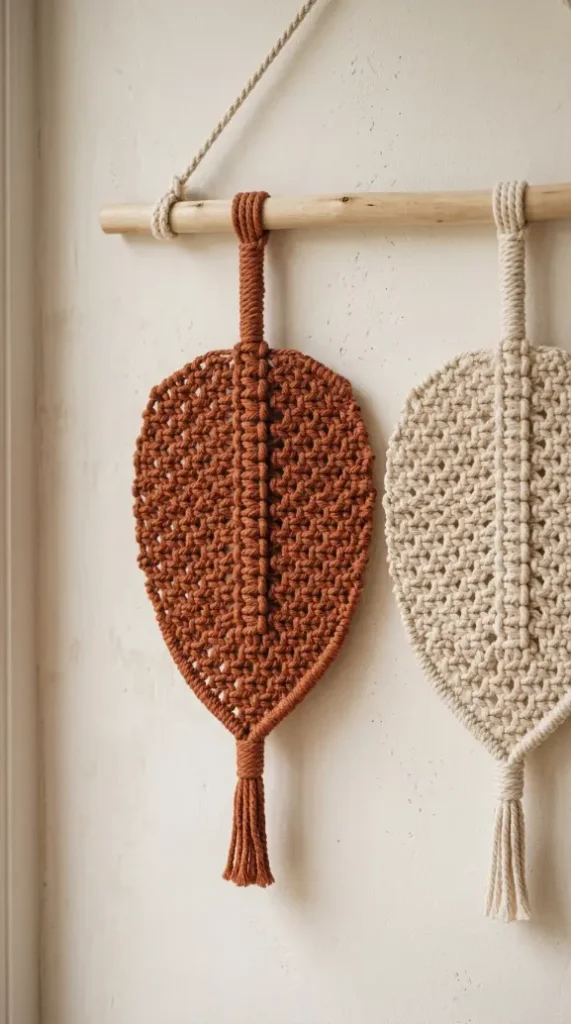
2. A Rust-Dyed Macramé Leaf
What it is: The same basic macramé leaf form as the single large leaf, but knotted in warm rust-dyed natural cotton rope — the rust color achieved at home by soaking natural cotton rope in a bath of warm water, white vinegar, and iron-rich rust dye or natural walnut hull dye before knotting — producing a leaf in a deep warm rust-terracotta tone that reads immediately as autumnal.
How to make it: Prepare the rust dye bath first: dissolve two tablespoons of iron mordant powder in warm water, or simmer walnut hulls in water for one hour and strain. Soak your pre-cut natural cotton rope lengths in the dye bath for 30 to 60 minutes, checking the color every 15 minutes — longer soaking produces a deeper rust tone. Rinse with cool water and dry completely before knotting. Once dry, knot exactly as per the basic single leaf pattern. The dyed rope will have a slightly stiffer hand than undyed rope, which actually helps the leaf hold its shape more clearly.
Styling tip: Hang a rust-dyed leaf beside two natural cream leaves on a single long dowel to create an instant autumn color story in two materials from one project.
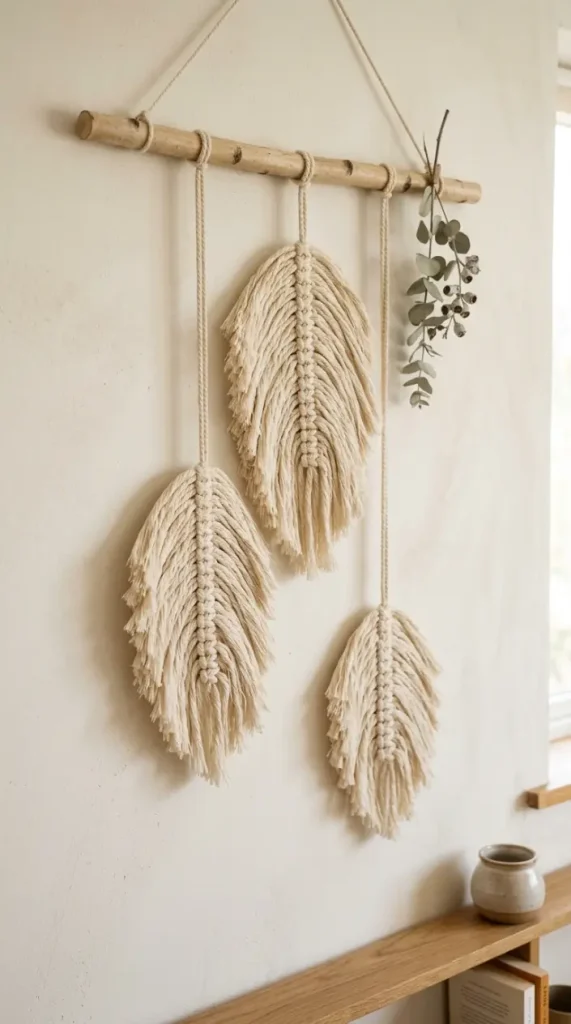
3. A Three-Leaf Cascading Wall Hanging
What it is: Three macramé leaves in graduating sizes — large, medium, and small — mounted on a single dowel and positioned at different hanging heights by attaching each leaf to the dowel with rope sections of different lengths, creating a cascading vertical composition that fills a wall section far more dynamically than three leaves hung at the same height would.
How to make it: Make one large leaf (30cm), one medium leaf (22cm), and one small leaf (15cm) using the basic half-hitch leaf pattern, scaling the rope strand count and row count proportionally for each size. Rather than mounting each leaf directly to the dowel, attach a hanging rope section of different lengths between the dowel and each leaf’s mounting point — 5cm for the large leaf, 15cm for the medium leaf, and 28cm for the small leaf — so the three leaves hang at three distinct heights below the same dowel, creating the cascading staggered composition. Finish each leaf tip with unraveled fringe of proportionally varying lengths.
Styling tip: Use all three leaves in natural cream but add a single dried eucalyptus stem tucked behind the dowel beside the hanging for a mixed botanical moment.
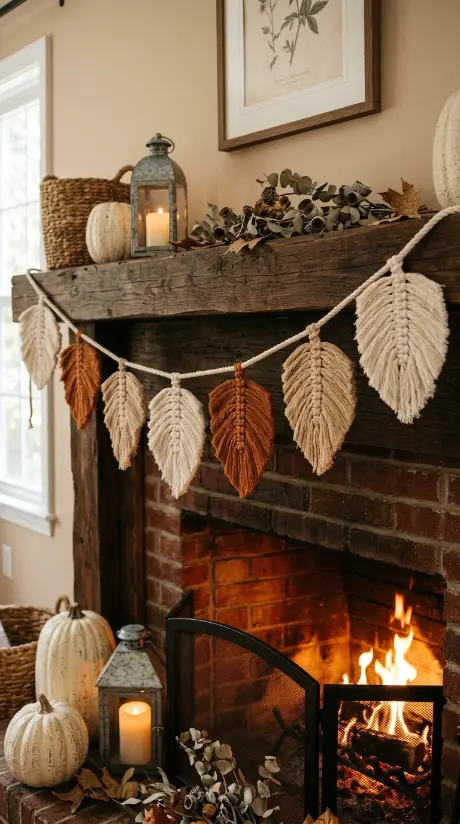
4. A Macramé Leaf Garland
What it is: Seven to nine individual macramé leaves in varying sizes — alternating cream and rust-dyed, some with and some without fringe tips — connected along a single length of natural jute twine or cotton rope and hung horizontally across a mantel, a window frame, or a shiplap wall section as a garland rather than a traditional vertical hanging.
How to make it: Make seven to nine individual leaves in varying sizes and colors following the basic leaf pattern. Instead of mounting to a dowel, attach each finished leaf to a length of 4mm natural cotton rope or jute twine by tying the leaf’s top mounting strands around the garland rope at regular intervals of approximately 15cm to 20cm. Alternate the leaf sizes and rust versus cream colors as you attach them, and vary the angle of each leaf slightly — some straight, some tilted left, some tilted right — so the garland reads as a natural scatter of fallen leaves rather than a uniform row.
Styling tip: Drape the finished garland loosely across a fall mantel between the cream pumpkins and dried botanicals, allowing the rope to form natural gentle dips between each leaf attachment point.
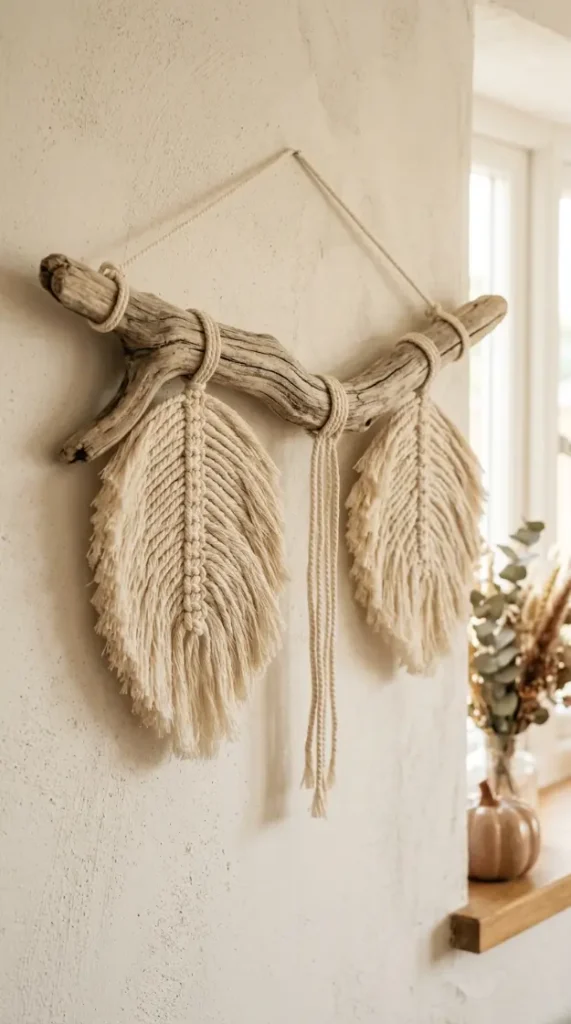
5. A Macramé Leaf With Driftwood Mount
What it is: A large macramé leaf mounted on a piece of naturally found driftwood or a weathered branch rather than a smooth dowel — the driftwood’s irregular organic form and weathered grey-tan surface contrasting with the clean cream rope knotwork of the leaf and giving the finished piece a more specifically natural and more coastal-meets-farmhouse character.
How to make it: Find a naturally weathered branch or driftwood piece approximately 45cm to 55cm long with a naturally interesting form — slight curves, visible grain, perhaps a small branching section. Lightly sand any rough splinters and seal with clear matte varnish if desired. Mount two or three large macramé leaves directly onto the driftwood branch using lark’s head knots at their natural organic positions — not necessarily centered or symmetrical but placed where the branch’s form suggests them naturally. Add a few loose rope strands between the leaves for additional textural movement.
Styling tip: Lean the finished driftwood mount against a wall rather than hanging it for an even more casual natural display that suits the farmhouse fall aesthetic.
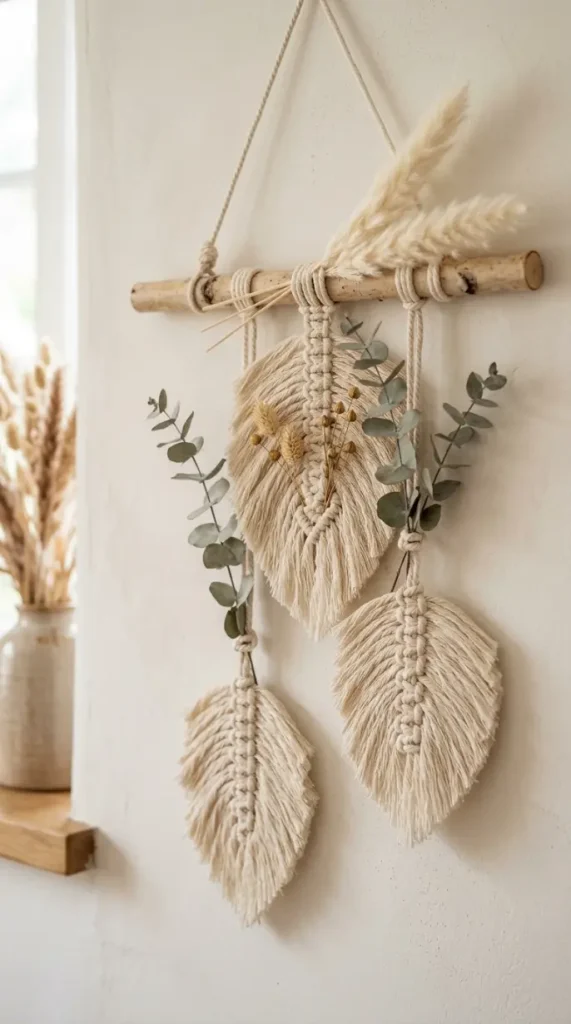
6. A Mixed Macramé and Dried Botanical Hanging
What it is: A wall hanging that combines macramé leaf forms with actual dried botanicals — dried eucalyptus stems, dried seed heads, a few dried pampas grass mini-plumes, and small dried flowers — woven and tied directly into the macramé rope structure between and around the leaf forms, creating a piece that blurs the line between textile and botanical wreath in the most specifically autumnal possible combination.
How to make it: Begin with a basic three-leaf cascading hanging on a 60cm dowel. Once the leaves are complete, take dried eucalyptus stems approximately 20cm long and tie them to the hanging rope sections between the leaves using small square knots, leaving the stem ends and leaf tips free. Tuck small dried seed heads into the gaps between knot rows on one or two of the leaf surfaces — the knotwork’s texture naturally holds them without gluing. Wire two or three small dried pampas mini-plumes to the dowel at asymmetric positions. The finished piece combines handmade textile texture with genuine dried autumn botanical material.
Styling tip: Spray the finished hanging very lightly with clear matte sealant from 30cm to help the dried botanical elements hold their form over the full season.
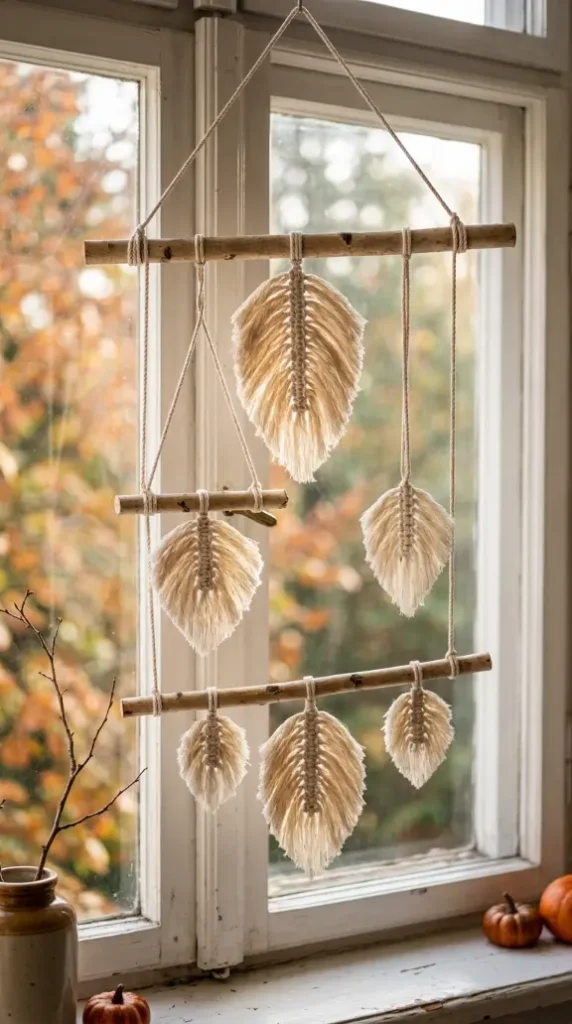
7. A Macramé Leaf Mobile
What it is: Five to seven individual macramé leaves in graduated sizes attached to a horizontally balanced stick or dowel framework — one main horizontal dowel with two or three smaller secondary dowels hanging below it at different lengths from the main dowel, each smaller dowel carrying one or two leaves — creating a three-dimensional hanging mobile that moves gently in air currents and catches light from multiple angles rather than presenting a single flat composition.
How to make it: Make five individual leaves in varying sizes. Cut one main 45cm dowel and two secondary dowels at 25cm and 20cm. Attach the two secondary dowels below the main dowel using 4mm rope at different lengths — one at 20cm drop and one at 35cm drop. Balance the secondary dowels carefully by adjusting where the rope attaches before tying permanently. Attach the leaves to the secondary dowels and directly to the main dowel at varied positions, testing the balance as you go. The mobile should hang level when balanced and rotate slowly in room air movement.
Styling tip: Hang the finished mobile in a window or doorway where air movement will animate it rather than against a flat wall where its three-dimensional quality is lost.
8. A Large Scale Statement Leaf Hanging
What it is: One single very large macramé leaf — approximately 50cm to 60cm long and 30cm wide at its widest point — made from chunky 6mm or 8mm natural cotton rope rather than the standard 4mm, the larger rope producing a leaf of such generous, bold scale that it functions as a statement art piece rather than a decorative accent, its individual knot detail large enough to read clearly from across a room.
How to make it: Cut twenty-four lengths of 6mm natural cotton rope at 180cm each. Fold in half and attach to a 65cm dowel using lark’s head knots, giving 48 working strands. Work the standard alternating half-hitch leaf pattern but with the larger rope, which requires less rows to produce more visual impact — approximately 22 rows to reach the leaf’s full length. The heavier rope will create a more substantial, more clearly three-dimensional knot texture across the leaf surface. Finish with a long fringe of approximately 15cm unraveled strands at the leaf tip. Mount on a wide natural timber branch rather than a slim dowel to suit the leaf’s larger scale.
Styling tip: Hang the large scale leaf alone on a feature wall with nothing else competing for attention — it earns the space as a standalone piece.
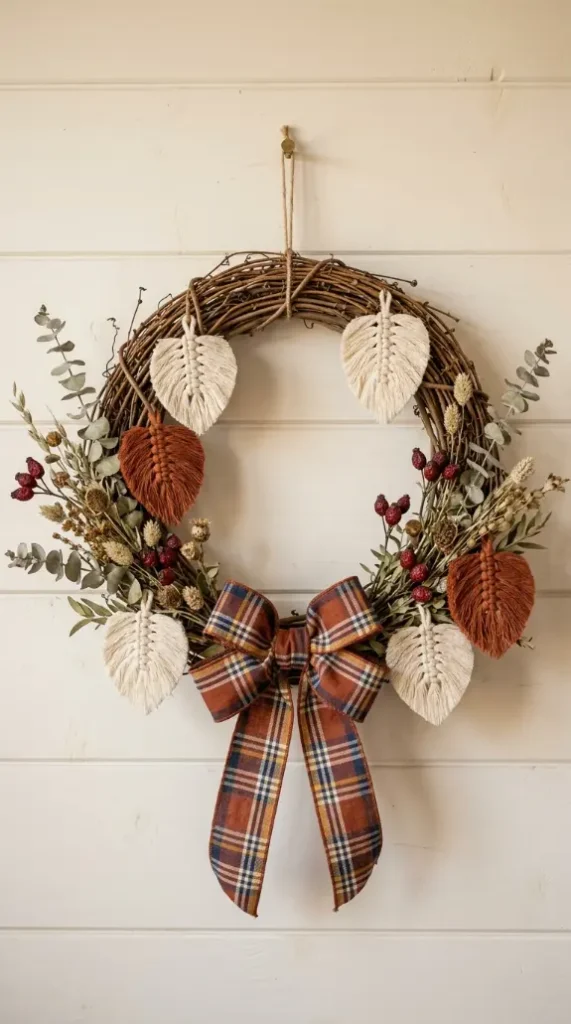
9. A Macramé Leaf Wreath
What it is: A circular grapevine or twig wreath base approximately 35cm to 40cm diameter, with six to eight individual small macramé leaves wired and tied at various positions around the wreath perimeter and within the wreath interior — some leaves pointing outward, some inward, some flat to the wreath face — combined with dried botanicals tucked between the grapevine strands to create a wreath that is simultaneously a traditional circular fall wreath form and a macramé textile piece.
How to make it: Make six to eight small macramé leaves approximately 12cm to 16cm each in cream and rust-dyed rope. Attach each finished leaf to the grapevine wreath base by threading its mounting strands through the grapevine and tying securely at the back — distributing the leaves around the wreath at varied positions and angles rather than evenly spaced. Tuck dried eucalyptus stems, dried rosehips, and dried seed heads into the grapevine gaps between and around the leaf positions. Add a wide plaid ribbon bow at the bottom of the wreath for a farmhouse fall finish.
Styling tip: Hang the macramé leaf wreath on a shiplap wall or a natural wood front door for a fall entrance moment that combines the textile warmth of macramé with the traditional wreath form.
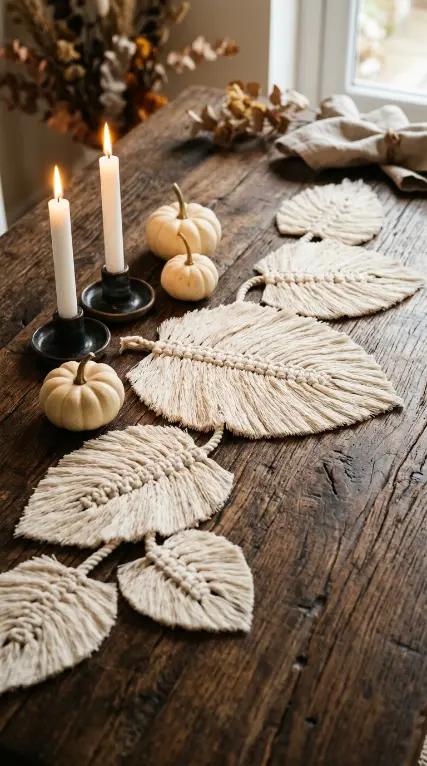
10. A Macramé Leaf Table Runner
What it is: Five individual macramé leaves in varying sizes connected in a horizontal linear arrangement on a length of natural 4mm cotton rope, designed to be laid flat along the center of a dining table or coffee table as a textile table runner — an entirely different application of the macramé leaf form that brings the handmade botanical textile to the table surface rather than the wall.
How to make it: Make five macramé leaves in graduated sizes: one large 28cm at center, two medium 20cm on either side, two small 14cm at each end. Lay all five leaves face-up on a flat surface in the desired arrangement. Connect them by threading a length of 4mm cotton rope through the top mounting strands of each leaf at consistent intervals, tying a small gathering knot at each connection point. The rope should create a horizontal backbone connecting all five leaves, with the leaves fanning downward from the rope on each side of center. The finished runner should be approximately 100cm to 110cm long.
Styling tip: Lay the macramé leaf runner on a dark wood dining table with cream pillar candles in ceramic holders on either side and a few small cream pumpkins scattered among the leaf forms for a complete fall table setting.
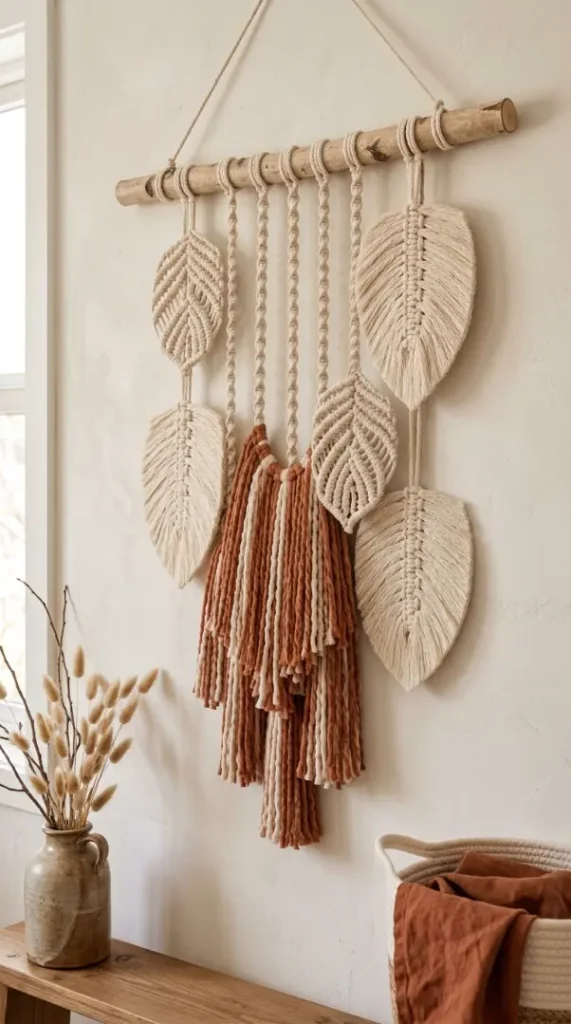
11. A Boho Layered Multi-Texture Leaf Hanging
What it is: A wall hanging that layers macramé leaf forms with other fiber techniques and textures — some leaves knotted in standard half-hitch, some in a lace-open spiral knot that creates a more open delicate texture, some in chunky square knot sections — combined with long loose yarn tassels in warm rust and cream colors hanging between the leaves for a more maximalist, boho-styled textile wall piece with greater textural complexity than a standard leaf hanging.
How to make it: Make three leaves in standard half-hitch knotwork. Make two additional smaller leaves using only spiral half-hitch knots, which produces an open, slightly twisted rope texture that contrasts clearly with the solid half-hitch surface of the standard leaves. Between the leaf forms on the main dowel, attach bundles of twelve to sixteen strands of chunky cream or rust-dyed yarn approximately 45cm long folded in half and tied to the dowel with a lark’s head knot, creating full yarn tassel sections between the leaves. The combination of three knotwork textures and the yarn tassels creates a rich layered fiber wall hanging.
Styling tip: Display the boho layered hanging over a rattan headboard or on a bedroom wall where its maximalist fiber texture suits the room’s softness.
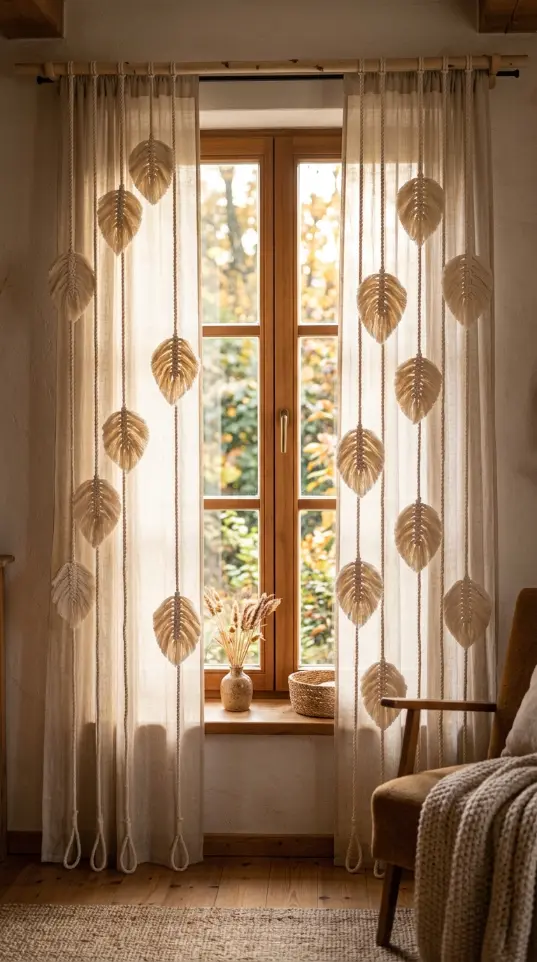
12. A Macramé Leaf Curtain Panel
What it is: A partial curtain or window panel made from twelve to sixteen individual macramé leaves — six to eight per side of a window frame, attached to two vertical ropes that hang from a single dowel mounted above the window — creating a botanical textile window treatment that filters natural light through the open rope knotwork of each leaf while maintaining the leaf forms as readable botanical shapes against the window light behind.
How to make it: Mount a 90cm dowel above the window frame. From the dowel, hang two vertical 4mm cotton ropes at the window’s outer edge positions, each rope running the full window height. Make twelve to sixteen small macramé leaves approximately 12cm to 16cm each. Attach the leaves to the two vertical ropes at regular intervals down the window height using square knots at each leaf’s top — alternating which side of each rope the leaf hangs on for a staggered natural distribution. The leaves should be spaced approximately 12cm to 15cm apart vertically, creating two botanical rope curtain panels at the window’s sides.
Styling tip: Use this macramé leaf curtain panel treatment in a bedroom or bathroom window where privacy is not required but botanical texture and natural light filtering is the decorative goal.
13. The Complete Fall Macramé Leaf Wall Hanging
What it is: The most ambitious version of the fall macramé leaf project — a large full-composition wall hanging approximately 65cm wide by 100cm long, combining seven macramé leaves in two sizes and two rope tones (cream and rust), a full-width square knot header section at the top, individual loose strand tassels between leaves, two small woven square sections mid-composition for textural variety, dried botanical elements woven throughout, and a long cascading fringe base of unraveled rope strands at the bottom — the complete fall macramé leaf wall hanging as a finished gallery-quality textile art piece.
How to make it: Begin with a 70cm natural birch dowel. Working from the top, create a full-width header section of approximately 8cm using alternating square knots across all 48 working strands. Then divide into seven leaf working groups and knot each leaf individually — three large 25cm leaves in cream, two medium 18cm leaves in rust, two small 14cm leaves alternating cream and rust. Connect the leaf groups with loose strand sections and small square knot joiners. Weave dried eucalyptus stems into the composition at three positions. At the bottom of the full composition, bring all strands together and work a final 5cm square knot footer section before releasing all strands into a long cascading fringe of approximately 20cm, each strand fully unraveled to soft fiber.
Styling tip: Hang the complete fall macramé leaf wall hanging as the sole statement piece on a large limewash wall section with nothing else competing — it earns the space alone.