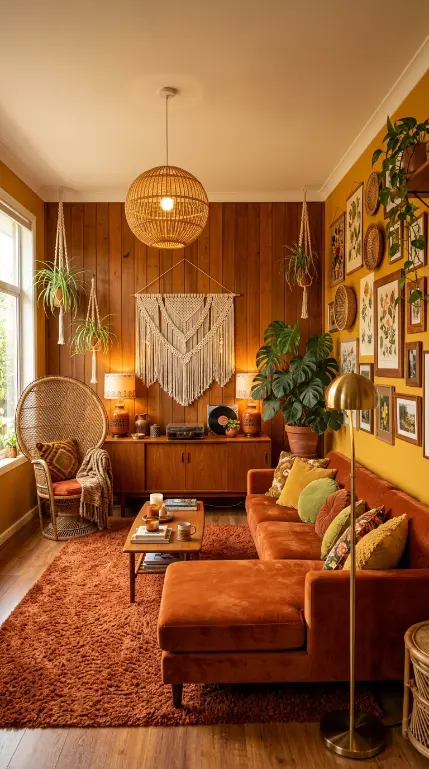
12 Vintage Home Decor Ideas 1970s Earthy Maximalist
The 1970s living room was never a curated, controlled environment — it was an accumulation of bold color, layered texture, low-slung furniture, and the particular confidence of a decade that believed more was always more. The earthy maximalist version of this aesthetic is the richest and most visually abundant form of 70s-inspired decorating: harvest gold walls, terracotta ceramic, burnt orange velvet, shag rugs, rattan pendant lights, wood panelling, macrame, and more houseplants than most people own today. It is the aesthetic that arrives as a complete sensory environment rather than a series of individual objects.
1. A Harvest Gold or Burnt Orange Statement Wall
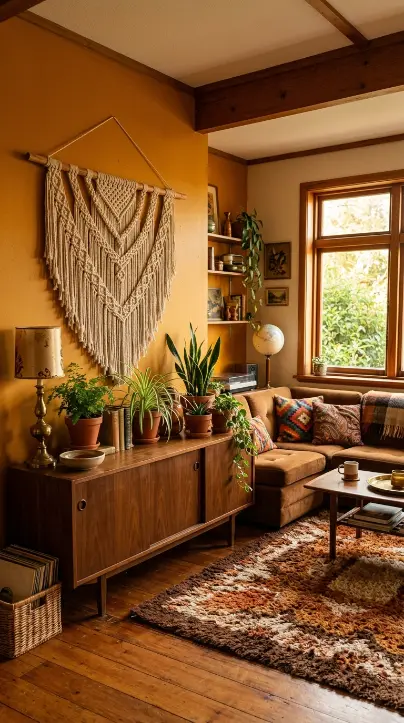
The single fastest way to establish 1970s earthy maximalist direction in a living room is to paint one wall — or all four — in harvest gold, burnt orange, warm terracotta, or deep avocado green. These colors were the defining palette of the decade and they remain the palette’s most immediately recognisable signature. Against these warm-saturated walls, timber furniture glows, rattan becomes rich, and velvet upholstery deepens dramatically.
2. A Shag Rug as the Room’s Textural Foundation
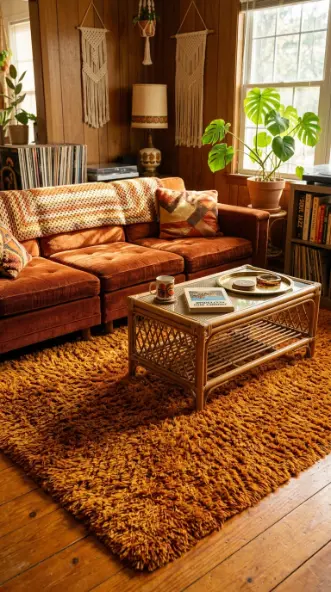
The shag rug — deep pile, in warm burnt orange, harvest gold, cream, or avocado green — is the most tactile and most immediately 70s object in the earthy maximalist living room. It should be large enough to sit under all four legs of the main seating group, and it should be deep enough in pile that it reads as genuinely luxurious from across the room. The shag rug underfoot transforms the entire physical experience of being in the room.
3. A Low-Profile Walnut or Teak Credenza Along One Wall
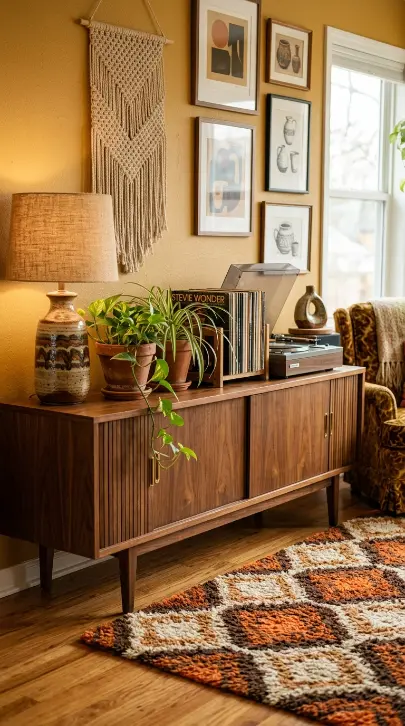
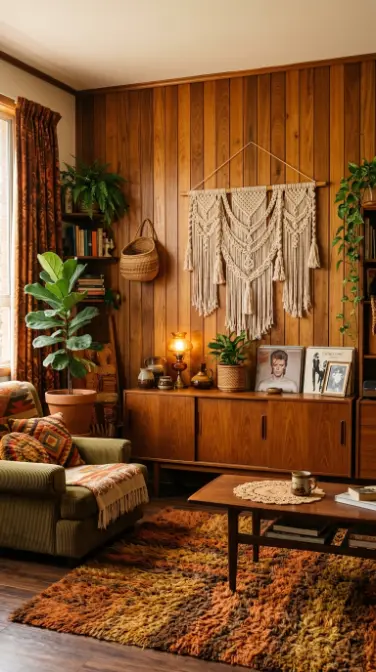
The teak or walnut credenza — long, low, with tapered legs and either sliding door or tambour-front storage — is the iconic 1970s storage furniture piece. Styled on top with a collection of terracotta pots, ceramic lamps, and a record player, it becomes the room’s most characterful and most era-defining horizontal surface.
4. Rattan Pendant Lighting — Large Globe or Drum Forms
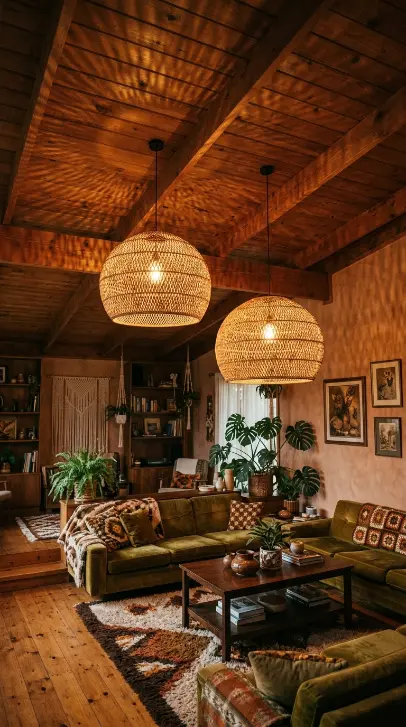
The rattan pendant light — in globe, drum, or open-weave dome form — is the 1970s ceiling lighting object that most immediately transforms the ambient quality of a room. Its woven natural material casts patterned warm light through the gaps in the weave, warming every surface below it and giving the room the particular organic quality that distinguishes earthy maximalist from any other maximalist approach.
5. Macrame Wall Hangings Above the Sofa
Large macrame wall hangings — knotted natural cotton or jute, sometimes with wooden dowels at the top, sometimes with feathers or beads woven into the knots — above the sofa provide the 1970s living room’s characteristic hand-crafted, bohemian wall covering. The larger and more generous the macrame, the more it reads as a genuinely considered 70s interior decision rather than a casual accessory.

6. An Abundance of Houseplants — The 70s Indoor Garden
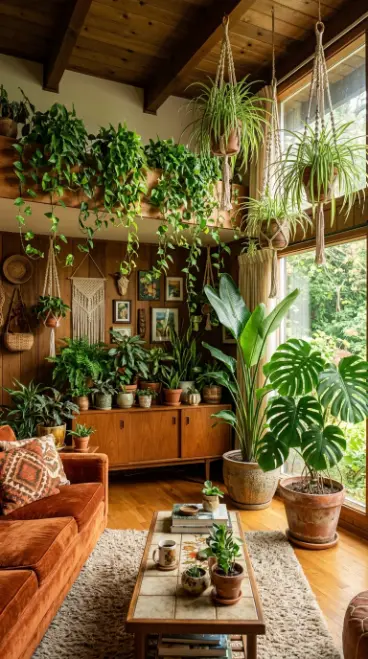
The 1970s living room contained more houseplants than almost any other decade’s interior ideal. Spider plants, pothos, Swiss cheese monsters, bird of paradise, Boston ferns, and tall snake plants occupied every corner, hung from the ceiling in macrame plant holders, trailed from shelves, and sat in ceramic and terracotta pots on every surface. An earthy maximalist 70s room without plants is missing its most fundamental living material.
7. Wood Panelling on One Wall for Warmth and Texture
Wood-panelled walls — tongue-and-groove vertical planks in warm timber tones, or the darker horizontal panelling characteristic of 1970s dens and family rooms — applied to one living room wall create an immediate and enveloping sense of warmth that paint alone cannot achieve. Against warm timber panelling, all the other earthy maximalist elements — velvet, rattan, shag — read more richly.
8. A Velvet or Corduroy Sectional in Burnt Orange, Avocado, or Deep Brown
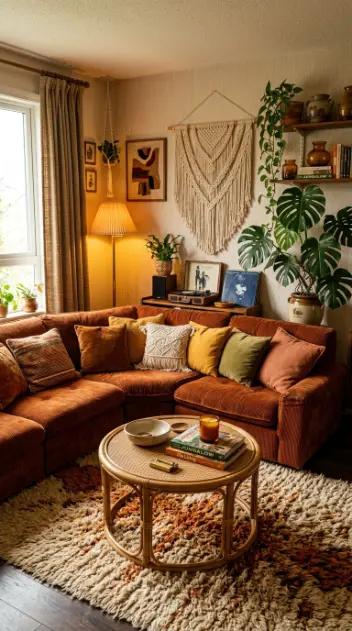
The 1970s sectional sofa — low profile, modular, upholstered in velvet, corduroy, or heavy woven fabric in the era’s signature earthy tones — is the room’s seating anchor and its most dramatic single furniture statement. A burnt orange velvet sectional on a shag rug, surrounded by plants and rattan, is one of the most instantly recognisable and most warmly beautiful interiors available in contemporary decorating.
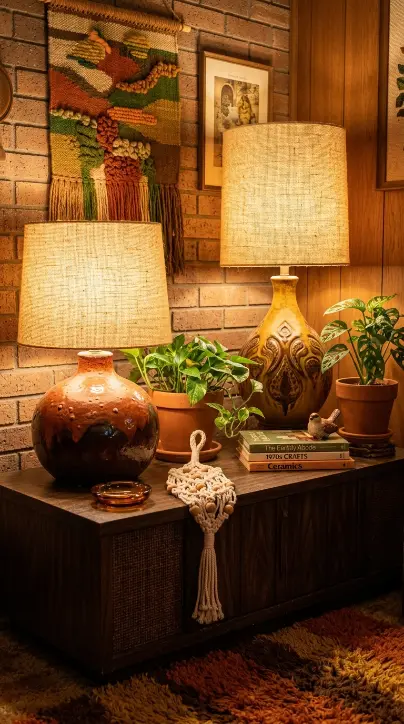
9. A Ceramic Table Lamp as a Sculptural Light Object
The ceramic table lamp — bulbous or organic form in warm terracotta, harvest gold, or deep brown glaze — is both a functional light source and the 1970s living room’s most characteristic decorative object. Two matching ceramic lamps on a credenza or one large ceramic lamp on a side table warm the room with amber light and add the hand-made material quality that distinguishes 70s earthy maximalist from all later decades.
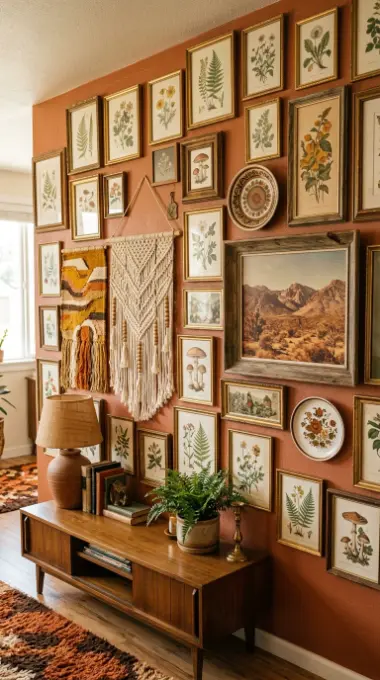
10. A Gallery Wall of Vintage Prints, Woven Pieces, and Botanical Art
The 1970s gallery wall mixes vintage botanical prints in warm tones, woven textile wall art, macrame sections, oversized photographic prints, and hand-painted ceramic plates on the wall — arranged without strict grid logic, layered densely, and covering a large wall area. It is the maximalist wall at its most genuinely personal and most era-specific.
11. Rattan Armchairs and a Rattan Coffee Table in the Seating Group
Rattan — woven, natural, warm honey-toned — in the form of an Egg chair, a Papasan, or a more geometric armchair form beside a rattan or bamboo coffee table sits in the 1970s living room as the natural material counterpart to all the velvet and corduroy. The combination of velvet upholstery and rattan furniture in the same seating group is one of the decade’s most beautiful and most sustainable material pairings.
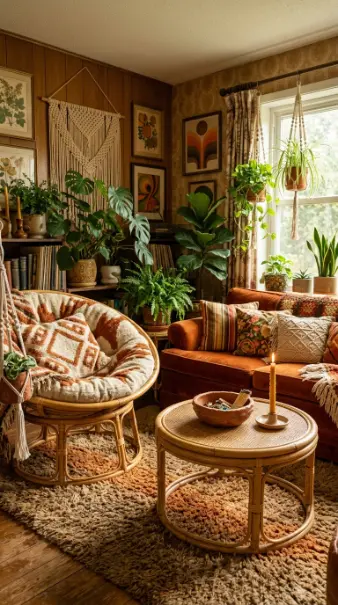
12. The Complete 1970s Earthy Maximalist Living Room
Harvest gold walls with wood panelling on one side. A burnt orange velvet sectional on a deep shag rug. Rattan pendant lights above. A long teak credenza below a large macrame wall hanging. An abundance of houseplants — monstera, spider plants, trailing pothos. A rattan Egg chair beside the credenza. Two ceramic table lamps in warm terracotta glaze. A vintage botanical gallery wall on the fourth wall. The complete 1970s earthy maximalist living room is not a room that is trying to impress — it is a room that simply refuses to be boring, and every surface and every corner confirms it.