20 Quirky Home Decor Curiosity Cabinet Dark Office
Curiosity-cabinet chic is somewhat mysterious, sometimes melancholy, and subtly reminiscent of the Victorian fascination with the natural wonders of the world — rooms rich in uncommon treasures mixed with humble found objects where adventure, intrigue, and unfinished stories seem to hang in the space. And in a dark home office, this aesthetic finds its most natural and most powerful home.
The dark office is no longer a design apology. It is a deliberate choice — the choice to create a workspace that feels like somewhere rather than anywhere, a room that has weight and atmosphere and a quality of focused intimacy that a bright white office with cable management and a standing desk simply cannot replicate. Dark walls that absorb light rather than reflect it. Warm amber lamps instead of overhead panels. Shelves that hold objects with stories instead of folders with labels. A desk that feels like a piece of furniture rather than a flat surface with legs.
For too long, interior design has been about the set — the matching sofa, the coordinated rug, the predictable art. In 2026 the most compelling spaces are discovery-driven — personal, narrative-layered, and built around the things a person actually finds fascinating rather than the things a room is supposed to contain. The curiosity cabinet dark office is exactly that philosophy applied to the workspace. It is not organized for productivity alone. It is organized for wonder. The best examples have collections with a story to tell — and the story makes sense. The pieces should be interesting and unique, showcased in a way that complements the room’s furnishings yet strong enough to stand out.
These 20 ideas cover every dimension of creating a quirky, curiosity-cabinet-style dark home office — from the walls and the lighting to the desk, the shelving, the collected objects, and the atmospheric details that make the difference between a dark room with furniture in it and a dark office that feels like the most interesting room in the house.
1. Paint Every Wall and the Ceiling in the Same Deep Dark Color
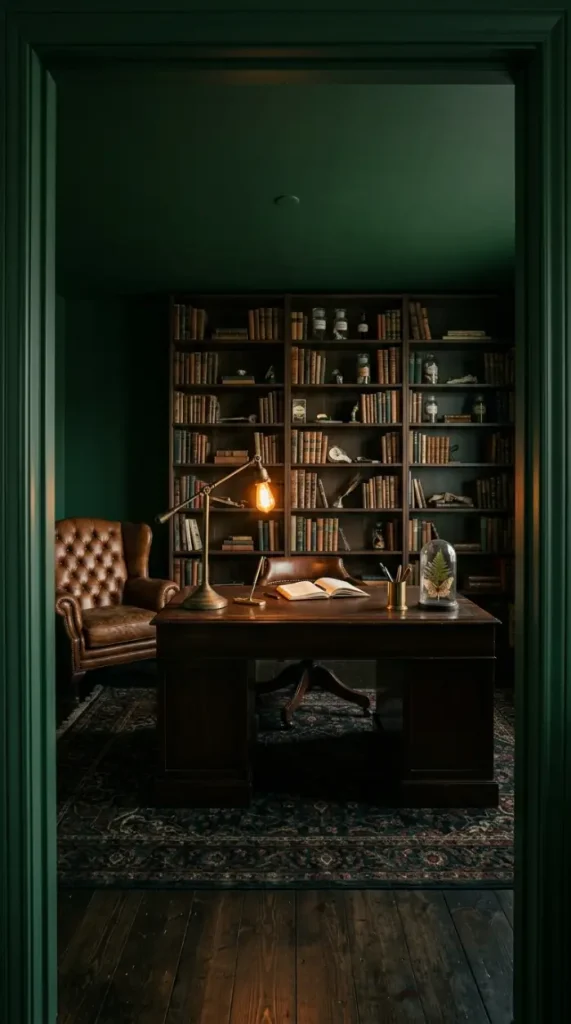
The curiosity cabinet dark office begins with one foundational decision that changes the entire character of the room: painting all four walls and the ceiling in the same deep, saturated dark tone — deep forest green, dark charcoal, inky navy, or rich burgundy — in a flat matte finish, with no break between ceiling and walls. When the same dark color wraps every surface including the ceiling, the room loses its conventional boundaries. The corners disappear. The ceiling descends into the same atmospheric envelope as the walls. The room becomes a contained world — its own private atmosphere — and everything placed within it gains presence and importance against the dark ground that a white or neutral room can never provide. The flat matte finish is critical — any sheen at this depth reads as cheap and undoes the entire effect.
2. Build a Full Wall of Floor-to-Ceiling Dark Timber Bookshelves
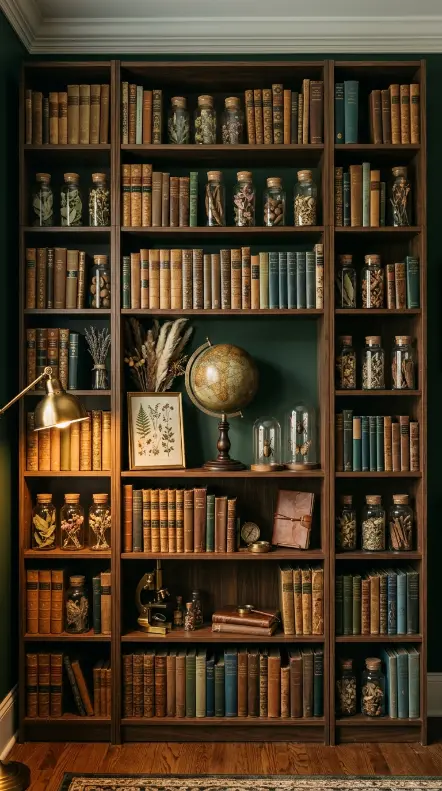
The curiosity cabinet dark office lives or dies on its shelving — and floor-to-ceiling dark timber bookshelves covering one complete wall from edge to edge are the structural backbone of the entire aesthetic. In dark stained walnut, ebonized oak, or deep mahogany, the shelves hold not just books but the collected evidence of a curious and well-traveled mind: leather-bound volumes, glass apothecary jars with specimens, brass scientific instruments, framed botanical prints leaning against spines, taxidermied insects under glass domes, antique globes, stacked maps, dried botanical bundles, and the kind of small objects that make visitors lean in and look more closely. Old-world collectors put their collections into apothecary jars, under bell jars or in framed shadow boxes to highlight their beauty and individuality — under glass they become important. The shelves should look full without looking cluttered — each object given enough space to breathe and be seen, nothing competing too aggressively with its neighbor, the whole wall reading as a single composed installation rather than accumulated storage.
3. Display a Curiosity Cabinet Glass Case as the Office Centerpiece
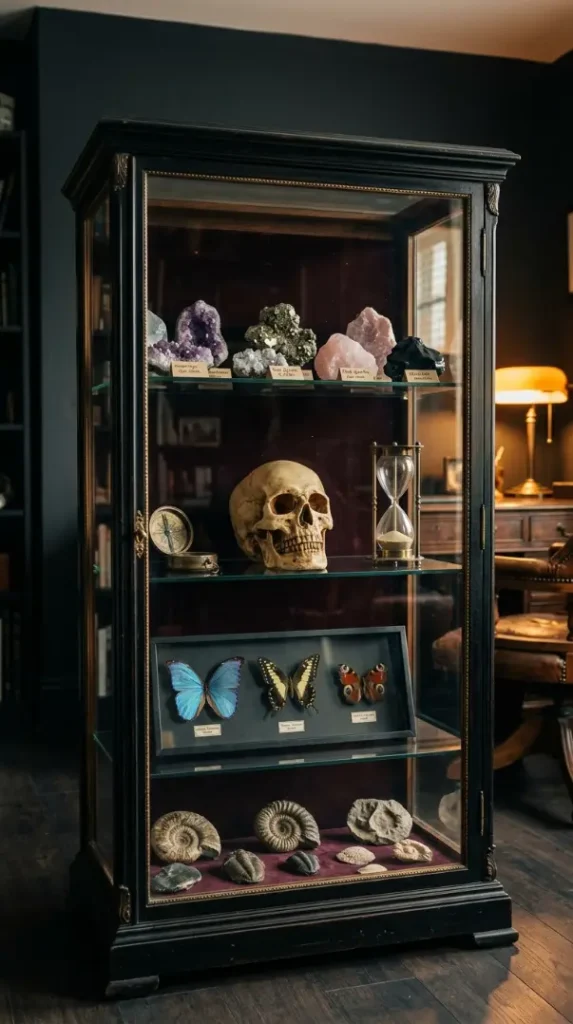
A glass display cabinet or glass-topped display table put smaller objects front and center with larger pieces layered underneath or toward the back — grouping similar objects in masse captures the curiosity-cabinet feel and has a striking aesthetic impact. In the dark curiosity cabinet office, a single dedicated glass display case — a Victorian-style museum cabinet with a dark timber frame and glass panels on all sides — positioned as the room’s centerpiece object tells the entire story of the office’s aesthetic in one piece. Inside: antique keys in graduated sizes on a velvet-lined tray, a collection of mineral specimens and geodes, taxidermied butterflies pinned on a dark backing, a small human skull replica, fossils in varying sizes, and small scientific instruments. The glass case makes every object within it precious — it declares that these things are significant, that they were chosen deliberately, and that they deserve to be seen.
4. Use a Dark Antique Roll-Top Desk as the Workspace
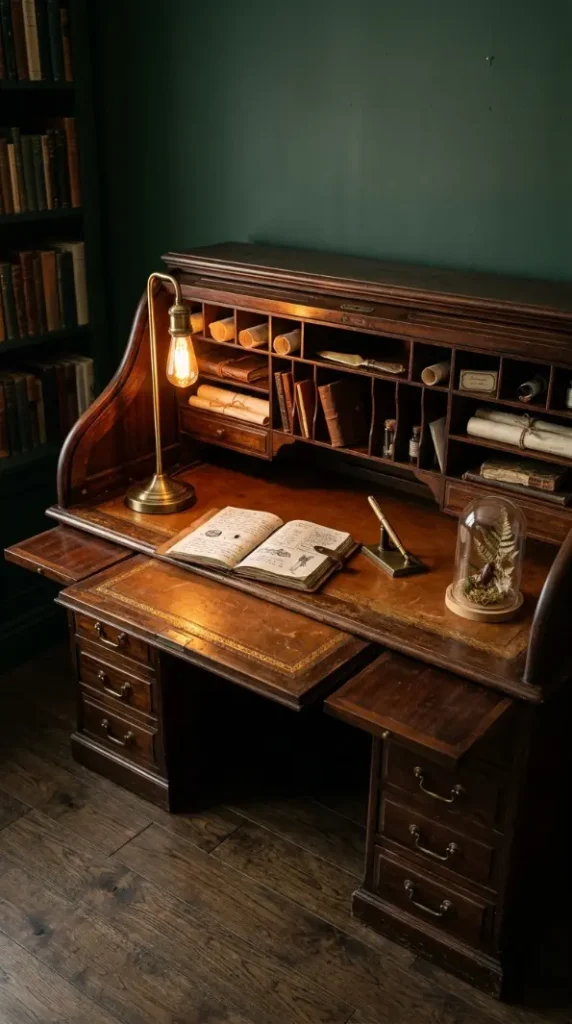
A vintage desk with carved legs, worn wood, or a roll-top style gives a room that forgotten study feel — vintage desks offer more personality and charm than modern ones. In a curiosity cabinet dark office, the roll-top desk is not merely a functional workspace but the room’s most characterful piece of furniture — a piece of history that has survived long enough to find itself in a room designed around the very qualities that make it irreplaceable. The tambour roll-top, when open, reveals a complex internal landscape of small pigeonholes, pull-out trays, and tiny drawers that is itself a kind of curiosity cabinet — each compartment housing a different small object, a different category of thought, a different fragment of the work being done at the desk. Leather-tooled surface, brass hardware, worn patina — the roll-top desk is the centerpiece the curiosity cabinet dark office was always building toward.
5. Install Dark Velvet Curtains From Ceiling to Floor
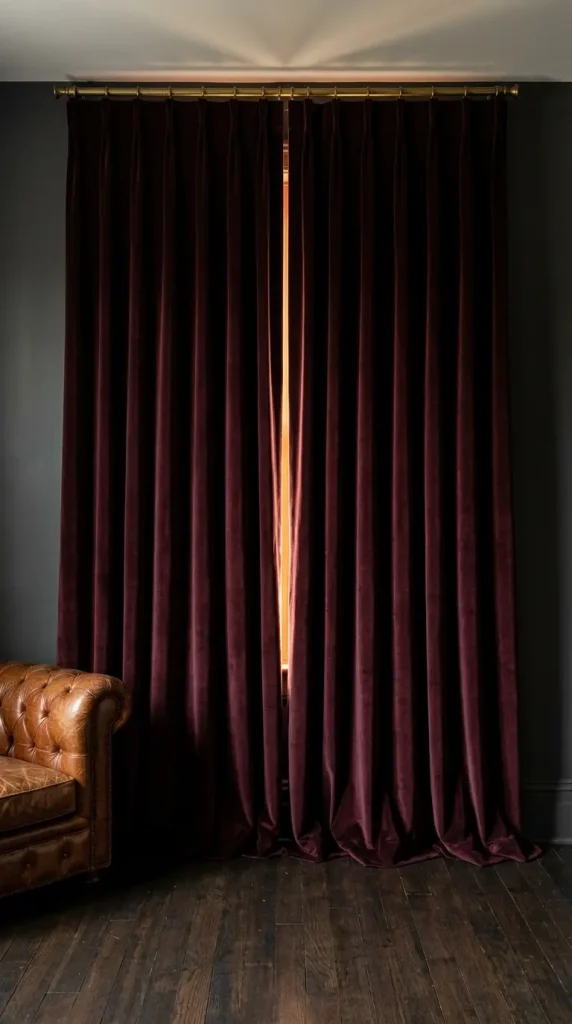
Thick curtains in wine red, bottle green, or dark gold absorb sound and light, helping to create a quiet, soft workspace that feels luxurious and private. In the curiosity cabinet dark office, the curtains are not window treatments in the conventional sense — they are architectural elements that define the room’s atmospheric quality as directly as the wall color. Heavy dark velvet curtains — in deep burgundy, forest green, or inky navy — hung from a slim brass curtain rod at ceiling height and falling in full heavy folds to the floor on both sides of the window create a theatrical darkness that makes the room’s own warm lamplight feel richer and more precious by contrast. The velvet absorbs both light and sound, giving the office a quality of hushed containment — the outside world muffled, the inside world warm and self-sufficient.
6. Collect Antique Scientific Instruments as Desk Decor
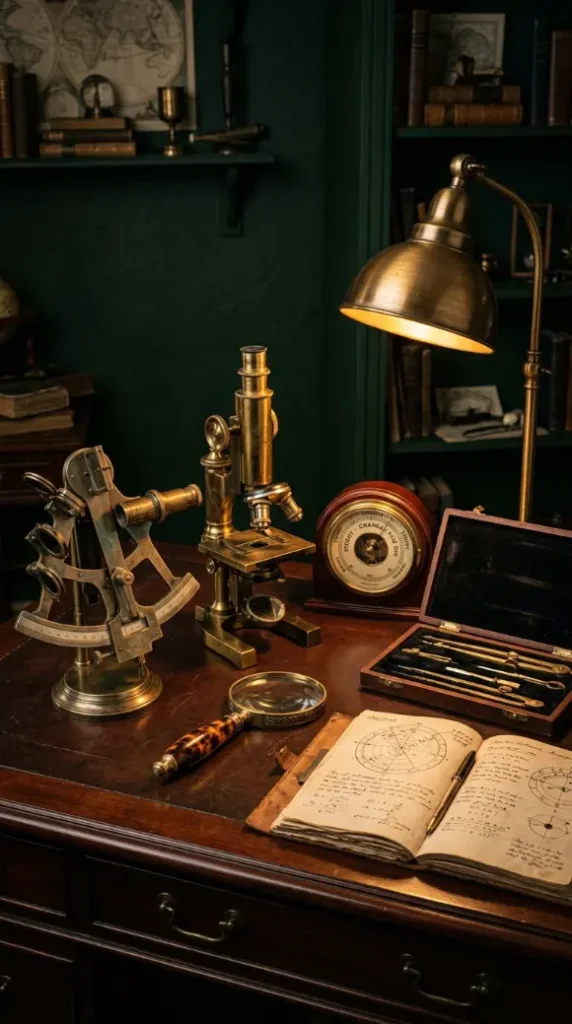
Vintage scientific instruments add a touch of nostalgia and intellectual charm to a curiosity cabinet — they showcase the beauty of old scientific discoveries while doubling as intriguing conversation starters. In the dark office, a collection of antique scientific instruments arranged on the desk surface and on shelves around it — a brass sextant, a vintage magnifying glass on a stand, an antique aneroid barometer in a wooden case, a Victorian microscope, a brass astrolabe, a set of drawing compasses in a velvet-lined case — transforms the workspace from an office into something closer to a Victorian gentleman scientist’s private laboratory. Each instrument was made to measure, observe, or understand the world — and their presence in the dark office communicates the same intellectual ambition, the same curiosity about how things work, in the most quietly spectacular material language possible.
7. Mount Framed Antique Botanical and Anatomical Prints on the Dark Walls
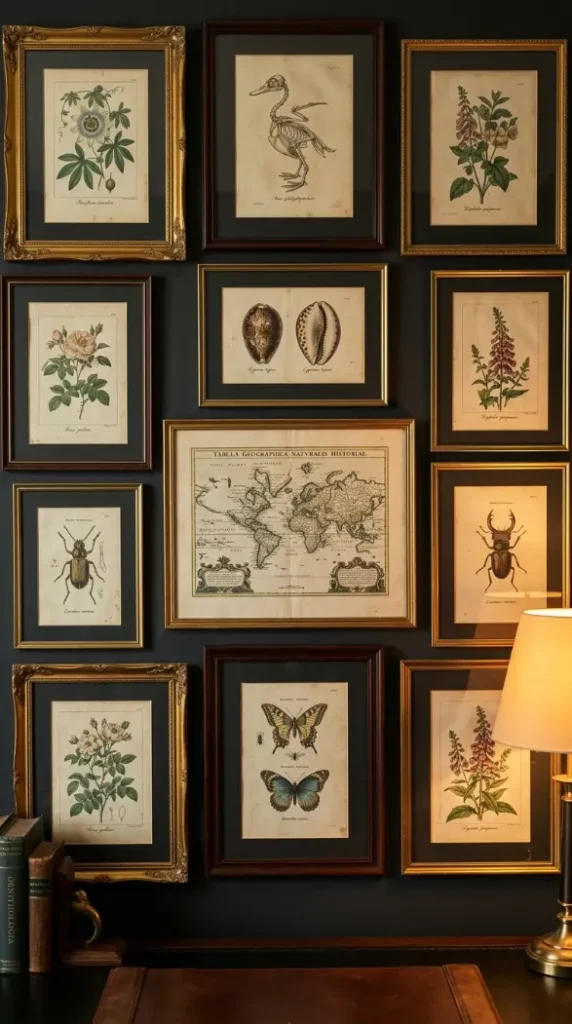
Framed detailed educational diagrams from vintage books or printables nod to Victorian science and natural history — two recurring motifs in the curiosity cabinet aesthetic. On deep dark office walls, framed antique botanical illustrations — the kind with hand-colored engravings of rare plants labeled in Latin, with visible plate marks and aged paper — and antique anatomical diagrams — cross-sections of shells, bird skeletons, insect morphologies — hung in a dense, overlapping gallery arrangement create a wall display that is simultaneously art collection, reference library, and cabinet of curiosities. The aged paper of the illustrations glows warmly in lamplight against the dark wall behind them, each frame becoming a small illuminated window into a specific corner of the natural world. Mix gilt frames with dark timber frames of varying sizes, hang them closer together than standard gallery spacing, and allow some to overlap slightly — the density is part of the aesthetic.
8. Place a Worn Leather Chesterfield Armchair in the Reading Corner
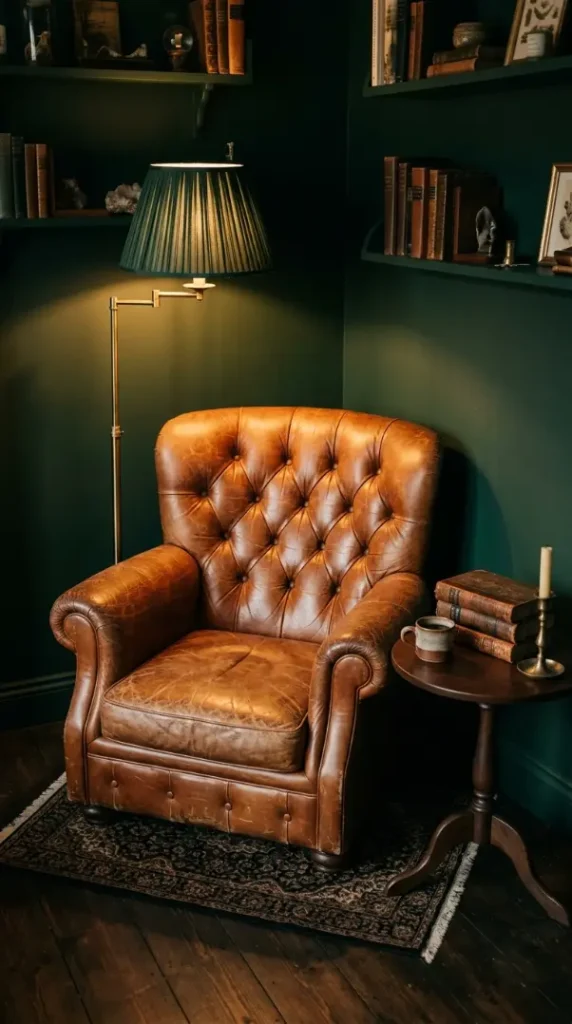
The curiosity cabinet dark office needs a chair that belongs to it as completely as the roll-top desk and the floor-to-ceiling shelves — and the worn cognac or tobacco leather Chesterfield armchair is that chair. Not a new Chesterfield with stiff leather and uniform button tufting — a genuinely worn one, where the leather has developed its own creases, its own areas of deeper color at the arms and seat, its own faded patina that makes it look like it has been sat in by several generations of serious readers. Positioned in the office corner with a small antique side table beside it, a brass floor lamp above it, and a stack of leather-bound books on the side table, the worn Chesterfield armchair creates a reading nook within the office that has its own distinct atmospheric identity from the desk zone — a place for a different kind of work, slower and more contemplative.
9. Install a Dark Tin Ceiling for Architectural Drama Overhead
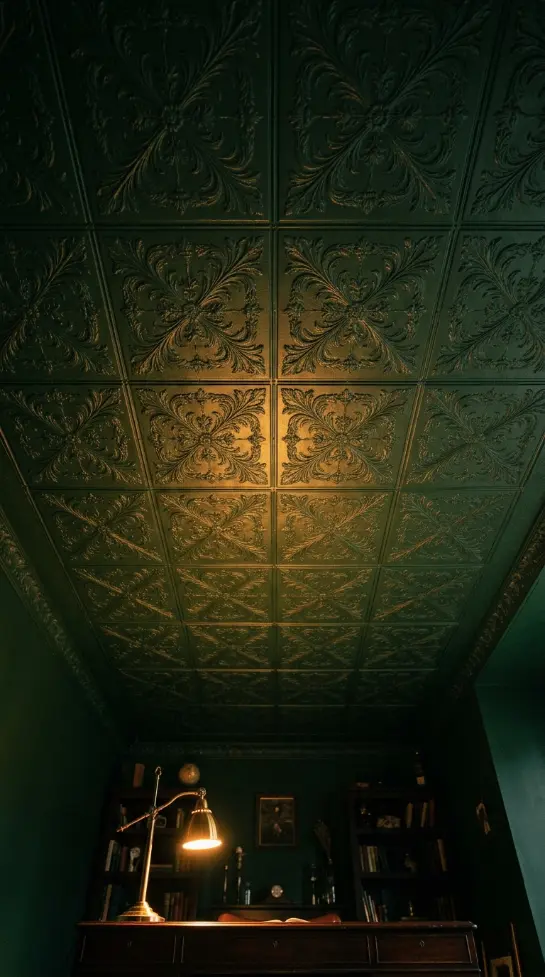
Tin decor is having a significant moment in 2026 — tarnished silver and tin aesthetic pieces are showing up everywhere as statement elements. In the curiosity cabinet dark office, a pressed tin ceiling — the kind found in Victorian commercial buildings and old Parisian apartments — painted in a dark tone matching the walls or left in its original aged metallic finish, creates an overhead surface with extraordinary decorative depth. The repeating geometric or botanical relief pattern of the pressed tin tiles catches lamplight at every angle, creating a ceiling that is never flat and never static — its shadows shifting as the light source below moves, giving the room an overhead texture that no painted or plastered ceiling could approach. Installed in dark forest green, aged bronze, or simply left in its natural oxidized tin, the pressed tin ceiling is the architectural decision that elevates the curiosity cabinet dark office from a styled room to a designed one.
10. Use Glass Apothecary Jars to Display Specimens and Collections
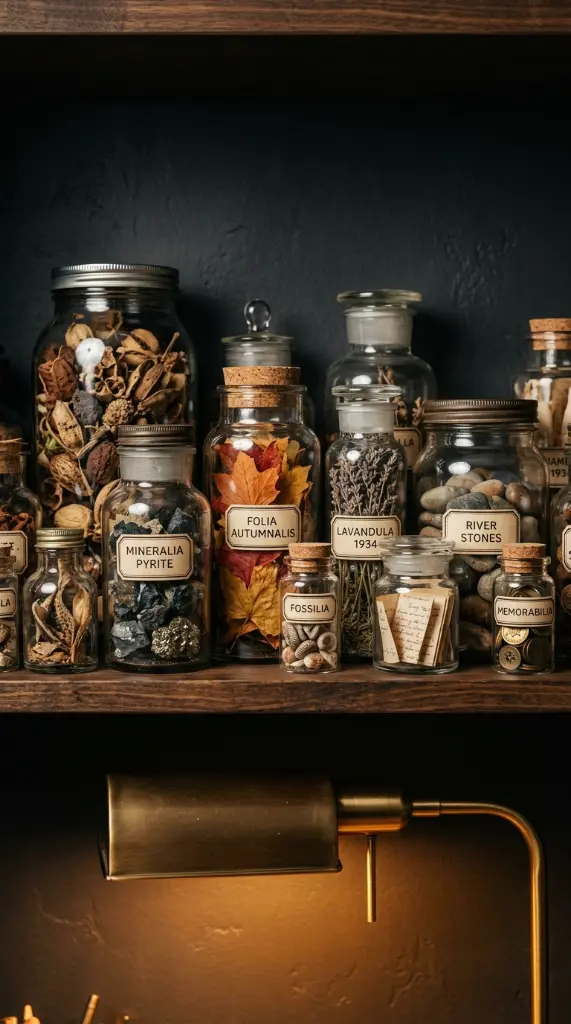
Original wonder rooms included fossils, preserved insects, botanicals and the such — dried flowers stored in vintage French canning jars, nests, feathers, and smudge sticks tucked here and there create the curiosity cabinet atmosphere. In the dark office, a collection of glass apothecary jars — in varying sizes from tiny to large, some with cork stoppers, some with glass lids, some with aged metal lids — arranged on shelves and across desk surfaces and windowsills contains everything that the curiosity cabinet aesthetic collects: dried seed pods, mineral fragments, pressed flowers, small fossils, dried herbs, sand from a specific beach, old coins, antique buttons, fragments of aged paper with handwriting on them. Each jar is a small contained world — a specimen of something specific — and together they create a display with the atmosphere of an old pharmacy or a natural history collection that has been assembled by someone with an exceptionally specific and well-traveled eye.
11. Hang a Vintage Celestial or Antique World Map on the Dark Wall
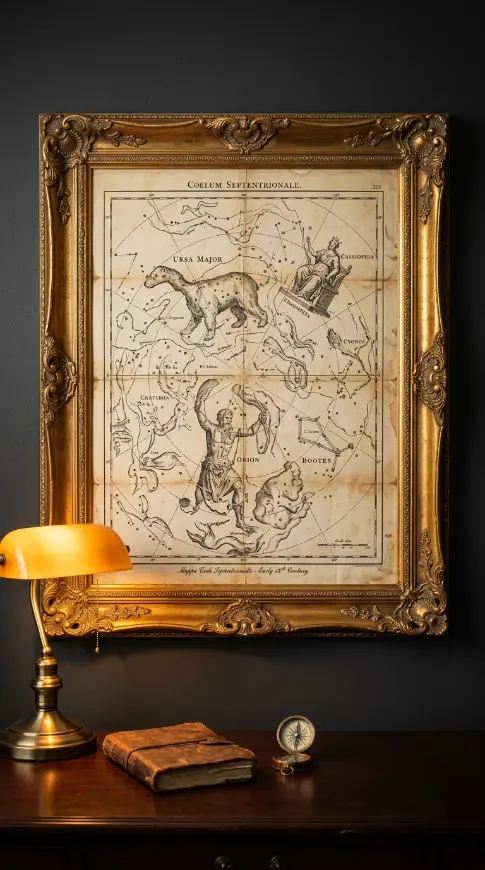
A large antique map — a celestial chart of the constellations, a hand-colored 18th-century world map, a historical anatomical diagram, or a vintage geological survey — framed in a substantial ornate gilt frame and hung as the primary statement piece on the dark office wall behind the desk creates a visual focal point that is simultaneously decorative, intellectual, and deeply atmospheric. The aged paper of a genuine antique map or a high-quality reproduction — yellowed at the edges, with visible fold lines, hand-drawn lettering, and the particular quality of a world understood differently from how we understand it now — belongs in a curiosity cabinet dark office in the same way a great painting belongs in a museum. It is the primary art object from which every other object in the room takes its reference.
12. Create a Dark Academia Gallery Wall With Vintage Portraits
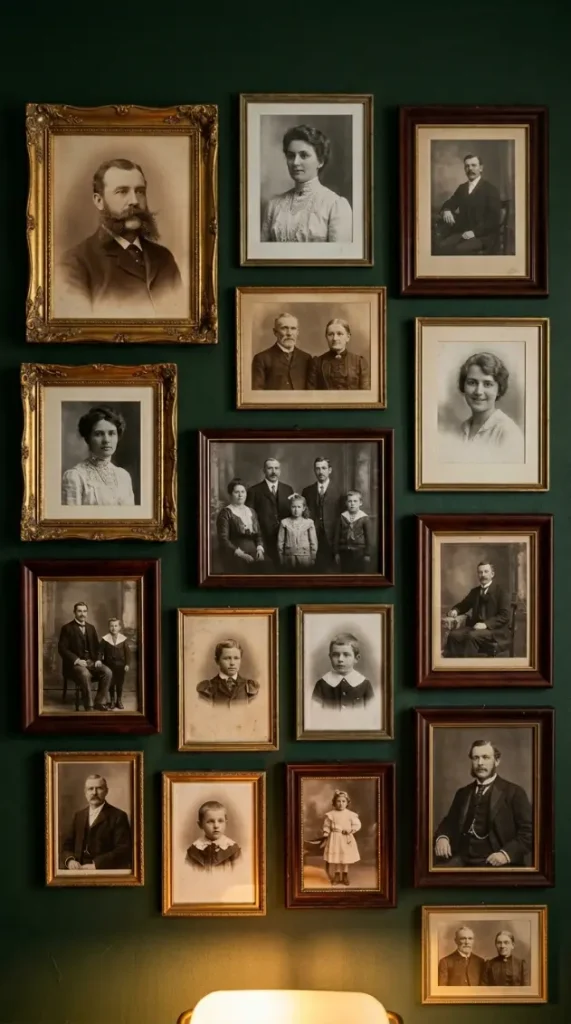
A gallery wall of framed vintage portrait photographs — black and white or sepia-toned portraits of unknown people from the early 20th century, found at antique markets and estate sales — hung on the dark office wall creates one of the most atmospheric and most distinctly curiosity-cabinet decorative installations possible. The unnamed subjects in their formal poses, their unknown stories, their expressions held for a camera they had perhaps never encountered before — all of them looking out from the dark wall of a 21st century home office with the same quiet, serious faces — create a wall that generates genuine questions, genuine curiosity, genuine wonder about who these people were and where their paths eventually led. Framed in ornate gilt or dark timber frames, grouped in a dense arrangement, they transform a dark wall into a portrait gallery that belongs to another century.
13. Use a Globe as a Sculptural Desk Accent
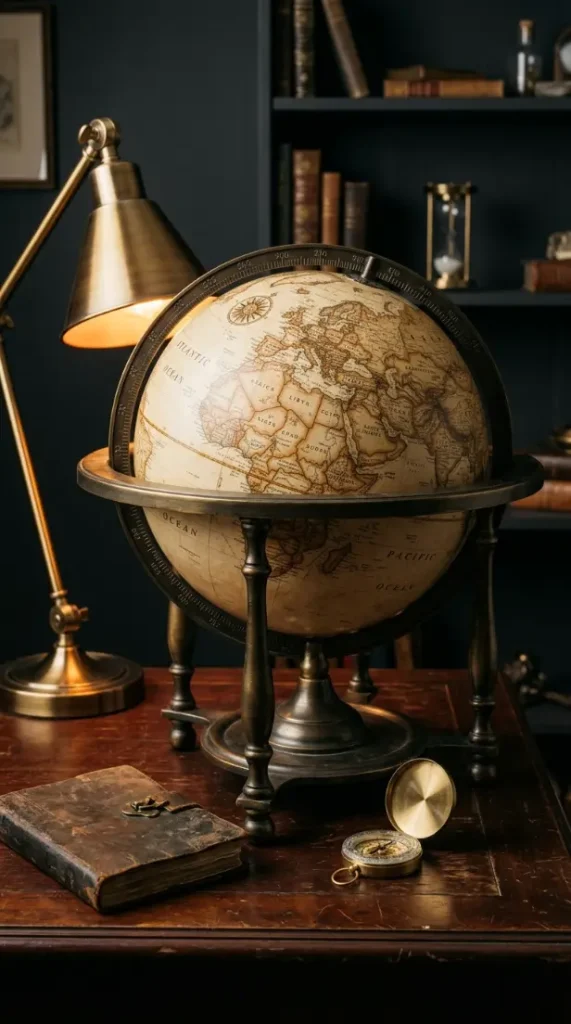
An antique or antique-style globe — on a dark brass or aged mahogany stand, in warm aged cartographic colors — is one of the most universally recognized and most deeply appropriate objects for the curiosity cabinet dark office. It references exploration, cartography, the desire to understand the world as a physical object, and the Victorian intellectual tradition of collecting beautiful instruments of knowledge. On a desk, it sits at the precise intersection of decorative object and functional reference tool — and whether it is consulted or not, its presence communicates something true about the mind of the person who works at this desk. An antique-style globe with aged cream and sepia cartographic coloring, on a dark brass three-legged stand, positioned beside the desk lamp in the warm amber lamplight, is the single most characterful desk accent the curiosity cabinet dark office has available to it.
14. Install a Dark Green Banker’s Lamp as the Primary Desk Light
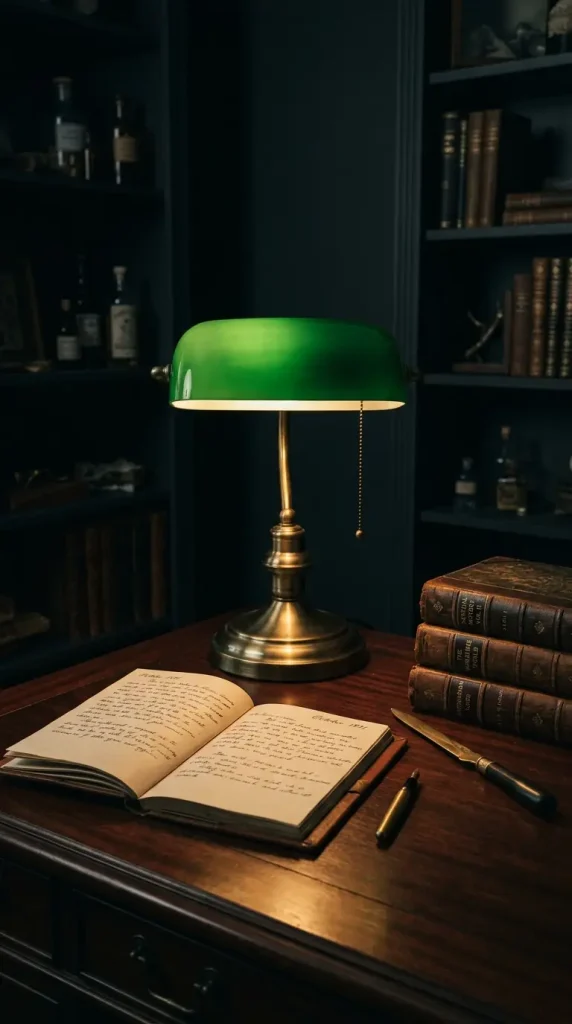
The green glass banker’s lamp — its emerald or forest green glass shade casting a distinctive pool of warm green-tinted light downward onto the desk surface — is the quintessential curiosity cabinet dark office lamp, and it earns that position because nothing else in the history of desk lighting has been so specifically associated with the combination of serious intellectual work and beautiful atmospheric light. A solid brass banker’s lamp with a deep forest green cased glass shade, placed at the desk and switched on, turns the entire desk surface into a pool of warm green-amber light that exists in no other domestic lighting context. The green shade filters the warm bulb inside into a light that is simultaneously warm and cool, amber and green, and the pool it casts on the dark desk surface is one of the most characterful and most photographically compelling small-scale lighting moments in any interior.
15. Display a Collection of Antique Keys in a Shadow Box Frame
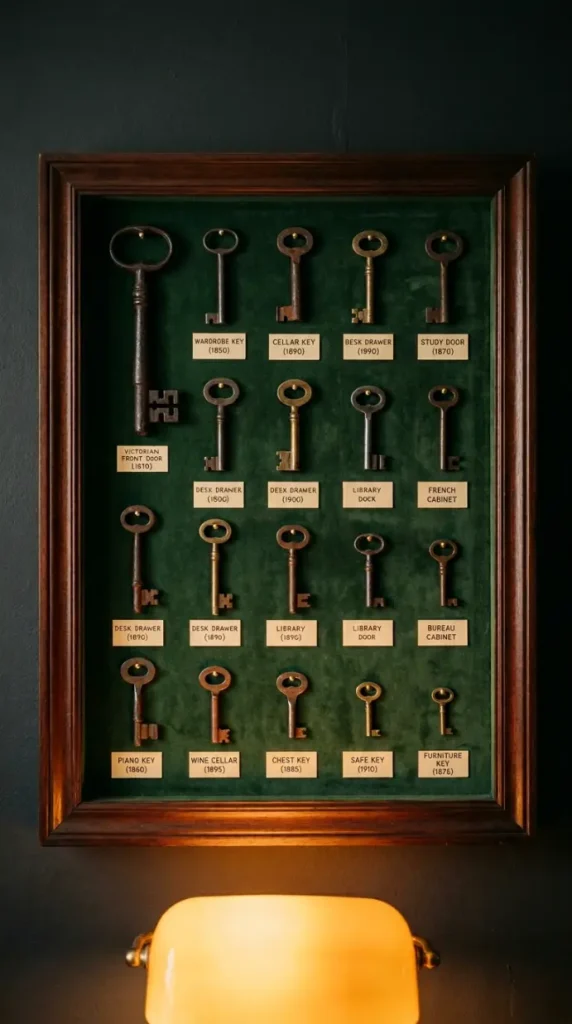
An antique keys collection adds mystery and charm to a curiosity cabinet — each key holds untold stories waiting to be discovered. A large shadow box frame — deep enough to hold objects at varying depths — lined in dark velvet and filled with a collection of antique keys in varying sizes, shapes, and ages of patina, mounted on the dark office wall, turns a collection of small metal objects into a museum-worthy installation. Large ornate Victorian door keys, small cabinet keys with decorative bow heads, long slender skeleton keys, tiny jewelry box keys with intricate bit patterns — each one mounted at a specific point on the dark velvet backing, each one labeled with a small cream card below it in a fine hand. The shadow box key collection asks the most compelling question any curiosity cabinet object can ask: what did each of these once open, and where is that door now?
16. Add a Dark Taxidermy or Natural History Object as a Statement Piece
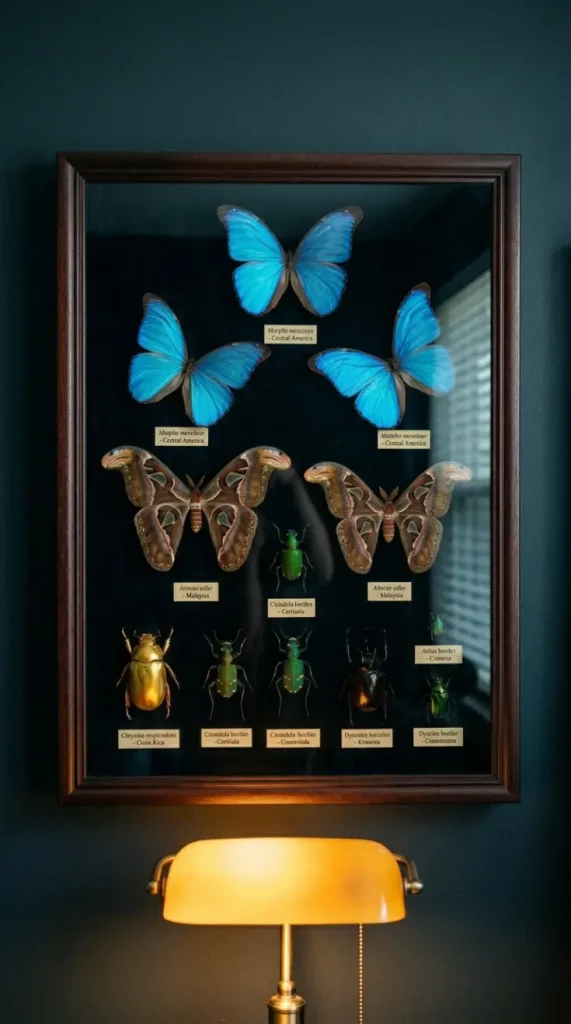
The natural history object — whether a genuine piece of taxidermy, a museum-quality replica, or a carefully chosen natural specimen — is the curiosity cabinet element that most clearly declares the aesthetic’s commitment to the Victorian collector tradition. Displaying taxidermy butterflies adds a touch of whimsy and nature to a curiosity cabinet. In the dark office, a large framed entomology display — a professional collection of exotic beetles, iridescent blue morpho butterflies, and large tropical moths pinned on a dark backing and mounted behind glass in a deep timber frame — hung on the dark wall or displayed on the desk surface under a large glass dome communicates the curiosity cabinet aesthetic at its most fully realized. The insects, in their preserved perfection, are simultaneously beautiful and unsettling, scientific and decorative, natural and deeply artificial — and that specific tension is exactly what the curiosity cabinet dark office is built on.
17. Line the Windowsill With Colored Glass Bottles and Specimen Jars
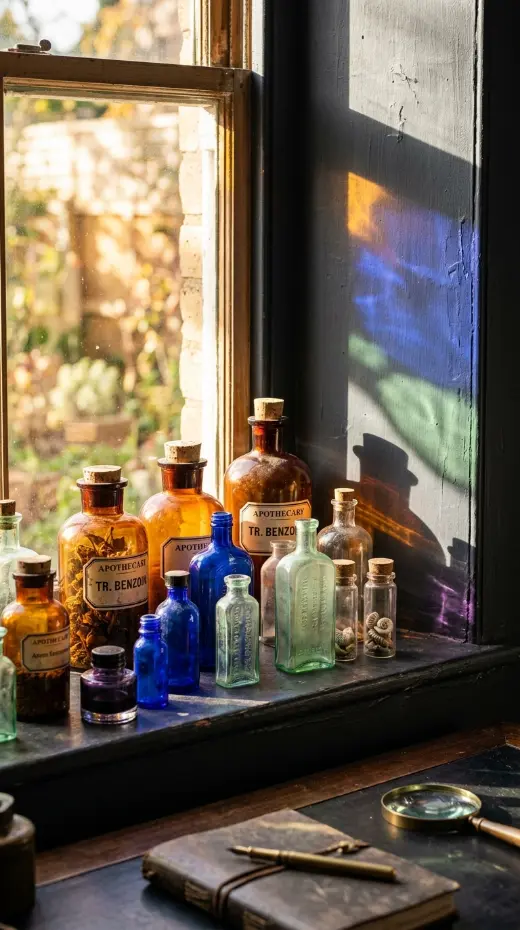
When warm afternoon light passes through a collection of glass objects on a dark office windowsill — amber glass apothecary bottles, deep cobalt blue specimen jars, pale green vintage medicine bottles, and clear glass vials — the colored light they throw onto the dark wall and the dark desk surface beside the window is one of the most atmospheric and most unexpected light effects possible in a home workspace. The bottles and jars work double duty: as curiosity cabinet collected objects during the day, and as a natural light installation in the late afternoon when the sun is low and its light is warm. Incorporating multiple light sources creates warmth and depth — key to the dark office vibe. The colored glass windowsill is the one light source in the curiosity cabinet dark office that requires no electricity and no installation — just a collection of interesting old glass and the right time of day.
18. Install a Dark Green Baize-Lined Writing Surface on the Desk
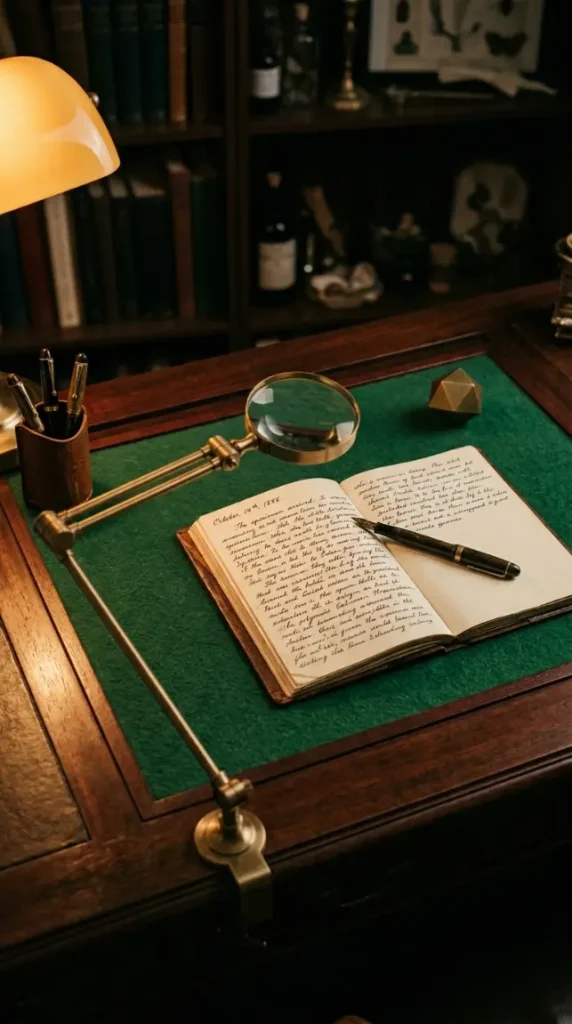
The baize-lined writing surface — the traditional dark green wool baize covering that Victorian desks used as both a writing surface and a color accent — is the desk detail that most clearly places the curiosity cabinet dark office in its proper historical and aesthetic lineage. A writing desk with a recessed dark green baize panel — or a large blotter pad in the same dark green baize — set at the center of the desk surface creates a working zone that is both practically superior for writing and visually specific to a design tradition that values the quality of the working experience as much as the quality of the objects around it. On a dark mahogany desk, the green baize is the one surface in the room where the work actually happens — and making that surface beautiful is one of the most quietly considered design decisions the curiosity cabinet dark office can make.
19. Drape Dark Fabric Over Objects to Create Mystery and Atmosphere
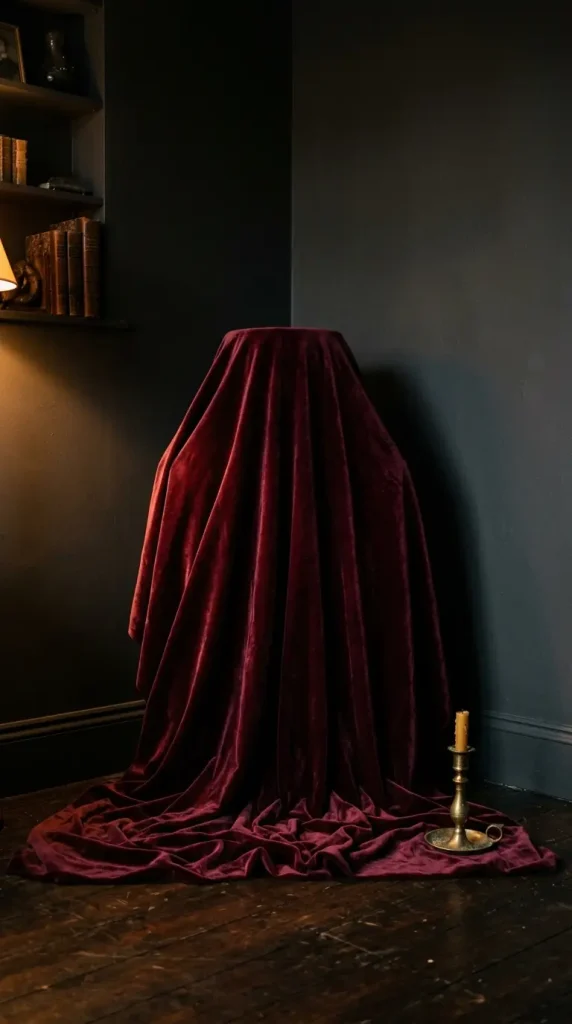
The covered object — a painting, a mirror, or a piece of equipment draped in dark velvet or heavy linen — is one of the most theatrical and most atmospheric curiosity cabinet gestures available. It implies that what is beneath the covering is significant, perhaps too significant to be seen at all times, perhaps revealed only at the right moment. In a dark curiosity cabinet office, one large draped form in a corner — a covered object under dark velvet that might be a birdcage, a sculptural piece, or a vintage instrument — creates an atmosphere of mystery that makes the room feel like it has secrets. It also creates a beautiful textural mass of dark fabric that contributes to the room’s overall sensory richness in a way that requires nothing more than a length of dark velvet and the confidence to leave something permanently covered.
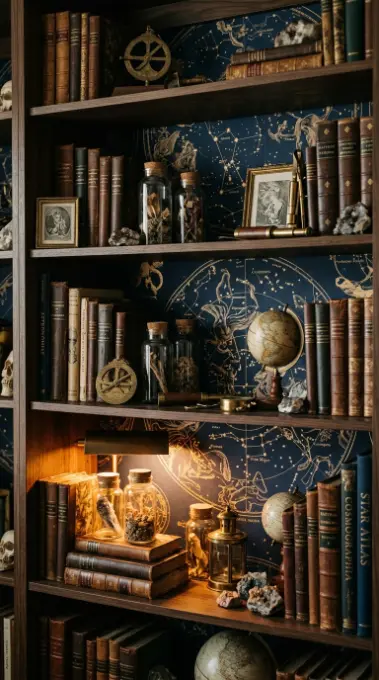
20. Use Dark Wallpaper With a Botanical or Celestial Pattern Behind the Shelves
A dark patterned wallpaper — applied to the wall visible behind and between the books and objects on the office bookshelves — adds a layer of visual depth and decorative richness that painted shelves and painted walls cannot approach. The pattern, glimpsed through the gaps between books and objects, creates a background that is never fully visible and never fully hidden — always suggesting more than it reveals, always contributing to the room’s overall density of interest without competing with any individual object. A deep navy celestial map wallpaper, a dark forest green botanical print, or an inky black and gold fern pattern applied to the shelf wall behind the books transforms the bookshelf from a storage and display system into a composed installation with its own internal world.