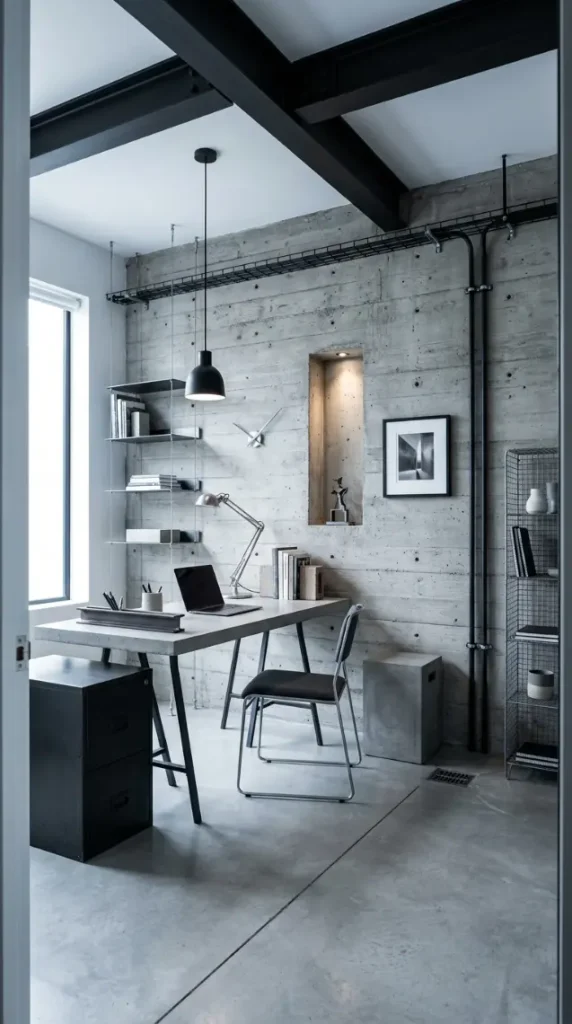
24 Home Office Inspiration Modern Minimal Concrete Steel
A home office built from poured concrete and raw or blackened steel speaks an entirely different material language than the warm wood and linen office, and the difference is not merely aesthetic but functional: where warmth and softness invite lingering, concrete and steel’s cool, hard, unyielding surfaces create an environment that reads as serious, architectural, and built specifically for sustained focus rather than rest. This is an office for someone who wants the room itself to communicate precision before a single word of work has been done in it.
Concrete is the material that anchors this entire aesthetic, whether as an actual poured concrete desk slab, a polished concrete floor, or a single feature wall left in its raw, board-formed state with the timber grain pattern of its casting mold still visible across the surface. Concrete’s particular honesty as a material — it never disguises what it is, never imitates anything else, and carries the literal record of its own making in every surface imperfection and form-tie hole — gives a minimal office a foundation of genuine architectural seriousness that no painted drywall could replicate.
Steel, typically left raw and allowed to develop a light surface patina, or blackened and sealed in a matte powder coat, contributes the second half of this material story: where concrete is heavy, mineral, and static, steel is thin, structural, and precise, appearing as slim desk legs, open shelving brackets, a single dramatic cantilevered shelf, or a task lamp’s articulated arm. The contrast between concrete’s mass and steel’s linearity is the visual relationship the entire room is built around, and getting that relationship right — concrete doing the grounding, steel doing the defining — is the single decision that separates a genuinely considered industrial-minimal office from one that merely looks unfinished.
The discipline that governs successful minimal styling in this material world is more demanding than in any warmer aesthetic, because concrete and steel offer the eye almost nothing in the way of inherent visual softness or warmth to fall back on, meaning every decorative choice must be more deliberate, every surface kept more genuinely empty, and every accent object selected with more precision, because a cluttered desk against a concrete wall reads as chaos in a way the same clutter against a warm wood backdrop never would.
These 24 ideas cover every dimension of the modern minimal concrete and steel office — from the foundational desk and wall treatments to the shelving, lighting, seating, and the complete room where every poured surface and every steel edge works together as one disciplined, architectural, genuinely focused place to work.
1. The Poured Concrete Desk Slab as the Architectural Centerpiece
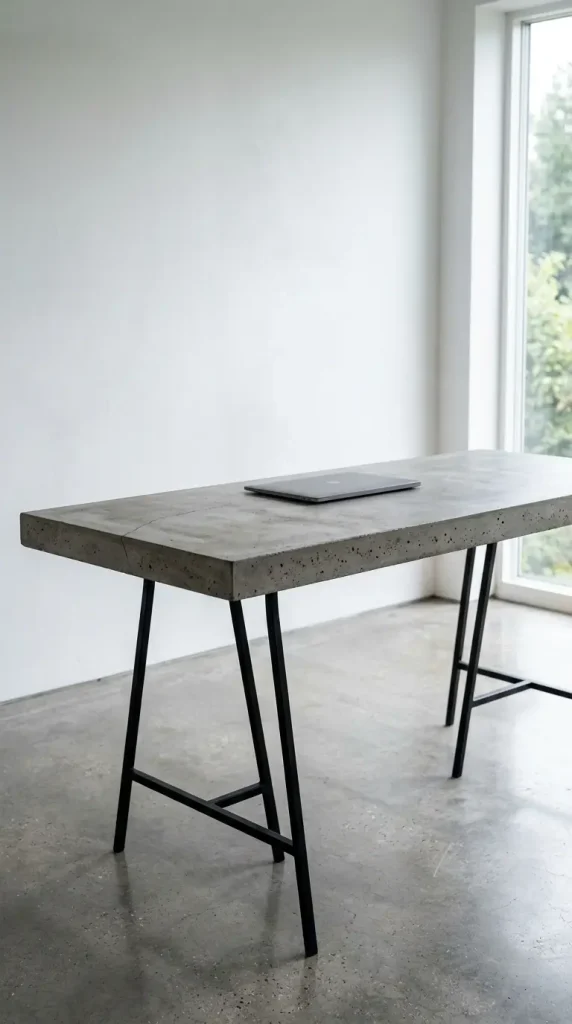
A genuine poured concrete desk — cast as a single solid slab rather than a concrete-look laminate or veneer applied over a cheaper substrate — establishes the room’s material honesty in its most literal and most structurally significant form, because the desk itself becomes a small piece of architecture rather than furniture in the conventional sense. A slab cast at 4 to 6cm thickness, supported on slim steel legs rather than a solid concrete base, achieves a visual paradox central to this aesthetic’s appeal: a material associated with permanence and mass appearing to hover with unexpected lightness, its true weight contradicted by the slimness of the steel structure holding it above the floor.
2. A Raw Board-Formed Concrete Feature Wall
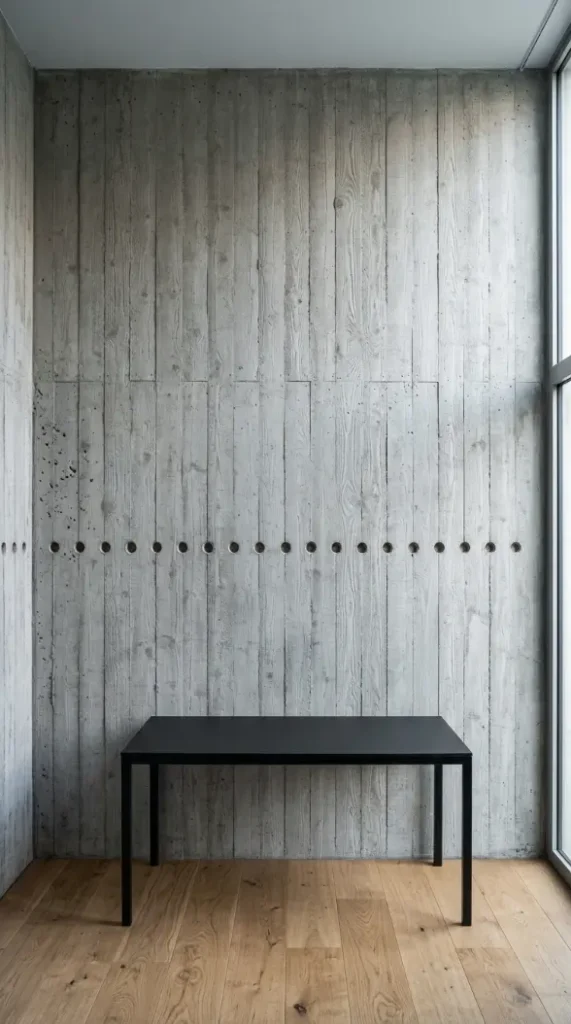
A single wall left in its raw, board-formed state — poured against a timber formwork that leaves the wood grain’s exact pattern imprinted permanently into the concrete’s surface once cured and the forms removed — gives a minimal office its most architecturally significant surface, because this wall literally records the specific physical process of its own construction in a way no applied wallpaper or paint treatment ever could. The visible grain lines, the occasional small air-bubble void, and the faint horizontal seams where one formwork panel met the next all read as evidence of genuine construction rather than decoration, anchoring the entire room in an industrial honesty that extends from the wall through every other material choice that follows it.
3. A Blackened Steel Cantilevered Shelf With No Visible Support
A single steel shelf, bracket-mounted directly into a concrete wall using a concealed structural fixing so that the shelf appears to project outward with no visible bracket, leg, or support beneath it, achieves the most dramatic possible demonstration of steel’s structural precision, because the apparent impossibility of an unsupported horizontal surface holding weight makes the engineering itself the design feature. This cantilevered form works specifically because concrete’s mass provides the genuine structural anchor the fixing requires, meaning the shelf’s drama depends entirely on the wall behind it being exactly the kind of solid, load-bearing material this aesthetic already prioritizes, one material choice directly enabling the visual impact of another.

4. A Single Black Steel Task Lamp With an Articulated Arm
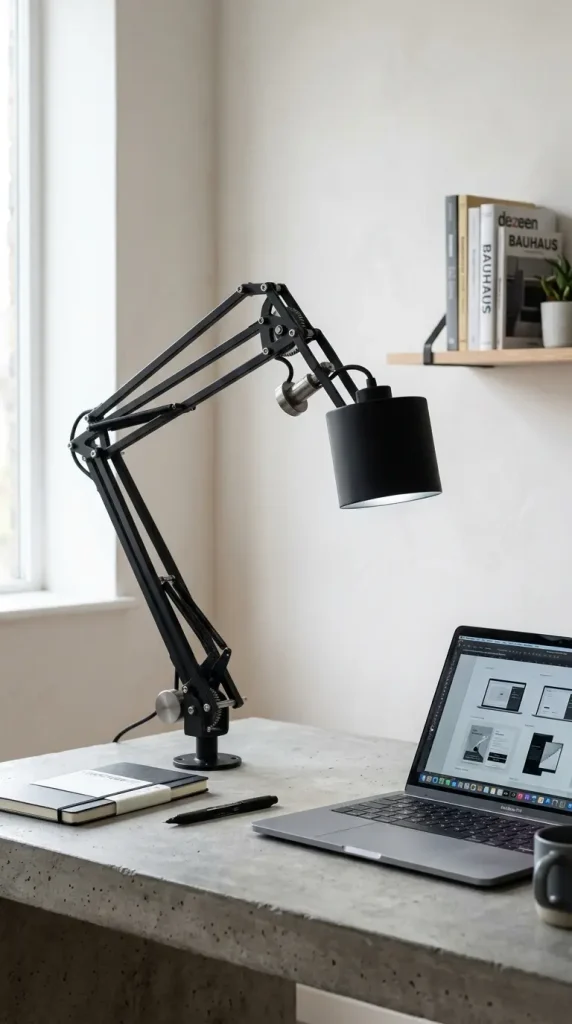
A task lamp built entirely from matte black steel, with a fully articulated multi-jointed arm allowing precise positioning and a simple cylindrical or conical shade with no decorative detail beyond its engineering, performs the same essential lighting function as any desk lamp while reinforcing the room’s commitment to visible mechanical honesty. Unlike a lamp with a fabric shade or a softly rounded ceramic base, this steel lamp’s joints, counterweights, and adjustment mechanisms remain entirely exposed and visible, turning the simple act of adjusting the light’s angle into a small demonstration of the same structural precision evident throughout the rest of the room.
5. A Minimal Steel-Frame Task Chair With No Upholstered Excess
A task chair built on a matte black steel frame, fitted with only the thinnest necessary padding in a single charcoal or graphite-toned wool or technical fabric rather than thick, contoured, multi-zone upholstery, keeps the seating in this room consistent with the same disciplined material restraint governing every other furniture choice. The chair’s visible steel structure — its base, its height-adjustment mechanism, its frame connecting seat to back — remains as exposed and legible as the lamp’s joints or the desk’s legs, and the thin seat pad’s minimal cushioning depth signals that this chair is built for alert, upright working posture rather than the reclined comfort a softer aesthetic’s chair might prioritize.
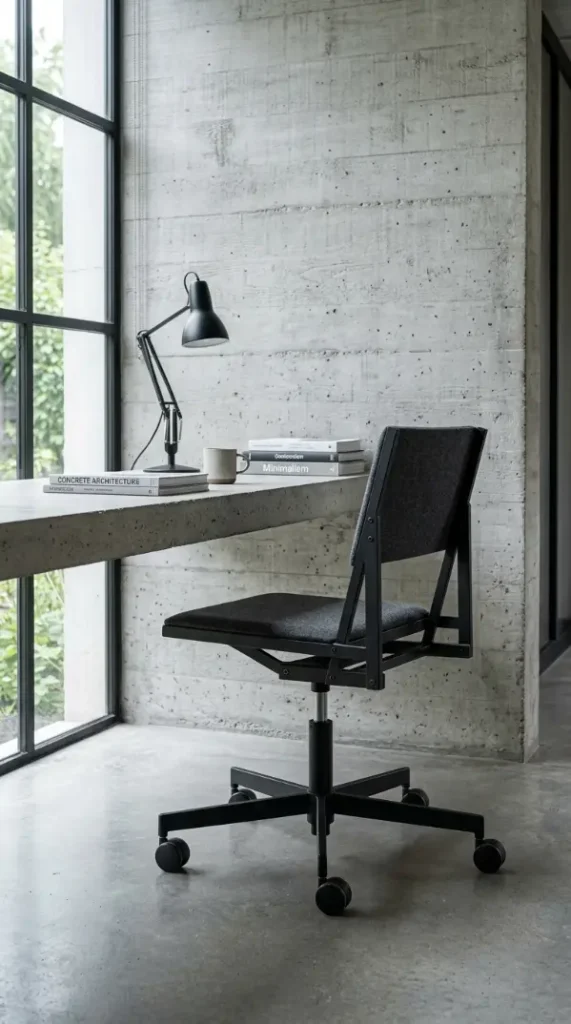
6. Polished Concrete Flooring Throughout
A polished concrete floor, ground and sealed to a smooth low-sheen finish rather than left rough or covered with any rug, extends the desk and wall’s material honesty down to the single largest surface in the room, and its cool, reflective quality does genuine optical work that a softer flooring material could not: it bounces available daylight back upward into the room rather than absorbing it, keeping the space feeling brighter and more open despite the otherwise heavy, mineral-toned palette surrounding it. The floor’s continuous, seamless surface, with only the faintest natural variation and the occasional visible expansion joint running in a single straight line across the room, reinforces the room’s overall sense of having been engineered as one continuous architectural gesture rather than assembled from separate decorative layers.
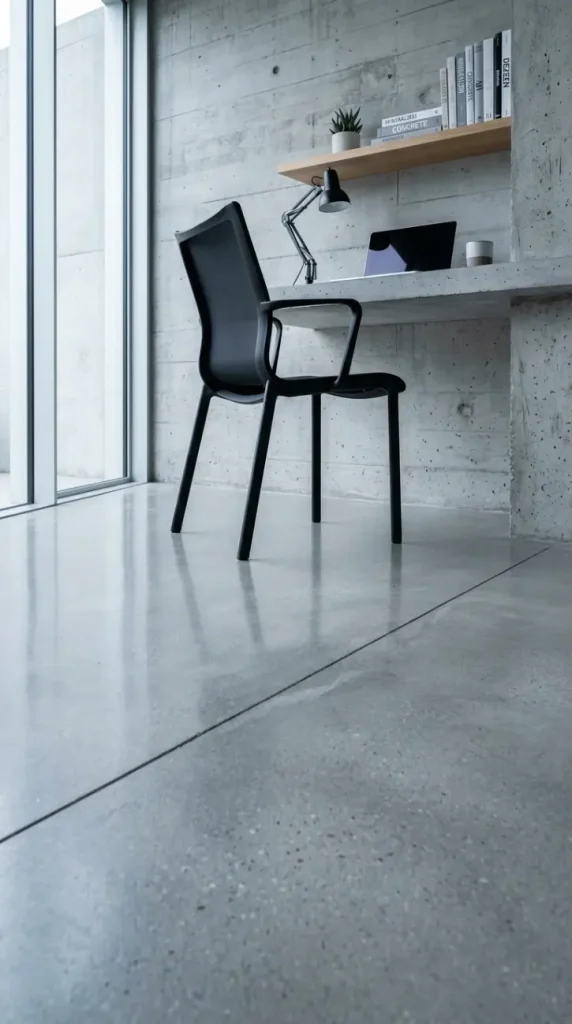
7. A Single Steel Shelving Frame With Open Wire Mesh Baskets
Where a warmer office uses woven natural baskets for storage, the concrete and steel office calls for a freestanding shelving unit built from a slim matte black steel frame holding open wire mesh baskets rather than solid shelves, the mesh’s open structure keeping the storage visually light and allowing sightlines through to the wall behind it rather than creating the same kind of solid visual block a closed cabinet or solid shelf would. This shelving type, originally developed for industrial and commercial kitchen use, carries an inherent honesty about its own structural purpose, and using it in a home office context rather than disguising or softening it reinforces the room’s consistent commitment to functional, unornamented material choices.
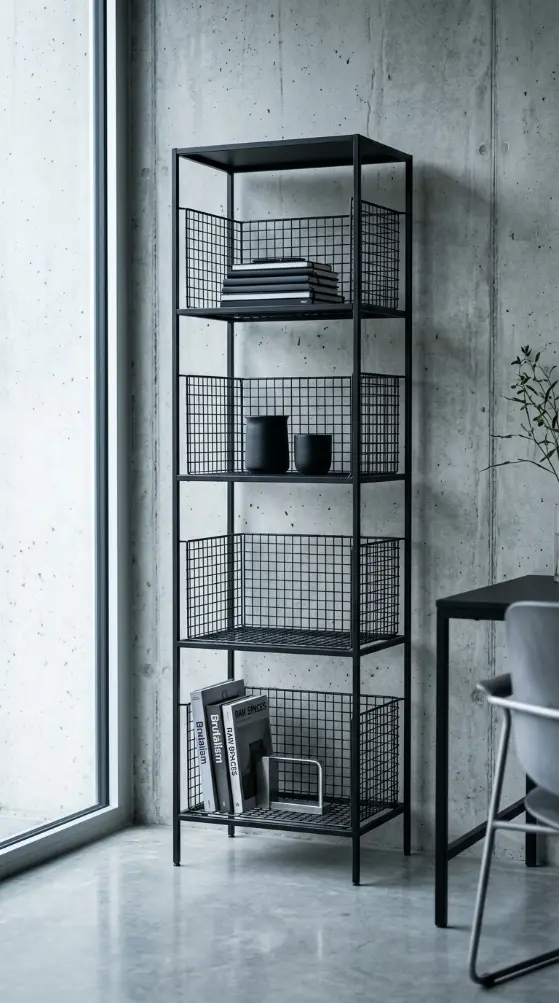
8. Unfiltered Direct Daylight With No Curtain or Shade
Where a warmer aesthetic relies on linen to soften and diffuse harsh daylight, the concrete and steel office often makes the opposite choice deliberately: leaving the window entirely unadorned, with no curtain, blind, or shade of any kind, allowing direct, cool, unfiltered daylight to fall across the concrete and steel surfaces exactly as it would across any genuinely industrial or architectural space. This decision accepts the harsher shadows and higher contrast that direct light creates as consistent with the room’s overall aesthetic of unsoftened honesty, treating the play of hard-edged light and shadow across the concrete’s textured surface as a feature rather than a problem requiring a textile solution.
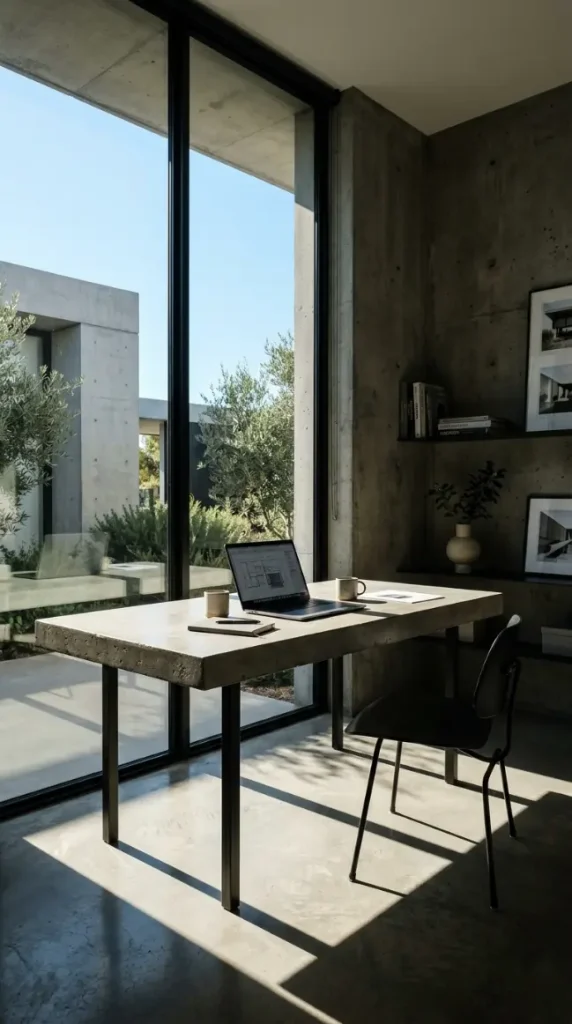
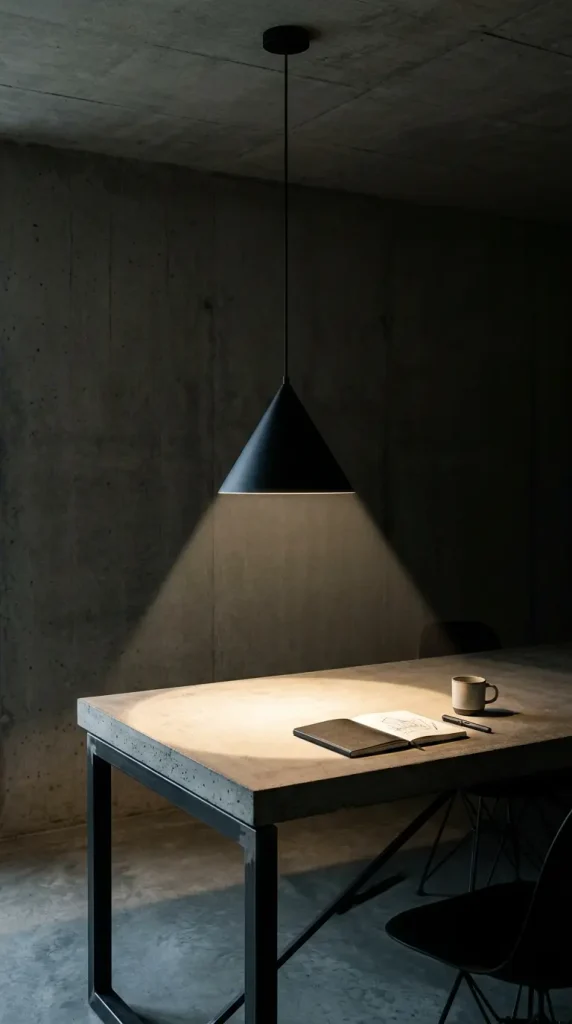
9. A Single Black Steel Pendant Light With a Precise Conical Shade
One pendant light, hung directly above the desk on a slim black cable with a precisely formed conical or cylindrical shade in matte black or raw spun aluminum, provides the room’s primary overhead illumination through a fixture whose geometric exactness matches the same precision evident in the desk’s structural legs and the lamp’s articulated arm. Unlike a softer, more diffused pendant shade, this fixture directs its light in a controlled, defined cone or column, creating a deliberate pool of brightness exactly where the desk surface needs it most while leaving the rest of the room in comparative shadow, reinforcing the room’s overall preference for defined, purposeful light over even, shadowless ambient wash.
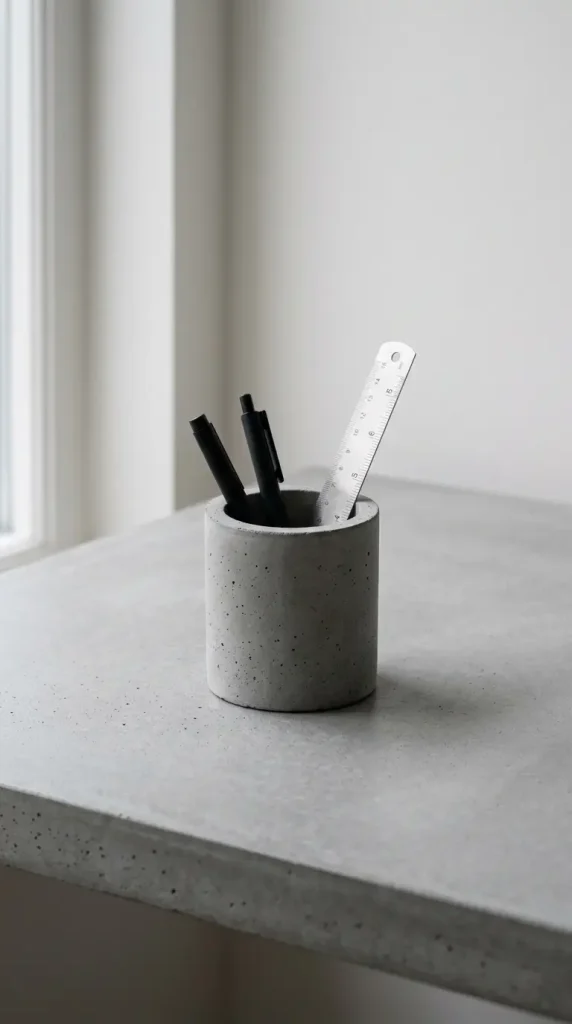
10. A Single Unglazed Concrete Vessel for Pens and Small Objects
A small vessel cast from the same raw concrete as the desk slab, left entirely unglazed and unsealed, holding pens, a small ruler, or a USB drive, extends the room’s foundational material down to its smallest functional object, proving the same honesty governing the desk and the feature wall can scale all the way down without becoming precious or decorative. The vessel’s slightly porous, matte surface, with the same subtle aggregate variation as the larger desk slab, makes clear that every object in the room, regardless of size, was selected according to the same material logic rather than allowing smaller accessories to default to whatever convenient material happens to be available.
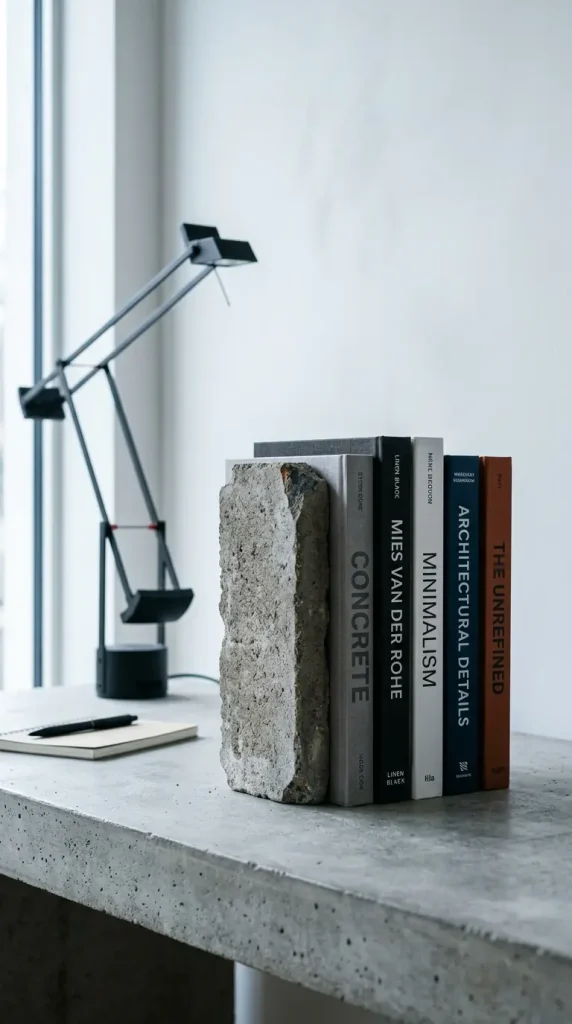
11. A Concrete Block or Brick as a Deliberate Paperweight and Bookend
Repurposing a single raw concrete block or a cast concrete brick, its surface left exactly as it would appear on a construction site, as a functional bookend or paperweight on the desk surface, makes explicit the room’s willingness to import genuinely industrial, unrefined objects directly into the working space rather than only using materials that have been processed or finished for decorative use. This small object carries real weight, both literally and conceptually: a single concrete brick standing upright against a row of books does the practical job of any bookend while being unmistakably, unapologetically what it actually is, with none of the polish a purpose-made decorative bookend would receive.
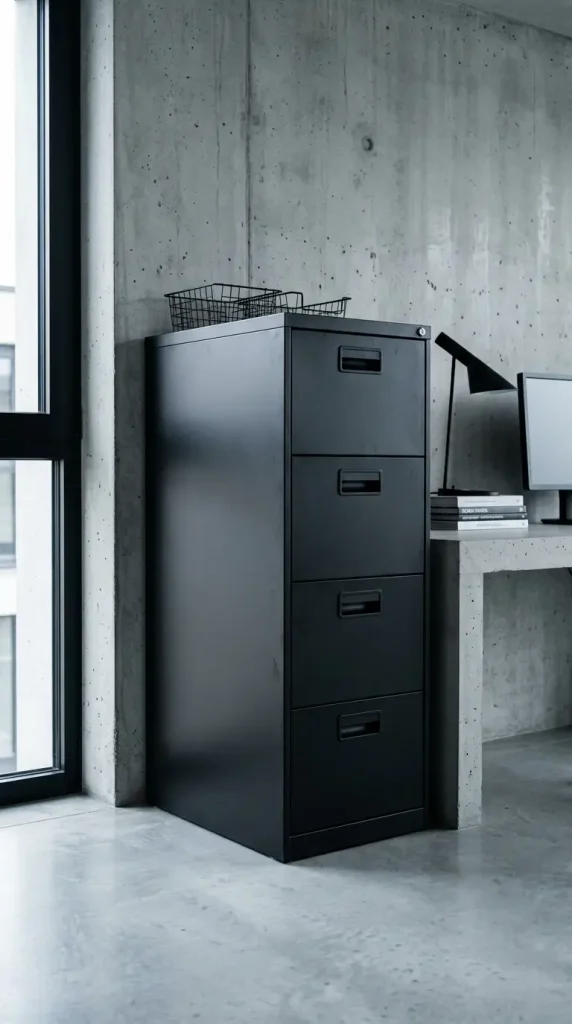
12. A Single Black Steel Filing Cabinet Left Visibly Industrial
Rather than disguising office storage as furniture, a genuine steel filing cabinet — the kind manufactured for actual commercial and industrial use, in a matte black powder coat with simple recessed drawer pulls and visible seam lines where its sheet metal panels join — can be embraced directly and openly in this aesthetic precisely because its honest industrial character matches the room’s overall material philosophy rather than needing to be softened or hidden. Positioned as a freestanding unit rather than built in, the cabinet’s visible function as exactly what it is, office storage equipment with no pretense otherwise, reinforces the same unornamented honesty running through the concrete wall and the steel shelving beside it.
13. Exposed Structural Steel Ceiling Beams Left Unclad
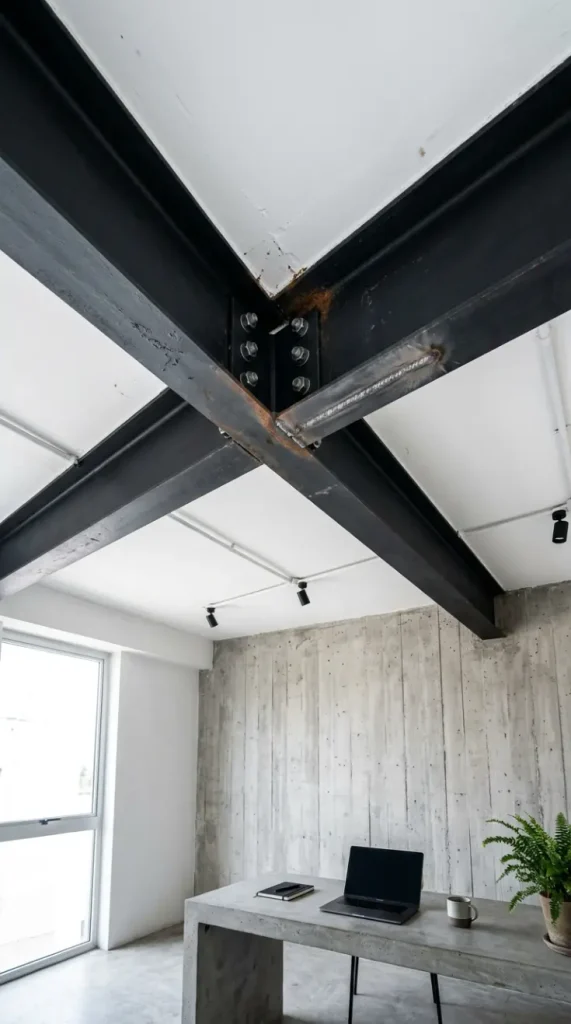
In a home office converted from a loft, basement, or warehouse-style space, leaving structural steel ceiling beams entirely exposed and unclad, their original mill finish or a single coat of matte black paint the only treatment applied, extends the room’s material honesty upward into the architecture’s actual structural bones rather than concealing them behind a finished ceiling. The beams’ I-shaped or box-section profiles, their visible bolted or welded joints, and their occasional small rust bloom or weld scar left untouched all reinforce the sense that this room’s industrial character is structural rather than decorative, the ceiling telling the same honest story about the building’s actual construction that the board-formed concrete wall tells at floor level.
14. A Single Black Steel Wall Clock With No Decorative Face
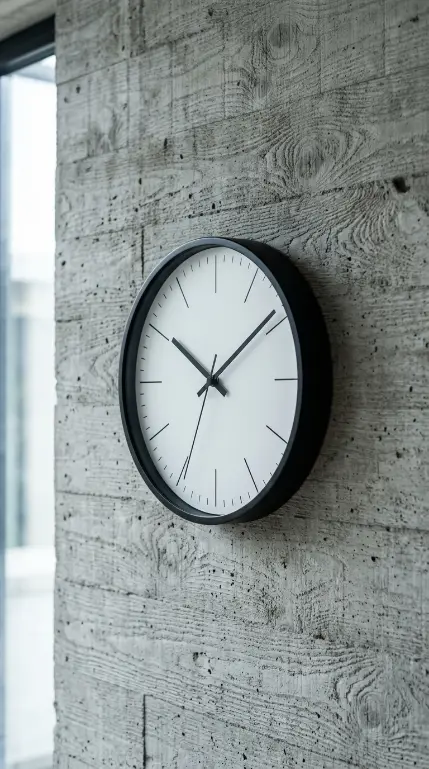
A wall clock built from a simple matte black steel case and a minimal white or grey face with thin black hour markers and no numerals, hour-only or with the simplest possible numeral typography, contributes function without decoration in exactly the register this room’s aesthetic demands, its presence on the concrete wall reading as a precision instrument rather than a decorative accessory. The clock’s mechanical simplicity, often achieved through an exposed or semi-exposed quartz movement visible at the case’s back when the piece is viewed from an angle, reinforces the same fascination with visible function evident in the steel lamp’s joints and the cantilevered shelf’s hidden engineering.
15. A Single Steel-Framed Black and White Architectural Photograph
One framed photograph, depicting a piece of brutalist or industrial architecture in black and white, in a slim matte black steel frame with no mat board border, positioned alone on an otherwise bare wall section, gives the room its single moment of representational imagery while keeping that imagery in direct conversation with the room’s own material identity. Rather than introducing color, pattern, or any softer subject matter, this single photograph reinforces and reflects the room’s own architectural seriousness back at itself, functioning less as decoration in the conventional sense and more as a kind of thematic mirror hung on the wall.

16. A Concrete Plinth as a Sculptural Side Table
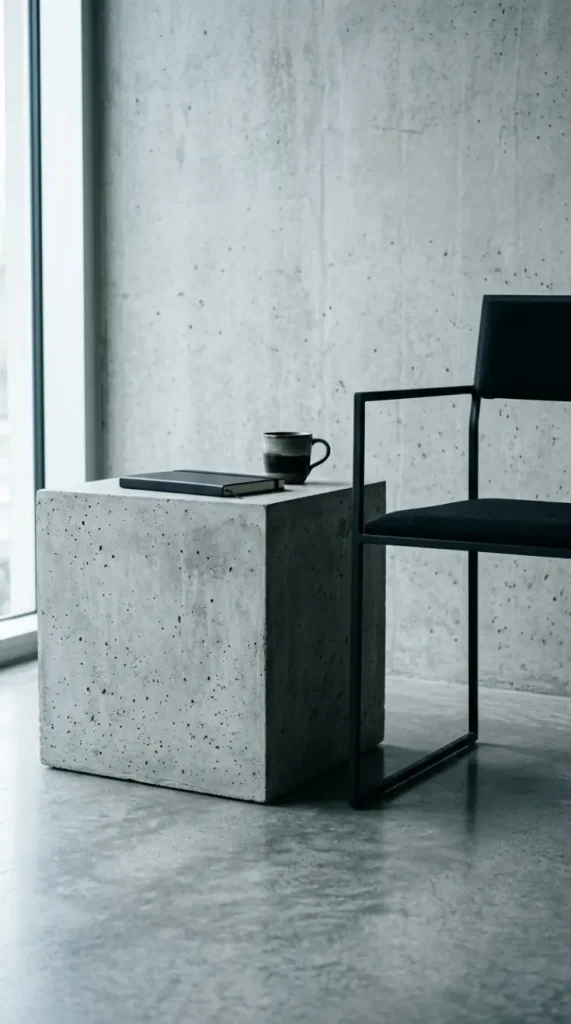
A simple cast concrete plinth, cube or cylinder-shaped, positioned beside the desk chair or near the reading corner of the room, functions as a side table with no added surface treatment beyond the concrete’s own cast finish, holding a single object — a closed laptop when not in use, a cup of coffee, a single book — without requiring any additional material to be introduced into the room. The plinth’s solid, monolithic form, lacking any legs, joints, or visible construction beyond its own poured mass, provides a moment of pure sculptural weight that contrasts deliberately with the thin, structural steel elements found everywhere else in the room.
17. Steel Conduit and Cable Trays Left Visibly Exposed
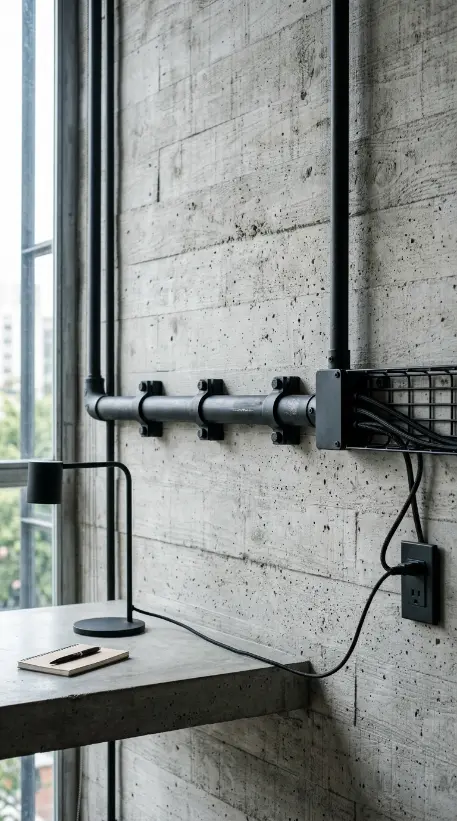
Rather than concealing electrical conduit and cable runs behind walls or within discreet channels, running them openly along the concrete wall’s surface in matte black steel conduit pipe and open cable tray, secured with simple visible pipe clamps at regular intervals, treats the room’s electrical infrastructure with the same honest visibility given to its structural steel beams and its mechanical lamp joints. This approach, borrowed directly from genuine industrial and commercial fit-outs where concealing services behind finished surfaces is often impractical or unnecessary, turns a typically hidden building system into one more piece of evidence supporting the room’s overall commitment to showing rather than disguising how everything in it actually works.
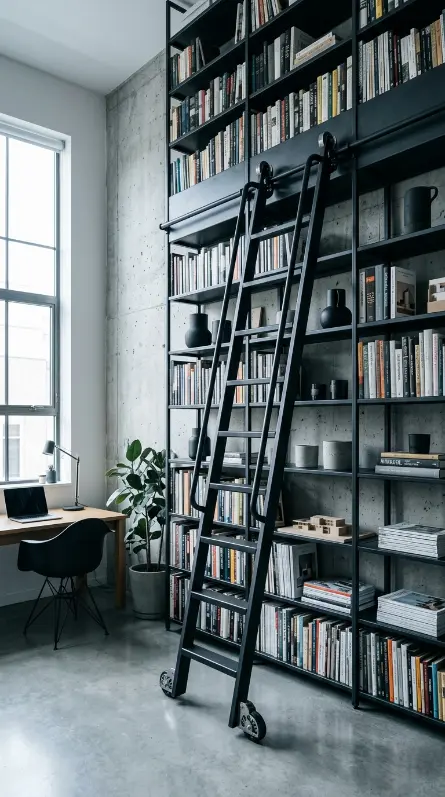
18. A Single Steel Library Ladder for Tall Shelving Access
In an office with floor-to-ceiling steel shelving against the concrete feature wall, a rolling steel library ladder, running on a horizontal steel track mounted near the shelving’s top edge, gives the room a genuinely functional piece of equipment for accessing the highest storage levels while contributing yet another structurally honest steel object to the space. The ladder’s visible wheels, its track, and its simple geometric rail form all continue the room’s preference for legible mechanical function, and its rolling, repositionable nature means it remains a piece of active equipment in daily use rather than a static decorative prop standing permanently in one place.
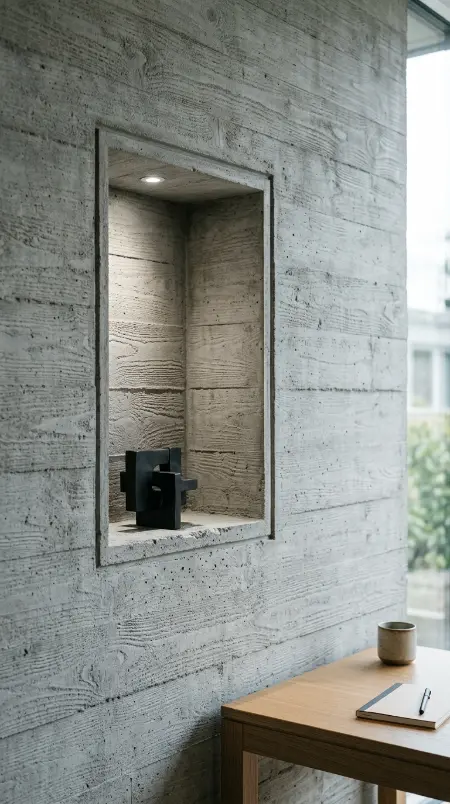
19. A Concrete Wall Niche for a Single Recessed Object Display
A single rectangular niche, formed directly into the concrete wall during the original pour rather than added afterward, creates a recessed display space for one carefully chosen object — a small steel sculpture, a single stone, a small architectural model — set back from the wall’s main plane rather than projecting from it the way a shelf does. This recessed display approach, common in genuinely architectural concrete buildings, treats the wall itself as a piece of functional sculpture capable of holding and framing a single significant object, and the niche’s depth and proportions, cast precisely during construction, cannot be casually added or repositioned later, giving this detail a permanence matching the room’s overall architectural seriousness.
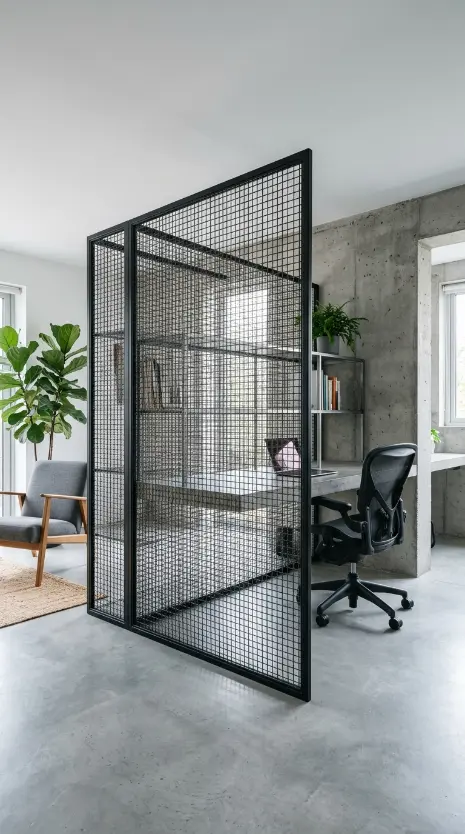
20. A Steel Mesh Privacy Screen Instead of a Solid Partition
In an open-plan home where the office occupies a portion of a larger room rather than a fully enclosed space, a freestanding steel mesh screen, built from the same matte black steel frame and open wire mesh panels as the room’s shelving, creates a partial visual boundary defining the work zone without fully enclosing it or blocking the daylight and sightlines a solid partition wall would interrupt. The screen’s open structure allows the concrete and steel materials beyond it to remain partially visible through the mesh from the rest of the room, maintaining the sense of continuous architectural material running throughout the larger space rather than treating the office as a separate, visually disconnected zone.
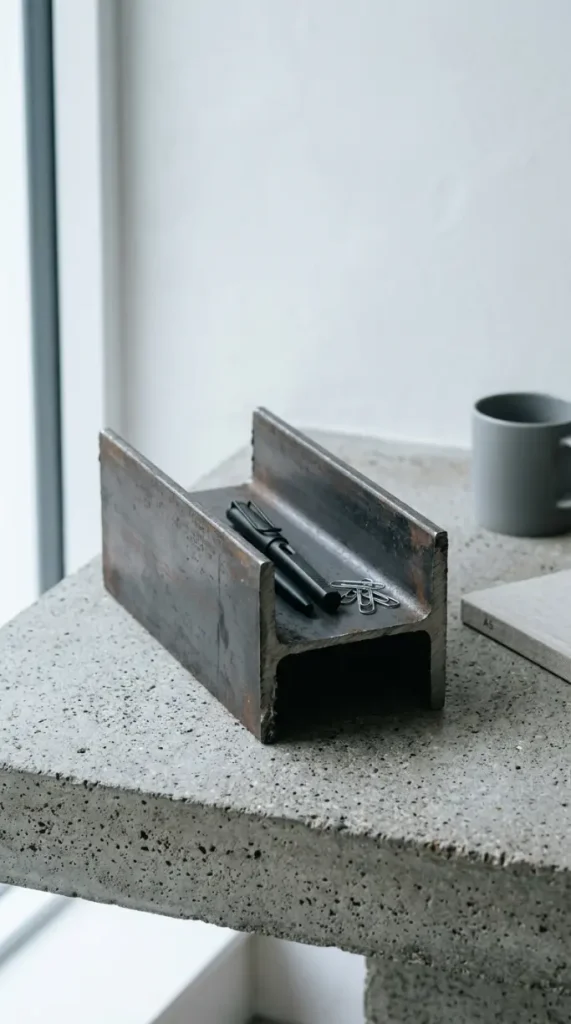
21. A Single Steel I-Beam Section Repurposed as a Desk Accessory Tray
A short section of genuine structural steel I-beam, cut to approximately 25cm length and laid on its side directly on the concrete desk surface, creates an unconventional but entirely consistent accessory tray, its natural channel form between the beam’s two flanges holding pens, paperclips, or a phone in the recessed space the I-profile naturally creates. This object, like the concrete brick used as a bookend, takes a piece of genuine structural building material completely out of its original architectural context and repurposes it directly as a desk accessory with no modification beyond the cut, demonstrating the room’s specific aesthetic confidence in finding function and beauty in materials never intended for decorative use.
22. A Concrete Floor Drain Grate Left Visible as an Industrial Detail
In a basement or ground-floor home office conversion where an existing floor drain remains from the space’s previous industrial or utility function, leaving its steel grate cover exactly in place rather than covering or removing it preserves a genuine piece of the building’s actual history within the polished concrete floor. This small, low, easily overlooked detail rewards close attention the way the concrete wall’s form-tie holes do, standing as one more piece of evidence that this room’s industrial character is inherited from a real architectural past rather than manufactured for visual effect, the kind of detail that a person renovating the space purely for aesthetic reasons would likely remove but that this aesthetic’s commitment to honesty insists on keeping.

23. A Single Steel Cable Tension Wire Shelf System
A shelving system built not from rigid brackets but from taut vertical steel cables, run under tension from ceiling to floor and fitted with simple steel shelf brackets that clamp directly onto the cables at adjustable heights, achieves the room’s thinnest and most visually minimal possible shelving solution, the cables themselves nearly disappearing from view at a normal viewing distance while still providing genuine load-bearing structure for books and small objects. This system, more commonly seen in retail and gallery fit-outs than residential furniture, brings a specific commercial-architectural precision into the home office that reinforces the room’s overall sense of being built to professional structural standards rather than furnished from a conventional furniture catalog.
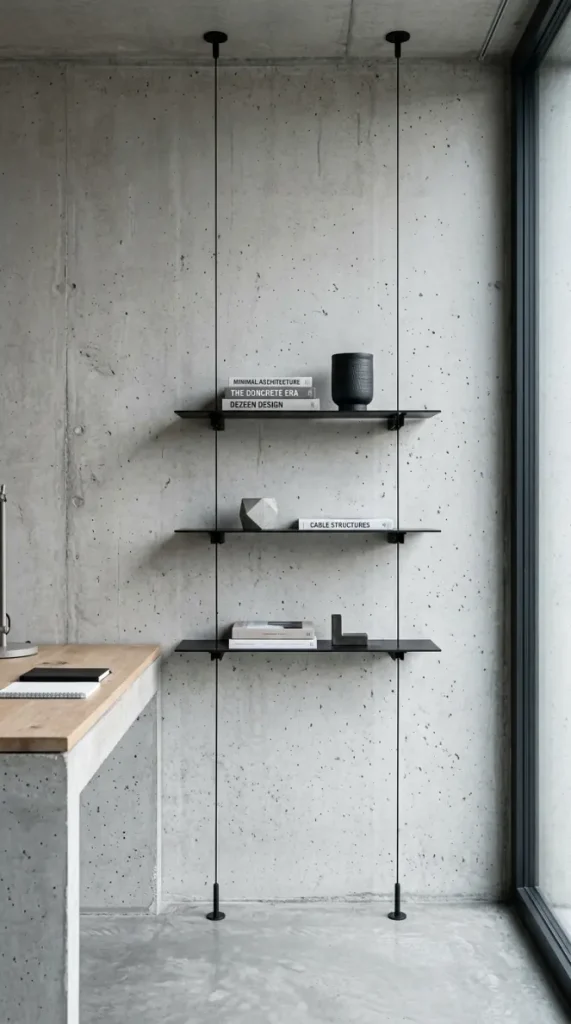
24. The Complete Modern Minimal Concrete and Steel Office — Every Material Together
The complete modern minimal concrete and steel office is the fully realized version of every principle in this guide working together across one entire architectural space: a poured concrete desk slab hovering on slim steel A-frame legs, a raw board-formed concrete feature wall with its construction history left fully legible, a cantilevered steel shelf and a tension wire shelving system both demonstrating structural precision with no visible excess support, a steel-frame task chair and an articulated steel lamp both leaving their mechanisms exposed, polished concrete flooring extending the material honesty underfoot, unfiltered daylight through a bare window accepting hard shadow as a feature rather than a flaw, exposed structural steel beams and visibly run conduit extending the same honesty upward and along the walls, and small objects throughout, the unglazed concrete vessel, the repurposed I-beam tray, the concrete brick bookend, the original drain grate left in place, all proving that nothing in the room defaults to convenient materials when the room’s own logic demands something more considered. Every surface hard, precise, and legible. Every decision structural before it is decorative. The office that makes clear, from the moment anyone steps into it, that focused work and architectural seriousness were never separate ambitions.