25 Small Storage Closet Organization Tiny Apartment Ideas
There is a particular kind of satisfaction that comes from opening a small closet in a tiny apartment and finding everything exactly where it should be — a satisfaction that is entirely disproportionate to the scale of the space involved. The small storage closet in a tiny apartment is the most demanding organizational challenge in domestic life precisely because the margin for error is zero. In a large home, a disorganized closet is an inconvenience. In a tiny apartment, a disorganized closet is a spatial crisis — the failure to organize one small space has immediate and unavoidable consequences for every other space in the home.
The fundamental principle of small closet organization in a tiny apartment is vertical density. Most small closets are used to perhaps forty percent of their available volume, with objects piled on a single shelf, clothes hanging on one rail below, and the floor occupied by a chaotic pile of shoes and forgotten objects. The organized small closet uses every centimetre from floor to ceiling: a high shelf above the hanging rail for rarely accessed seasonal items, double hanging rails where clothing length permits, the inside of the door for additional hook or pocket storage, the floor space beneath the hanging clothes for a rolling shoe rack or stacked drawer units. The goal is not to have fewer things — it is to have a specific, considered position for every thing.
The second principle is category clarity. A small closet that stores everything regardless of category becomes visually and functionally overwhelming regardless of how much storage hardware it contains. The organized small closet assigns specific zones to specific categories: one zone for clothing, one for accessories, one for shoes, one for linens or seasonal items. Within each zone, the organizational tools — the baskets, the dividers, the drawer units, the labeled bins — maintain the category boundaries so that every item can be found at a glance and returned to its correct position without effort.
These 25 ideas show every dimension of small storage closet organization for tiny apartments — from the foundational double hanging rail that immediately doubles clothing capacity to the complete closet transformation where every square centimetre from door to back wall and floor to ceiling has been considered and organized into a system of complete functional beauty.
1. The Double Hanging Rail — Immediately Double Your Capacity
The single most impactful small closet organization improvement available requires only one piece of hardware and fifteen minutes of installation: a second hanging rail installed below the primary rail in any section of the closet where shorter clothing hangs. Tops, blouses, jackets, folded trousers, and skirts all hang in the upper 90cm to 100cm of the available hanging height — which means the lower 60cm to 80cm of that zone is completely empty space. Installing a secondary rail — either a purpose-made drop-down extender that hooks over the primary rail or a fixed secondary rail on brackets — immediately doubles the hanging capacity of the short-clothing section. In a small apartment closet, this single change can add space for twenty to thirty additional garments in an area that was previously holding nothing.
2. Velvet Slim Hangers — The Single Change That Transforms Visual Calm
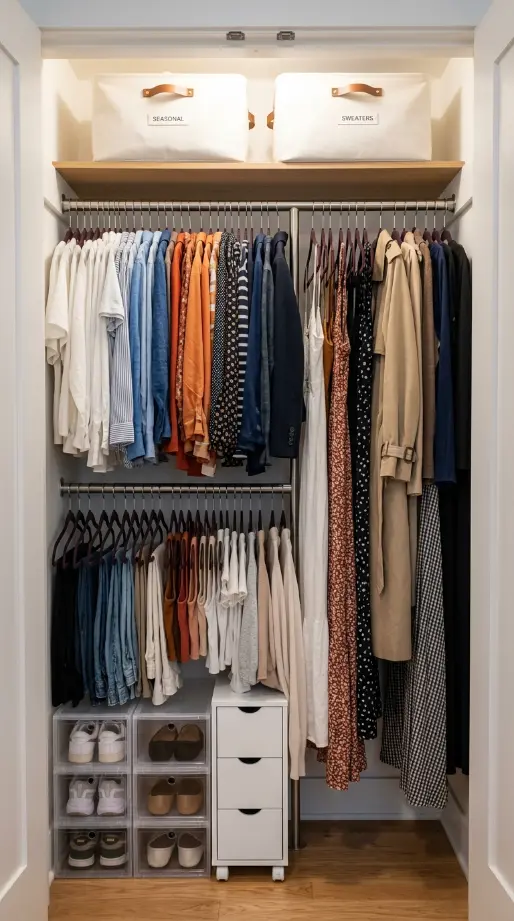
Replacing every mismatched plastic, wire, and wood hanger in a small apartment closet with matching slim velvet hangers is the organizational change that produces the most dramatic visual improvement for the least cost and effort. Mismatched hangers of different thicknesses, colors, and styles create visual chaos regardless of how well the clothing itself is organized — the eye reads the inconsistency of the hangers before it reads the organization of the clothes. Matching slim velvet hangers in one color — typically black, grey, or natural — immediately create visual calm, and their slim profile (approximately 5mm thick versus 15mm to 20mm for standard plastic hangers) allows thirty percent more garments on the same rail length.
3. Over-the-Door Organizer — The Door as Storage Space
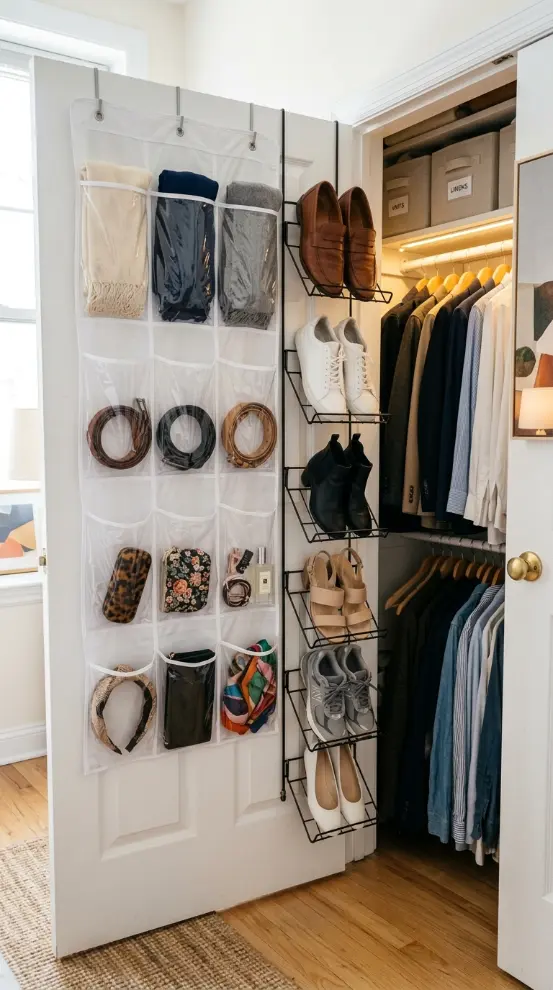
The inside face of a closet door is the most underutilized storage surface in any small apartment — a flat vertical surface typically holding nothing while the closet interior struggles to accommodate everything. An over-the-door organizer — either a clear pocket organizer for accessories or a metal rack system for shoes, cleaning supplies, or pantry items — converts the door interior into a significant additional storage zone without requiring any drilling or permanent installation. A clear pocket organizer with twelve to twenty-four pockets on the back of a clothing closet door can hold belts, scarves, small bags, jewelry cases, and accessories that would otherwise occupy drawer or shelf space. A wire rack on the back of a pantry closet door can hold spice jars, foil and cling wrap boxes, cleaning spray bottles, and a collection of items that would otherwise crowd the interior shelves.
4. Labeled Basket System — Visible Category Organization
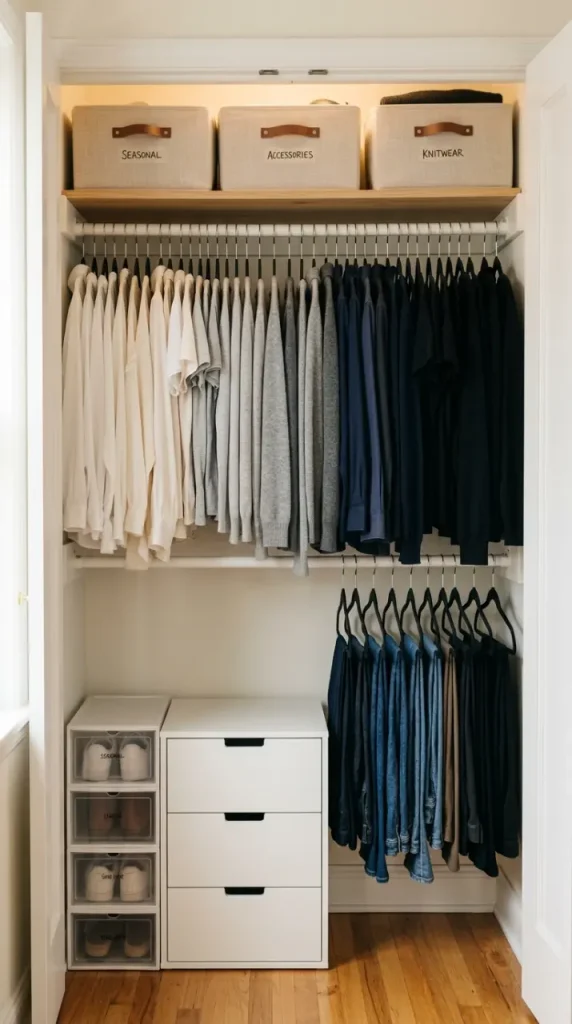
A labeled basket system — matching woven seagrass or wire baskets in consistent sizes arranged on closet shelves, each basket labeled with its category of contents — creates the most visually calm and most functionally immediate closet organization system. In a small apartment linen closet, pantry closet, or general storage closet: one basket for CLEANING SUPPLIES, one for EXTRA TOILETRIES, one for MEDICINES, one for BATTERIES AND CABLES, one for SEASONAL ACCESSORIES, one for GIFT WRAP. Each basket the same size, the same style, the same material — the visual consistency creating order even before the contents are examined. The label on each basket allows every category to be found at a glance and maintained over time, preventing the gradual erosion of the system that occurs when items return to the wrong location.
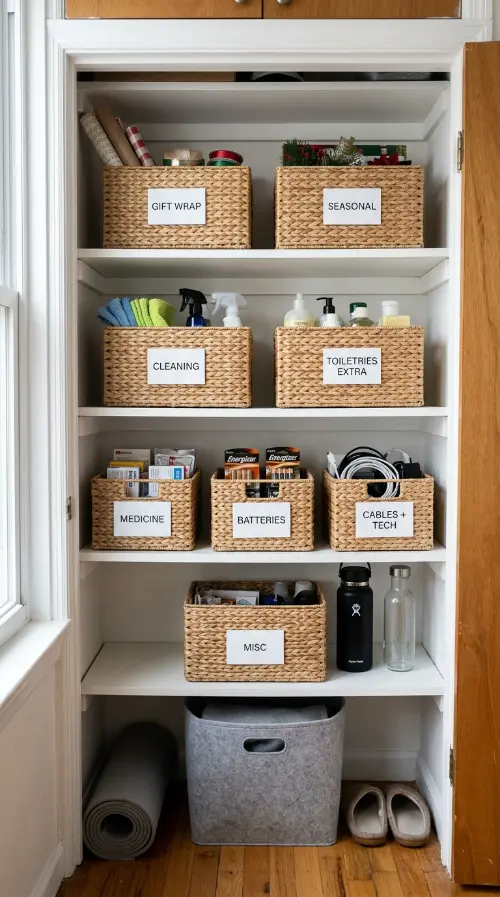
5. Vertical Space Maximization — Floor to Ceiling Shelving
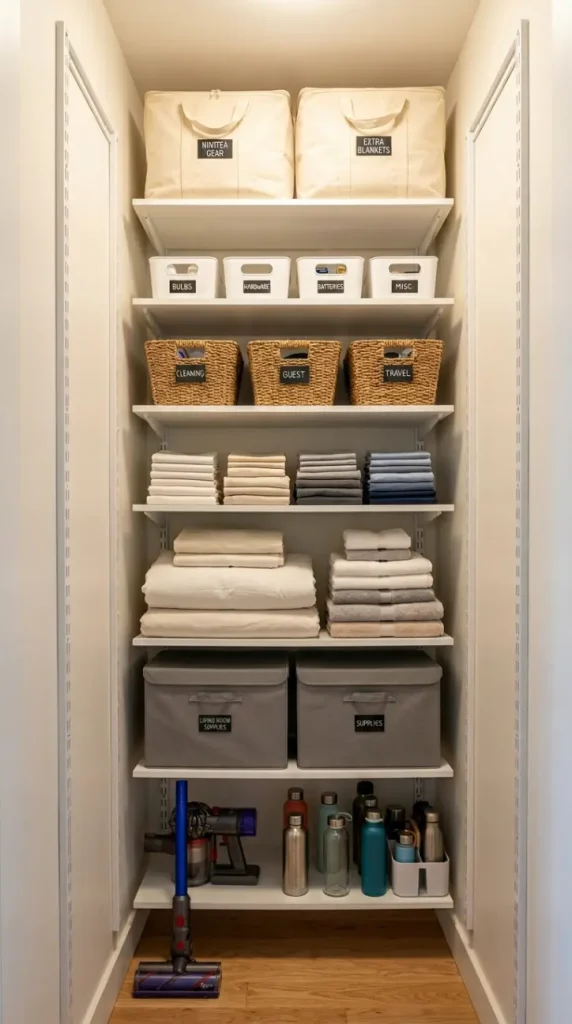
A small closet fitted with floor-to-ceiling shelving — shelves from approximately 15cm above the floor all the way to the ceiling, spaced at approximately 25cm to 30cm intervals — uses every centimetre of the closet’s vertical dimension and increases storage capacity by two to three times compared to a closet with only one or two standard shelves. In a small apartment where a wardrobe closet is not the right application — a general storage closet, a linen closet, or a utility closet — floor-to-ceiling shelving is the single most capacity-increasing organizational installation available. The key is adjustable shelving: tracks and brackets that allow shelf heights to be changed as storage needs evolve, rather than fixed shelves that commit to one spacing permanently.
6. The Capsule Wardrobe Closet — Edit Before Organizing
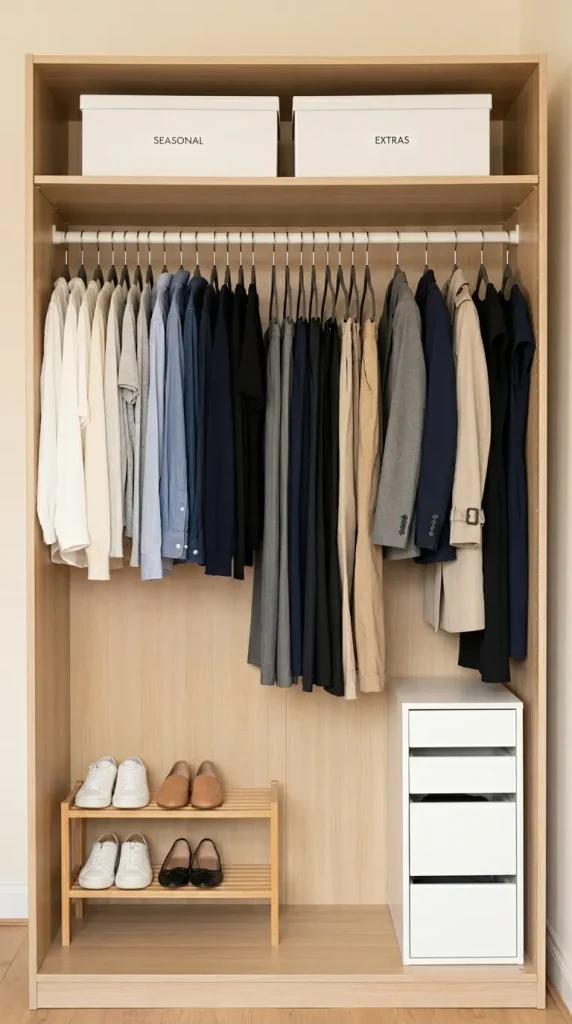
The most effective small apartment wardrobe closet organization begins not with buying organizational products but with editing the contents. A closet that contains seventy garments when twenty are worn regularly is an organizational problem that no amount of additional hardware can solve. The capsule wardrobe approach — reducing the closet contents to a defined set of garments that are all worn, all work together, and all have a specific place — is the foundational act of small closet transformation. After the edit: organize the reduced capsule wardrobe by category (tops, trousers, dresses, outerwear) then by color within each category on matching slim hangers. The resulting closet is organized not by storage system but by the disciplined reduction of contents to only those garments that genuinely belong there.
7. Under-Shelf Storage — Hooks and Hanging Baskets Underneath
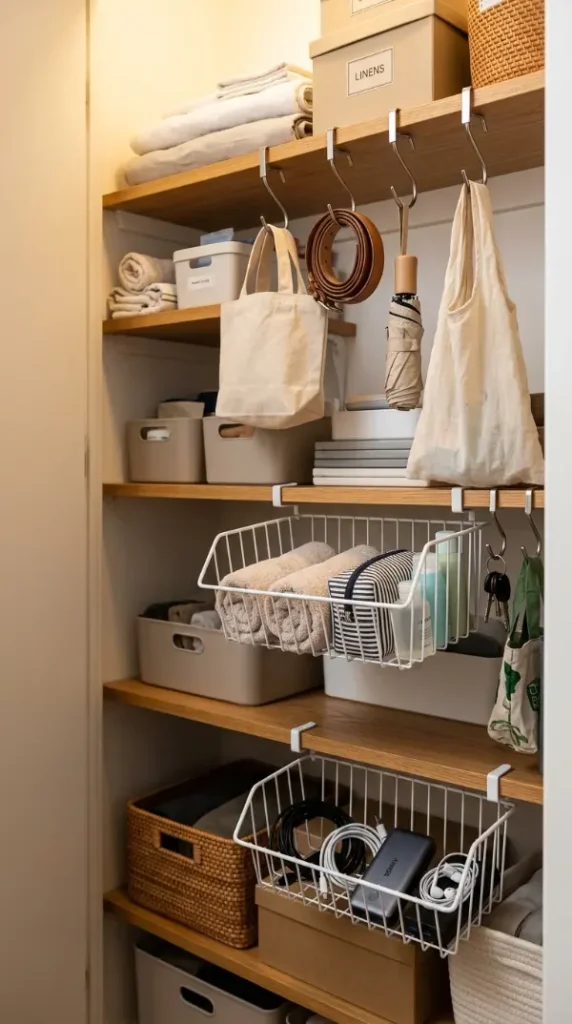
The underside of every fixed shelf in a small apartment closet is a storage surface that most people never use. Under-shelf hooks — simple S-hooks or purpose-made under-shelf clips — and under-shelf hanging wire baskets that clip onto the shelf edge convert the previously empty space below each shelf into additional active storage. Under a linen closet shelf: an under-shelf wire basket holding spare soap bars or small toiletries. Under a pantry shelf: S-hooks holding a row of mugs or a row of measuring cups. In a clothing closet: under-shelf hooks holding scarves, belts, or small bags. The under-shelf storage principle adds storage capacity without adding shelves, making it the most space-efficient organizational improvement for a closet that already has basic shelving.
8. Shoe Organization — Six Systems for Small Closet Floors
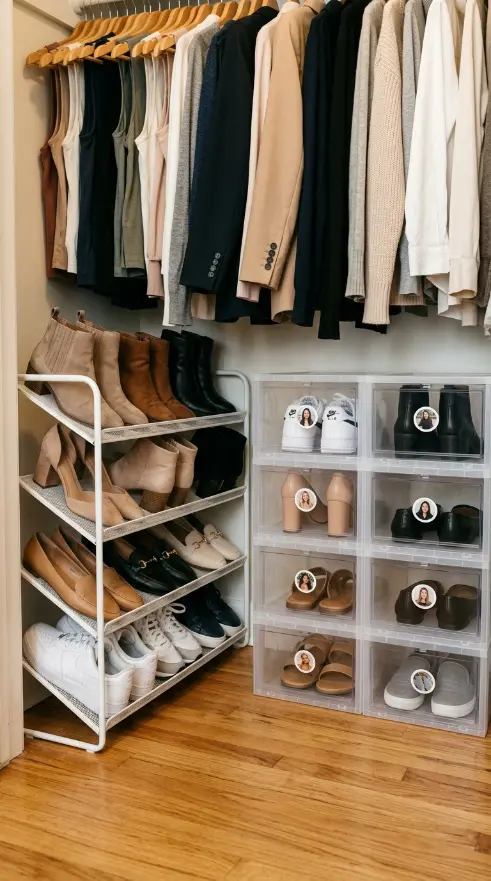
Shoes are the most spatially inefficient category in any small apartment closet — a pair of shoes thrown loosely on a closet floor can occupy 40cm by 15cm of floor area while only using 10cm of height, leaving 50cm to 60cm of valuable vertical space above each pair completely empty. Six shoe storage systems that solve this inefficiency: a vertical shoe rack that stores shoes heel-up-toe-down reducing floor footprint by thirty percent, a clear stackable shoe box collection that uses vertical stacking, a hanging shoe organizer on the closet door that holds twelve pairs vertically, an angled shoe shelf that stores pairs at forty-five degrees reducing spacing between pairs, a drawer-style under-bed shoe organizer that slides under a hanging rail section, or a simple pegboard with dowel shoe pegs mounted on the closet back wall holding pairs by their heels.
9. The Tiny Pantry Closet — Deep Shelf Solutions
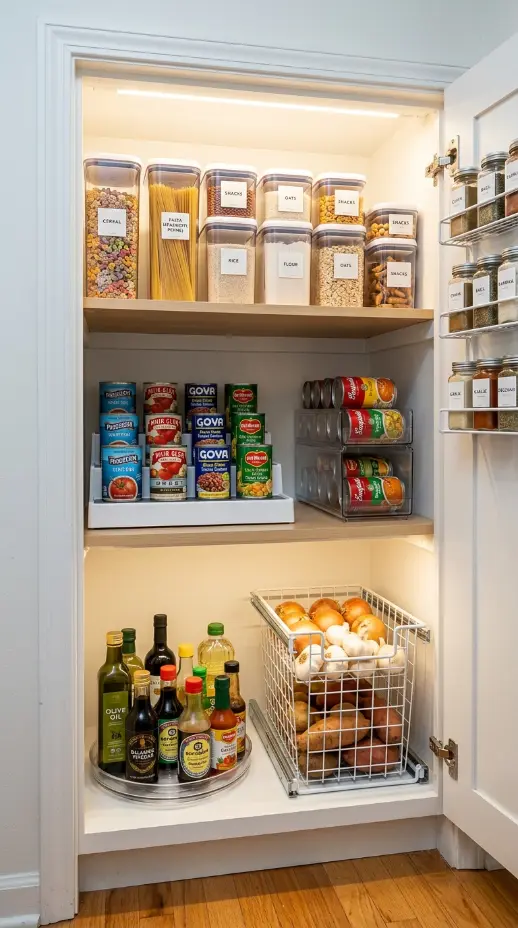
A small apartment pantry closet — a closet devoted to food storage — presents the specific organizational challenge of deep shelves where items placed at the back become invisible and inaccessible, leading to forgotten expired food and duplicated purchasing. Deep pantry shelf solutions: turntable lazy Susan platforms for corner or deep shelf access, pull-out wire drawer baskets installed inside the shelf depth that bring the back of the shelf to the front, risers that create a second tier on one shelf allowing cans and jars to step up behind the front row, can organizers that hold cans in a slanted row so the first can rolls forward as one is removed. Each solution addresses the specific problem of deep shelf inaccessibility that makes small pantry closets frustrating rather than functional.
10. The Hall Closet — Multipurpose Small Entry Storage
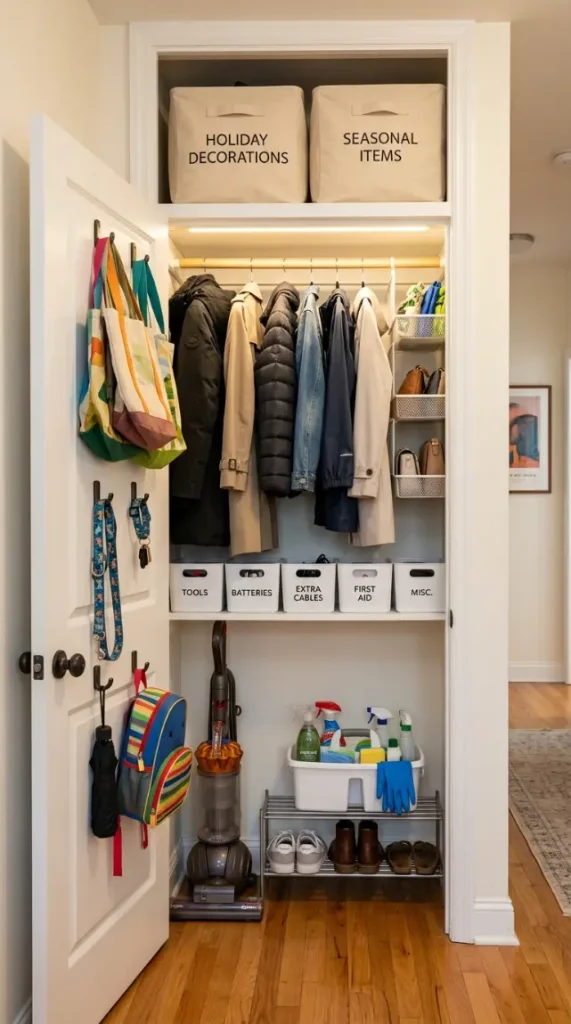
The hall closet in a tiny apartment is typically the home’s only dedicated general storage space, and it is almost always asked to serve too many categories simultaneously: coats and bags, cleaning equipment, extra toilet paper, the vacuum cleaner, holiday decorations, tools, extra household supplies, sports equipment. The organized hall closet assigns specific zones to each category and uses the door, the full height, and the full depth simultaneously. Upper shelf: seasonal items in labeled canvas bags. Hanging rail section: coats on matching hangers. Door interior: hooks for bags and umbrellas. Floor: vacuum cleaner upright, cleaning supplies in a handled caddy, shoe storage for the most-worn outdoor shoes.
11. Linen Closet Organization — Folded Sets in Pillowcases
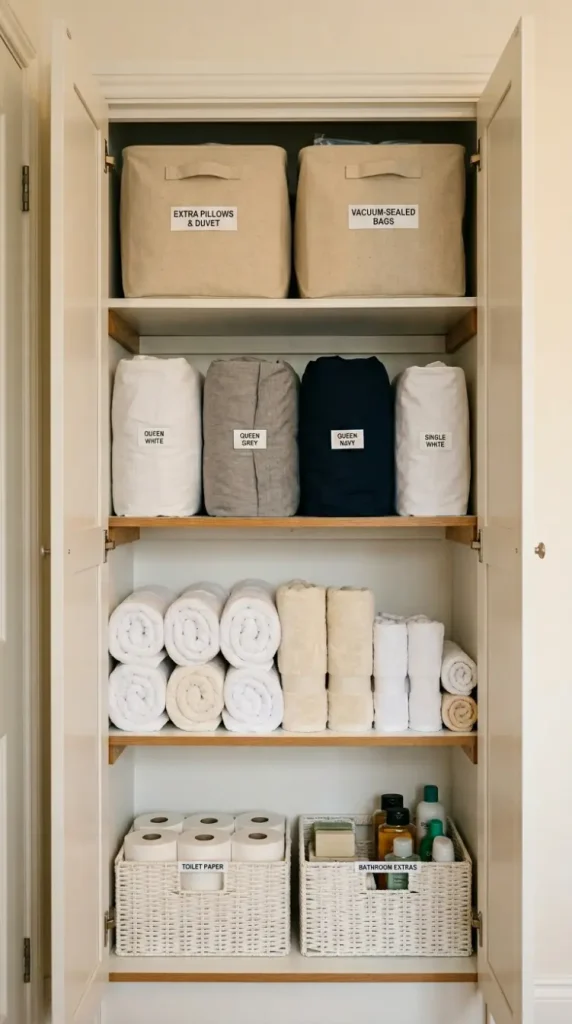
The linen closet in a tiny apartment — a small closet holding bedding sets, towels, and bathroom linens — is most efficiently organized when each bedding set is stored as one complete unit rather than as separately folded individual pieces. The pillowcase storage method: fold the flat sheet, the fitted sheet, and the spare pillowcase into one package, then slip the entire set inside the remaining matching pillowcase — creating a self-contained bedding set bundle approximately the size of a folded pillowcase. Each bundle is labeled with a small tag. The linen closet becomes a row of neat, equal-sized bedding bundles on each shelf, with towels rolled rather than folded for a consistent cylindrical form that stacks efficiently and shows the full towel collection at a glance.
12. Closet Lighting — The Organization Element Everyone Forgets
A dark closet is an unorganized closet regardless of how well its systems are designed — if you cannot see what is in the closet, the organization becomes invisible and ineffective. Adding lighting to a small apartment closet requires no electrician: a battery-powered or plug-in LED puck light adhered to the underside of the top shelf, a motion-activated LED strip light mounted along the top of the closet opening, or a rechargeable magnetic LED light that attaches to a metal closet surface. The addition of closet lighting immediately makes every organizational system more functional — labels become readable, colors become distinguishable, and the experience of opening the closet changes from frustrating to satisfying.
13. Children’s Closet in a Tiny Apartment — Low and Accessible
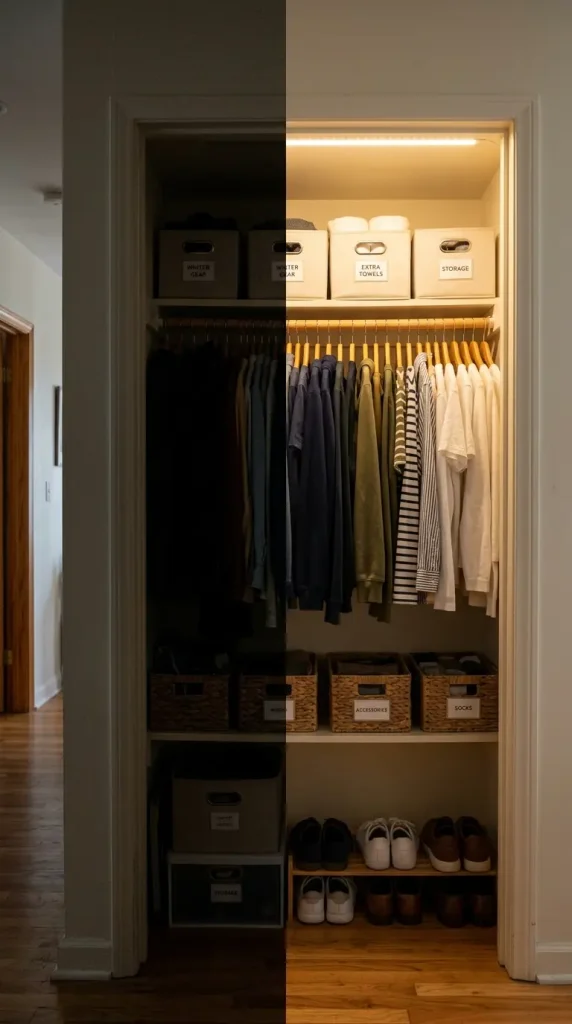
A child’s closet in a tiny apartment must solve two specific problems simultaneously: the standard hanging rail is too high for a child to independently access their own clothing, and the categories appropriate for a child’s wardrobe are different from adult categories. The organized children’s small apartment closet: a lower hanging rail at approximately 90cm height allowing children to select and return their own clothing independently, clear labeled picture-and-word bins on low shelves for toys, shoes, and accessories within reach, high shelves above child reach for seasonal storage and parent-managed items, a simple step stool stored in the closet for the transitional heights.
14. The Cleaning Closet — Small Utility Organization
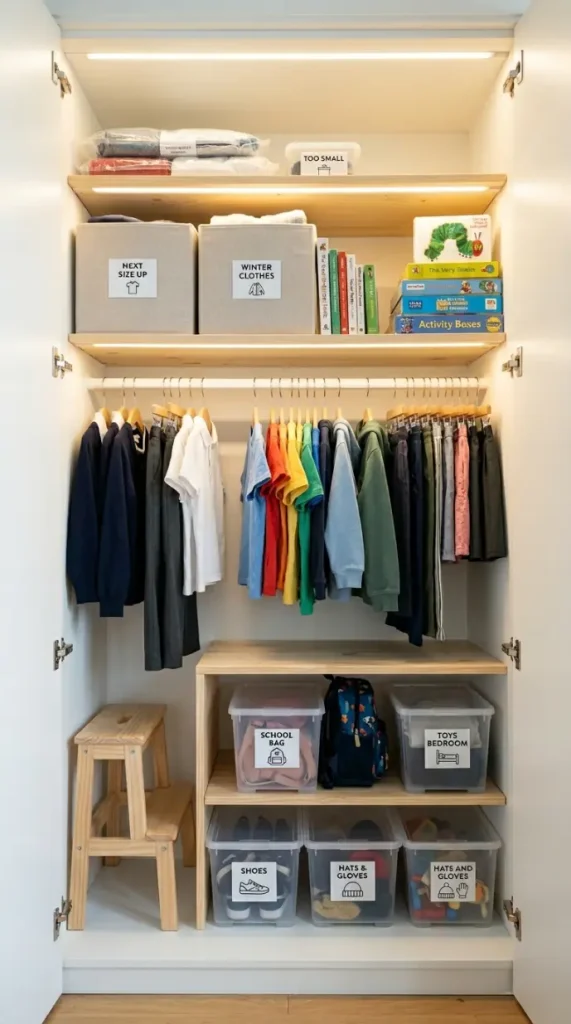
A small apartment utility or cleaning closet — even one as small as 45cm wide by 50cm deep — can be organized to hold every cleaning tool and supply needed for a complete apartment cleaning kit. The key is vertical: broom, mop, and vacuum cleaner standing upright using the full height. A wall-mounted holder with clips keeps the broom, mop, and dustpan clipped vertically against the back wall. Above: a shelf holds cleaning spray bottles in a carried caddy, cleaning cloths in a small bin, backup supplies in a labeled box. The closet door interior holds a narrow wire rack with additional spray bottles and small cleaning supplies. Every item has a specific mounted or placed position.
15. Folding Technique Display — The KonMari Vertical Fold for Drawer Space
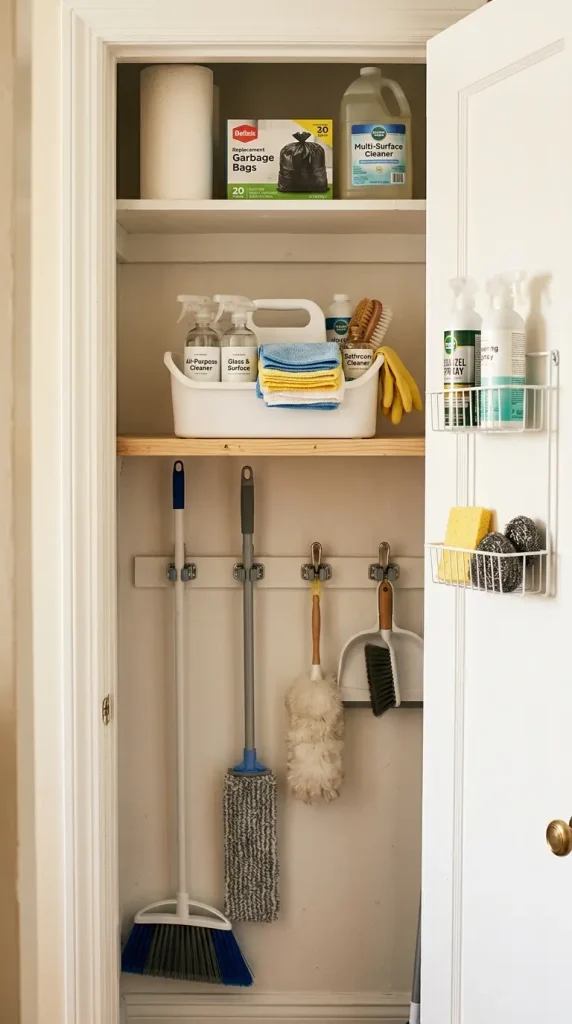
The vertical fold — placing clothing items standing upright in a drawer or bin rather than stacking them in horizontal layers — is the single most capacity-increasing drawer organization technique available for tiny apartment storage. A drawer that holds twelve t-shirts in horizontal stacked layers holds twenty-four t-shirts in vertical file-fold rows, all simultaneously visible, all accessible without disturbing others, and all maintaining their fold when removed. The KonMari-inspired vertical fold for t-shirts, sweaters, jeans, and most other clothing categories transforms drawer storage from a frustrating hidden-under-pile situation into a clearly organized display where every item can be seen and selected at a glance.
16. The Awkward Corner Closet — Angled Wall Solutions
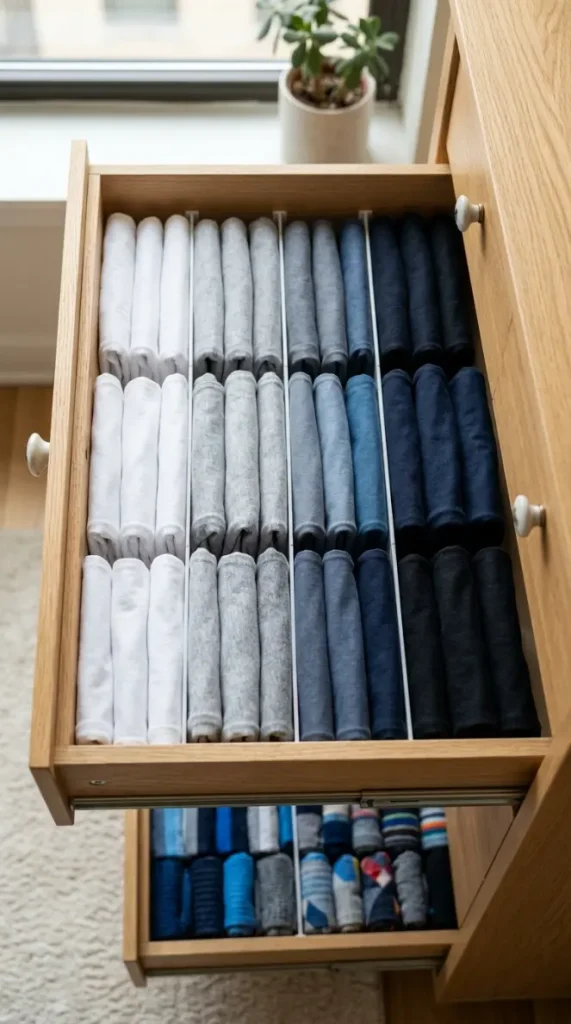
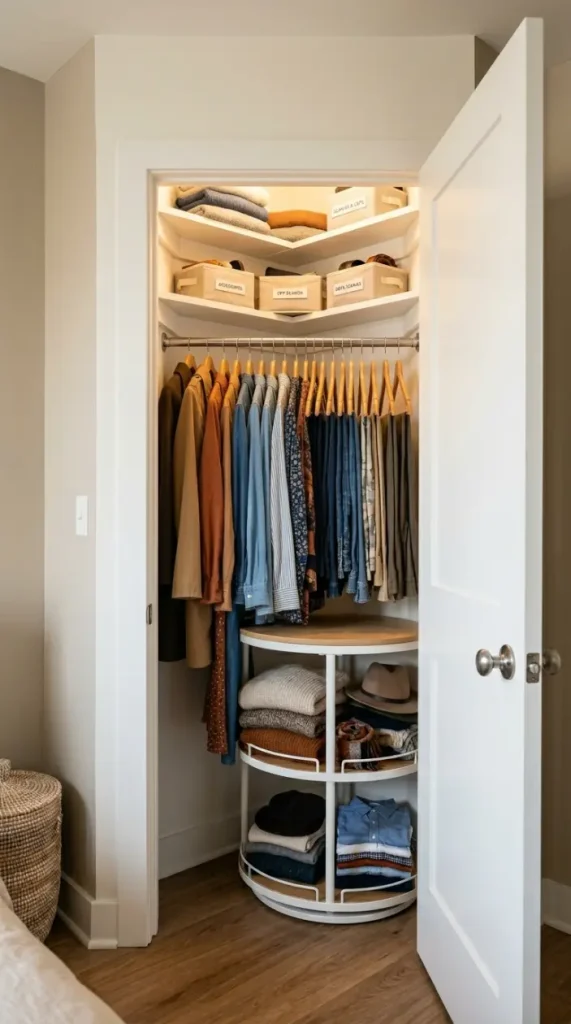
An awkward corner closet — a closet in a corner of a small apartment where two walls meet at ninety degrees, creating a triangular or very deep-corner usable space — is the most spatially challenging closet type in any small apartment. Standard rectangular shelving leaves the back corner largely inaccessible. Solutions: a rotating carousel or lazy Susan corner shelf unit that uses the full diagonal depth of the corner, a diagonal rod installing the hanging rail at forty-five degrees across the corner to use the maximum diagonal width, pie-cut corner shelves that fill the triangular corner profile, or a purpose-made corner wardrobe unit with angled doors that use the diagonal space efficiently.
17. The Wardrobe Closet Without a Closet — Freestanding Solutions
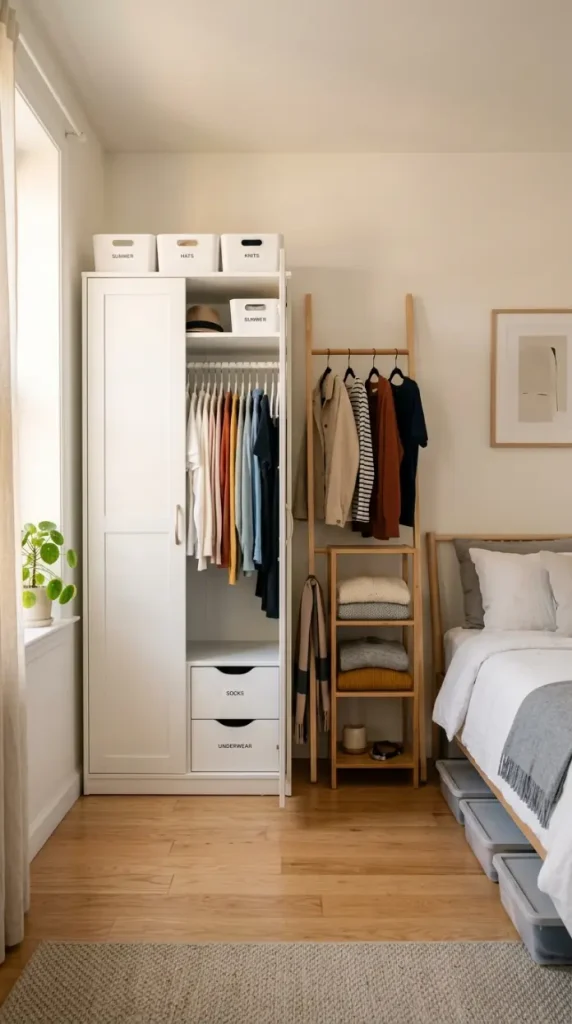
Many tiny apartments have insufficient built-in closet space or no built-in closet at all, requiring freestanding storage solutions that function as a closet while fitting within the apartment’s spatial constraints. The most effective freestanding closet solutions for tiny apartments: a slim rolling garment rack (45cm deep by 90cm wide) that can be pushed against a wall and covered with a linen curtain when not in use, an IKEA PAX wardrobe unit with interior organizational inserts customized for the specific storage requirements, a ladder rack that leans against the wall holding approximately fifteen garments and using zero floor footprint, or a tension rod in a hallway alcove creating an instant hanging zone.
18. Seasonal Rotation System — Spring/Summer and Autumn/Winter Swap
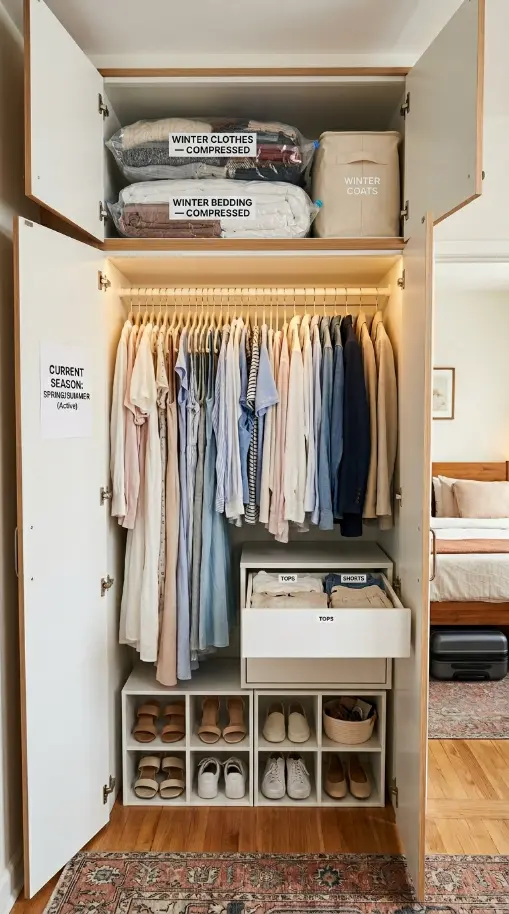
A tiny apartment with a small closet cannot hold every item of clothing from every season simultaneously — attempting to do so results in chronic overcrowding that makes every category inaccessible. The seasonal rotation system: the current season’s complete wardrobe in the closet on the hanging rail and in the drawers, the off-season’s complete wardrobe in vacuum-compression bags or large labeled canvas storage bags stored in the highest closet shelf, under the bed, or in a suitcase. The rotation happens twice per year (spring and autumn), and each rotation is also an opportunity to review and edit the off-season wardrobe before it returns to the active closet.
19. The Office Supply and Paper Closet — Tiny Apartment Home Office Storage
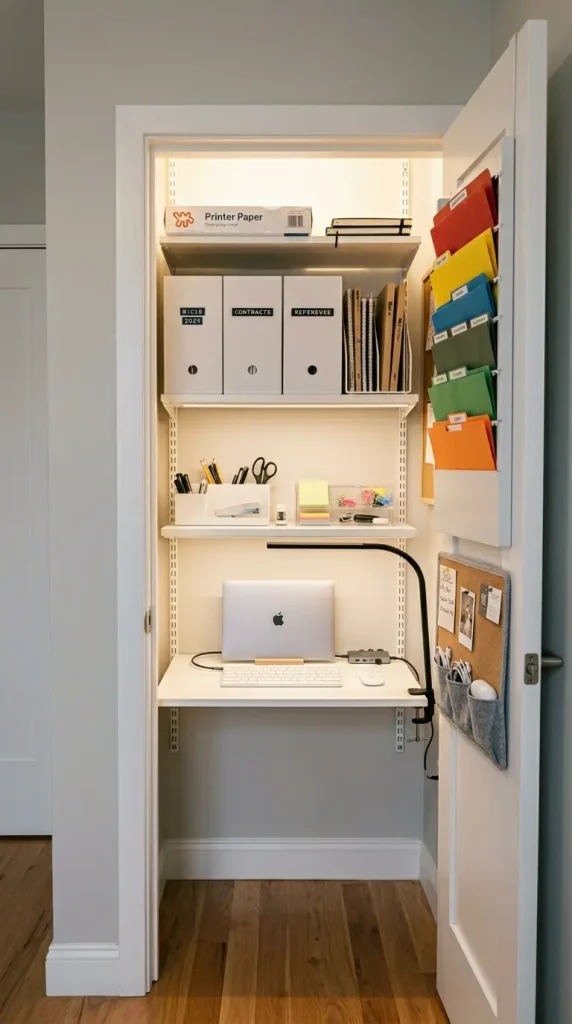
Many tiny apartment dwellers need to store home office supplies, documents, and equipment without a dedicated office room. A small repurposed closet can serve as a complete home office storage zone: a shallow shelf at desk height for a laptop and charger when stored, shelves above for labeled document boxes and office supply organizers, a small bulletin board mounted inside the closet door for notes and reference materials, a hanging file organizer for documents, a small drawer unit for stationery and cables. The home office closet, when organized, can hold everything needed for a complete home office function in approximately one square metre of floor area.
20. Cable and Technology Storage — The Hidden Tech Closet Drawer
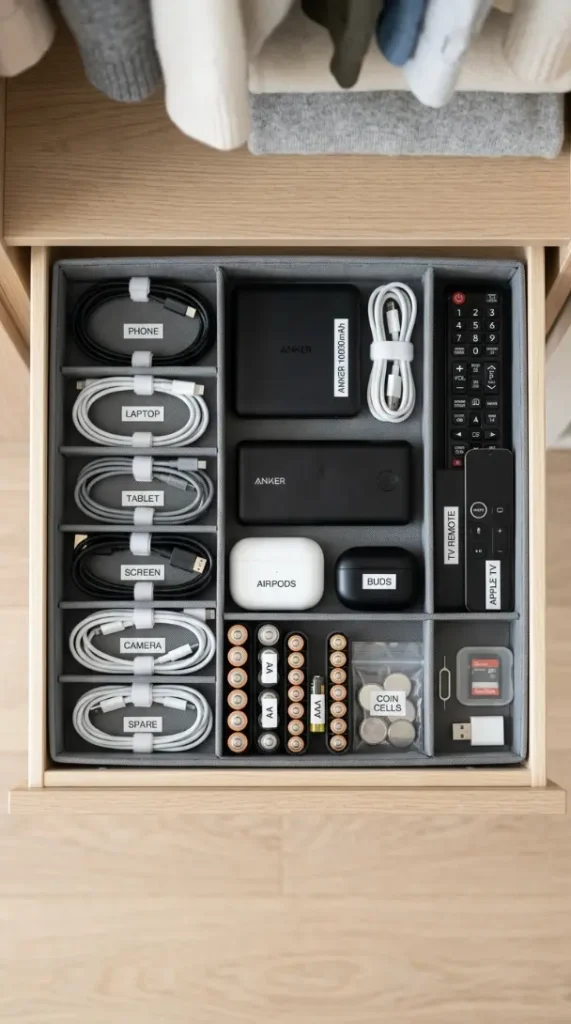
Charging cables, power banks, wireless earbuds, spare adapters, remote controls, batteries, and small tech accessories are among the most organizationally challenging items in a tiny apartment — they are small, numerous, tangly, and usually stored in a tangled pile in a drawer or bowl. A dedicated tech drawer in a closet or storage unit: a single shallow drawer lined with a custom cable and tech organizer — individual compartments for charging cables (rolled with velcro cable ties), a section for power banks, a section for earbuds in their cases, a row for AAA and AA batteries, a section for remote controls. Every cable identified with a small labeled cable tag. The result is a tech drawer that is completely navigable without untangling.
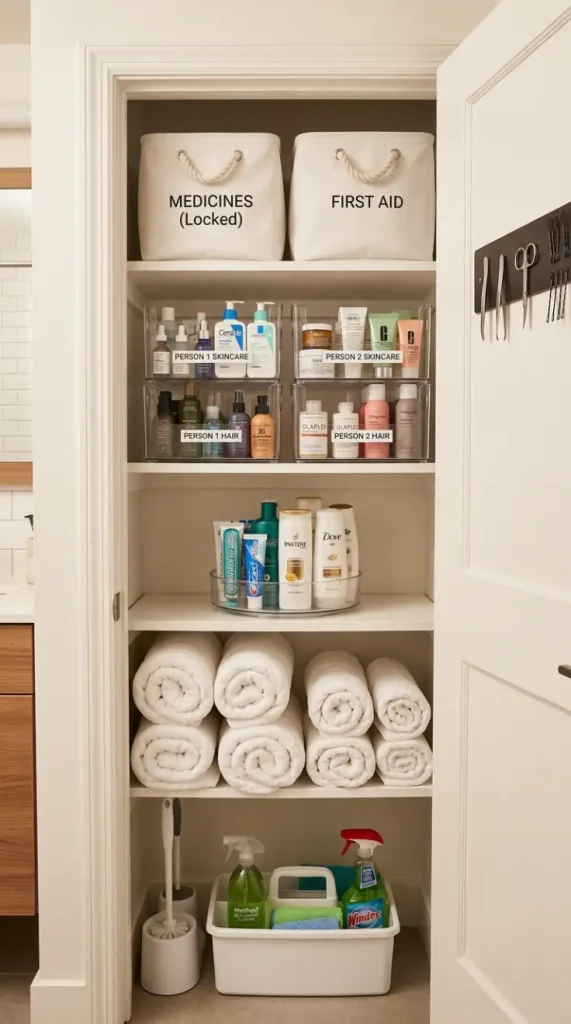
21. The Bathroom Storage Closet — Tiny Apartment Linen and Toiletries
A small bathroom storage closet in a tiny apartment — a small closet adjacent to or within the bathroom — must hold all bathroom and toiletry supplies for the household: towels, toiletries in use, backup supplies, medicines, first aid items, cleaning supplies for the bathroom. The most effective bathroom storage closet organization for a tiny apartment: clear acrylic containers on shelves for toiletries organized by person or category, a turntable in the back of the deep shelf for backup supplies, a small medicine cabinet insert with a lockable section, rolled towels standing upright using the shelf height efficiently, a magnetic strip inside the door for metal tweezers and nail scissors and bobby pins.
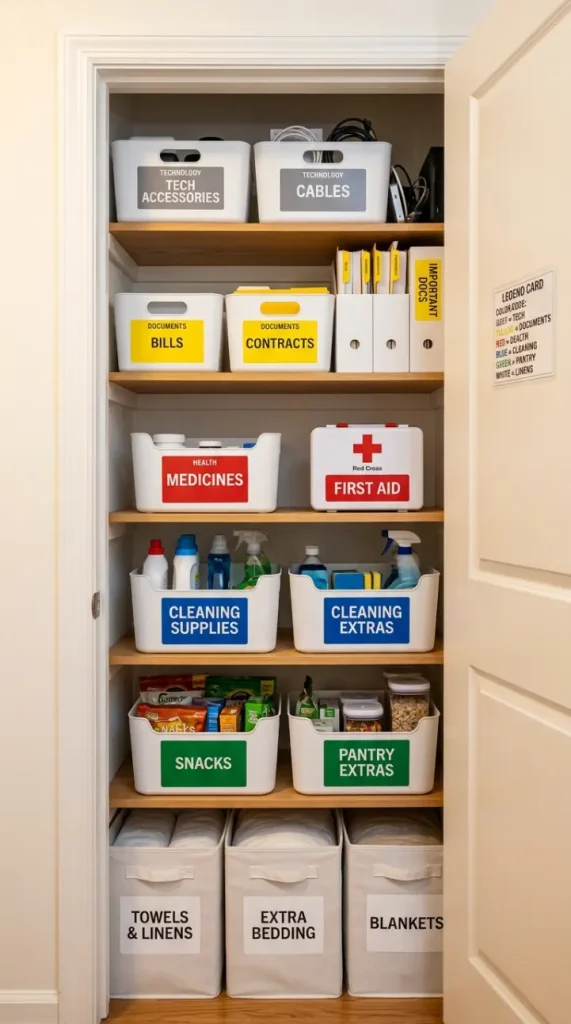
22. Color Coding Closet Organization — Visual Category Language
Color coding the contents of a small apartment closet — using specific colors for specific categories across all labels, all storage boxes, and all organizational containers — creates a visual category language that allows the closet to be navigated at a glance rather than read label by label. A color coding system: red labels and red-edged containers for HEALTH and MEDICINE categories, blue labels and blue containers for CLEANING, green for FOOD and PANTRY, yellow for DOCUMENTS, white for CLOTHING and LINENS, grey for TECHNOLOGY. The color code makes the closet immediately intuitive for everyone in the household without requiring reading labels on every individual item.
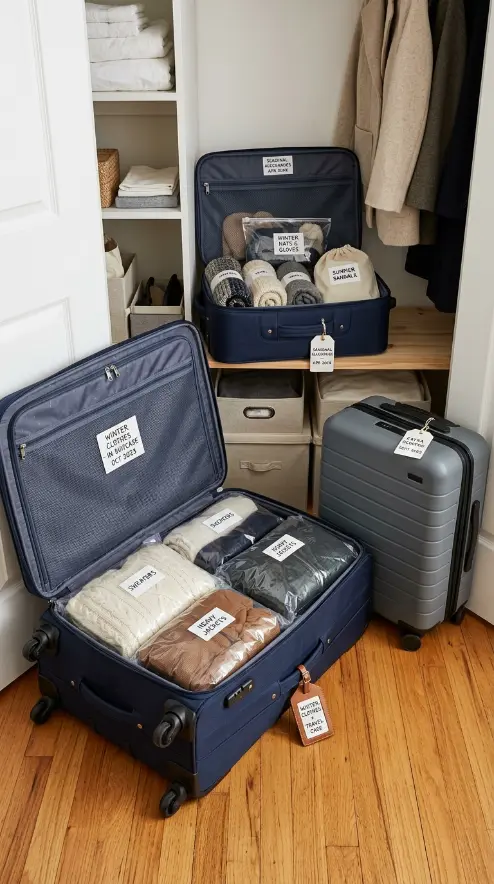
23. Suitcase as Storage — Travel Luggage Inside Closets
In a tiny apartment where storage is at an absolute premium, empty suitcases stored in a closet while containing nothing are a significant waste of limited storage volume. Repurposing the interior of stored suitcases as active storage — the large suitcase holding seasonal clothing compressed and sealed inside, the smaller case holding extra bedding or towels, the carry-on bag holding off-season accessories and smaller items — converts the suitcase from an occasionally used travel item taking up closet space into a dual-purpose travel and storage solution that earns its closet footprint year-round.
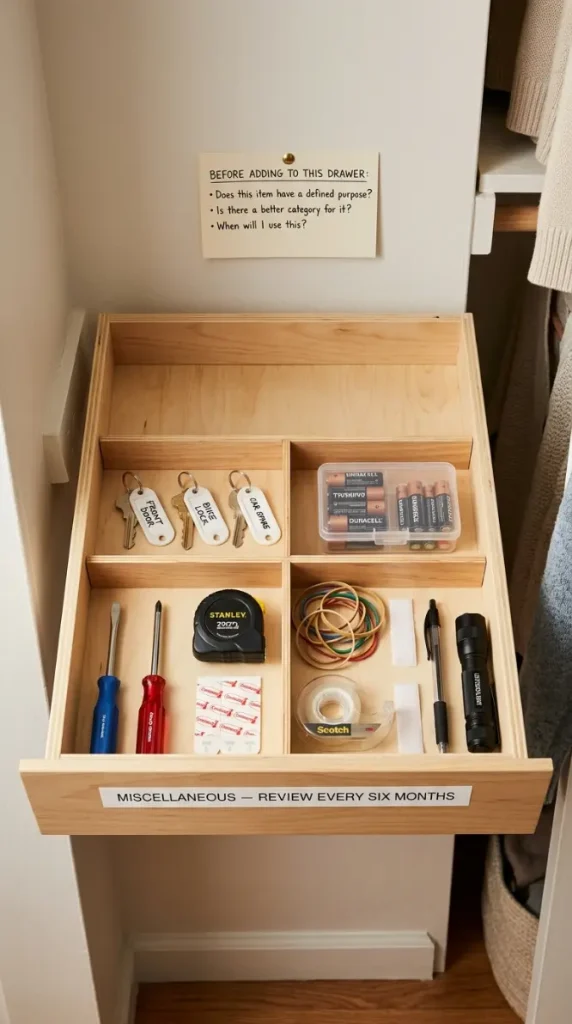
24. The Junk Drawer Closet — Controlling the Chaos Category
Every tiny apartment has one space — usually a drawer or a small closet section — that becomes the default destination for every item that does not have a defined home: spare keys, batteries, rubber bands, expired coupons, mystery hardware, and accumulated miscellany. This is the junk drawer or junk closet section, and it cannot be organized out of existence — but it can be contained and controlled. The organized junk section: a defined location with a physical boundary (one specific drawer or one specific basket, never more), an annual or bi-annual purge schedule, and a decision rule for items that enter (every item added must have a defined purpose for being kept). The goal is not to organize the junk but to contain it to its designated zone.
25. The Six-Month Edit — Organizational Maintenance System
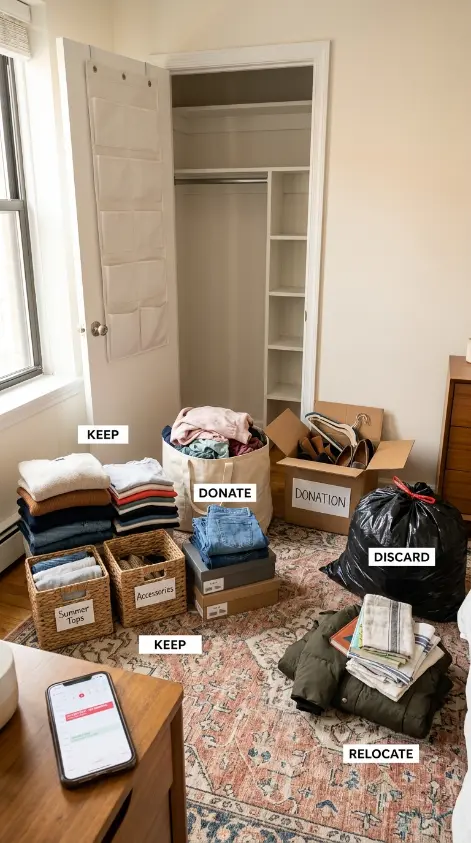
The most beautifully organized small apartment closet will become disorganized within six to twelve months without a maintenance system. The six-month edit: a calendar reminder set twice a year (typically spring cleaning season and autumn before the holiday period) to review every closet and storage area in the tiny apartment. The edit process: remove everything from the closet, decide on each item (keep, donate, discard, or relocate), clean the closet interior, and return only the items that belong in this specific closet in their organized positions. The six-month edit is not a reorganization — it is a maintenance of the original system, removing the accumulated drift that gradually erodes any organizational structure.