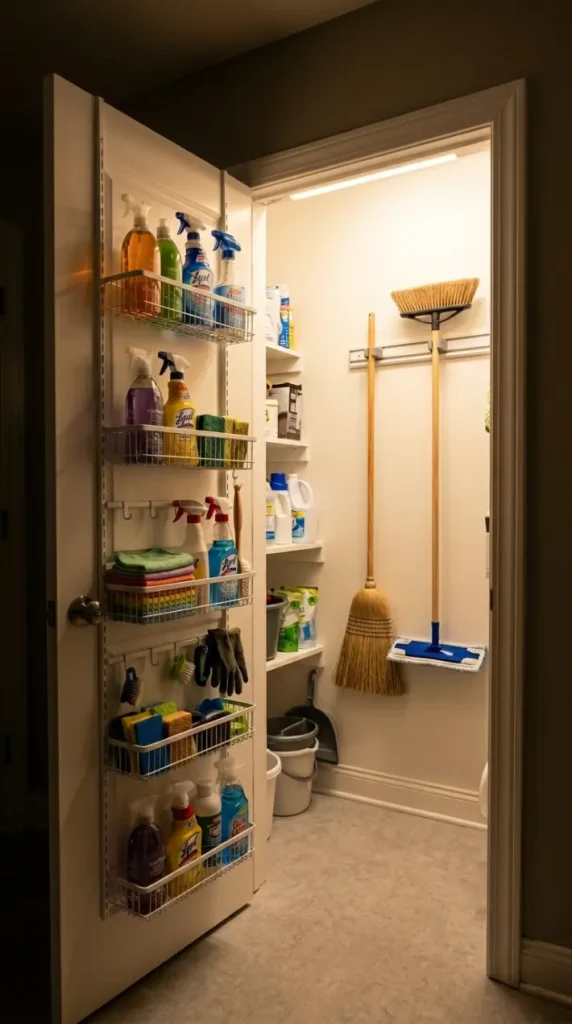
13 Cleaning Closet Organization Door-Mounted Caddy System
There is a version of a cleaning closet that most homes have — and almost no one is happy about it. The spray bottles that have tipped onto their sides. The mop handle that falls out every single time the door opens. The roll of paper towels that is somehow always at the back behind everything else. The rubber gloves that have migrated to three different locations simultaneously. The bucket that takes up a third of the available floor space. The broom that leans at an angle that defies both physics and patience.
None of this is inevitable. Almost all of it is solved by a single organizational system applied to one surface that most cleaning closets have in abundance and almost none of them use effectively — the back of the door.
The door-mounted caddy system is the organizing principle that transforms a cleaning closet from a space you open reluctantly and close quickly into one that is genuinely satisfying to use. The door surface — typically between 60 and 90 centimetres wide and up to 200 centimetres tall — represents significant storage real estate that sits completely unused in most homes. When that surface is fitted with a properly designed caddy system, every spray bottle, every cloth, every scrubbing pad, every pair of rubber gloves, and every small accessory has a specific, accessible, always-visible home. Nothing falls. Nothing gets lost behind something else. Nothing requires excavation to locate. The door opens, everything is immediately visible and immediately reachable, and the entire ritual of getting the right supplies for the right cleaning task takes seconds rather than the frustrating minutes of rummaging that most people currently experience.
In 2026, the door-mounted cleaning caddy system has evolved significantly beyond a single over-the-door shoe organizer repurposed for spray bottles. The best systems combine multiple caddy types — wire baskets, spray bottle holders, shelf caddies, magnetic strips, roll dispensers, and adjustable rails — in a single cohesive installation that addresses every category of cleaning supply with a purpose-built solution. This post covers exactly how to build that system from scratch, zone by zone, supply category by supply category, door panel by door panel.
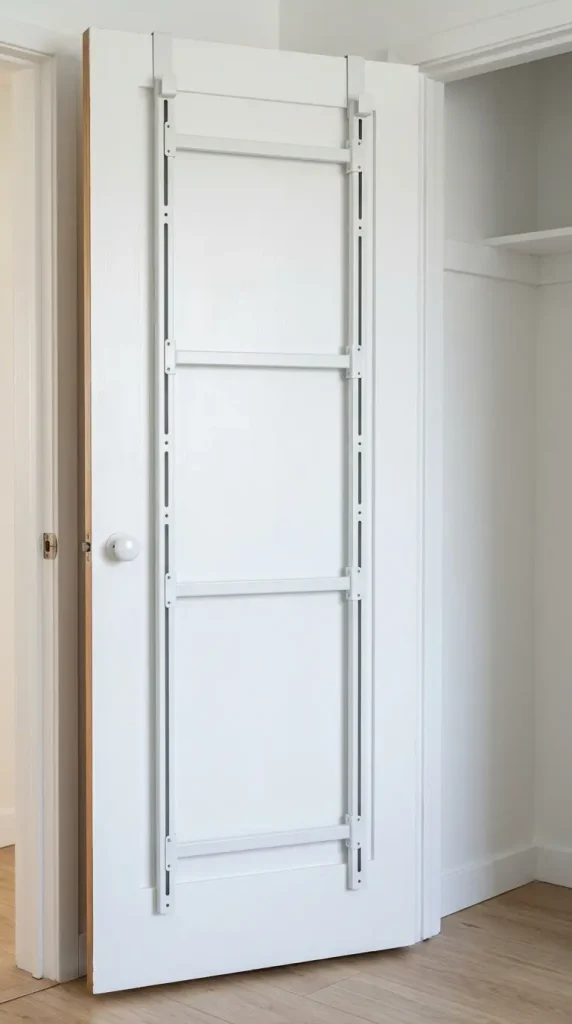
1. Start With a Full-Length Over-Door Rail System as the Caddy Foundation
Before any individual caddy component can be placed, the door needs a structural foundation system to mount everything onto — and the most versatile and highest-capacity foundation available for a cleaning closet door is a full-length adjustable over-door rail system. These systems consist of two vertical steel rails that hook over the top of the door and run the full height of the door panel, connected by horizontal crossbars at adjustable intervals that serve as mounting points for every caddy, basket, shelf, and holder added afterward. The rail system itself costs almost nothing relative to the organizational value it delivers, requires zero wall drilling, zero permanent modification, and can be reconfigured completely at any point by simply repositioning the crossbars and swapping out the caddy components attached to them. Choose a system in matte white or matte black powder-coated steel rather than chrome — chrome shows water spots and fingerprints from cleaning supply contact immediately and consistently, while a matte finish remains clean-looking between sessions. The full-length version that runs from the top of the door to within 10 centimetres of the floor maximizes the usable door surface completely and accommodates the full range of caddy components needed for a complete cleaning supply organization system.
2. Mount Individual Spray Bottle Holders at the Most Accessible Door Zone
Spray bottles are the most frequently reached-for items in any cleaning closet — and they are also, in almost every unorganized cleaning closet, the most frequently knocked over, leaked, and rummaged-through items in the entire space. Dedicating a specific zone of the door-mounted caddy system to spray bottles, with individual purpose-built holders for each bottle, solves every one of these problems simultaneously. Individual spray bottle holders — a simple loop of coated wire or a molded plastic cradle that clips onto the door rail and holds a single bottle by its neck with the trigger pointing outward and the bottle hanging vertically — keep every bottle upright, prevent leaking, make every bottle immediately visible and individually accessible without moving anything else, and create a visual row of supplies that communicates at a glance which products are available and which need restocking. Mount the spray bottle holder zone at approximately chest to eye height — the most ergonomically accessible door zone — so that every bottle can be grabbed and replaced with one hand without bending or reaching overhead. Five to seven individual holders in a single horizontal row or two staggered rows handles the full range of spray cleaning products most households use: all-purpose cleaner, glass cleaner, bathroom disinfectant, kitchen degreaser, floor spot cleaner, and one or two specialty products.

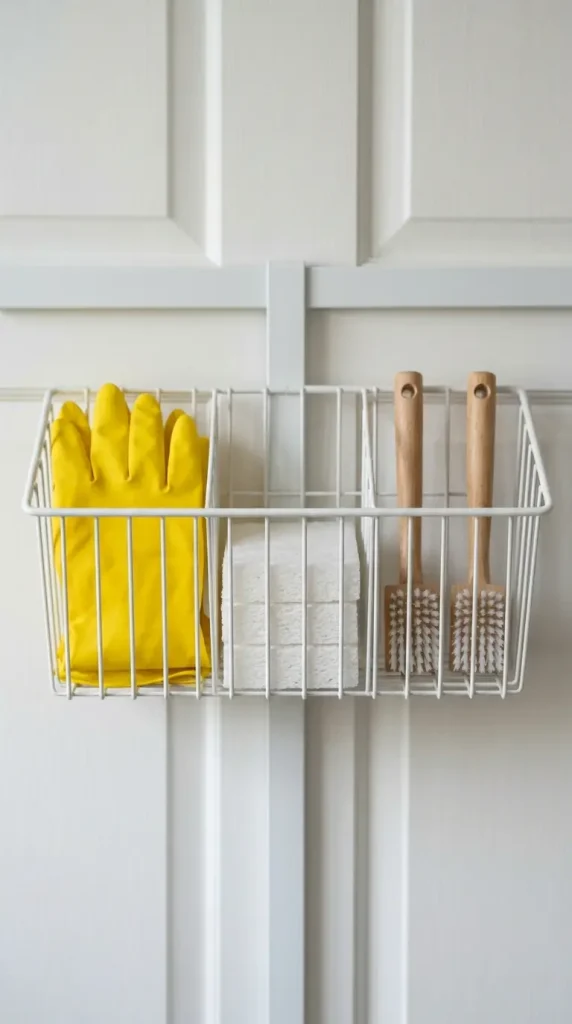
3. Install a Deep Wire Basket at Mid-Door Height for Bulky Cleaning Supplies
The spray bottle zone handles liquids. The mid-door zone needs to handle the bulkier, less uniform category of cleaning supplies — rubber gloves, sponges, scrubbing pads, steel wool, cleaning brushes, pumice stones, and the various small accessories that accumulate in any cleaning supply collection and resist every other organizational approach because they are too irregular in shape to sit neatly on a flat shelf. A deep wire basket — approximately 30 centimetres wide, 10 centimetres deep, and 15 centimetres tall — mounted on the door rail at mid-door height is the solution for this entire category. The wire construction allows visibility of everything inside the basket from the front without opening or rummaging, the depth is sufficient for bulkier items like rolled rubber gloves, and the open top means items can be dropped back in from above with one hand while the other is occupied. Add a simple divider — a single piece of bent wire or a small plastic insert — to separate the basket into two or three compartments: rubber gloves in one section, sponges and scrubbing pads in the second, small brushes and accessories in the third. The basket zone handles everything that the spray bottle holders and shelf caddies cannot, and completes the door caddy system’s coverage of the full range of cleaning supply shapes and sizes.
4. Add a Full-Width Shelf Caddy at the Top of the Door for Microfiber Cloths
The top zone of the door-mounted system — from approximately 160 centimetres to the top of the door — is the overhead zone, and it belongs to the items that are used regularly but not urgently grabbed mid-task: the folded microfiber cloth collection, the spare sponge supply, the cleaning glove refills, and the small flat items that disappear in drawers and baskets but stack beautifully on a flat surface with a front rail. A full-width shelf caddy in matte white coated wire — a simple flat shelf with a 5 centimetre upstand rail along the front edge to prevent items sliding off — mounted at the top of the door rail system creates a dedicated storage zone for folded microfiber cloths that makes the entire cleaning cloth situation permanently solved. Fold each microfiber cloth in thirds and stand it upright in a row along the shelf — the way a file folder stands in a filing system — so every cloth is individually visible and individually removable without disturbing any other cloth on the shelf. A full-width shelf at this size holds twelve to sixteen folded cloths standing upright with room remaining. Color-code the cloths by cleaning zone — blue for bathroom, yellow for kitchen, green for general surfaces, white for glass — and the shelf becomes a system within a system that makes cloth selection for the right task a one-second visual decision rather than a guessing exercise.

5. Use a Magnetic Strip for Metal-Capped Cleaning Tools and Small Metal Accessories
A magnetic strip is one of the most underused organizational tools in any cleaning closet context — its application in kitchens for knife storage is widely understood, but its utility in a cleaning closet for the metal-capped and metal-handled accessories that accumulate in every cleaning supply collection is almost entirely overlooked. A strong neodymium magnetic strip mounted on the door rail or directly on the inside of the closet door at approximately 140 centimetres height holds metal-tipped cleaning accessories — a stainless steel scraper, a metal grout brush with a metal-banded handle, small steel wool pads in their individual wrappers, metal-handled detail brushes, a stainless steel sponge holder, and any other metal-component cleaning tool — firmly against the wall without any holder, basket, or clip required. The magnetic strip keeps these small, awkward metal objects immediately accessible, prevents them from sinking to the bottom of baskets where they are never found without full excavation, and costs almost nothing. A 30 centimetre strip handles six to eight individual metal cleaning accessories comfortably and takes up approximately one square foot of door surface space.

6. Mount a Paper Towel Roll Dispenser on the Door Rail for Instant Access
A paper towel roll sitting on a closet shelf or propped against a wall is a paper towel roll that will always end up on the floor at the worst possible moment. A wall-mounted paper towel dispenser — the kind with a simple horizontal bar that holds the roll and allows it to spin freely for single-handed tearing — mounted directly on the door rail system at approximately 130 centimetres height turns the paper towel into a proper, permanent door-caddy citizen. For a cleaning closet specifically, the ability to grab a sheet of paper towel single-handedly while already holding a spray bottle in the other hand is a genuine functional improvement to the cleaning workflow that most people do not realize they want until they have it and then cannot imagine being without it. Choose a dispenser in matte black or matte white to match the rail system, with a simple tensioned bar design that tears cleanly without the entire roll spinning off the bar. Add a second smaller dispenser beside it for a roll of heavy-duty shop towels or a roll of lint-free glass cleaning cloths, giving the door a dedicated disposable and semi-disposable sheet dispensing zone that handles the full range of paper-based cleaning materials.

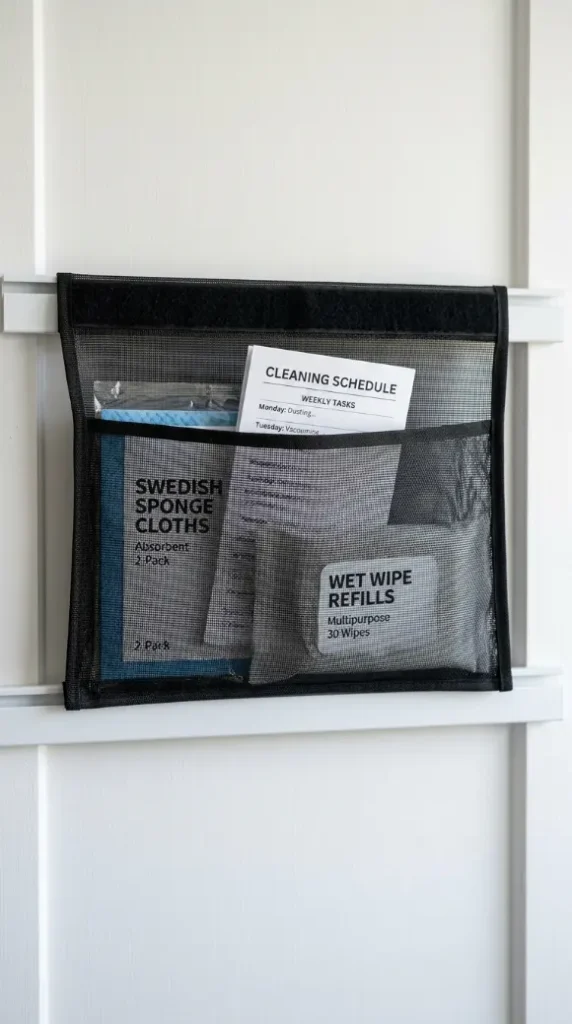
7. Install a Narrow Mesh Pocket for Flat Items Like Cleaning Pads and Instruction Cards
Between the deep wire baskets that handle bulky three-dimensional items and the spray bottle holders that handle tall cylindrical items, there is a category of cleaning supply that has no natural home in most caddy systems — the flat, thin, wide items. Replacement scrubbing pad refills in their flat packaging. Disposable cleaning wipe packets. Flat sponge cloths still in their sealed envelopes. The printed cleaning schedule or product instruction cards that are genuinely useful to have visible in the closet and genuinely impossible to store anywhere except a flat pocket. A narrow mesh fabric pocket — approximately 30 centimetres wide and 20 centimetres tall, with a hook-and-loop attachment strip along its top edge that clips to a door rail crossbar — handles every item in this category perfectly. The mesh fabric gives visibility of everything inside the pocket without requiring it to be opened, the flat form factor sits flush against the door surface without projecting more than 3 centimetres into the closet space, and the wide opening allows flat items to be slid in and retrieved with one hand. Mount it at approximately 120 centimetres height, between the spray bottle zone above and the glove basket below.
8. Dedicate the Bottom Door Zone to a Caddy Tray for Cleaning Product Bottles
The bottom zone of the door-mounted system — from floor level to approximately 60 centimetres height — is the zone that should handle the heaviest, tallest, most awkward items in the cleaning closet that cannot go on the upper door sections: the large refill bottles of cleaning concentrate, the tall bottle of floor cleaner, the wide tub of bathroom scrub powder, the spray can of oven cleaner. A low deep wire caddy tray — approximately 40 centimetres wide, 15 centimetres deep, and 20 centimetres tall — mounted at the very bottom of the door rail system creates a floor-adjacent zone that holds these tall and heavy bottles upright, prevents them from tipping on the closet floor, and keeps them accessible at waist height rather than requiring crouching to reach items stored at floor level. The open front of the wire tray means every bottle is visible and reachable directly without moving anything. A simple label on each bottle confirms contents at a glance. This bottom tray also handles the backup supply of spray bottle refills — larger bottles of the cleaning concentrates that are decanted into the amber glass spray bottles on the upper door zone — creating a visual supply chain from the large concentrate bottles at the bottom to the ready-to-use spray bottles at eye level that makes restocking spray bottles a one-second task every time.
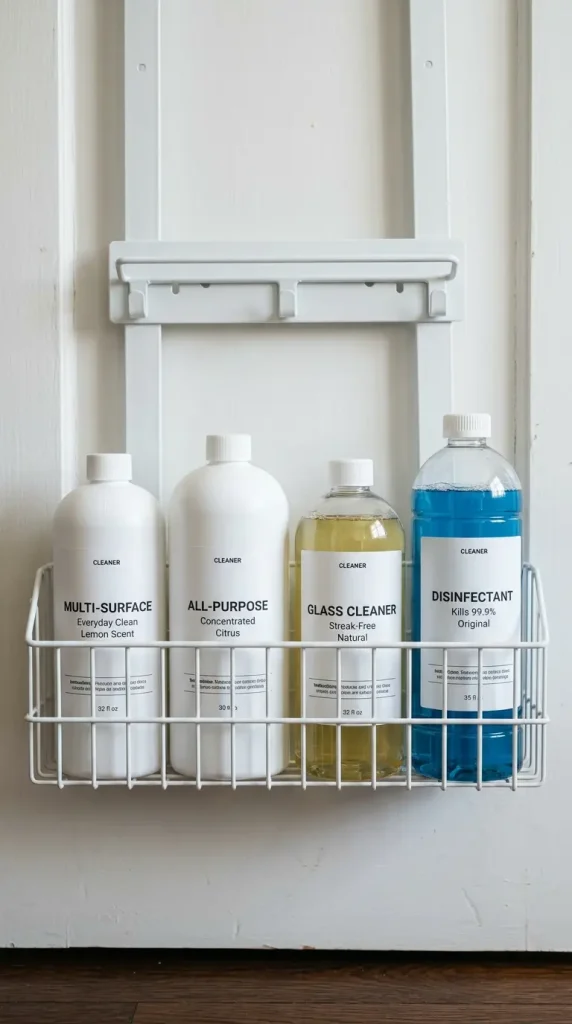
9. Use Clear Matching Containers to Decant Every Loose Item in the Interior Closet
The door-mounted caddy system handles the entire door surface — but the interior of the cleaning closet still needs to work in coordination with it, and the single most impactful thing you can do to the interior shelving is to remove every original product packaging from every loose small item and decant everything into matching clear containers. Dishwasher tablets out of their cardboard box and into a clear lidded jar. Cleaning tablet refills out of their plastic sachet strip and into a labeled clear container. Drain cleaning crystals out of their branded pouch and into a small glass jar. Surface wipes refills in a clear flat-front container. Spare rubber gloves folded and stored in a labeled clear bin. When every item in the interior of the cleaning closet is in a matching, clearly labeled container rather than its original retail packaging, two things happen simultaneously: the visual noise of competing colors, fonts, branding, and package shapes disappears completely, and the actual quantity of every supply becomes immediately visible and assessable without opening anything. The combination of a fully organized door caddy system and a fully decanted interior shelf system makes the cleaning closet one of the most satisfying organizational achievements in any home — because it is the closet that genuinely gets used daily and the one that most directly affects the friction of the most universally dreaded domestic task.

10. Label Every Zone of the Door Caddy System With a Small Printed Category Label
A door-mounted caddy system without labels is a system that works perfectly for the person who installed it and becomes gradually less reliable for everyone else in the household — and even for the installer, six months after installation when the memory of which zone was designated for what has faded. Small printed category labels — a simple rectangle of white card stock, approximately 5 by 2 centimetres, with the zone category printed in clean sans-serif type and attached to the front rail of each caddy component with a small adhesive label holder — make every zone of the door system immediately legible and self-maintaining. The label does not need to be elaborate. A small white rectangle reading SPRAY BOTTLES in clean black type on the front rail of the spray bottle zone. CLOTHS on the shelf caddy. GLOVES AND SPONGES on the wire basket. REFILL BOTTLES on the bottom tray. PAPER TOWELS on the dispenser. The label system transforms the caddy from a visual organization tool that requires interpretation into a true system — one that any member of the household can follow correctly, that makes restocking straightforward for anyone, and that maintains its organizational integrity over time because the return location of every item is permanently and clearly communicated rather than assumed.
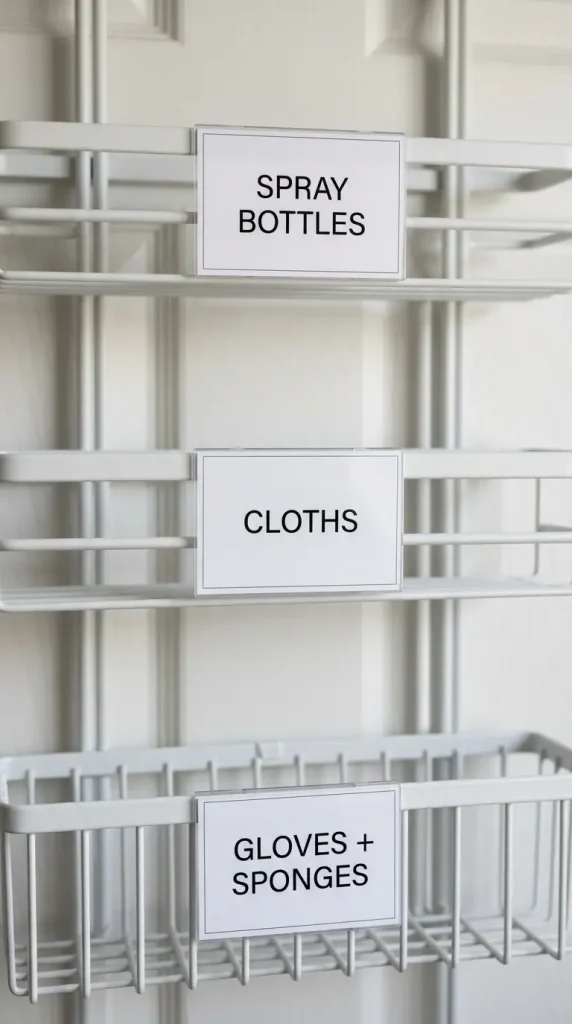
11. Add a Slim Fold-Out Hook Row for Hanging Long-Handled Tools Temporarily
There is a category of cleaning tool that the door caddy system cannot hold permanently and the interior wall-mounted holders hold permanently — the long-handled tools that move between sessions: the mop that is drying after use, the scrub brush that was just used wet and needs to air dry before being clipped back onto its wall holder, the extendable duster that is too long for any caddy basket. A slim fold-out hook row — a compact bar with three to five individual hooks that folds completely flat against the door surface when not in use and folds outward 90 degrees to present the hooks when the closet door is open — installed on the door rail at approximately 150 centimetres height creates exactly this temporary hanging zone. When the closet door is closed, the fold-out hook row takes up zero projection space and does not interfere with anything in the closet interior. When the door is open for active use, the hooks present outward into the room and handle any long-handled, wet, or actively-in-use tool that needs to hang freely during or between cleaning sessions without dripping on the floor or leaning against a wall.
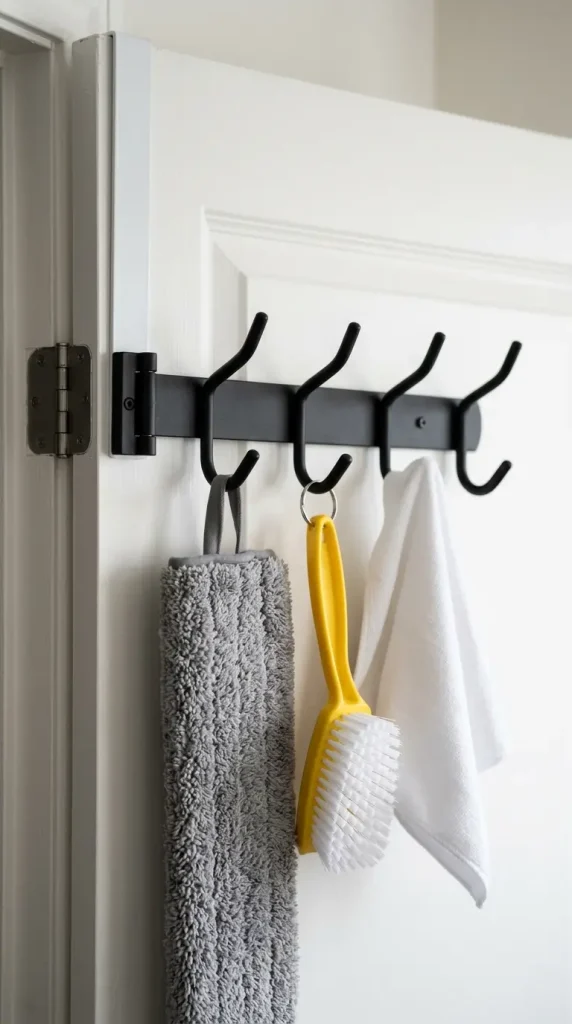
12. Install a Small Whiteboard or Chalkboard Panel for the Running Restocking List
The cleaning closet is the one place in a home where a running restocking list is genuinely and practically useful — not a note on a phone, not a mental note that will be forgotten at the shop, but a physical list that is visible and updatable at the exact moment when the last paper towel roll is used, the spray bottle refill concentrate runs out, or the rubber gloves develop their first hole. A small whiteboard or chalkboard panel — approximately 20 by 15 centimetres — mounted on the inside of the closet door just above or below the caddy system, with a slim marker holder clipped beside it holding a single dry-erase marker, creates a permanent shopping list surface that lives at the point of discovery. The moment the last sponge is taken from the caddy basket, the hand that took it writes SPONGES on the board before closing the door. The moment the spray bottle feels light, GLASS CLEANER REFILL goes on the list. When restocking day arrives, the board is the list — complete, accurate, and requiring zero memory because it was written in real time by the person who noticed the need. It is the detail that makes the whole door caddy system self-maintaining rather than requiring periodic full reassessment to identify what has run out.
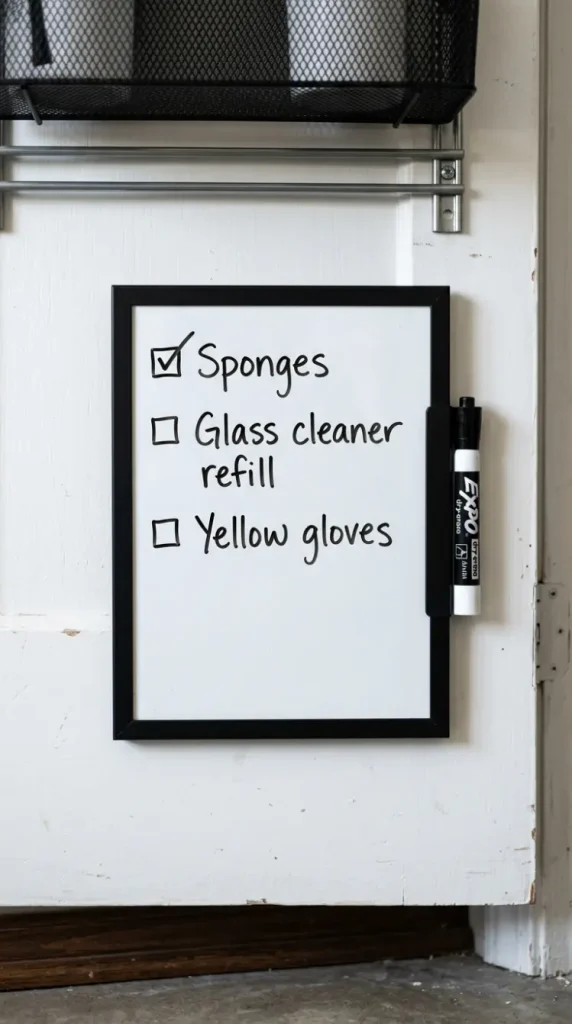
13. Light the Interior With a Motion-Activated LED Strip at the Door Frame Top
A cleaning closet without interior lighting is a cleaning closet that relies entirely on whatever ambient light reaches it from the room outside — which is invariably insufficient for reading labels on the caddy shelves, identifying the correct cloth color from the shelf caddy row, or assessing whether a product bottle needs restocking. A battery-operated or rechargeable LED strip light — approximately 30 to 40 centimetres in length, 2700K warm white tone, with a built-in motion sensor that activates the moment the door opens — mounted inside the door frame at the very top of the closet creates a complete interior lighting solution that requires no wiring, no electrician, and no structural modification. The motion activation means the light is on every time the closet is in use and off every time it is not — it never needs to be switched on or off manually, it never gets left on accidentally, and it never requires the door to be fully open toward a wall outlet to function. A warm white 2700K tone rather than cool white prevents the closet from feeling clinical and makes the amber glass spray bottles and the warm tones of natural-fiber cleaning tools read at their best rather than under the flattening wash of cool white light.