26 Minimal Outdoor Living Space Design for a Rooftop Terrace
A rooftop terrace is one of the most extraordinary outdoor spaces a building can offer — elevated above the street, open to sky on all sides, removed from the noise and the clutter of ground-level life. And yet most rooftop terraces fail to reach their potential not because of what they lack but because of what they add too much of. Too much furniture, too many planters, too many competing materials, too many objects that individually seem reasonable but collectively create a rooftop that feels like a storage area with a view rather than a considered outdoor room above the city.
Minimalism is the design philosophy that suits rooftop living more naturally than any other, because the rooftop already has the most powerful design element available — the sky, the view, the elevated position — and the designer’s only real job is to not compete with it. Every furniture piece, every material, every planter, every lighting fixture on a minimal rooftop terrace should earn its place by doing something essential and doing it beautifully, and everything else should be removed.
The minimal rooftop terrace at its best is a room without walls — a floor plane of beautiful material, a handful of considered furniture pieces, a few living plants, and the city or the sky as the backdrop that no interior could replicate. These 26 ideas cover every dimension of this design approach from the foundational deck material choice to the furniture selection, the planting strategy, the lighting, the privacy screening, and the complete minimal rooftop room in its most fully realized form.
1. The Pale Concrete Deck as Minimal Foundation
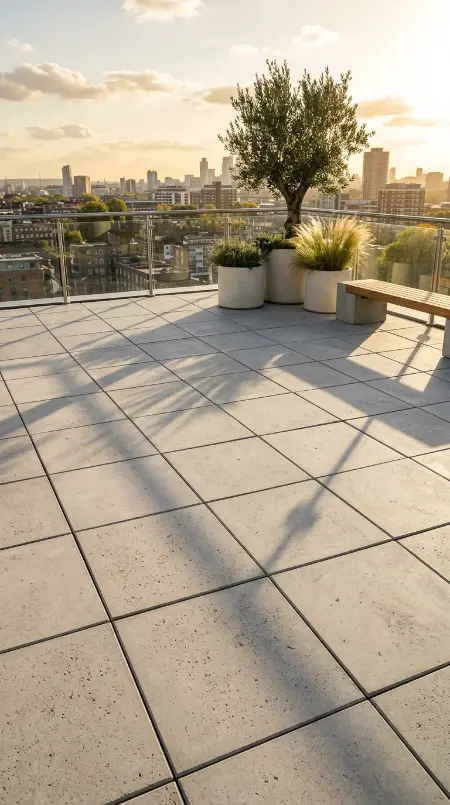
The deck material is the largest single surface on any rooftop terrace and the decision that most determines the aesthetic character of everything placed on top of it. For a minimal rooftop, large format pale grey concrete pavers — laid in a consistent grid with fine dark joints — create the most honest and most architecturally serious foundation available. The pale grey concrete reads as neutral against the sky, recedes visually so the view and the furniture become the focus, and develops a beautiful natural weathering patina over time that makes it more interesting rather than less. Size matters enormously — pavers of at least 60cm by 60cm, ideally 80cm by 80cm or larger, with minimal joint width, create a surface that reads as a single plane rather than a mosaic of small units.
2. Low-Profile Teak Platform Furniture
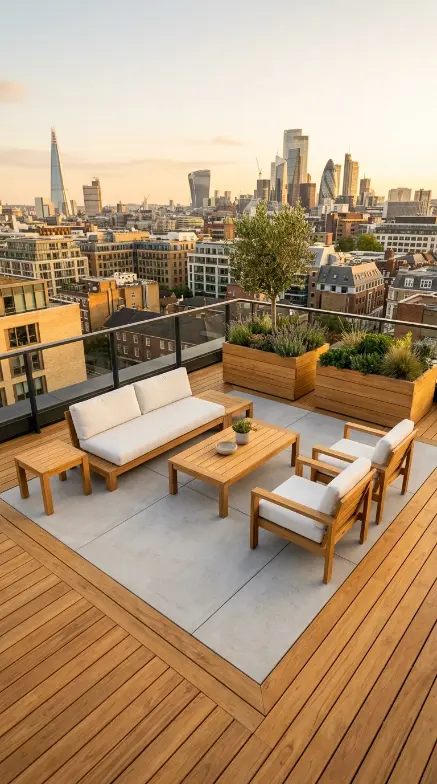
The furniture height on a minimal rooftop terrace is as important as the furniture form — and low-profile platform furniture, sitting just 30 to 35cm from the deck surface, is the choice that best serves the rooftop context. Low furniture keeps the visual horizon open, emphasizes the sky and the view over the furniture forms, and creates a relaxed ground-level sitting culture that feels genuinely different from conventional upright outdoor seating. A teak platform sofa with thick off-white cushions, a matching low teak coffee table, and two low teak armchairs constitute a complete minimal rooftop furniture arrangement that needs nothing added to it — the warm honey-gold of the teak against the pale concrete deck and the sky beyond is a material combination of natural completeness.

3. Single Material Palette Throughout
The minimal rooftop terrace achieves its visual coherence not through complexity but through restraint — and the most powerful restraint available is the single material palette decision: choosing one primary material and using it for every element on the terrace. Teak for the furniture, the planter boxes, and the deck border. Or pale concrete for the pavers, the planters, and the low bench. Or dark steel for the railing, the furniture frames, and the outdoor lighting fixtures. When one material appears repeatedly throughout the terrace in different forms and functions, the eye reads the space as unified and intentional rather than assembled from separate decisions.
4. Architectural Planting in Identical Containers
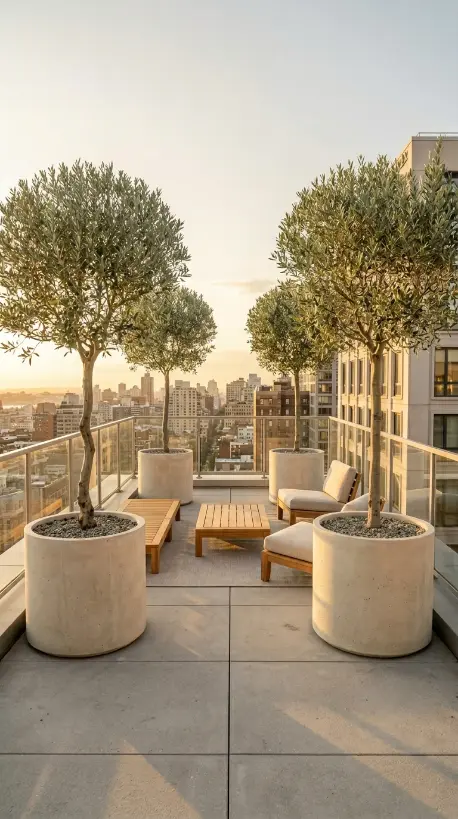
The planting strategy on a minimal rooftop terrace must follow the same rules as everything else — restraint, repetition, architectural form over decorative variety. Four identical large containers, identically sized and identically planted, positioned at the four corners of the terrace or at regular intervals along the perimeter, create a planting scheme that reads as a design decision rather than a garden. The containers should be simple cylindrical or rectangular forms in pale concrete, white fibreglass, or dark Corten steel. The plants should be architectural — a single olive tree, a single ornamental grass clump, a single bamboo — never mixed planting, never flowers, never color. The power is entirely in the repetition.
5. Glass Perimeter Railing for Unobstructed Views
The perimeter railing on a rooftop terrace is the element that either preserves or destroys the view — and for a minimal rooftop terrace, the only railing that fully preserves the view is floor-to-railing-height frameless glass panels in minimal stainless or dark steel point-fixings. A glass railing makes the rooftop feel genuinely elevated and genuinely open — the city, the sky, and the horizon are fully visible from every seated and standing position on the terrace. The glass also creates a wind barrier that makes the terrace usable in conditions that would make an open railing terrace uncomfortable. On a minimal terrace, the glass railing is invisible by design — it protects without interrupting.
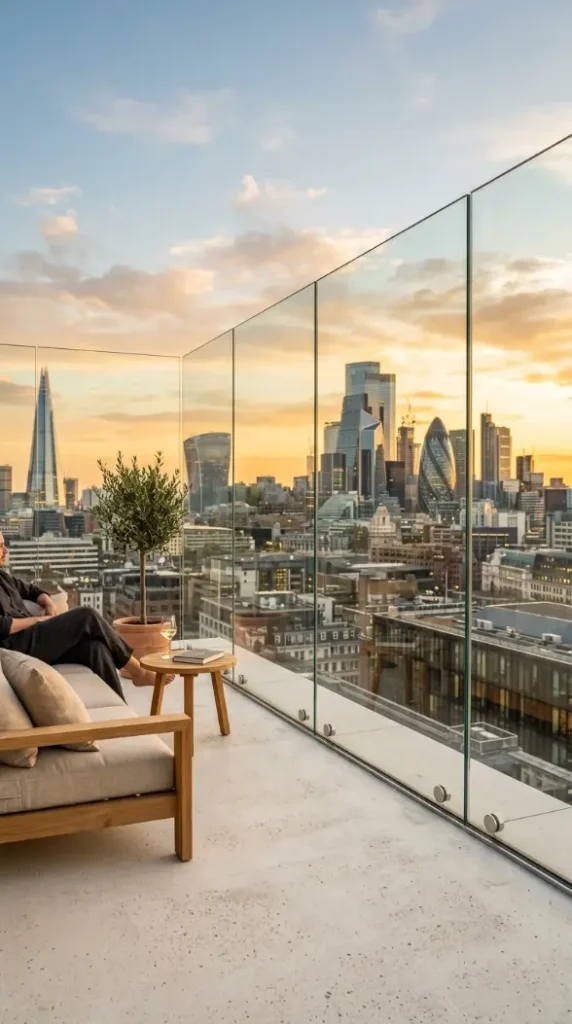
6. Minimal Rooftop Lighting — Warm Floor Level
Lighting on a minimal rooftop terrace should always be at low level — never overhead, never harsh, never cold. Floor-level outdoor lanterns in dark concrete or dark steel, warm Edison candle bulbs inside, positioned beside and between the furniture pieces rather than mounted overhead, create a warm amber ground-level glow that makes the rooftop feel genuinely atmospheric after dark while the city lights provide the overhead drama that no fixture could match. Three to five floor lanterns, consistently styled, placed at furniture perimeter and along the deck edge, are sufficient. The simplicity of the lighting scheme is part of the minimal aesthetic.
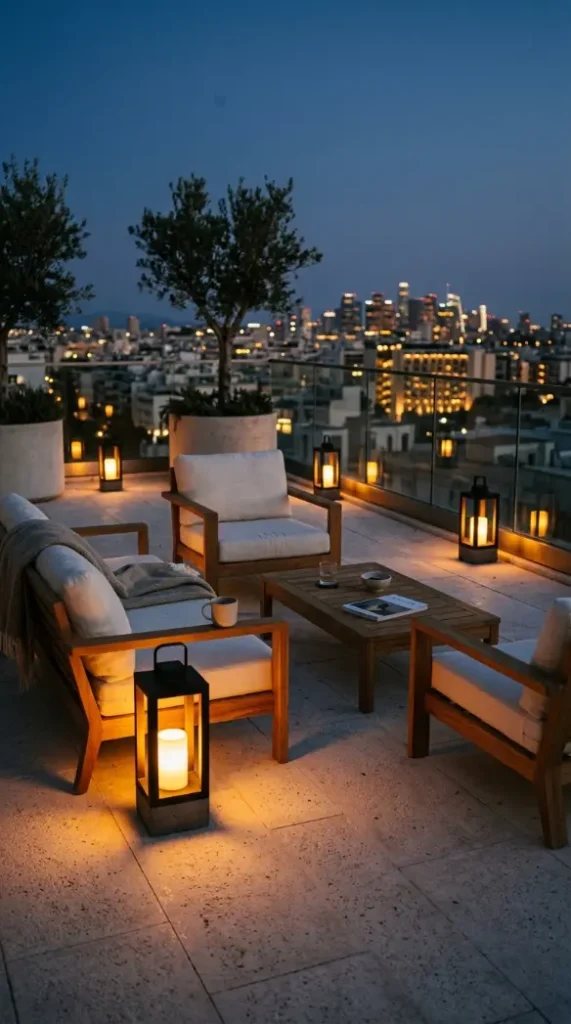
7. Privacy Screening With Minimal Timber Battens
A rooftop terrace that is overlooked by neighboring buildings or upper floors requires a privacy solution — and the minimal rooftop demands that the solution be as architectural and as restrained as everything else on the terrace. Vertical timber battens in teak or dark stained timber, mounted on a slim steel frame at the terrace perimeter, create a privacy screen that filters views from outside while allowing air movement and light filtration from inside. The rhythm of the vertical battens — consistently spaced, consistently proportioned — creates a wall surface of natural material that is genuinely beautiful in its own right and becomes more interesting as the timber weathers and develops patina.
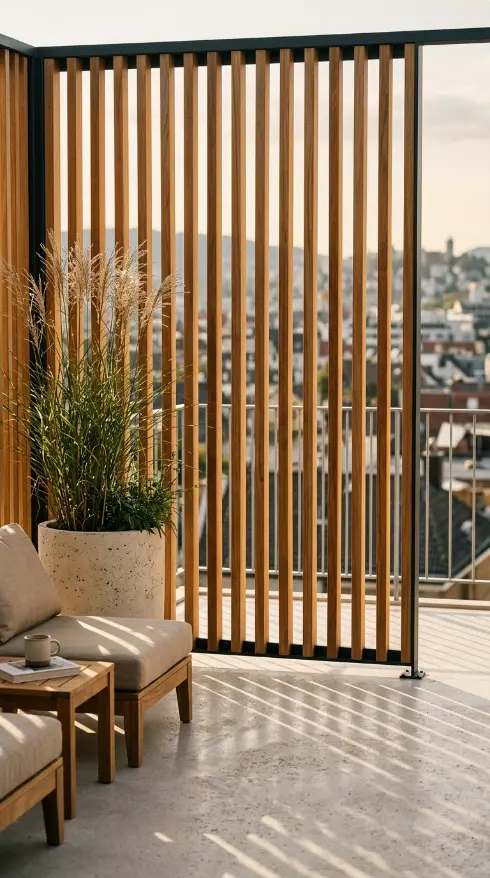
8. Outdoor Rug to Define the Living Zone
An outdoor rug on a rooftop terrace does what every rug does in any room — it defines a zone within the larger floor plane, anchors the furniture arrangement to a specific area, and introduces a layer of texture and warmth that hard flooring alone cannot provide. On a minimal rooftop, the outdoor rug must be simple and must not compete: a large flat-weave in natural off-white, pale grey, or warm sand, in a simple stripe or plain weave, sized to extend under all furniture legs and create a clearly defined living zone within the larger pale concrete deck. The rug should feel like it belongs to the architecture rather than being placed on top of it.
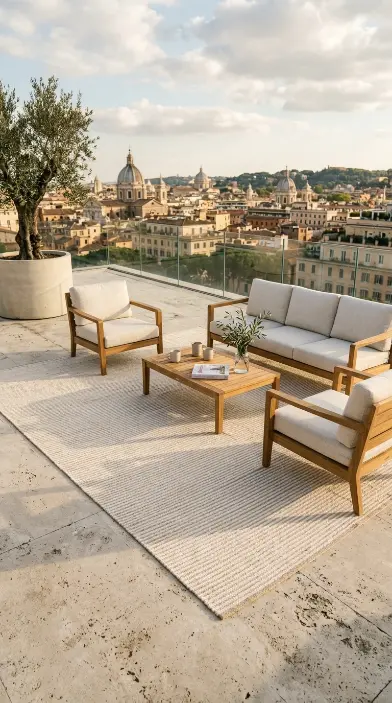
9. Rooftop Dining Zone — Minimal Concrete Table
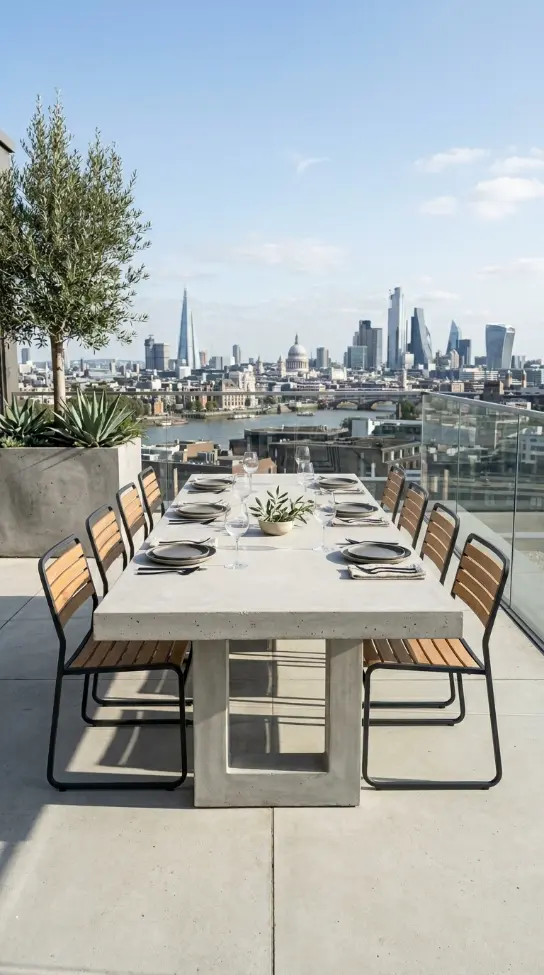
A rooftop dining area — separate from the living zone or combined with it on smaller terraces — requires one large table and enough chairs, and on a minimal rooftop terrace the table material should be concrete, teak, or dark steel rather than any material that introduces visual complexity. A poured concrete outdoor dining table — simple rectangular form, thick slab top, concrete trestle or slab legs — has a presence and a permanence on a rooftop terrace that lighter materials cannot achieve. It reads as a piece of architecture as much as a piece of furniture, and its pale grey tone against the sky and the city beyond creates a material relationship of genuine simplicity and genuine beauty.
10. Minimal Rooftop With Infinity Edge Plunge Pool
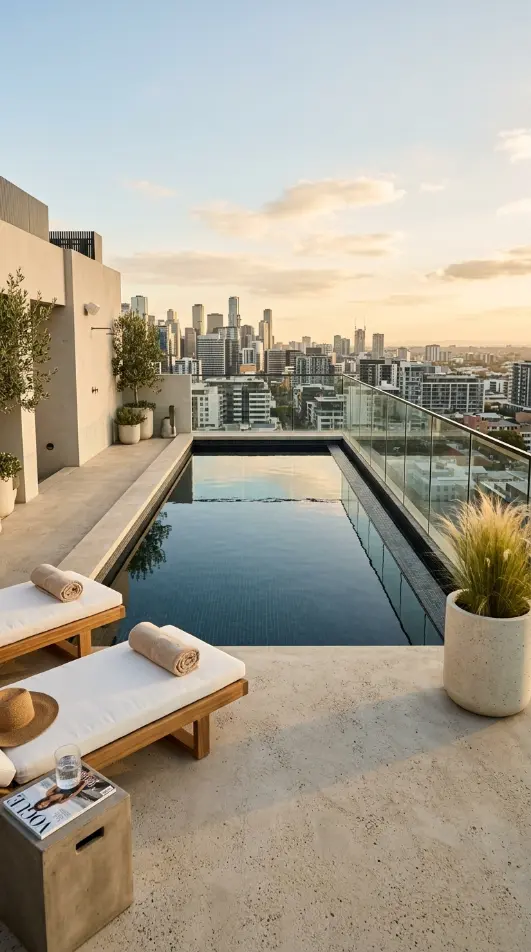
A shallow plunge pool or lap pool integrated into a rooftop terrace — with a dark tiled interior and an infinity edge facing the city view — is the element that elevates a rooftop terrace from beautiful outdoor room to genuinely extraordinary urban amenity. On a minimal rooftop, the pool should be simple in form: rectangular, dark-tiled interior, flush with or slightly above the deck plane, one infinity edge facing the primary view direction. No waterfall features, no complicated shapes, no decorative tilework — the water surface itself, reflecting sky and city, is the most powerful visual element the rooftop can have.
11. Monochrome Color Palette — White Cushions and Pale Deck
The most minimal and most spatially expansive rooftop terrace color palette uses white or off-white for all soft furnishings — cushions, throws, outdoor rugs — against a pale concrete or pale limestone deck, with natural timber as the only warm accent and green plants as the only color. This near-monochrome palette makes the terrace feel larger, makes the sky and the view appear more vivid by contrast, and creates a visual cleanliness that is the rooftop equivalent of a white-walled gallery — a neutral stage on which the city and the sky perform. In strong sunlight, the white and pale palette glows with a quality that any saturated color would reduce rather than enhance.

12. Rooftop Terrace at Night — City Light Backdrop
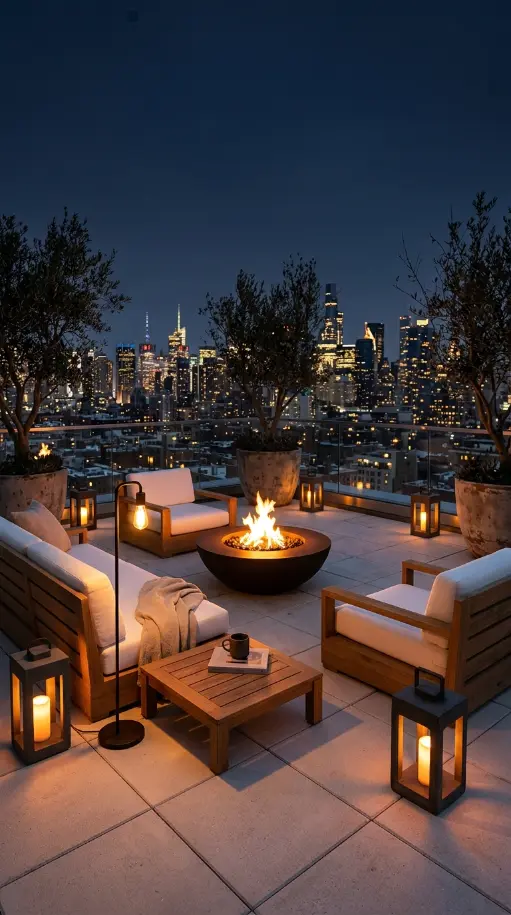
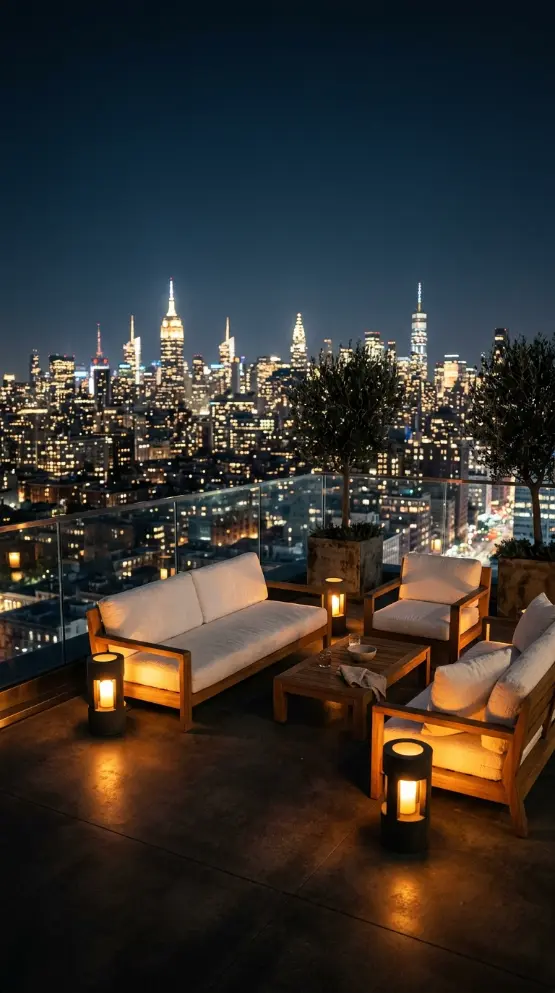
The rooftop terrace at night, when the city lights are the backdrop and the floor-level lanterns are the only artificial light source on the terrace itself, is the version of the minimal rooftop that most clearly demonstrates why the minimal approach is correct — because the city at night is itself the most powerful and most complex visual element, and a minimal terrace steps back and lets it perform. Low amber lanterns, white cushions catching warm light, the silhouettes of architectural plants against the illuminated sky, the city glowing beyond the glass railing — this is the image that makes the minimal rooftop terrace feel genuinely extraordinary.
13. Slim Outdoor Floor Lamp as Vertical Accent
A single slim outdoor floor lamp — in dark powder-coated steel, approximately 150cm tall, with a minimal shade or bare Edison bulb — positioned at one end of the sofa arrangement on a minimal rooftop terrace provides both warm ambient light and a vertical accent element that gives the low horizontal furniture arrangement a compositional anchor. The slim steel pole of the floor lamp disappears against the sky during the day and becomes a warm point of amber light against the city at night. It is the minimal rooftop terrace’s equivalent of a floor lamp in a living room — the element that makes the furniture zone feel like a room rather than a furniture collection.

14. Outdoor Daybed for Rooftop Lounging
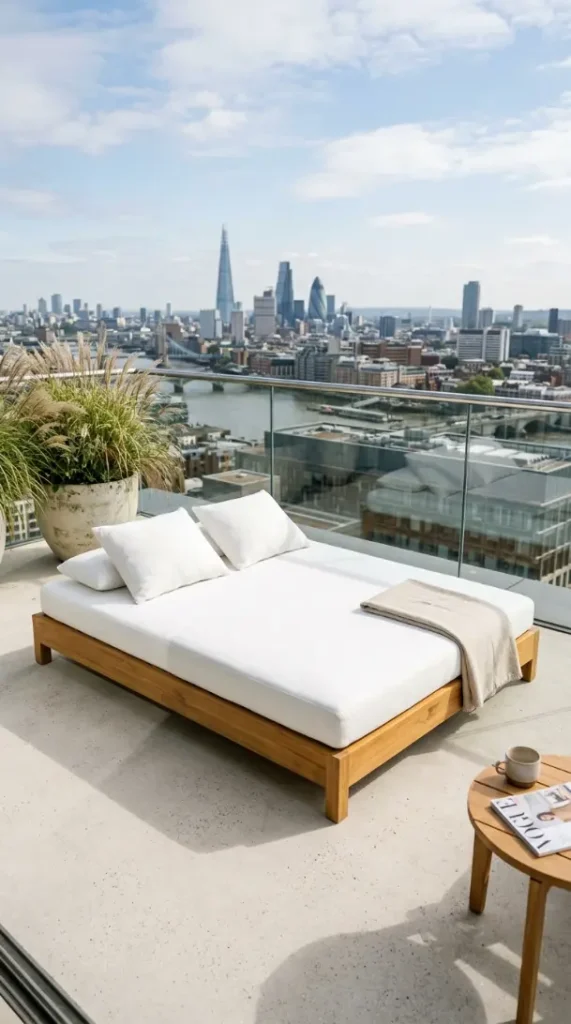
A single large outdoor daybed — a wide, low platform in teak or concrete with a thick outdoor mattress in white or natural linen — positioned facing the primary view direction on a minimal rooftop terrace is one of the most luxurious and most spatially generous additions possible. The daybed is wider and longer than a standard sun lounger and allows for genuinely horizontal resting rather than merely reclining — it is a bed outside, and that specific generosity of scale makes the rooftop feel like a private outdoor bedroom above the city. Style with one or two white outdoor cushions and a simple natural linen or cotton throw folded at the foot.
15. Rooftop Terrace With Outdoor Kitchen Strip
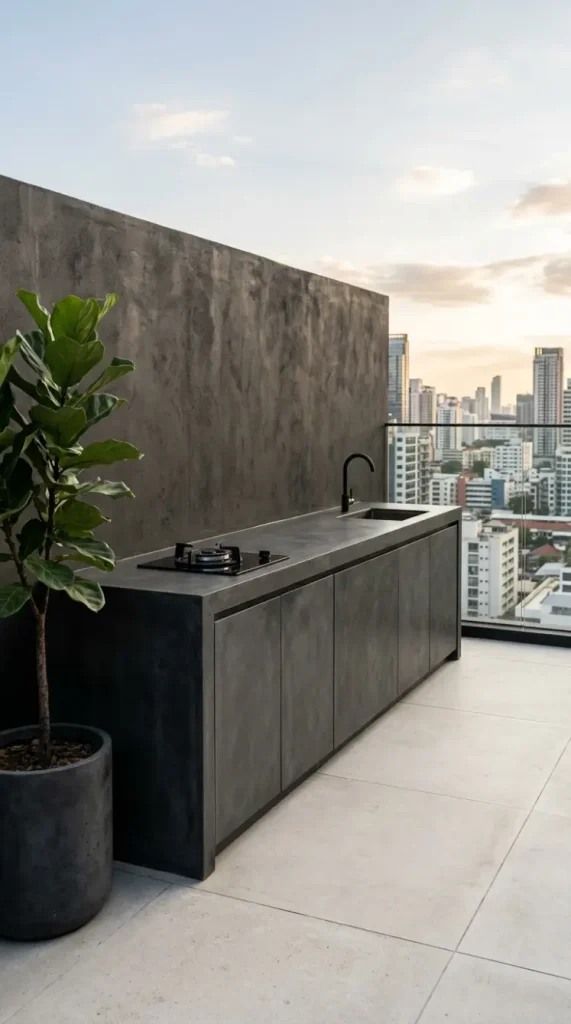
A minimal outdoor kitchen strip — a single run of dark concrete or dark steel benchtop with a built-in gas burner, a small sink, and concealed storage below, running along one terrace wall or perimeter — makes a rooftop terrace genuinely self-sufficient for outdoor entertaining without introducing the visual complexity of a conventional outdoor kitchen setup. The key is the single run of consistent material: one benchtop, one material, one line — not an island, not multiple units, not multiple materials. The minimal outdoor kitchen strip is an extension of the architecture rather than a piece of equipment placed in the space.
16. Folding Minimal Outdoor Chairs for Flexible Entertaining
On a minimal rooftop terrace, the furniture arrangement for everyday use should be fixed and considered — but the furniture for occasional larger entertaining should be storable and deployable without cluttering the terrace in its everyday state. Slim folding outdoor chairs in dark powder-coated steel or natural teak — simple, lightweight, stackable — stored flat against a terrace wall or in a minimal outdoor storage unit, deployed when needed and returned when not — allow the terrace to host twelve people for dinner or two people for morning coffee with equal elegance and without permanent furniture crowding the minimal floor plan.

17. Rooftop Herb Garden in Uniform Planters
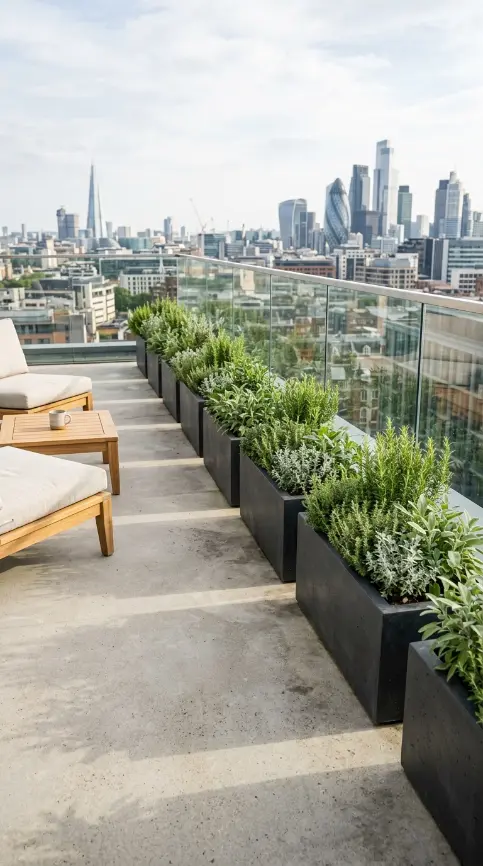
A rooftop herb garden — rosemary, thyme, sage, mint — planted in a row of identical narrow rectangular planters along one terrace perimeter creates a living green edge to the minimal rooftop that is simultaneously decorative, aromatic, and genuinely useful for outdoor cooking and entertaining. The key is uniformity: same planter form, same planter material, same spacing, same planting height — the row reads as a designed element rather than a collection of individual pots. Dark concrete or dark Corten steel rectangular planters, consistently spaced, with a consistent herb planting height, create a green border of genuine architectural quality.
18. Dark Steel Fire Pit as Minimal Rooftop Feature
A single minimal fire pit — a simple dark powder-coated steel bowl or concrete cube with a gas or bioethanol flame — positioned at the center of the furniture arrangement or at the terrace perimeter facing the view, provides warmth, light, and the most ancient form of outdoor atmosphere available on a minimal rooftop terrace. The fire pit makes the rooftop usable in cooler seasons and evenings, and its warm flame creates an ambient light source that works with the floor lanterns to make the terrace genuinely atmospheric after dark. Choose the simplest possible form — a low dark steel bowl, a concrete cube with a slot flame — nothing decorative, nothing ornate.

19. Rooftop Terrace Morning Ritual — Minimal Coffee Setup
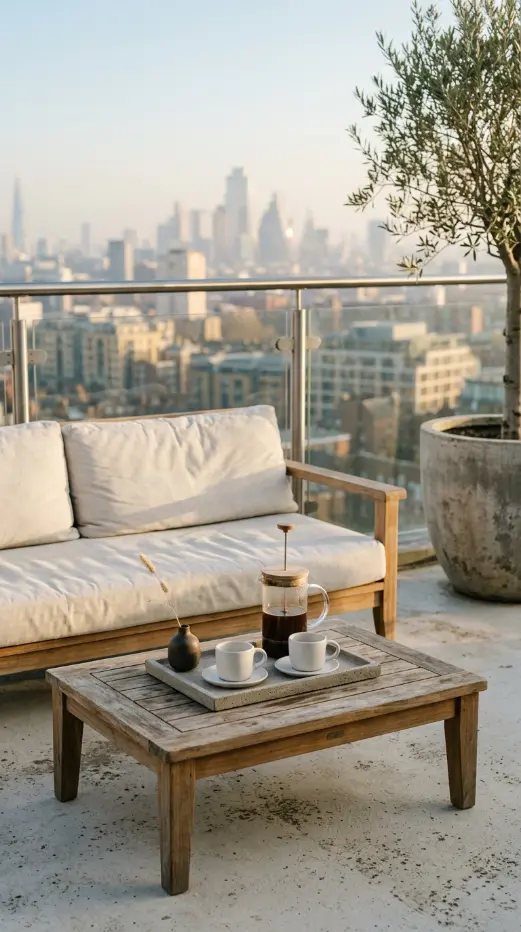
The minimal rooftop terrace at its most domestic and most beautiful moment is early morning — before the city is fully awake, when the light is soft and the air is still and the terrace is a genuinely private world above everything. The morning ritual on the minimal rooftop: a simple tray with a coffee press, two ceramic cups, and a small vase with one stem, placed on the low teak coffee table — white cushions still holding the previous evening’s relaxed arrangement, the city waking slowly beyond the glass railing. This is the image that makes the minimal rooftop terrace feel like the most desired room in any building.
20. Rooftop Terrace With Shade Sail
A minimal shade sail — a single large tensioned fabric panel in natural off-white or pale grey canvas, supported on two or three slim dark steel posts and one terrace wall fixing point — provides shade over the primary seating zone without the visual complexity of a pergola or awning structure. The shade sail’s tensioned triangular or rectangular form has its own geometric beauty when seen from below and from the city beyond — it reads as a designed element rather than a shade solution. The fabric billows very slightly in wind, which is the only movement on a minimal rooftop terrace and therefore the most alive and most beautiful detail in the composition.

21. Minimal Rooftop Storage Unit — Flush with Terrace Wall
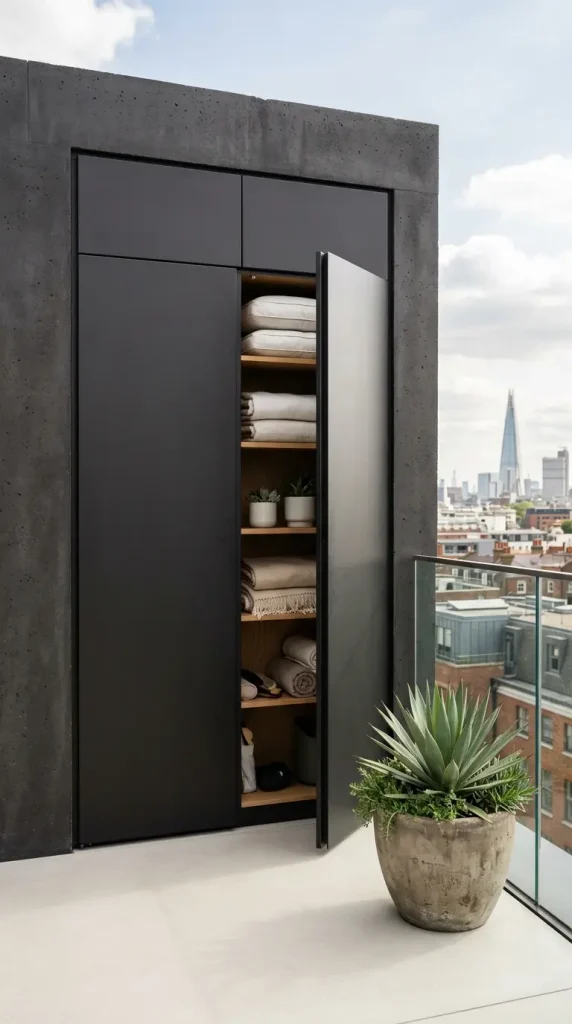
Every rooftop terrace requires storage for outdoor cushions, throws, lighting accessories, and maintenance items — and on a minimal terrace, the storage solution must be architecturally integrated rather than visually intrusive. A single tall rectangular storage unit in dark concrete panel or dark powder-coated steel, built flush against the terrace parapet wall, with push-open handle-free doors in the same dark material as the unit body, reads as part of the terrace architecture rather than a piece of furniture placed against a wall. Inside: full-depth shelving sized for cushion storage and outdoor accessories.
22. Wet Weather Transition — Retractable Roof Element
A minimal retractable roof element — a slim motorized louvre system or retractable glass roof panel mounted on dark steel posts above the primary seating zone — makes the minimal rooftop terrace genuinely all-weather and genuinely usable in rain without converting it into an enclosed room. The louvre or glass panel retracts fully on clear days, leaving the terrace completely open to sky, and closes in rain or direct midday sun, creating a sheltered outdoor room that retains the views and the outdoor air. The minimal rooftop retractable roof is the element that transitions the terrace from a fair-weather luxury to a genuine all-season outdoor room.

23. Elevated Garden Bed Along Parapet Wall
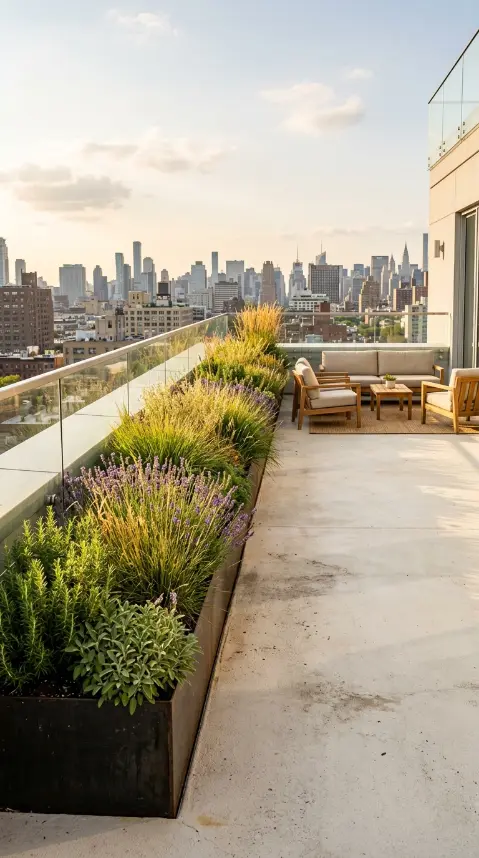
A single continuous elevated garden bed — a long narrow dark concrete or Corten steel planter running the full length of one parapet wall at approximately 50cm height — creates a living green border to one side of the minimal rooftop terrace that provides privacy at seated level, wind protection from one direction, and a dense planting of grasses, lavender, rosemary, and low structural plants that brings genuine garden quality to the rooftop without the complexity of multiple separate containers. The long horizontal form of the continuous elevated bed reads as an architectural element — a green wall at terrace edge — rather than a collection of plants.
24. Minimal Outdoor Shower on Rooftop Terrace
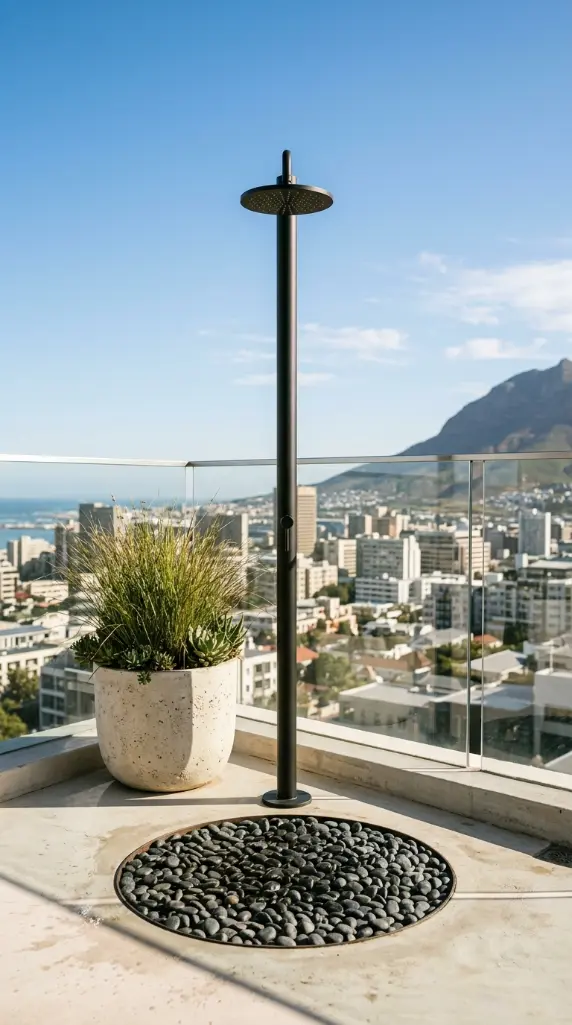
A rooftop outdoor shower — a single slim copper or dark steel pipe riser with a large rainfall head, mounted against the parapet wall or on a freestanding dark steel post, with a small dark pebble or dark stone shower base at deck level — is both a genuinely practical addition to a rooftop terrace with a plunge pool and one of the most photogenic and most luxurious-feeling elements a rooftop can have. The outdoor shower on a rooftop, with the city visible beyond and the sky above, is one of the most extraordinary sensory experiences available in an urban building.
25. The Complete Minimal Rooftop Terrace — Summer Day
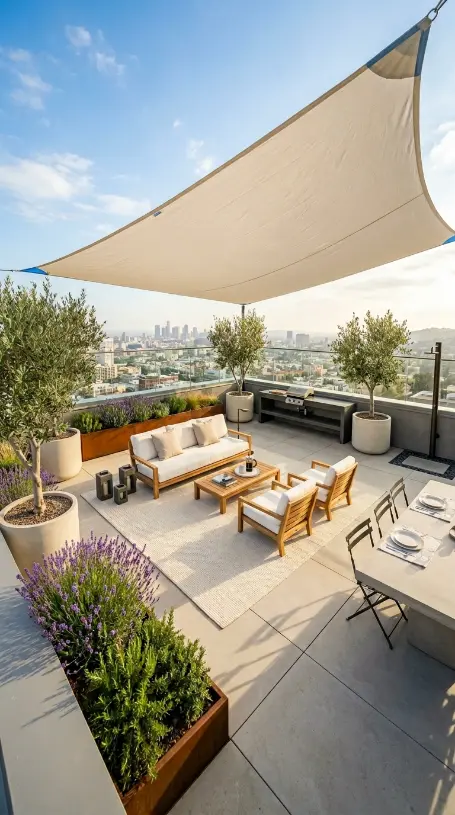
The complete minimal rooftop terrace on a summer day — pocket doors or parapet access wide open, shade sail deployed, all furniture arranged, herbs and architectural plants in full growth, the city vivid in summer haze beyond the glass railing, morning coffee on the low table, a book left open on the daybed — is the fullest and most beautiful expression of everything the minimal outdoor living design approach achieves. Nothing extra. Every element doing its work. The sky and the city as the backdrop that no interior could replicate.
26. The Complete Minimal Rooftop Terrace — Winter Evening
The same minimal rooftop terrace on a winter evening — fire pit burning, floor lanterns glowing, the slim outdoor floor lamp casting warm amber light on the white cushions, the city lights at their most vivid in the cold clear air, the olive trees bare or silver against the illuminated sky, a natural throw folded on the sofa, two people sitting close to the fire — is the version of the minimal rooftop that reveals the deepest reason for the minimal approach: when everything is stripped back, what remains is the city, the fire, the warmth, and the people, which is exactly what an outdoor room should be.