
28 Indoor Outdoor Living Dark Dining Room Pocket Doors
There is a particular kind of dining experience that only one specific architectural configuration can create — the experience of sitting at a table in a room that is simultaneously dark and dramatic on the inside and completely open to light, air, and the natural world on the outside. The dark dining room with pocket doors that disappear entirely into the walls is how that experience is achieved, and once you have designed a room around this combination, every other dining room configuration feels like a compromise.
Pocket doors are the only door solution that delivers genuine architectural honesty in an indoor-outdoor dining room. Bifold doors fold awkwardly into the opening and reduce the clear span. Sliding doors stack outside the wall and interrupt the facade. French doors open into the room and block space. Pocket doors vanish. They slide into a cavity within the wall and cease to exist as visible objects — the wall simply opens into a full-width threshold between the dark interior and the bright exterior, with no door hardware, no door panel, no stacked door leaf interrupting the view or the flow. The opening becomes a frame. The dining room becomes a room with one wall that can be removed entirely.
The dark dining room is the perfect partner for this configuration because of the contrast it creates. A pale dining room that opens to an outdoor space loses its interior identity — the outside light floods in and the room becomes simply a covered extension of the deck. A dark dining room — deep charcoal walls, dark timber floor, moody pendant lighting, dramatic furniture — holds its interior character even when the pocket doors are fully open. The darkness of the inside and the brightness of the outside create a visual tension that makes both spaces more beautiful than they would be alone, each space defining the other by contrast.
These 28 ideas show every direction this configuration can take — from the most minimal single pocket door opening to a full dining room wall that disappears entirely, every dark wall treatment, every flooring transition strategy, every lighting approach, and every outdoor dining extension that makes a dark dining room with pocket doors the most architecturally and atmospherically rewarding dining space available.
1. Full-Width Single Wall Pocket Door Opening
The most architecturally pure expression of the indoor-outdoor dark dining room is the single wall that disappears entirely — a full-width pocket door system spanning the complete dining room wall, with two or three large door panels that retract fully into wall cavities on each side, creating a threshold the full width of the room with no panel, no frame, no hardware interrupting the connection between the dark interior and the bright outdoor space. When open, the room simply has no fourth wall. The dining table inside and the outdoor table beyond read as a continuous dining axis separated only by the change of material from interior floor to outdoor deck. The dark charcoal walls of the interior make the full-width opening more dramatic by contrast — the dark room opening completely to the bright natural world.

2. Dark Charcoal Wall Treatment with Pocket Door Frame Detail
The wall into which the pocket doors retract is itself a design opportunity — the pocket door wall in a dark dining room should be treated as a continuous architectural surface, with the door opening framed by a clean reveal detail that communicates the engineering precision of the hidden door mechanism. A deep charcoal plaster or limewash finish on the full pocket door wall, carried continuously from the solid wall sections through the door frame reveal and into the soffit above, creates a wall that reads as one uninterrupted surface whether the doors are open or closed. The reveal detail — the clean edge of the wall where the door disappears into its cavity — should be a flush, shadow-gap detail in matching dark material, so the door opening appears as a clean cut in the wall rather than a framed aperture.

3. Continuous Floor from Dark Interior to Outdoor Terrace
The most powerful single detail in an indoor-outdoor dark dining room is the floor that continues without interruption from the interior to the exterior — the same wide dark stained oak plank running from the far interior wall through the pocket door threshold and out onto the covered outdoor terrace, with no threshold strip, no level change, no material transition interrupting the visual continuity. This single design decision, more than any other, creates the feeling that the indoor and outdoor spaces are one room rather than two rooms separated by a door. The dark floor running continuously makes the pocket door threshold feel like a change in ceiling condition rather than a change in space — the dark dining room simply continues outward under a different sky.

4. Moody Dark Dining Room with Aged Brass Pendant Cluster
The lighting design of the dark dining room is what determines whether it reads as dramatically atmospheric or simply gloomy — and the difference is warm amber Edison light sources positioned low above the dining table. A cluster of three aged brass cage pendants hung at different drop heights above the dining table — the lowest at approximately 75cm above the table surface, the others at 90cm and 110cm — creates a lighting installation of both practical and visual richness. The warm amber Edison filaments glowing inside their aged brass cages cast warm directional light on the dark walnut table surface and the faces of people sitting around it, while the dark charcoal walls behind absorb the light and prevent any reflection that would compromise the room’s moodiness. The brass pendants become the room’s warm light jewelry against the dark.

5. Pocket Doors with Dark Timber Panel Face
The pocket door panels themselves — their face material when closed — are a significant design element in a dark dining room, and the most beautiful choice is a dark stained timber panel in near-black or deep charcoal-brown that, when closed, reads as a continuation of the dark interior wall rather than an interruption of it. Use wide horizontal or vertical dark timber planks as the door face, finished in the same deep stain as the dining room floor, so the closed pocket doors appear as a dark timber paneled wall rather than a door. When the pocket doors slide open, the dark timber panel face disappears into the wall and the full outdoor view replaces what was a warm, architectural dark timber surface. The door panel is beautiful when closed and invisible when open — the two best states a door can be in.

6. Outdoor Extension Dining Table on the Terrace
The covered outdoor terrace that the pocket doors open to should contain its own complete dining setup — not a casual secondary zone but a fully realized outdoor dining table that reads as a continuation of the indoor dining axis. A long teak or dark powder-coated steel outdoor dining table positioned on the terrace in direct visual and spatial alignment with the indoor dark walnut dining table creates a two-table dining configuration that can seat a large gathering with some inside and some outside, or that can have the pocket doors fully open to read as one long dining room extending from the dark interior through to the bright terrace. The outdoor table in dark teak or dark metal continues the room’s dark material language outdoors.
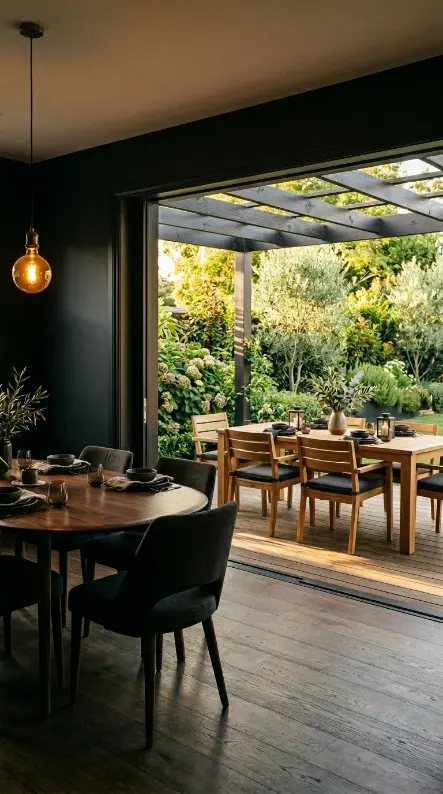
7. Dark Green Dining Room with Pocket Doors
Deep forest green — particularly as a matte limewash or deep paint finish — is the strongest alternative to charcoal as the dark dining room wall treatment, and it has a specific quality that charcoal does not: it connects the interior darkness to the natural world outside in a way that makes the indoor-outdoor transition feel inevitable rather than designed. A deep forest green dining room opening through pocket doors to a lush green garden creates a color continuity between the moody interior green and the vivid natural exterior green — the two greens different in tone and saturation but clearly related, making the room feel like an extension of the garden rather than simply a room that looks at it. Pair the forest green walls with aged brass pendants, dark walnut furniture, and natural linen to create the warmest possible dark green dining interior.

8. Pocket Door Track Detail — Recessed Ceiling Track
The ceiling track into which the pocket door rollers travel is a detail that most builders treat as a functional necessity and most designers treat as an opportunity. In a dark dining room where the aesthetic is about precision and restraint, the pocket door ceiling track should be a recessed flush detail — a clean slot cut into the ceiling plaster at the line of the door opening, with the roller mechanism entirely hidden above the ceiling plane and only the clean slot visible as a precise shadow line in the ceiling surface. The recessed flush ceiling track, in a charcoal or dark plaster ceiling, becomes almost invisible — a clean precise line that communicates the sophistication of the pocket door mechanism without calling attention to itself.

9. Dark Dining Room Evening Setting — Pocket Doors Open to Lit Garden
The most atmospheric moment of the dark dining room with pocket doors is the evening dinner — the dining room fully lit with warm amber Edison pendants, candles on the table, the pocket doors fully open to a garden or terrace that has its own warm outdoor lighting: string lights above the terrace, small lanterns in the garden, uplighters on the planting. The warm interior amber light and the warm exterior garden lighting together create a continuous warm atmosphere that makes the dark dining room and the lit garden feel like one warm environment, with the pocket door threshold simply marking the point where ceiling ends and sky begins.

10. Pocket Door Wall as Gallery Wall — Dark Dining Room Art
When the pocket doors are closed, the dark dining room becomes a fully enclosed room — and the pocket door wall in its closed state is a large, prominent wall surface that should be treated with the same design intention as any gallery wall in a great room. The most beautiful treatment for a dark dining room pocket door wall in its closed state is a curated arrangement of large-format moody artworks and oversized mirrors in dark or aged brass frames — the gallery wall covering both the solid wall sections flanking the pocket door opening and the dark timber pocket door panel faces themselves, so the gallery reads as a continuous wall of art whether the doors are open or closed.

11. Dark Dining Room with Pool View Through Pocket Doors
When the outdoor space beyond the pocket doors contains a pool — particularly a dark-bottomed pool or a pool with dark natural stone coping — the visual relationship between the moody dark dining room and the dark pool beyond creates a color and material continuity of extraordinary sophistication. The dark interior and the dark pool reflect and amplify each other — the dark walnut table inside and the dark pool water beyond rhyming in tone, the aged brass pendants inside reflected in the pool surface. When the pocket doors are fully open on a still evening, the pool surface visible from the dining table creates the impression that the dark dining room extends all the way to the water’s edge.

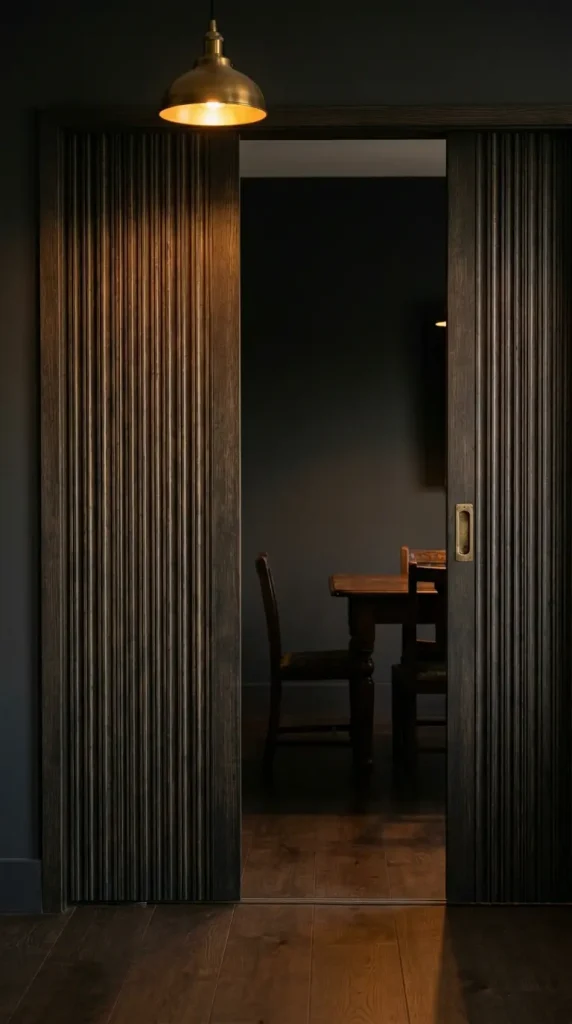
12. Pocket Doors with Dark Fluted Timber Panels
Fluted vertical timber panels — narrow parallel ridges running the full height of the door panel, creating a three-dimensional surface of light and shadow — on the face of the pocket door panels create a textural richness that makes the closed door wall one of the most beautiful surfaces in the dark dining room. Deep dark stained fluted timber pocket door panels catch light differently across each ridge — the raised edges appearing slightly lighter than the recessed grooves, creating a subtle vertical rhythm of tone variation across the full door face. The fluted dark timber pocket door panel is the detail that makes the closed dining room feel genuinely crafted rather than merely built.
13. Dark Dining Room with Covered Outdoor Kitchen Beyond Pocket Doors
The outdoor space that pocket doors connect a dark dining room to does not need to be purely a dining terrace — the most functionally complete configuration is a covered outdoor kitchen directly beyond the pocket doors, so the cooking and the eating exist in one continuous indoor-outdoor flow. A dark stained timber or dark stone outdoor kitchen bench running along the outer wall of the terrace — with a built-in grill, outdoor sink, and storage below — positioned so it is fully visible from the dining table inside creates a kitchen-to-table experience of complete spatial integration. The dark material language of the outdoor kitchen — dark stone benchtop, dark stained timber cabinetry — continues the dark aesthetic of the indoor dining room outdoors.

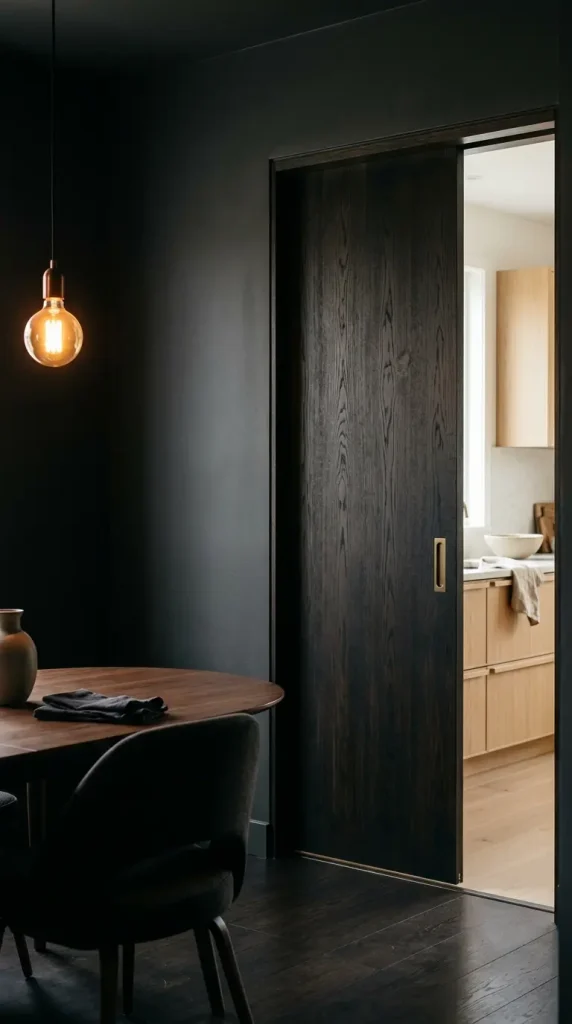
14. Single Pocket Door Between Dark Dining Room and Interior Space
Pocket doors in a dark dining room are not exclusively about the indoor-outdoor connection — a single large pocket door between the dark dining room and an adjacent internal space (kitchen, living room, butler’s pantry) provides the same spatial flexibility and the same wall-opening drama within the interior plan. A single floor-to-ceiling pocket door panel in dark stained timber — approximately 110cm wide by 260cm tall — between the dining room and the kitchen creates a dining room that can be either completely open to the kitchen for casual family meals or completely closed for formal dinner parties where the kitchen and its activity should not be visible. The dark stained timber pocket door closed against a dark charcoal dining room wall is a simple, beautiful, precise architectural element.
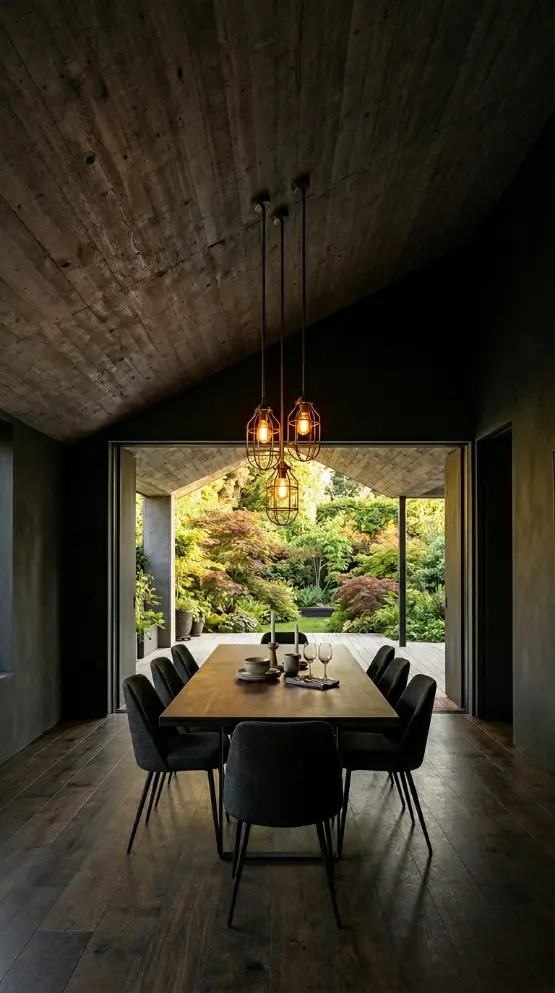
15. Dark Dining Room with Raked Concrete Ceiling
A raked ceiling — sloping from a lower entry point to a higher point above the main dining table, following the internal roofline — in deep charcoal or raw dark concrete creates a dramatic overhead volume for the dark dining room that makes the space feel genuinely architectural rather than simply decorated. The raked ceiling draws the eye upward toward the highest point above the dining table, creating a natural focus for the aged brass pendant cluster that hangs from the apex. When the pocket doors are fully open, the raked ceiling continues visually to the outdoor soffit of the covered terrace, creating a continuous sloped overhead surface from interior to exterior that makes the two spaces feel architecturally unified.
16. Dark Dining Room Sideboard Styling Against Charcoal Wall
The sideboard in a dark dining room — a long low dark walnut or dark ebonized oak sideboard against one charcoal wall — is the surface that carries the room’s decorative story outside of the dining table itself. Against a deep charcoal wall, the sideboard styling should follow the same dark material language: dark ceramic vessels, dried botanicals, aged brass objects, smooth dark stones, a moody landscape artwork above in a wide dark or aged brass frame. One large dark green or near-black ceramic vase with dried pampas grass. Two aged brass candlestick holders with white tapers. One small stack of large format hardcover books with dark cloth spines. One small dark stoneware bowl holding smooth dark river stones. The sideboard against the charcoal wall is the room’s secondary altar — a curated dark world within the dark room.

17. Pocket Doors in a Dark Green and Brass Dining Room — Winter Setting
The indoor-outdoor dark dining room in winter — when the pocket doors are closed against the cold and the room turns fully inward — is a completely different and equally beautiful space from the summer open configuration. The winter dark dining room becomes a sealed warm world: the dark timber pocket doors closed and beautiful, the aged brass pendants at full warm amber glow, candles on the table, the pocket door glass panels (if glazed) showing the dark winter garden beyond as a moody exterior backdrop rather than an open connection. A dark green dining room in winter with glazed pocket doors showing a rain-wet dark garden beyond is one of the most atmospheric dining room configurations available.

18. Dark Dining Room Ceiling Treatment — Dark Timber Battens
A ceiling treatment of dark stained timber battens — narrow timber strips of approximately 4cm width spaced at regular intervals across the full ceiling area in a dark near-black stain — creates a dining room ceiling of extraordinary material richness and directional drama. The battens run parallel to the pocket door opening, so their direction draws the eye toward the outdoor connection. The gaps between the battens reveal either a dark plaster ceiling behind or, in a more technically ambitious installation, concealed LED warm strip lighting that makes the batten ceiling glow from within with warm amber light between each batten. The dark batten ceiling makes the dark dining room’s overhead plane as considered and as beautiful as its walls.

19. Indoor Outdoor Dark Dining Room — Rainy Day Ambience
A dark dining room with pocket doors in the rain — the doors closed or partially closed against the weather, the rain falling on the outdoor terrace and garden visible through the glazed pocket door panels, the interior warm and amber and completely sheltered — is its own specific and extraordinary atmosphere. The dark interior holds all its warmth and drama while the rain outside intensifies the contrast between the moody dry interior and the wet grey exterior world. The sound of rain on the outdoor terrace, the grey diffused light through the glazed panels, the warm amber of the Edison pendants and the candles inside — this is the dark dining room at its most fully itself.

20. Dark Dining Room with Pocket Doors to a Courtyard
A pocket door opening to an enclosed courtyard — rather than an open garden — creates a completely different spatial experience from the wide-open outdoor connection. A courtyard has walls, enclosure, its own defined atmosphere. A dark dining room opening through pocket doors to a small dark-planted courtyard — with dark rendered walls, dark smooth pebbles on the ground, one large architectural plant in a dark basalt pot, a single pendant light hanging in the courtyard from above — creates an indoor-outdoor connection of extraordinary spatial intimacy. The courtyard is experienced as a room adjacent to the dining room rather than as the exterior world, and the pocket doors become the threshold between two equally atmospheric enclosed spaces.

21. Pocket Door Hardware — Minimal Recessed Pull Detail
The hardware on a pocket door panel is the most intimate physical touchpoint of the entire indoor-outdoor architectural concept — the moment a person grasps the recessed pull to slide the door into the wall is the moment the indoor-outdoor connection is activated. For a dark dining room, the recessed pull should be a minimal carved slot or a simple aged brass recessed finger pull — a detail so resolved and so understated that it communicates the quality of everything in the room without announcing itself. The recessed pull in dark timber, flush with the door face, or a small oval aged brass recessed plate, is the hardware detail that separates a considered pocket door from a builder’s one.

22. Dark Dining Room Open to Outdoor Dining Under Stars
The dark dining room on a clear night — pocket doors fully open, the warm amber interior light of the pendants and candles flowing out to the terrace where an outdoor dining table is also set, the star sky visible above the uncovered outdoor zone, the warm interior and the dark night sky creating the most complete version of the indoor-outdoor dining experience available — is the singular most atmospheric version of this configuration. The dark dining room at night under stars makes every other dining location feel ordinary. The dark interior blends with the dark sky — the warm amber light sources connecting both spaces — creating a dining environment that extends from the dark walnut table inside all the way to the night sky above.

23. Dark Dining Room Floor-to-Ceiling Dark Bookcase Wall
A floor-to-ceiling dark bookcase — built into the wall opposite the pocket doors, in dark stained timber matching the dining room floor — creates a library wall for the dark dining room that makes it simultaneously a dining room and a reading room and a collecting room. Dark stained shelves lined with hardcover books, dark ceramic vessels, dried botanicals, small framed artworks, smooth dark objects — the bookcase wall is the dark dining room’s most layered and most personal surface. When the pocket doors are open and the outdoor light floods in from one side, the bookcase wall on the opposite side sits in warm ambient light, its depth and complexity revealed by the contrast with the bright outdoor threshold.

24. Dark Dining Room with Pocket Doors and Outdoor Fire Pit Beyond
An outdoor fire pit positioned on the terrace beyond the pocket doors — a dark basalt or dark concrete fire bowl with a gas or wood fire burning — creates an outdoor light source of extraordinary warmth and drama that is visible from the dining table inside, the amber flames of the fire extending the warm amber interior light philosophy to the outdoor zone. The dark dining room, the warm amber pendants, the candlelit dinner table, the fully open pocket doors, and the amber fire pit burning in the dark garden beyond create a sequence of warm amber light sources from the interior table to the outdoor fire that makes the evening dining experience feel genuinely elemental.

25. Dark Dining Room with Pocket Doors and Hanging Outdoor Plants
Hanging outdoor plants — large basket ferns, trailing devil’s ivy, dense trailing pothos in dark woven baskets — suspended at varying heights from the covered terrace structure directly beyond the pocket door opening create a curtain of living green that partially frames the outdoor threshold. The hanging plants do not obstruct the opening — they hang at the sides and above, at varying depths on the terrace ceiling, creating a botanical canopy through which the outdoor dining table and garden are glimpsed. From inside the dark dining room, the hanging green plants against the bright outdoor light create a living green frame for the outdoor world — the dark interior, the green botanical canopy at the threshold, and the bright outdoor space beyond creating three layers of depth.

26. Dark Dining Room Acoustic Consideration — Pocket Doors Closed
A dark dining room with pocket doors is two rooms in one, and the acoustic difference between the open and closed configurations is as significant as the visual difference. When the pocket doors are fully open, the room gains the acoustic dimension of the outdoor space — birds, wind, distant sounds. When the pocket doors are fully closed, the dark dining room becomes a sealed acoustic environment where the quality of the surfaces determines the sound of the room. Thick wool or linen curtains on the wall flanking the pocket door opening, a large deep-pile rug under the dining table, upholstered dining chairs, and one wall of full bookshelves together create a dark dining room that sounds as warm and intimate as it looks — every surface absorbing sound and creating a room of complete auditory coziness.

27. The Dark Dining Room in a Heritage or Period Home — Pocket Door Retrofit
Pocket doors in a heritage or period home — a Victorian terrace, a Federation bungalow, a mid-century modern house — require a retrofit approach that respects the existing architectural character while delivering the modern spatial flexibility of the disappearing wall. In a dark period dining room, the pocket door wall retrofit should use dark stained timber panels that respect the period proportion of the existing room while the door head and frame are designed to sit flush with the existing wall — so the pocket door looks like it has always been there. The dark paint treatment of the walls and the period-appropriate dark timber door face together create a pocket door that feels intrinsic to the house rather than grafted onto it.

28. The Complete Vision — Dark Dining Room, Full Indoor Outdoor Flow, All Elements Together
The final idea is the complete vision — a fully realized dark dining room with pocket doors in its most complete and most considered form: deep charcoal limewash walls, dark stained wide oak floor running continuously through the fully open pocket door threshold to the outdoor terrace, three aged brass Edison pendant cluster above the dark walnut oval dining table, full-width pocket door opening with both door panels completely retracted and invisible, a covered outdoor terrace with the same dark floor, an outdoor dining extension table in dark teak, hanging plants framing the threshold, a burning fire pit at the far terrace edge, the dark garden beyond, and above it all a clear night sky. Every element of the indoor-outdoor dark dining room concept in one fully realized space.


