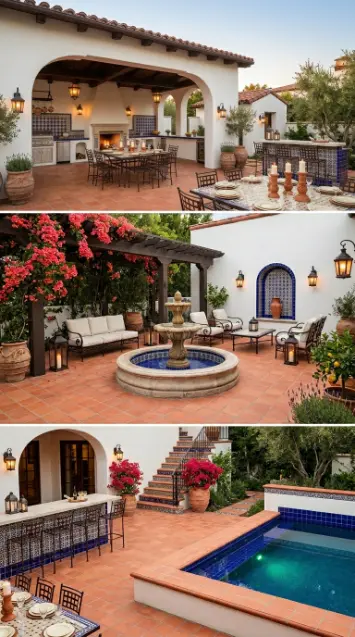
18 Outdoor Living Space Design Spanish Revival Arched Tile
Spanish Revival is the architecture of warmth made permanent. When the Spanish missionaries and settlers built their missions and ranchos across California and the American Southwest, they were not trying to create a style — they were solving the problem of a hot, dry climate with the materials and forms they knew from home: thick stucco walls that absorbed heat during the day and released it slowly at night, terracotta tile roofs that shed rain and breathed beneath, arched openings that framed views without surrendering shade, and interior courtyards that created private microclimates of cool air and the sound of water. The result was an architecture so perfectly calibrated to its landscape that it became the defining visual language of the region and one of the most enduringly beautiful styles in the entire history of American domestic design.
The outdoor living space in a Spanish Revival home is not a garden attached to a house. It is the house extended into the landscape, the interior pushed outward through arched openings, the tiled floor continuing under the sky, the thick stucco walls giving way to colonnade and courtyard while maintaining the same warmth, the same depth, the same quality of light that the interior rooms provide. Terracotta Saltillo tile underfoot, hand-painted Talavera accent tiles on fountains and risers and table surfaces, wrought iron furniture and lanterns and window grilles, potted terracotta with bougainvillea and olive and citrus, a fountain at the courtyard center, a pergola wrapped in wisteria or jasmine, an outdoor kitchen in the Spanish tradition of the al fresco meal — these are the elements of an outdoor living space that does not merely reference Spanish Revival but belongs to it entirely.
These 18 ideas explore every dimension of the Spanish Revival outdoor living space — from the architectural foundations to the furniture, the tile work, the water features, the planting, the lighting, and the complete courtyard compositions that make the outdoor room feel as finished and as permanent as the house it belongs to.
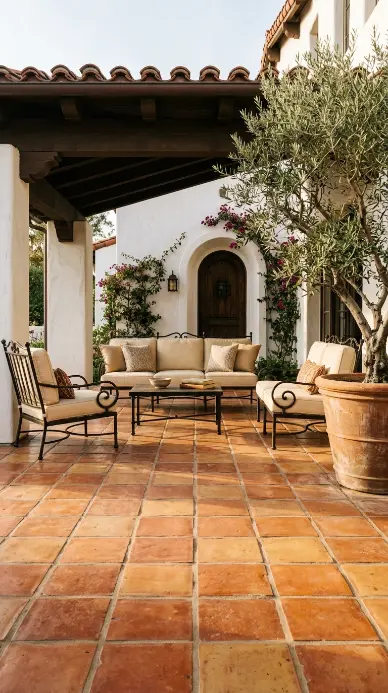
1. Terracotta Saltillo Tile Flooring as Outdoor Living Foundation
Lay large format Saltillo terracotta tiles — handmade Mexican terra cotta pavers approximately 30cm x 30cm or 40cm x 40cm in warm orange-red fired clay — as the primary floor surface of the full outdoor living space, extending the tile out from the house foundation across the full covered and uncovered terrace area. The Saltillo terracotta tile is the single most foundational material decision in a Spanish Revival outdoor space — it sets the warm orange-red tone of the floor from which every other material decision in the space grows, its handmade variation and occasional imperfection communicates the artisan quality that is central to the Spanish Revival aesthetic, and its thermal mass keeps the outdoor floor warm underfoot through the evening hours long after the sun has moved on.
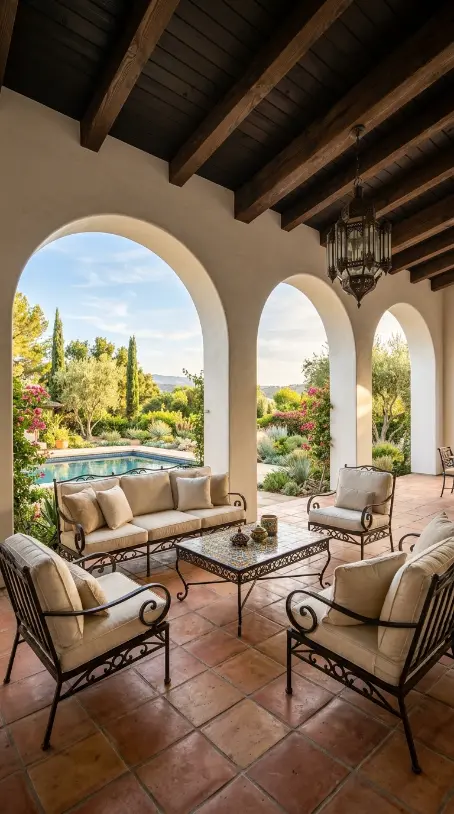
2. Arched Stucco Loggia as Outdoor Living Room Structure
Build or restore a Spanish Revival loggia — a covered outdoor room defined by a series of arched openings in thick white or warm cream stucco, the arches approximately 250-280cm tall with the characteristic rounded arch form of Spanish Colonial architecture, the loggia approximately 3-4 metres deep and running the full width of the house rear facade, the floor in Saltillo terracotta and the ceiling in dark stained timber beams and tongue-and-groove boarding. The arched stucco loggia is the architectural backbone of the Spanish Revival outdoor living space — it is not a pergola or a veranda but a genuine outdoor room with a ceiling, shade, and the structural definition that transforms a terrace into a habitable space that functions in full sun, light rain, and the cool of the evening equally well.
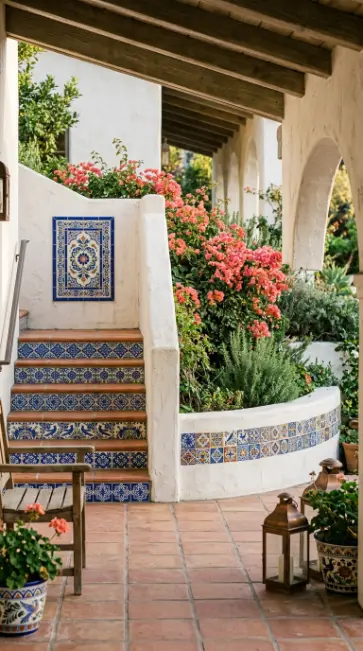
3. Talavera Hand-Painted Tile Accent Panels and Risers
Incorporate hand-painted Talavera ceramic tile panels — Mexican Talavera tiles in deep cobalt blue and white, or in the full multi-colour Talavera tradition of cobalt, terracotta, yellow, green and black on white — as accent surfaces throughout the outdoor space: on the risers of the outdoor staircase, on the face of a low garden wall or planter, on the surround of the outdoor kitchen, on a decorative panel set into the stucco wall, and on the outdoor dining table base. The hand-painted Talavera tile accent is the Spanish Revival outdoor space’s most immediate and most characterful decorative element — it provides the color story of the outdoor space in the most durable possible medium, it references the long tradition of Moorish-influenced tile work that is at the heart of both Spanish and Mexican colonial decoration, and its cobalt and white or multi-colour palette against white stucco and terracotta tile is one of the most naturally beautiful color compositions in architecture.
4. Central Courtyard Fountain as Spanish Revival Focal Point
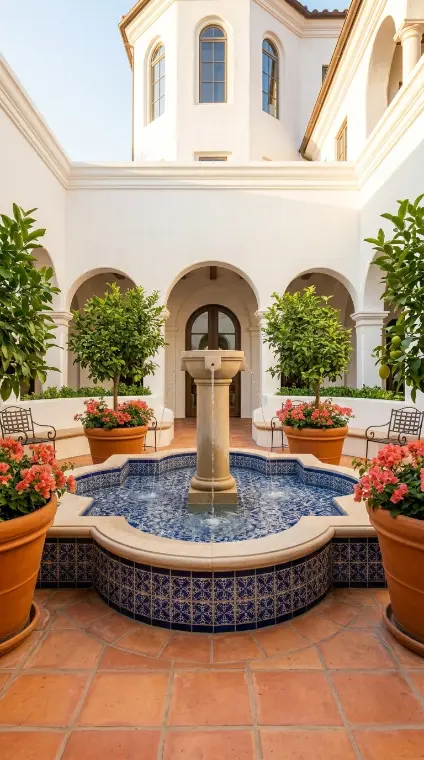
Install a traditional Spanish Revival courtyard fountain — a central wall fountain or freestanding tiered fountain in carved stone, cast concrete, or terracotta, lined or decorated with Talavera tile in cobalt blue and white, positioned at the center of the courtyard or at the midpoint of a courtyard wall — as the primary focal point and sensory anchor of the outdoor living space. The courtyard fountain is the most essential element of the Spanish Revival outdoor space after the architecture itself — it provides the sound of moving water that transforms the outdoor space from a visual experience into a full sensory one, it cools the surrounding air through evaporation, it creates the visual focal point toward which the entire courtyard arrangement faces, and it carries the direct lineage of the Moorish garden tradition that is at the root of every Spanish Colonial outdoor space ever built.
5. Wrought Iron Outdoor Furniture as Spanish Revival Signature
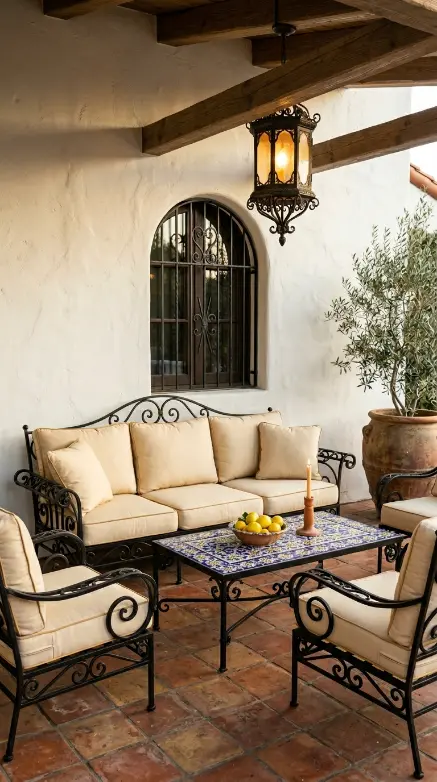
Furnish the Spanish Revival outdoor living space entirely with dark wrought iron furniture — a wide wrought iron sofa with forged scrollwork arms and back, matching wrought iron armchairs, a low wrought iron coffee table with a Talavera tile or glass top, a wrought iron dining table and chairs, wrought iron plant stands, and wrought iron pendant lanterns — all in the characteristic dark blackened iron finish with visible forged detail work that is the defining furniture and hardware finish of the Spanish Colonial aesthetic. Dark wrought iron against white stucco, terracotta tile, and Talavera blue and white is the most quintessentially Spanish Revival material combination available — the dark forged iron reads as ancient and artisan simultaneously, its scrollwork references the Moorish metalwork traditions that came through Spain and across the Atlantic, and in the warm climate of the outdoor living space it ages into a deeper, more beautiful version of itself every year.
6. Spanish Revival Outdoor Dining Space With Tile-Topped Table
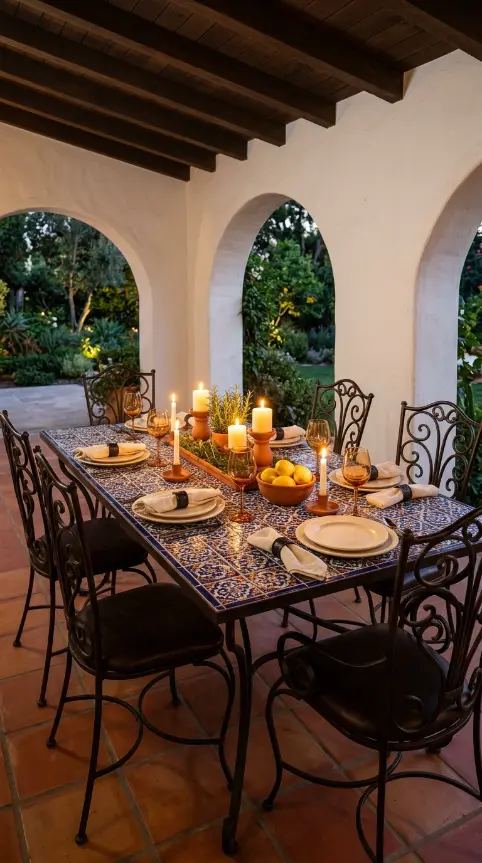
Create a dedicated outdoor dining area under the loggia or beneath a pergola — a long wrought iron or dark timber dining table with a hand-laid Talavera tile top, surrounded by wrought iron or dark carved timber dining chairs with leather or cushioned seats, the dining area defined by the loggia architecture above and the Saltillo terracotta floor below, the table centerpiece a long terracotta tray with candles and fresh herbs and a bowl of citrus. The outdoor dining table with a hand-laid tile top is one of the most beautiful and most durable outdoor dining surfaces possible — the Talavera tiles embedded in the table top are impervious to weather, completely heat-resistant for outdoor dining, and create a dining surface that functions simultaneously as the table’s primary decorative element and its most functional material, and the pattern of the tiles is always visible and always beautiful regardless of whether the table is set for dinner or cleared.
7. Spanish Revival Outdoor Kitchen With Talavera Tile Backsplash
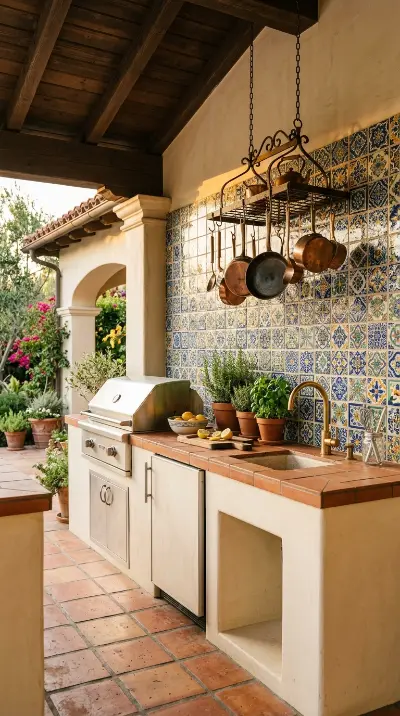
Build an outdoor kitchen in the Spanish Revival tradition — a wide plastered stucco counter and base in white or warm cream stucco, a built-in BBQ and outdoor range, a deep undermount sink, and a full-height backsplash of hand-painted Talavera tile in cobalt blue and white covering the full back wall behind the counters. The outdoor kitchen is the most functionally generous addition to a Spanish Revival outdoor living space — it allows the outdoor room to function as a complete hospitality environment without connection to the indoor kitchen, and a Talavera tile backsplash on the outdoor kitchen turns the most functional surface in the outdoor space into its most decorative one simultaneously.
8. Bougainvillea-Covered Pergola Over Outdoor Living Area
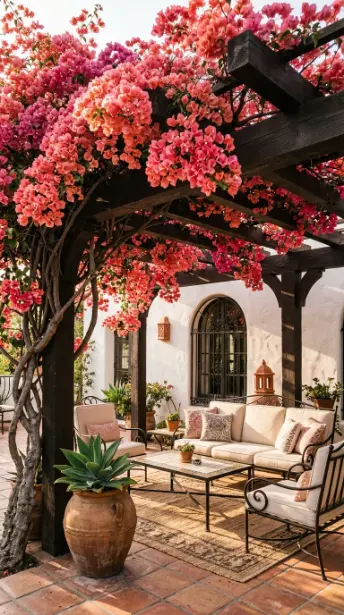
Build a substantial timber or iron pergola over the primary outdoor seating area — dark stained timber posts and beams or dark wrought iron columns and iron beam structure, the pergola overhead beam structure completely covered by a mature bougainvillea trained across the full overhead span, the vivid coral-pink or magenta papery bracts cascading through and over the pergola beams to create a living color canopy above the outdoor living space. A bougainvillea-draped pergola over a Spanish Revival outdoor space is the most romantically Spanish outdoor element available — the bougainvillea has been the defining ornamental plant of Spanish and Mediterranean architecture since it was brought from Brazil to the Old World, and a fully established bougainvillea over a pergola creates an outdoor living space of extraordinary beauty that no constructed canopy can replicate.
9. Arched Tile Niche as Decorative Outdoor Wall Feature
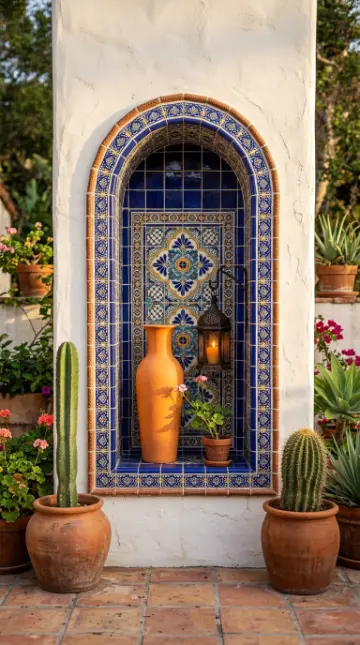
Create one or more arched niches — a rounded arch recess set into the thick stucco exterior wall, approximately 60-80cm wide and 90-120cm tall with the characteristic rounded arch top form of Spanish Colonial architecture, lined entirely with hand-painted Talavera tiles in cobalt blue and white — holding a terracotta vessel, a ceramic saint figure, a small outdoor lantern, or a potted plant. The arched Talavera-lined wall niche is the Spanish Revival outdoor space’s most intimate decorative element — it references the history of the nichos that appear in Spanish Colonial walls throughout Mexico and the American Southwest, its tile lining creates a jewel-like interior within the wall, and the object placed within it gains an architectural frame that elevates it to the status of a considered object rather than a placed object.
10. Spanish Revival Outdoor Lounge With Day Bed and Tile Accent Wall
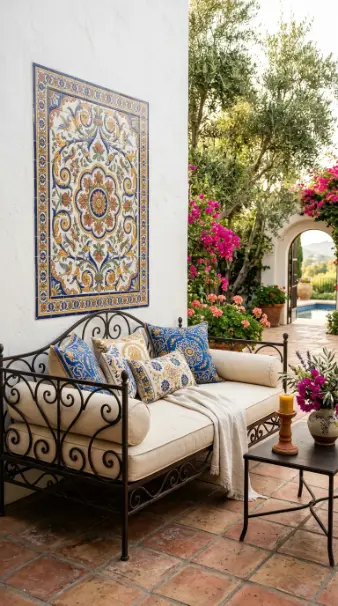
Create a dedicated outdoor lounge zone — a wide outdoor daybed or chaise lounge arrangement in dark wrought iron or dark carved timber with thick cream or warm ivory cushions and bolster pillows, positioned against a stucco accent wall that features a large decorative Talavera tile panel composition, the daybed oriented to face the garden, pool, or courtyard fountain beyond. The outdoor daybed against a Talavera accent wall is the most luxurious and most meditative position in the Spanish Revival outdoor space — it provides a place for horizontal rest in the outdoor room that is also architecturally framed, the Talavera panel above providing a backdrop of color and pattern that enriches the daybed position without interrupting its restfulness.
11. Spanish Revival Tiled Staircase and Landing
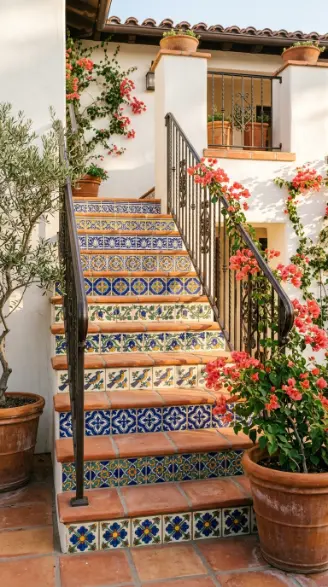
Design an outdoor staircase in the Spanish Revival tradition — wide shallow steps with stone or stucco treads and Talavera-tiled risers, hand-wrought iron railings with scrollwork detail, landing platforms in Saltillo terracotta tile at top and base, and terracotta pots with trailing bougainvillea and rosemary flanking the stair base. The Spanish Revival outdoor staircase is one of the most photographically and architecturally beautiful circulation elements available — the Talavera tile risers provide color and pattern at exactly the height where the eye falls naturally when ascending stairs, the handmade terracotta treads provide warmth and texture underfoot, and the wrought iron scrollwork railing creates a dark linear element against the white stucco wall and the bright tile that perfectly encapsulates the material language of the entire style.
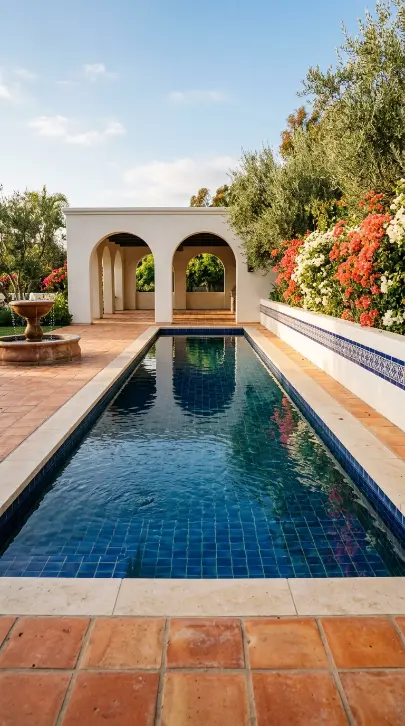
12. Spanish Revival Pool Surround in Talavera Tile and Saltillo Terracotta
Design the pool surround in the Spanish Revival tradition — a rectangular pool with the interior pool walls and floor in deep cobalt blue or aqua Talavera-inspired tile, the pool coping in honed limestone or terracotta, the surrounding pool deck in large format Saltillo terracotta tile extending to the loggia, and a raised planter wall on one pool side with a Talavera tile decorative band. The Spanish Revival pool is the most material-rich and most classically beautiful pool design in American residential architecture — the combination of deep cobalt blue pool water above Talavera-inspired tile, warm orange-red Saltillo terracotta pool deck, and white stucco walls creates a color and material composition that cannot be replicated by any other pool design approach, and the fountains or water features that Spanish Revival pools typically incorporate add the sound element that is inseparable from the courtyard tradition.
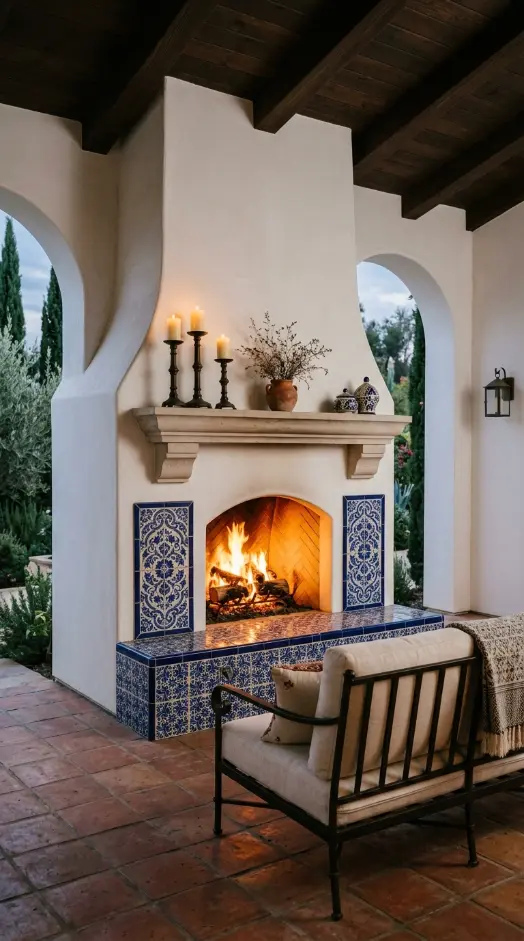
13. Spanish Revival Outdoor Fireplace With Talavera Tile Surround
Build an outdoor fireplace in the covered loggia or on the open terrace — a thick stucco chimney breast and firebox surround in smooth white or warm cream stucco, with a wide mantelpiece in carved limestone or honed travertine, and a Talavera hand-painted tile surround panel flanking each side of the firebox opening. The outdoor fireplace with Talavera tile surround extends the Spanish Revival outdoor living space into the cool months, creating the outdoor room’s evening focal point and warming the loggia or terrace for use through the autumn and winter evenings that a purely warm-weather outdoor room would cede to the interior.
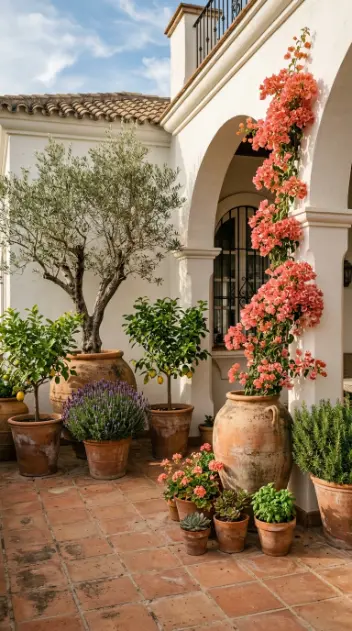
14. Terracotta Planter Collection and Spanish Revival Garden Planting
Style the Spanish Revival outdoor living space with a large collection of terracotta planters in varied sizes — from very large statement urns approximately 80cm diameter to medium glazed and unglazed pots to small groupings of shallow terracotta saucers — planted with the characteristic plants of the Spanish Revival garden: olive trees, citrus, bougainvillea, lavender, rosemary, jasmine, agapanthus, and tall columnar cypress. The terracotta planter collection is the Spanish Revival outdoor space’s living material palette — every pot connects the outdoor room to the Mediterranean and Mexican traditions that define the style, and the combination of terracotta clay, silvery-green olive and lavender foliage, the vivid pink-coral of bougainvillea, and the glossy green of citrus leaves against white stucco is among the most naturally beautiful planting compositions in any outdoor design tradition.
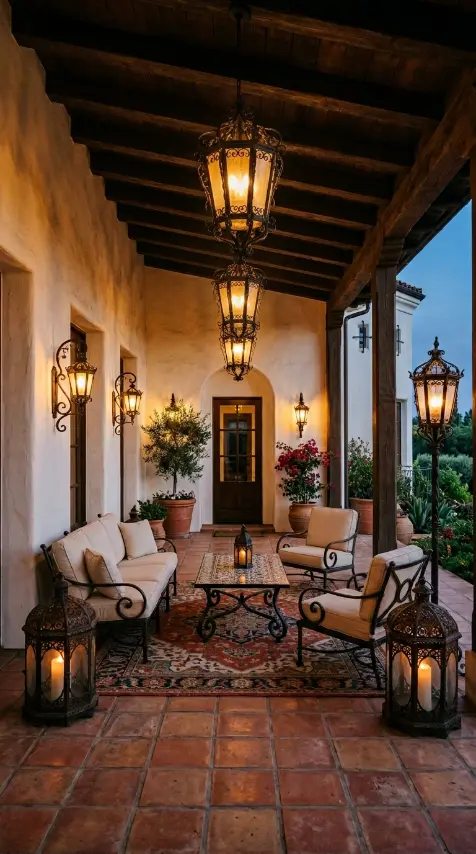
15. Wrought Iron and Glass Outdoor Lanterns as Spanish Revival Lighting
Light the Spanish Revival outdoor living space entirely with dark wrought iron and glass lanterns — large ornate wrought iron pendant lanterns hanging from loggia beams, tall dark wrought iron post lanterns at terrace perimeter and staircase base, wall-mounted dark wrought iron sconce lanterns on stucco walls flanking arched doors and windows, and large dark wrought iron floor lanterns on either side of the outdoor seating arrangement — all emitting warm amber candlelight or warm amber LED from within the glass panels. Wrought iron and glass lanterns are the Spanish Revival outdoor space’s primary lighting fixture — they are as fundamental to the aesthetic as the Talavera tile and the Saltillo terracotta floor, and in the warm amber glow of multiple lanterns at evening the Spanish Revival outdoor space reaches its most atmospheric and most beautiful state.
16. Spanish Revival Outdoor Bar With Talavera Tile Counter Face
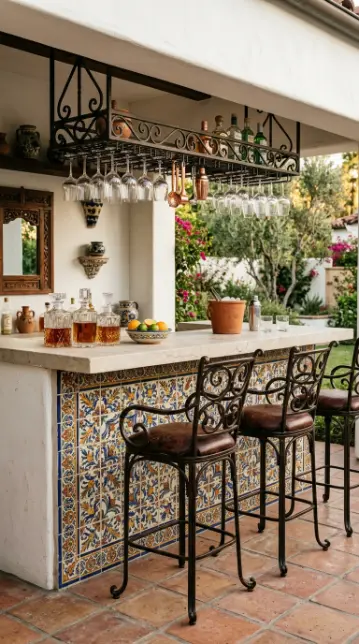
Build a dedicated outdoor bar station — a stucco-based bar counter approximately 120cm tall and 180cm long, with a honed limestone or terracotta tile bar top, a Talavera tile mosaic decorating the full face of the bar counter front facing the guests, a dark wrought iron bar rack above holding glassware and a hanging pot rail, and dark wrought iron bar stools with leather seats positioned at the bar counter. The outdoor bar with Talavera tile counter face is the most social addition to the Spanish Revival outdoor space — it creates a dedicated hospitality station that is both fully functional and architecturally beautiful, and the Talavera tile on the bar front transforms every guest interaction with the bar into an encounter with one of the most beautiful decorative surfaces in the outdoor space.
17. Spanish Revival Garden Path in Talavera and Terracotta Stepping Stones
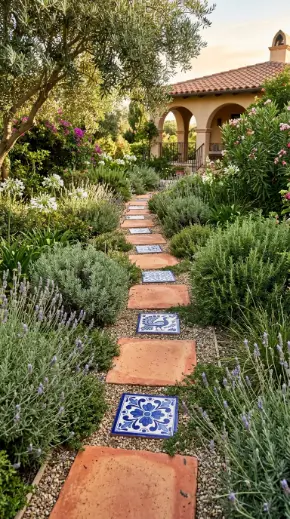
Lay a garden path through the Spanish Revival courtyard garden using alternating large Saltillo terracotta stepping stones and individual hand-painted Talavera tile inserts — a terracotta square stepping stone, then a Talavera tile square, then a terracotta stepping stone — the Talavera tile inserts in cobalt blue and white providing color accents along the path through the garden planting. The alternating terracotta and Talavera tile garden path is the most beautiful path surface available in the Spanish Revival tradition — it extends the material language of the loggia tile floor and the Talavera accent surfaces into the garden itself, creating visual continuity between the architectural outdoor rooms and the planted garden spaces between them, and the individual Talavera tile inserts in the path become small moments of color and pattern that reward looking down as well as outward in the garden.
18. Complete Spanish Revival Outdoor Living Space — All Elements Together
Design the most complete Spanish Revival outdoor living space as a single fully cohesive composition — every element simultaneously present: a large format Saltillo terracotta tile floor extending from the arched stucco loggia across the full courtyard terrace, a central tiered Talavera tile-lined fountain at courtyard center, a bougainvillea-covered pergola over the primary seating area with dark wrought iron scrollwork sofa and armchairs and a Talavera tile-topped coffee table, a full outdoor kitchen with Talavera tile backsplash, an outdoor dining area under the loggia with a long Talavera tile-topped dining table and wrought iron chairs, an arched Talavera-lined wall niche with terracotta vessel, a Spanish Revival outdoor fireplace with Talavera tile surround, a generous terracotta planter collection with olive trees and bougainvillea and lavender and citrus, multiple dark wrought iron and glass lanterns lit in warm amber throughout, a tiled staircase with Talavera riser panels and wrought iron scrollwork railing, an outdoor bar with Talavera tile counter face, and a rectangular pool with cobalt blue tile interior and Saltillo terracotta pool deck — the entire outdoor space unified by white stucco walls, terracotta tile floor, Talavera tile accents, dark wrought iron hardware, and the warm amber light of multiple lanterns at evening.