20 DIY Breakfast Nook Bay Window Wraparound Banquette
Every home has a bay window that is doing nothing. Three angled panes of glass jutting out from the wall, a radiator underneath, and the awkward dead space in front that never quite accommodates a piece of furniture naturally — so it ends up with a plant stand, a pair of chairs that nobody uses, or, in the most honest version, nothing at all. The bay window is one of the most architecturally generous features a home can have, and in most homes it is the most squandered.
A built-in banquette that follows the arc of the bay window turns architecture into seating rather than backdrop. That sentence contains the entire logic of the bay window breakfast nook build. The bay window already defines a zone. The banquette simply claims it — tracing the window line with built-in bench seating, adding a table at the center, and transforming what was previously dead space into the most used, most loved, and most photographed corner in the entire home.
Bay windows practically beg for a breakfast nook. The recessed area creates a natural alcove, and the windows flood the space with morning light. A bench built to follow the window’s angles — typically a three-sided shape with 120-degree corners on a standard bay window — kept at 18 to 22 inches high so cushions do not block the glass, creates a seating zone of extraordinary morning quality.
The wraparound banquette is the form that does this most completely. Three bench sections following the three faces of the bay window, meeting at the two angled corners, with a central table and the window above — it is a spatial composition that no amount of freestanding furniture can replicate. Beyond the footprint savings, nooks create a sense of enclosure that makes casual meals feel more intimate. The bay window banquette delivers both simultaneously: the enclosure of the built-in seating and the openness of the glass above it, morning light flooding in from three directions at once.
These 20 ideas cover every dimension of designing, building, and styling a DIY breakfast nook bay window wraparound banquette — from the structural build and storage to the upholstery choices, lighting, table selection, and the finishing details that make the difference between a bench in a bay window and a genuinely beautiful, genuinely designed room.
1. Build the Classic Three-Section Wraparound Bay Banquette
The standard bay window banquette is a three-sided shape, following the three window faces with bench sections meeting at the two angled corners. Building it begins with the bench box — a simple plywood box construction for each of the three sections, built to a seat height of 18 to 20 inches and a seat depth of 18 to 22 inches, each section sized to fit its corresponding window face. The three box sections are joined at the corners with angled timber cleats to match the bay window’s corner angles — typically 120 degrees on a standard bay — and the whole assembly is secured to the wall studs at the back. The plywood box tops are covered with 3-inch upholstery foam cut to size, wrapped in batting, and finished in the chosen upholstery fabric. The result is a wraparound banquette that follows the bay window line exactly, with seating on all three faces and the table centered between them.
2. Add Hidden Storage Drawers to the Banquette Base
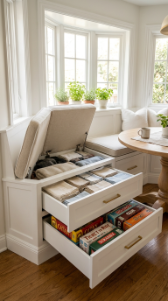
A dedicated breakfast nook transforms dead kitchen space into the most-used seat in the house — and banquettes are the gold standard for breakfast nook ideas. The hidden storage underneath the banquette seat is the detail that elevates the build from purely spatial to genuinely practical. Three approaches work well: full-height drawers in the banquette face with slim recessed pulls flush with the painted panel surface, lift-top seat sections with piano hinges and soft-close supports that allow the seat cushion to be lifted to access deep storage below, or a combination of drawers in the taller front-facing sections and lift-top access in the shallower angled corner sections. The storage capacity of the banquette base is substantial — a standard three-section bay window banquette typically contains 8 to 12 cubic feet of storage — enough for tablecloths, seasonal table accessories, board games, children’s craft supplies, or all of the above.
3. Upholster in Deep Velvet for a Luxurious Nook
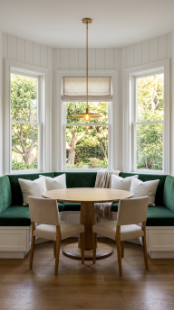
A wraparound bay window banquette upholstered in a deep jewel-tone velvet — forest green, sapphire blue, dusty rose, or deep mustard — transforms the breakfast nook from a clean practical seating zone into a genuinely luxurious interior feature with a richness and a material depth that linen, canvas, or cotton cannot provide. Velvet upholstery on a banquette rewards morning light particularly well — the soft pile catching the directional light from the bay window above and creating the characteristic velvet color shift that makes the fabric appear darker in the shadows of the tufting or seam lines and lighter on the raised pile surfaces, giving the nook a warmth and a depth that makes it the most inviting seat in the entire house. Deep forest green velvet against white painted paneling and with a natural brass pendant light above the table is the combination that has dominated high-end breakfast nook editorial photography throughout 2025 and 2026.
4. Install Beadboard Paneling on the Banquette Back
Bringing cottage-inspired charm to a bay window breakfast nook through vertical beadboard paneling — painted in the same hue and finish as the window trim and ceiling — ensures a seamless visual transition and gives the nook a resolved, built-in quality. The beadboard panel — installed on the back wall of the bay alcove above the banquette seat height — is the detail that makes the banquette feel truly built in rather than simply placed. The regular vertical groove rhythm of the beadboard creates a subtle but persistent texture behind the seating that is visible above the seat cushions, and its cottage-architecture reference gives the nook a timeless, characterful quality. Painted in the same colour as the banquette paneling and window trim — whether that is crisp white, warm cream, or a soft sage green — the beadboard back wall reads as a single continuous built-in installation rather than a separate applied element.
5. Use a Curved Round Table for a Bay Window Nook
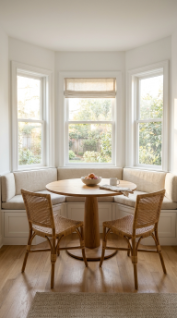
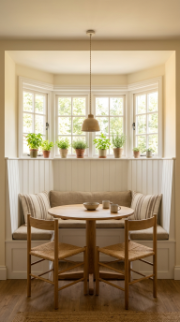
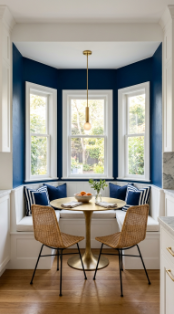
Round tables work best in corner nooks because everyone faces the center and nobody gets stuck on a sharp corner. A round 36-inch table seats three to four people, perfect for a small nook; a round 42-inch table seats four to five and needs at least a six-by-six-foot nook. The round table and the wraparound bay window banquette are the perfect geometric pairing — the curved arc of the banquette and the circular table creating a composition where every edge is soft and every seat has the same relationship to the center. The round pedestal table — with a single central column rather than four legs — is particularly well suited to the banquette nook because the pedestal base allows seating on all sides without any leg obstruction, and the generous knee clearance a pedestal provides is one of the most significant ergonomic improvements over a standard four-leg table in a confined banquette setting.
6. Panel the Banquette in Shiplap for a Modern Farmhouse Nook
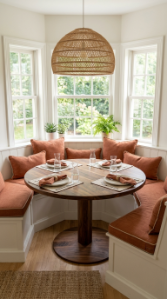
White painted horizontal shiplap paneling on the banquette front panels and the back bay alcove wall creates the defining material signature of the modern farmhouse breakfast nook — the horizontal reveal lines of the shiplap boards creating a regular rhythm that is both visually engaging and architectural without being precious or fussy. Vertical wall paneling sets a quiet rhythm behind the seating, while patterned cushions and a round wood table introduce variation without breaking the symmetry of the room. Shiplap applied to the banquette front panels runs the groove lines horizontally at approximately 4 to 6 inch reveal widths, and applied to the back alcove wall it creates a continuous textured backdrop that makes the nook feel deeply built-in and completely finished from every viewing angle in the kitchen.

7. Add a Banquette Library Corner With Built-In Shelves
Extending the wraparound banquette design to include a short run of built-in bookshelves on one side of the bay window — rising from the banquette seat height to the ceiling on the wall beside the bay, continuous with the banquette material and color — creates a breakfast nook with the character of a library reading corner as well as a dining space. The built-in bookshelf run beside the banquette uses the wall space adjacent to the bay window alcove that is typically left empty, and the books, objects, and plants displayed on the shelves give the nook a collected, lived-in quality that makes it feel genuinely personal. The connection between the banquette and the shelves — same painted color, same panel material, continuous plinth and cap rail — makes the whole assembly read as a single piece of built architecture rather than a furniture arrangement.
8. Stain the Banquette in a Warm Wood Tone for a Natural Look
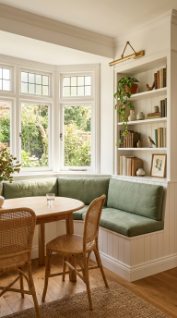
Instead of painted white or colored MDF, building and staining the banquette box in natural pine, cedar, or oak with a warm honey or mid-oak stain creates a breakfast nook with the material warmth of timber throughout — the banquette reading as a piece of built furniture rather than painted millwork. A natural stained timber banquette suits kitchens with natural wood cabinetry, open timber shelving, or an exposed ceiling beam — environments where the warmth of unstained or lightly stained wood is the defining material language and where painted white would look disconnected from the wider interior. The stained timber banquette pairs beautifully with linen, canvas, or leather upholstery, and with a natural wood table of the same or complementary timber tone the entire nook creates a warm, continuous material palette.
9. Hang a Statement Pendant Light Above the Nook Table
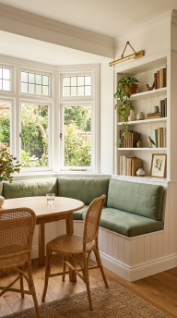
The pendant light above the banquette table is the single most powerful lighting decision in the entire nook design — it anchors the table visually, creates a sense of intimacy in the seating zone, provides task lighting for meals and work, and is the design element most likely to be noticed first by anyone entering the kitchen. Pale upholstery, a round pedestal table, and brass lighting center the nook without interrupting circulation. A statement pendant — whether a large woven rattan shade, a sculptural ceramic dome, a cluster of amber glass globes, or a slim natural brass ring — hung at approximately 30 inches above the table surface creates a warm, focused pool of light over the nook that distinguishes the dining zone from the surrounding kitchen and transforms the nook from daytime to evening with a quality of intimate warmth that overhead recessed lighting can never replicate.
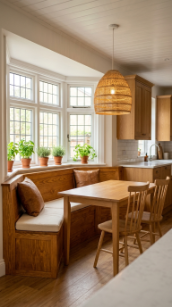
10. Apply Wallpaper to the Bay Alcove Back Wall
Achieving a polished look through a dramatic color scheme and statement wallpaper on the bay alcove back wall creates a tufted built-in banquette that takes advantage of the appealing graphic windows and highlights the semi-circular shape. Applying a statement wallpaper to the back wall of the bay window alcove — the section of wall behind and above the banquette seat, visible from every angle in the kitchen — creates the most impactful single-element transformation available to the banquette nook. The wallpaper pattern, seen framed by the three bay window panes above and the banquette below, is presented as a designed panel rather than a continuous wall treatment — making pattern choices that would feel overwhelming on a full kitchen wall completely appropriate in the concentrated bay window area. Botanical prints, geometric tile patterns, floral chinoiserie, and bold stripe wallpapers all work particularly well in this framed alcove format.
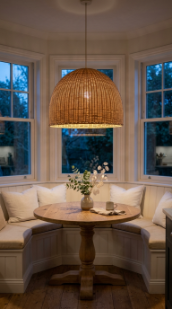
11. Create a Tufted Banquette for a Classic Look
Button tufting on the banquette back cushions — small upholstered buttons pulled through the cushion face at regular intervals with a long needle and heavy thread, creating the characteristic geometric dimple pattern — transforms the banquette from a simple bench seat into a piece of classic upholstered furniture with the quality reference of a Chesterfield sofa or a luxury restaurant booth. A tufted built-in banquette combined with statement wallpaper and a dramatic color scheme takes advantage of the appealing graphic bay windows to create a polished old-world charm. The tufting on the back cushion panels creates a visual richness and a decorative density that untufted flat cushions cannot achieve, and it gives the banquette the appearance of professional upholstery work even when achieved through a careful DIY approach with a long upholstery needle, strong button thread, and pre-covered upholstery buttons.
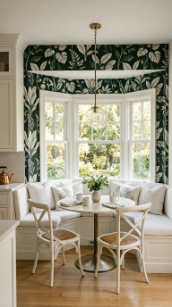
12. Add Under-Window Display Shelving Between the Banquette and Glass
Installing a slim display shelf — approximately 15cm deep, running continuously along the full base of the bay window glass directly above the banquette seat back — creates a linear display surface at window level that adds a layer of living objects between the banquette and the glass above it. The display shelf can hold small terracotta herb pots in the morning light, a row of amber glass bottles, a collection of small plants, or seasonal objects that change through the year — and the objects displayed on the shelf are backlit and luminous in the morning window light in a way that no other shelf position in the kitchen can replicate. The pedestal table keeps the center open, allowing the bay window to remain dominant — and the slim display shelf at window base level enhances the bay window rather than blocking it, the objects displayed sitting well below the main glass area.
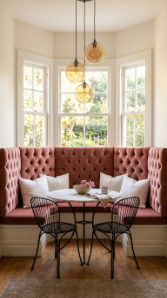
13. Paint the Interior Banquette Alcove in a Bold Color
Painting the interior walls of the bay window alcove — the three side walls that enclose the banquette zone — in a bold, saturated color while leaving the wider kitchen walls in white or a lighter neutral creates an intimate color pocket that makes the nook feel like a distinct room within the room. Deep navy, rich forest green, warm terracotta, dusty plum, or black are the colors that work best in the concentrated bay alcove format, because the limited wall area of the three alcove faces prevents the color from feeling overwhelming while the saturation provides a rich, jewel-box depth that transforms the nook’s character completely. The bold color on the alcove interior walls visible above the banquette seat contrasts with the lighter kitchen behind and frames the bay window as a deliberate color installation.

14. Use Wicker and Rattan Chairs Opposite the Banquette
Woven chairs introduce texture against painted millwork and smooth upholstery. Pairing the built-in upholstered banquette with natural wicker, rattan, or cane dining chairs on the opposite side of the table creates a material combination of significant visual richness — the warm natural material of the woven chair frames contrasting with the painted or upholstered banquette in a way that prevents the nook from feeling too monolithic or too matched. The mix of built-in upholstered seating and freestanding woven chairs is also the most practical seating configuration for the nook, because the chairs can be pulled out to accommodate additional guests at the table, used elsewhere in the kitchen when not needed, and replaced or changed with the seasons or the homeowner’s evolving taste without requiring any building work
15. Style the Nook for a Cozy Seasonal Morning
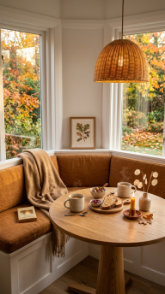
The bay window banquette nook in its full seasonal morning styling — breakfast table set with handmade ceramic mugs, a small wooden board with toast and jam, a beeswax candle in a ceramic holder, a small botanical print propped against the wall, and a soft linen throw draped on the corner of the banquette — is the image that makes the entire building project worthwhile. The styled nook is not just a dining space but a genuinely composed domestic still life that lives in the most light-filled and most sheltered corner of the kitchen, framed by the morning window and the warm embrace of the wraparound banquette. The styling of the nook changes with the seasons — fresh flowers and linen in spring, a herb pot and open cookbook in summer, a candle and woven throw in autumn, dried stems and warm ceramic in winter — the banquette providing the constant architectural frame that makes every seasonal arrangement beautiful.

16. Build the Banquette With a Lift-Top Window Seat
Rather than the full three-section wraparound banquette extending into the kitchen space, a more restrained version of the bay window breakfast nook can be achieved by building the banquette only under the window — a single wide window seat spanning the full bay width from wall to wall at window sill height, with the seat depth and height of a banquette, and no forward-extending bench sections. This window seat banquette is the simplest bay window build — essentially a single large box the full width of the bay, with lift-top storage access beneath the upholstered seat, positioned directly under the three window panes so the sitter looks out through the glass. A small table pulled in front with two chairs facing the window seat creates a dining nook of genuine intimacy and extraordinary morning quality.
17. Add Roman Shades to Each Bay Window Panel
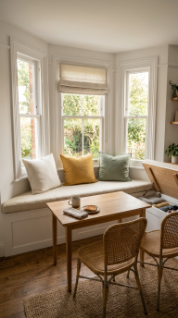
Roman shades or café curtains on the bay window provide light control during summer mornings when direct sun hits the table. Fitting each of the three bay window panels with its own individually operated Roman shade — each shade sized precisely to the panel width, all three in the same linen or cotton fabric — creates a light management system for the banquette nook that can be operated independently for different morning sun angles, pulled down for privacy in the evening, and used to control the quality and quantity of light entering the nook throughout the day. Linen Roman shades in a natural, unbleached, or softly colored fabric are the choice that integrates most quietly with the banquette nook aesthetic — the shade material and color echoing the banquette upholstery and allowing the window architecture to remain the dominant visual element when the shades are raised.
18. Install Brass Hardware on the Banquette for a Luxury Finish
The hardware choices on a DIY banquette — the drawer pulls, the hinges, the corner trim caps, the shelf brackets, and the cabinet feet — are the smallest details in the build but among the most visually impactful in the finished result. Replacing standard chrome or plastic hardware with warm polished or unlacquered brass throughout — slim recessed brass drawer pulls, brass piano hinges on the lift-top sections, brass corner trim caps at the angled corner junctions of the banquette frame, and small brass cabinet feet at the base of the front panels — elevates the painted banquette from a functional DIY build to a piece of considered cabinetry with a luxury material detail that costs very little to add but transforms the perceived quality of the whole installation.

19. Hang Café Curtains on the Lower Bay Window Panels
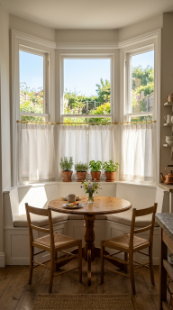
Café curtains — half-height curtains mounted on a slim brass rod at the mid-point of each bay window panel, covering the lower half of the glass while leaving the upper half entirely clear — are the window treatment that provides morning privacy and light softening from the sitting position of the banquette without blocking the sky and the upper garden view that the bay window provides. From the sitting height of the banquette seat, the café curtain covers the sightline directly to the street or neighboring garden, while the open upper window glass floods the nook with natural light and keeps the view of the sky, trees, and upper garden visible. Linen or cotton café curtains in white, cream, or a softly printed fabric hung on slim brass rods are the window treatment most in harmony with the banquette nook aesthetic — natural, simple, and appropriate to the scale.

20. The Complete Finished Bay Window Wraparound Banquette
The fully completed DIY bay window wraparound banquette — the finished result of the entire build process — is the room transformation that makes every hour of measuring, cutting, assembling, painting, and upholstering completely worth it. A dedicated breakfast nook transforms dead kitchen space into the most-used seat in the house. The completed banquette is permanent, architectural, and deeply personal — a structure built specifically for this house, this window, this family — and it shows. The proportions follow the bay window exactly. The storage is exactly where it is needed. The upholstery is exactly the color chosen. And every morning, the person who built it sits in the nook they made, in the light they planned for, with coffee in hand and the garden visible through the glass above, and knows it was worth it.