
20 Herb Garden Ideas Vertical Wall Mounted Cedar Frame
The wall is the most underused growing surface in any garden, patio, balcony, or kitchen, and the vertical cedar frame herb garden is the design solution that turns that wasted vertical space into the most productive, most beautiful, and most characterful feature a growing space can have. Growing up instead of out is not a compromise enforced by limited space — it is a genuinely superior approach in many situations, giving herbs better air circulation, more even light exposure at each plant level, and a harvesting convenience that a bed at ground level can rarely match.
A wall-mounted cedar frame herb garden is one of the most satisfying DIY projects in the garden world — not because it is particularly difficult, but because the return on effort is so immediate and so visually dramatic. Cedar boards, a few screws, some brackets, and an afternoon of building produces a structure that in a single growing season becomes covered in living herbs, fragrant and fresh and entirely beautiful. Cedar’s natural durability and its warm, honest character give the frame a quality that painted MDF or composite material simply cannot match — the boards weather gracefully, the warm red-honey tone transitions over time to a soft silvery patina that looks completely at home against stone walls, rendered surfaces, timber fences, and brick alike.
In 2026, the vertical cedar herb frame sits at the intersection of two of the strongest garden and home trends simultaneously: the productive beautiful garden, where everything grown is also considered and designed, and the small-space growing revolution, where patios, balconies, narrow courtyards, and even interior walls are being reclaimed as genuine growing territory by people who understand that the size of the growing space is far less important than the quality of the thinking that goes into it. These 20 ideas cover every approach to building, planting, styling, and maintaining a vertical wall-mounted cedar frame herb garden — from the simplest single-frame installation to the most architecturally ambitious multi-frame herb wall systems.
1. Build a Classic Vertical Cedar Frame With Three Tiered Planter Boxes
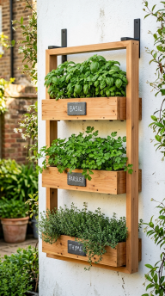
The foundation of the vertical cedar herb wall garden is the classic three-tier frame — a rectangular cedar outer frame approximately 60cm wide by 120cm tall with three horizontal cedar planter boxes of matching width attached at even intervals down the inner face, each box holding a different herb variety. This is the design that most vertical herb garden tutorials begin with, and for good reason: it is genuinely achievable for any moderately confident DIY builder, it produces an excellent result from the first season, and the proportions of the three-tier frame are visually balanced and aesthetically complete without requiring any refinement or additional styling. Build the outer frame from 1×4 or 1×6 cedar boards, construct each planter box with a 10cm depth and 8cm of internal height for root development, drill drainage holes in the base of each box, and mount the whole assembly on two heavy-duty outdoor wall brackets secured to the fence or wall. In a single afternoon of building and an hour of planting, the three-tier cedar herb frame becomes the best-looking and most useful object in the outdoor space.
2. Mount a Full-Width Cedar Herb Wall Across a Garden Fence
Scaling the vertical cedar herb garden from a single frame to a full-width installation across an entire fence panel — three or four matching cedar frames mounted side by side across the fence width — transforms an ordinary garden boundary into a living herb wall that is both a productive growing installation and one of the most architecturally dramatic features a garden can have. Each frame in the system holds three or four planter boxes, and when four frames are installed across a standard 2.4m fence panel width, the total number of planter boxes in the system reaches twelve to sixteen — enough growing capacity for the entire culinary herb collection of a household that cooks every day. The frames are built to the same module width so the horizontal planter box lines run continuously across all four frames when viewed straight on, giving the overall installation a grid quality that reads as designed and intentional even from a distance across the garden.

3. Design a Cedar Frame With Angled Planter Boxes for Better Drainage
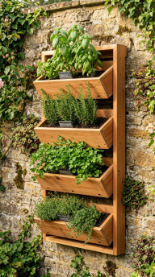
One of the most practically ingenious vertical herb garden design variations replaces the standard horizontal planter boxes with gently angled boxes — each box tilted slightly forward and downward at approximately 15 degrees from horizontal — so that excess water drains naturally forward and out of the drainage holes at the box base rather than pooling in the rear corners against the wall. The angled design also presents the herb plants at a slightly forward-facing angle that makes them more visible, more accessible for harvesting, and more dramatically displayed when viewed from the front. Building the angled boxes requires cutting the back boards of each box taller than the front boards by approximately 3 to 4cm — a simple adjustment to the standard box construction that takes no additional time but produces a significantly better growing environment for herbs that are sensitive to waterlogged roots. In natural cedar, the angled boxes give the vertical frame a more sophisticated, more purpose-built visual character than a standard flat-box frame — the tilt of each box level creating a subtle dynamic quality across the whole installation.
4. Create a Cedar Herb Frame for an Indoor Kitchen Wall
The vertical cedar herb frame is not exclusively an outdoor structure — mounted on an interior kitchen wall beside or above the cooktop, near the back door, or on a well-lit feature wall with a grow light installed above the frame, a cedar herb frame brings the productive garden aesthetic indoors and creates the most useful kitchen wall feature imaginable. An indoor cedar frame requires a few design modifications from the outdoor version: the planter boxes need drip trays beneath each level to protect the wall surface, the drainage holes should drain into a removable catch tray rather than freely, and the frame should be mounted with a small air gap behind it to prevent moisture against the wall. The cedar material is entirely appropriate for an indoor setting — its warm earthy tone pairs beautifully with linen, stone, brick, and tile kitchen aesthetics alike, and the living herb plants in their boxes above the countertop create an indoor kitchen garden moment that is both genuinely beautiful and functional with daily use.

5. Add a Cedar Vertical Herb Frame to a Narrow Balcony Wall
The narrow balcony is where the vertical cedar herb frame earns its position as the most space-efficient herb garden possible — a 60cm wide by 120cm tall cedar herb frame mounted on a balcony wall or railing takes up virtually no floor space whatsoever, holds six to twelve individual herb varieties in its planter boxes, and transforms the visual character of the balcony from an empty or cluttered small space into a genuinely designed outdoor room with a living green wall as its defining feature. On a balcony the wall-mounted format is not a design preference but a practical necessity — floor space is too limited for raised beds and ground-level containers, but vertical wall space is almost always available and almost always underused. A cedar frame mounted at a comfortable working height on the balcony wall, with herbs planted in its boxes that are appropriate for container growing and sun exposure, turns every square centimeter of the vertical balcony wall into productive, beautiful growing territory.

6. Install a Cedar Frame Herb Wall Beside an Outdoor Kitchen
The outdoor kitchen — whether a full built-in BBQ station, a pizza oven setup, or a simple prep counter beneath a pergola — is the outdoor space that has the most immediate and most daily use for fresh herbs, making it the most logical and most rewarding location for a wall-mounted vertical cedar herb frame. Mounting a substantial cedar herb frame — three or four tiers, wide enough to hold eight to ten herb varieties — on the wall immediately beside the outdoor kitchen creates a harvesting experience of extraordinary immediacy: reach for the rosemary, snip three sprigs directly above the prep counter, and return to the food in under ten seconds. The cedar frame beside an outdoor kitchen also performs a design function: it brings a natural material and a living green element to what can otherwise be a hard-surfaced outdoor cooking zone dominated by stone, metal, and tile, softening the overall aesthetic and connecting the cooking space to the garden around it.

7. Build a Cedar Frame With Integrated Potting Shelf at the Base
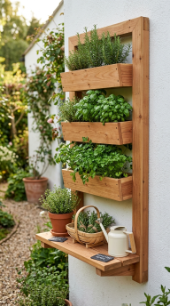
Adding a narrow integrated potting or staging shelf at the base of the vertical cedar herb frame — a small cedar shelf approximately 20cm deep that projects outward from the bottom of the frame at a comfortable working height — creates a combined vertical herb garden and staging surface in a single structure. The shelf serves as a rest point for tools, seed packets, a watering can, and harvested herb bundles while working at the frame, and between working sessions it holds terracotta pots of additional herbs, small decorative objects, or seasonal garden accessories that add visual interest at the base of the vertical frame. The potting shelf transforms the vertical cedar frame from a single-function wall planting structure into a complete outdoor herb garden station — a specific, purposeful territory in the garden with its own working surface, its own planting, and its own clearly defined aesthetic character.
8. Mount Multiple Small Cedar Frames in a Gallery Formation
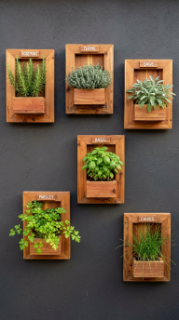
Rather than one large cedar herb frame, a gallery formation of five or six smaller individual cedar frames — each approximately 30cm wide by 40cm tall with a single planter box — mounted in a composed arrangement on a garden wall or outdoor living area wall creates a herb wall display that reads as much as a piece of outdoor art as a functional growing system. Each small frame holds one herb variety, and the frames are arranged in an intentional asymmetric or grid pattern across the wall with small gaps between them. The individual frame format allows the arrangement to grow and change over time — new frames added, seasonal herbs swapped in and out, the overall composition evolving as the garden evolves. Against a dark stone wall or a deep painted exterior surface, the warm cedar frames and the vivid green herb plants inside them create a composition of extraordinary visual richness — natural material warmth against architectural depth, living green against structural surface.
9. Train Climbing Herbs Up a Cedar Lattice Frame
A cedar lattice frame — a rectangular frame filled with a diagonal or square lattice pattern of thin cedar rails — mounted on the garden wall creates a vertical growing surface for climbing and scrambling herbs and edible flowers that need support as they grow upward. Climbing nasturtiums scramble enthusiastically across a cedar lattice in vivid orange and yellow, their round leaves and vivid blooms covering the lattice surface by midsummer in a display of extraordinary color and edible productivity. Lemon verbena, trained carefully with soft ties, grows tall against a cedar lattice to a height that a freestanding plant could never achieve. Climbing French beans — though not strictly a herb, their young tips are used as herbs in many cuisines — cover a tall cedar lattice completely by July. The cedar lattice frame is the vertical garden structure for plants that grow rather than simply sit in a container, and its visual result — a wall of climbing herbs and edible plants trained across warm cedar rails — is one of the most dramatically beautiful productive garden walls possible.

10. Install a Cedar Frame With Copper Pipe Watering System
A vertical cedar herb frame fitted with a simple drip irrigation system — thin copper tubing running across the top of the frame with small drip emitters positioned above each planter box that release a metered drip of water at each watering cycle — is the vertical herb garden upgrade that solves the most persistent maintenance challenge of the vertical growing format: the difficulty of watering each planter box evenly and consistently without water running down the wall or bypassing the lower boxes. Copper pipe is the material choice that fits the cedar herb frame aesthetic most naturally — the warm red tone of new copper and the blue-green patina of aged copper both sit in complete harmony with the warm red-honey of cedar, and the slim copper pipe running across the top of the frame reads as an elegant, designed detail rather than a practical addition. The system can be gravity-fed from a small reservoir at the top of the frame, or connected to a standard outdoor tap with a simple timer for fully automated watering on a daily schedule.
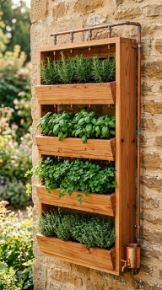
11. Build a Freestanding Cedar A-Frame Vertical Herb Structure
A freestanding A-frame cedar herb structure — two cedar vertical frames hinged or bolted together at the top ridge and opening outward at the base like a book or a ladder — stands independently without any wall mounting and creates planting surfaces on both sides of the structure simultaneously. The A-frame format doubles the planting capacity of a wall-mounted frame in the same footprint, allows the structure to be positioned anywhere in the garden — beside the patio, at the center of a garden path, at the garden gate — without requiring a suitable wall, and creates a genuinely three-dimensional herb garden object with a sculptural presence that a flat wall-mounted frame cannot achieve. Each face of the A-frame holds three to four tiered planter boxes, and because each side faces a different direction, the herbs on the two faces receive different light conditions through the day — making the A-frame the ideal structure for growing a combination of sun-loving Mediterranean herbs on the south-facing side and slightly more shade-tolerant herbs like parsley, chives, and mint on the north-facing side.

12. Use Cedar Frame Herb Walls to Define a Garden Zone
Two or three vertical cedar herb frames mounted side by side on posts to form a partial screen — not a full fence, but a visual divider approximately 1.5 to 1.8m tall that separates the kitchen garden zone from the lawn or seating area — creates a defined garden zone with the most beautiful and most productive dividing screen imaginable. The frames, mounted on cedar posts or steel ground anchor posts rather than on an existing wall, create a living green herb screen that provides visual separation, fragrance, food production, and year-round structure in a single installation. The screen format is not fully opaque — the planter boxes and their herbs allow filtered views through and around the structure — which means it creates the sense of a defined zone without completely enclosing or blocking the garden. With lavender, rosemary, and sage in the upper boxes of the screen frames, the height of the herb planting reaches 1.5 to 1.8m — tall enough to function as a genuine visual boundary while remaining entirely beautiful from every angle.

13. Style the Cedar Frame With Handmade Herb Labels and Accessories
The finishing accessories of a vertical cedar herb frame — the labels, the small decorative objects on the frame face, the watering tools stored beside it, and the seasonal additions around its base — are what separate a functional growing structure from a genuinely styled garden feature. Handmade herb labels in reclaimed cedar offcuts with herb names burned using a wood burning tool and mounted above each planter box with a small brass screw give each herb variety its name in the same warm material as the frame itself. A small vintage copper or aged brass watering can hanging from a hook on the side of the cedar frame. A hand-tied bundle of dried lavender from last season’s harvest hanging from a small nail at the frame corner. A small worn terracotta pot of compact Greek basil sitting on the frame’s lower ledge. Every one of these details costs almost nothing to add, takes minutes to place, and produces a result that transforms the cedar herb frame from a growing structure into a deeply personal and genuinely beautiful garden object.
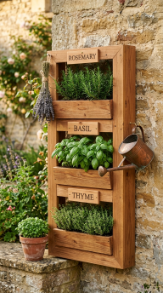
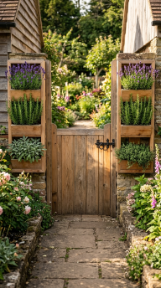
14. Mount Cedar Herb Frames on Both Sides of a Garden Gate
Two matching vertical cedar herb frames mounted symmetrically on either side of a garden gate — one frame on each gate post side, both frames at the same height — create the most welcoming and most fragrant garden entrance possible. Every visitor who opens the gate passes between two columns of living aromatic herbs at arm’s reach on both sides, brushing against rosemary, lavender, or sage and carrying the fragrance of the garden with them as they enter. The symmetrical gate frame installation reads as architecturally intentional from a distance — the matching frames flanking the gate creating a formal entrance that is entirely informal and entirely natural in its materials. In natural cedar, the warm boards on both gate frames complement the cedar gate itself if the gate is also timber, or provide a warm organic contrast against wrought iron or painted metal gate hardware. With lavender and rosemary in the upper boxes of both gate frames, the entrance to the garden is fragrant from twenty meters away in warm weather.
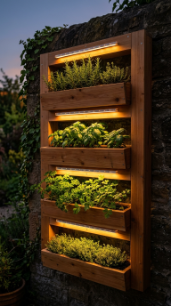
15. Create a Cedar Frame Herb Wall With Integrated Solar Lighting
Adding slim solar-powered LED strip lights or individual solar stake lights mounted on the cedar frame face above each planter box creates a vertical herb garden that transitions from a daytime kitchen garden feature into an atmospheric evening lighting installation — warm amber light washing across the herb plants from above each box, the cedar board surfaces catching the warm glow, and the whole frame glowing as a warm, living wall element in the garden after dark. The solar LED strips are mounted on the cedar frame face with small stainless screws, running along the top face of each horizontal planter box so the light falls downward and forward across the herb plants in each box. The warm amber color temperature is the only acceptable choice — cool white LED destroys the organic, warm character of the cedar and herb aesthetic entirely. At their best, solar-lit cedar herb frames make the garden worth being in long after the sun has gone down, and they do it with a quality of light — warm, directional, close — that no overhead garden floodlight could replicate.
16. Plant a Single-Herb Themed Cedar Frame for Medicinal or Tea Herbs

A cedar frame dedicated entirely to a single theme — a medicinal herb frame, a tea herb frame, or a culinary Italian herb frame — is a more focused and more culinarily useful approach than a general mixed collection, and it produces a visual result of greater coherence when every planter box holds a herb from the same family of use. A tea herb frame, for example, with chamomile in the top box, peppermint in the second, lemon balm in the third, and lavender in the bottom, produces a wall of herbs that collectively provide every component needed for a complete range of fresh herbal infusions from a single frame. A medicinal herb frame with echinacea, calendula, yarrow, and lemon verbena creates a natural first-aid and wellness garden in a single wall-mounted cedar structure. Mounted beside the back door with a small handmade chalkboard sign mounted on the cedar frame face naming the theme — “TEA GARDEN” or “APOTHECARY” — the single-theme frame tells a clear and beautiful story of its intended use.
17. Make a Narrow Vertical Cedar Frame for a Side Return or Passage

The narrow side return — the slim passage between a house and its boundary wall, often 60 to 90cm wide and entirely unused — is one of the most overlooked growing spaces in any garden, and a narrow vertical cedar herb frame designed specifically for the side return wall is the perfect solution for capturing that neglected space. A cedar frame approximately 40cm wide by 150cm tall with four narrow planter boxes of matching width transforms a dark, damp passage into a vertical herb garden that produces food, fragrance, and beauty in a space that was previously contributing nothing but stored bicycles and forgotten bin bags. The narrow format of the frame fits the side return proportions exactly, the cedar material manages the slightly reduced light conditions better than most growing systems, and the selection of herbs for the side return should focus on shade-tolerant varieties — mint, chives, flat-leaf parsley, and lemon balm all grow well with less direct light than the sun-hungry Mediterranean herbs.
18. Harvest From the Cedar Vertical Herb Frame — The Daily Kitchen Ritual
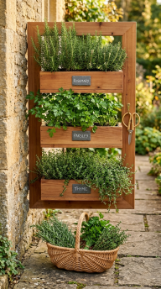
The moment that justifies the entire vertical cedar herb frame — the daily harvest — is one of the most quietly pleasurable domestic rituals in any home that grows its own herbs. A few steps to the frame, a pair of sharp herb scissors, a small gathering basket, and three minutes of mindful snipping produces the fresh herb component of the evening’s meal in a way that no supermarket purchase could replicate for freshness, fragrance, or satisfaction. The vertical format of the frame makes harvesting ergonomically perfect — every herb at arm’s reach, no bending, no reaching overhead, each planter box at exactly the right height for effortless harvesting. The harvest ritual connects the cook to the garden in the most direct and most daily way possible, and the frame itself — with its freshly clipped herb plants filling back in between harvests — becomes more lush and more productive the more regularly it is harvested, because regular cutting encourages each herb to produce new growth continuously through the growing season.
19. Build a Cedar Frame With a Chalkboard Panel for Growing Notes
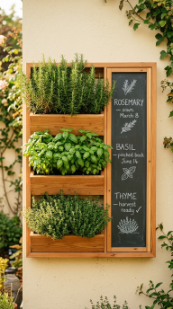
A cedar herb frame with a dedicated chalkboard panel — a section of chalkboard-painted MDF or a genuine slate panel set into the cedar frame face beside or between the planter boxes — gives the vertical herb garden a functional notes surface for recording sowing dates, harvest records, watering schedules, and growing reminders directly beside the herbs they refer to. The chalkboard panel can be as simple as a small slate tile set into a cedar-framed recess on the outer side of the frame, or as substantial as a full-height chalk-painted panel on one side of a wider frame. Written in chalk, the growing notes — “BASIL sown April 12,” “ROSEMARY — last watered Tuesday,” “THYME — ready to harvest” — give the herb frame a working, inhabited quality that transforms it from a static garden feature into a living record of the garden’s activity. The cedar frame, the living herbs, and the chalk-written growing notes together communicate a garden that is actively cared for, genuinely used, and deeply valued.
20. Create a Complete Cedar Herb Wall as the Garden’s Hero Feature
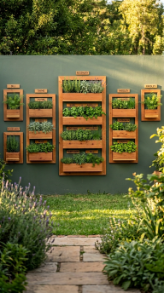
The most ambitious and most visually spectacular realization of the vertical cedar herb frame concept is the complete cedar herb wall — a full expanse of garden wall converted into a living herb garden installation through multiple cedar frames of different sizes arranged in a deliberate composition across the whole wall surface. Not a single frame, not three identical frames in a row, but a composed arrangement: a large central frame with four planter boxes as the anchor, flanked by two medium three-box frames, with two small single-box accent frames at the outer edges at different heights, and the whole composition tied together by the matching cedar material, the coordinated herb planting, and the handmade label system that gives every box its herb name. Against a garden wall painted in deep charcoal, warm sage green, or left as warm brick, the complete cedar herb wall becomes the garden’s defining visual feature — the installation that photographs best, impresses guests most, and produces the most herbs for the kitchen every single day of the growing season.


