
22 DIY Kids Playground With Cedar Swing Set and Slide
There is a particular satisfaction in building something your children will play on every day for the next decade. A DIY cedar playground is not just a building project — it is a decision about what the garden will look like, what your children will do after school, and what the backyard will be for the years when childhood is happening at full intensity in the space directly outside the back door. Cedar is the right material for this project for reasons beyond aesthetics: it is naturally rot-resistant, dimensionally stable through seasonal changes, and beautiful from the day it is finished to the day it greys into the garden and becomes a permanent feature of the landscape.
The best DIY cedar playgrounds are the ones that look like they belong in the garden they are built in — structures that use the same material warmth and craftsmanship as the house and the planting around them, rather than the bright primary-color plastic language of commercial playground equipment. They are also the ones that have been designed with genuine generational thinking: a structure that engages a four-year-old on the climbing wall becomes a den headquarters for an eight-year-old and a reading platform for a ten-year-old, if the design was generous enough in the first place.
These twenty-two ideas explore every dimension of the DIY cedar playground — from the simplest single swing to the most complete play tower — with every idea rooted in the same principle: build it from cedar, build it well, and build it for the garden it will live in.
1. Classic Cedar A-Frame Swing Set With Two Swings
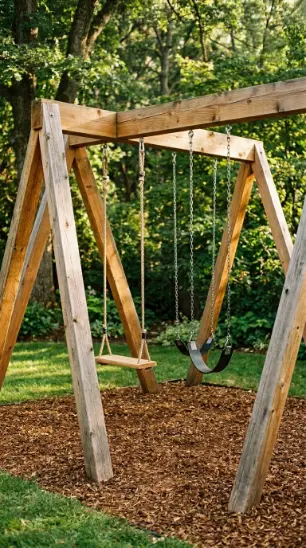
Build a classic A-frame cedar swing set — two wide A-frame leg assemblies in 10cm x 10cm cedar posts, braced with diagonal cedar braces at each leg base, with a 15cm x 15cm cedar overhead beam spanning between the A-frames, carrying two swings spaced generously apart. Use one flat cedar plank swing seat on natural rope and one standard belt swing on galvanized chain. The classic cedar A-frame swing set is the most fundamental DIY playground project — it is structurally robust, straightforward to build, and delivers the single most used piece of playground equipment in any garden. Finish with a waterproof natural oil or clear cedar sealer to protect the grain and maintain the warm honey tone.
2. Cedar Swing Set With Attached Slide Tower
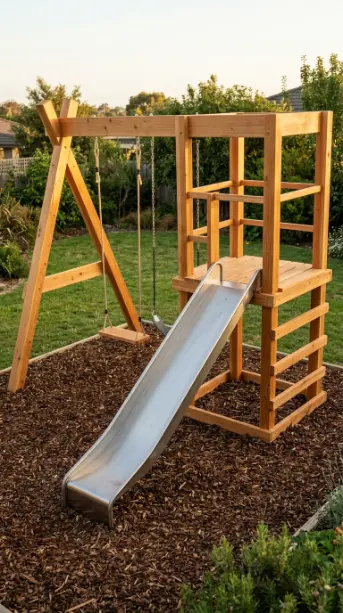
Extend the classic cedar A-frame swing set by attaching a timber slide tower platform to one end of the swing beam — a cedar platform deck approximately 1 metre above the ground, supported by four cedar corner posts and accessed by a cedar ladder, with a wide slide attached to the platform deck edge. The swing-and-slide combination structure is the most satisfying DIY playground upgrade: it turns a simple swing set into a complete play structure, doubles the play options in the same footprint, and the cedar tower platform creates an elevated destination that children use independently of the swing activity as a lookout point, den, and gathering place.
3. Cedar Fort Tower With Roof and Enclosed Walls
Build a fully enclosed cedar fort tower — a raised platform tower with three solid cedar board walls and one open front wall, a simple cedar shingle or corrugated metal roof, window cut-outs in the walls, and a cedar ladder or stair access. The enclosed cedar fort tower is the most imaginatively rich playground structure possible — children use the enclosed space as a den, a castle, a pirate ship, a house, or whatever the current story requires, and the solid cedar walls, real roof, and window openings give the structure a quality of genuine architecture that plastic play houses can never match.

4. Cedar Swing Set With Trapeze Bar and Climbing Rope
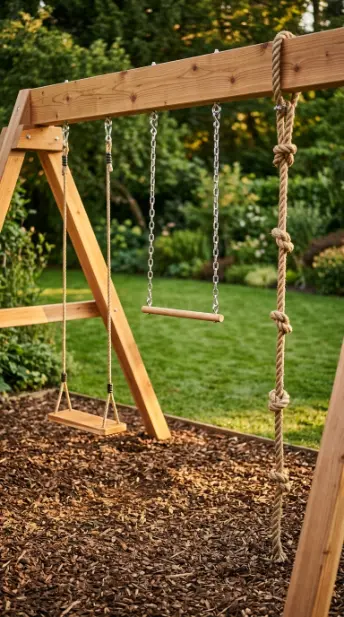
Replace one standard swing position on the cedar A-frame swing beam with a trapeze bar — a smooth cedar or hardwood dowel bar approximately 3cm diameter and 45cm long, suspended on two lengths of galvanized chain — and add a thick natural manila climbing rope hung from the same beam beside it. The trapeze bar and climbing rope combination on a cedar swing set transforms it from a swinging destination to a full-body strength and coordination challenge — the trapeze bar develops grip strength and upper body coordination, the climbing rope is one of the most physically demanding and rewarding playground elements available, and both age up naturally as children grow.
5. Double-Decker Cedar Play Tower With Upper and Lower Decks
Build a double-decker cedar play tower — a lower platform deck approximately 70cm above the ground and an upper platform deck approximately 1.4 metres above the ground, both accessed by cedar ladders or stairs, with the upper deck partially roofed and the lower deck open. The double-decker tower creates two distinct play environments at different heights — the lower deck is accessible for younger children, the upper deck is a more exclusive elevated space for older children — and the varied heights of a double-deck structure make it the most spatially interesting DIY playground structure possible.

6. Cedar Swing Set With Picnic Table Underneath
Build the cedar A-frame swing set with a deliberate open space design beneath the swing beam — and place a matching cedar picnic table directly beneath the overhead beam in the space between the A-frame legs. The cedar picnic table beneath the swing beam turns the underside of the swing set into a functional outdoor dining and activity space — children can move between swinging and sitting at the table without leaving the play structure zone, and parents can sit at the table while supervising younger children on the swings. Build the picnic table from matching cedar timber to create a unified material composition.

7. Cedar Playground With Sandbox Integrated Into Tower Base
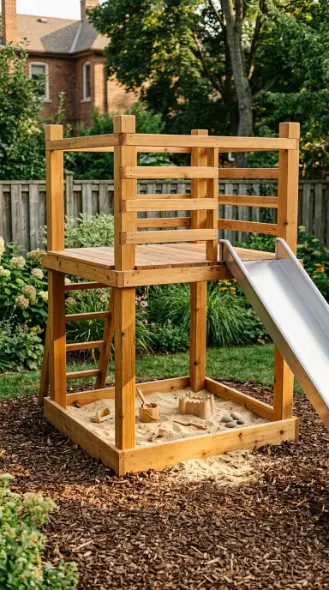
Build the cedar play tower with a large sandbox integrated directly into the ground level beneath the tower platform — the tower’s four corner posts framing a generous square sandbox area, the sandbox filled with clean play sand and accessible from all sides beneath the elevated platform deck above. The sandbox beneath the tower creates a sheltered play space — the platform deck above provides shade on sunny days, the tower posts define the sandbox boundaries naturally, and the elevated platform creates a roof for imaginative play scenarios. Add a simple cedar board sandbox edge at ground level between the corner posts to contain the sand.
8. Cedar Swing Set With Tire Swing
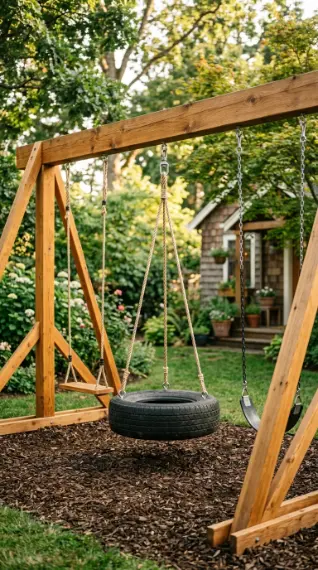
Add a tire swing to the cedar swing set by hanging a single recycled rubber tire horizontally from three equal lengths of chain or thick rope from a single point on the swing beam — the tire hanging flat and level approximately 40-50cm above the ground, allowing multiple children to sit on the tire rim or inside it simultaneously. The horizontal tire swing is one of the most socially generative playground elements — it accommodates multiple children at once, swings in all directions rather than in a fixed arc, and remains enduringly popular from toddlerhood through primary school years. Hang it from the center of the cedar beam for structural balance.
9. Cedar Playground With Rock Climbing Wall Panel
Attach a cedar climbing wall panel to one side of the play tower — a flat cedar board panel at a slight outward angle (approximately 70-75 degrees from vertical), fitted with a series of commercial colored climbing holds bolted through the cedar boards at varied positions, providing a genuine bouldering challenge on the way to the tower platform. The climbing wall panel on a cedar tower transforms the access experience from a ladder to a genuine physical challenge — it develops grip strength, problem-solving, and balance, and it scales in difficulty as children choose more challenging hold sequences as they grow.

10. Cedar Swing Set With Attached Horizontal Monkey Bars
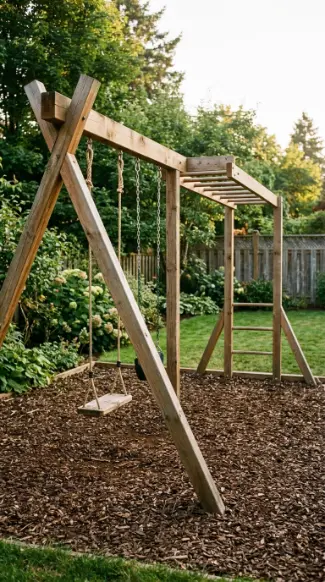
Extend the cedar A-frame swing set horizontally by attaching a cedar monkey bar run — a series of eight to ten round cedar or hardwood dowel rungs approximately 4cm diameter, spaced at approximately 30cm intervals between two parallel cedar side rails — attached to the end of the swing beam and extending the play structure horizontally. A monkey bar run attached to the cedar swing set creates the most physically demanding upper body challenge in the playground and is the piece of equipment that develops genuine hanging and swinging strength most efficiently. Build the side rails from cedar 5cm x 10cm sections and bolt the dowel rungs through pre-drilled holes.
11. Cedar Playground Incorporating an Existing Garden Tree
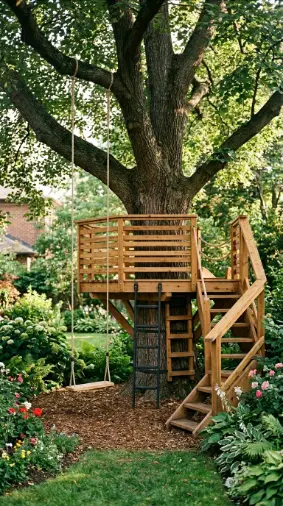
Design the cedar playground around an existing established garden tree — using the tree’s trunk as a natural post for one side of the swing set or tower structure, attaching cedar platform decking to the tree at a branch junction height, and building cedar railing, ladders, and connecting walkways that use the tree as their anchor point. A tree-integrated cedar playground has a quality of organic design that no freestanding structure can replicate — the tree provides shade, the bark of the trunk becomes part of the play experience, and the structure looks as though it grew from the garden rather than being installed in it.
12. Cedar Swing Set With Baby Bucket Swing
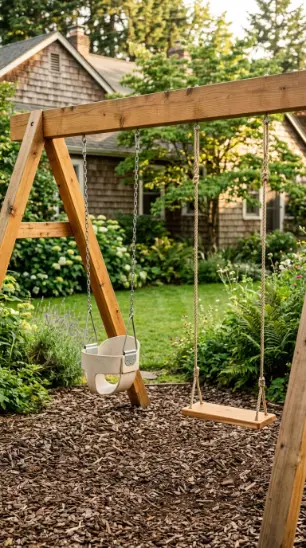
Add a baby bucket swing to the cedar swing set — a molded plastic or fabric sling bucket seat with leg holes, suspended on two lengths of chain or rope from the overhead cedar beam — to make the playground accessible for toddlers and younger children while retaining the flat seat swings for older children on the same structure. The baby bucket swing is the single most important playground addition for families with children under three — it allows the youngest child to swing safely and independently while older siblings use the standard swings on the same structure, making the cedar swing set a multi-age family destination from the first day.
13. Cedar Playground With Balance and Agility Course Attached
Extend the cedar playground beyond the swing set and tower by adding an attached balance and agility course — a cedar balance beam at varied heights, a series of cedar stepping post rounds at stepping stride, a short cedar wobble bridge, and a cedar slack line frame — all connected as a continuous circuit from the main tower structure. The cedar agility course extension transforms the playground from a static swinging and climbing destination to a full outdoor movement environment — children can complete circuits repeatedly, developing balance, coordination, and body awareness in a space that looks as natural and beautiful as any feature in the garden.

14. Cedar Swing Set With Adjoining Cedar Playhouse
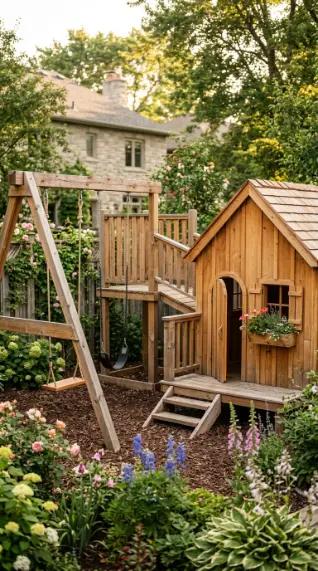
Build the cedar swing set directly adjacent to a small cedar playhouse — a cedar timber-framed playhouse with vertical board walls, a window and door opening, and a cedar shingle roof — connecting the two structures with a short cedar deck or plank walkway between the swing set platform and the playhouse entry door. The cedar swing set and adjoining playhouse creates the most complete DIY playground destination — the playhouse provides an enclosed play space for domestic imaginative play, the swing set provides the active physical play, and the connecting walkway links them as a single play world.
15. Cedar Playground With Fireman’s Pole
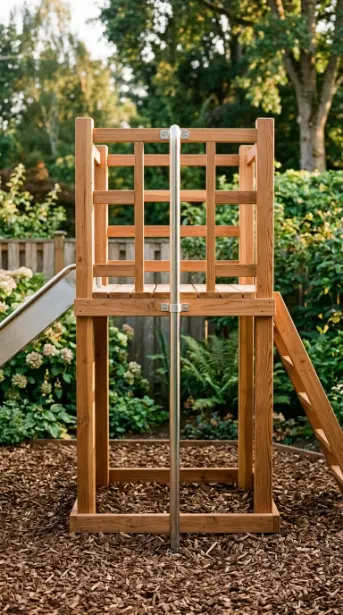
Add a fireman’s pole to the cedar play tower — a smooth 5cm diameter stainless steel or galvanized steel pole mounted vertically from the tower platform deck edge to the ground, secured at the top to the platform framing and at the base in a concrete footing — as a fast exit from the tower that is equally exciting as the slide. The fireman’s pole is one of the most joyful playground elements — the instant drop to the ground is a physical experience that no other play element provides, children approach it with a combination of bravery and excitement every single time, and it develops grip strength and body awareness in a way that is genuinely different from any other playground activity.
16. Cedar Swing Set With Attached Pergola and Shade
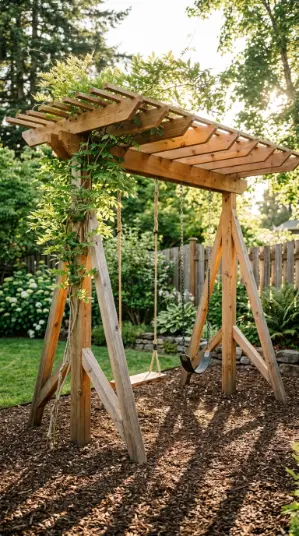
Extend the cedar swing set structure by adding a cedar pergola roof above the main swing beam area — cedar pergola beams running perpendicular to and above the main swing beam, supported on the A-frame post extensions, with cedar pergola rafters creating an open-slatted overhead shade structure. Grow a fast-establishing climbing plant — wisteria, climbing roses, or passionflower — up the A-frame posts and across the pergola top, so that the swing set gains a living green canopy over several growing seasons. The cedar swing set with pergola roof becomes one of the most beautiful garden features possible as the climbing plant establishes — a shaded, fragrant, living canopy over the swings.
17. Cedar Playground With Rope Bridge Between Two Towers
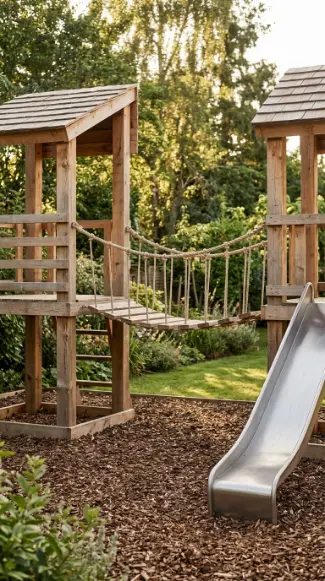
Build two separate cedar towers at a distance of approximately 2-3 metres apart and connect them with a rope bridge — a span of natural rope sides with cedar plank decking sections at step intervals, creating a swinging, moving bridge between the two elevated platforms. The rope bridge between twin cedar towers is the most adventurous and socially engaging playground element — crossing a swinging bridge requires balance, coordination, and a degree of courage, and it becomes the centerpiece of every play scenario that uses both towers simultaneously, whether as castle ramparts, jungle exploration, or pirate ships.
18. Cedar Swing Set With Hammock Frame Attachment
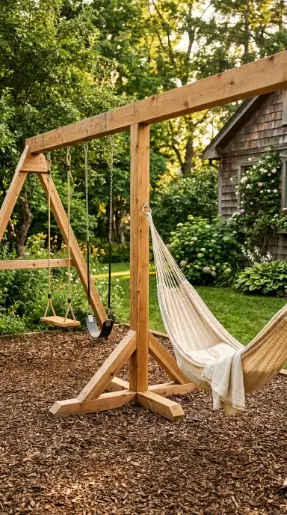
Build the cedar swing set with an extended beam that allows a large outdoor hammock to be hung from the beam end posts — the A-frame at one end holds the swings, and a separate single sturdy cedar post on a wide braced base at the other end of the extended beam provides the second hammock attachment point. A cotton or canvas hammock strung between the cedar beam end and the single cedar post creates a lounging and reading destination adjacent to the swings — making the cedar playground useful not just for active play but for the slower, quieter outdoor time that children and parents both need.
19. Cedar Playground With Attached Chalk Wall
Mount a large exterior chalkboard panel — a sheet of smooth dark chalkboard-painted timber or a genuine slate panel in a cedar frame — directly to one vertical face of the cedar play tower, creating a permanent outdoor chalk drawing wall at child height as part of the playground structure. A cedar-framed chalk wall attached to the play tower gives children a creative destination within the playground — a surface for drawing, writing, and mark-making that is genuinely part of the play structure rather than a separate station. Fill a small cedar-framed chalkboard tray mounted below the panel with chalk pieces for immediate use.

20. Cedar Playground With Night-Time Lighting
Add warm outdoor lighting to the cedar playground — solar-powered warm amber LED strip lights recessed under the swing beam and platform deck edges, small solar lanterns hung from the swing set A-frame posts, and path lights in the bark chip ground leading to the playground entrance — so that the cedar playground becomes a warm and beautiful garden feature at evening as well as a play structure during the day. Night-time cedar playground lighting transforms the outdoor play area into an evening garden destination and makes the natural cedar timber glow warmly after dark in a way that is genuinely beautiful as a garden lighting composition.

21. Cedar Swing Set With Garden Gate Entrance and Pathway
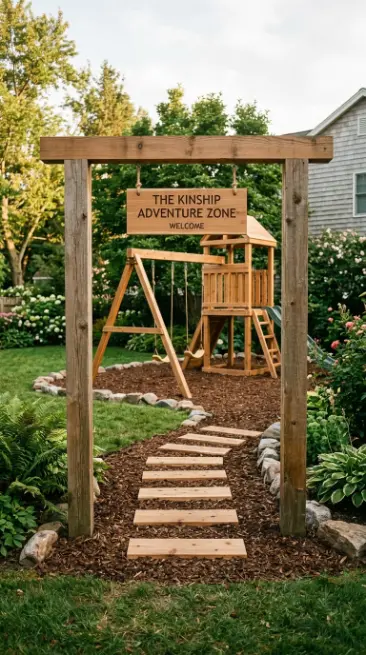
Create a formal entrance to the cedar playground area by building a simple cedar post and beam gateway — two cedar posts with a simple cedar beam spanning above — positioned at the edge of the bark chip play zone, with a short cedar board path leading from the gate to the base of the swing set. Add a simple cedar name or welcome sign hung from the beam above the gateway. The cedar gateway entrance transforms the playground from a piece of equipment in the garden to a defined destination — it gives the play space a threshold, a sense of arrival, and a named identity that children respond to with heightened imaginative investment.
22. Ultimate DIY Cedar Playground — Complete Play System
Build the most complete DIY cedar playground possible — a full play system combining every essential element: an A-frame swing set with three swings, an attached double-deck play tower with slide and fireman’s pole, a rope bridge connecting to a second fort tower with enclosed walls and roof, a horizontal monkey bar run, an integrated sandbox at the base of one tower, a climbing wall panel, a cedar playhouse adjoining the structure, and warm evening lighting throughout — all built from natural cedar timber with bark chip mulch ground surface and natural fieldstone edging.


