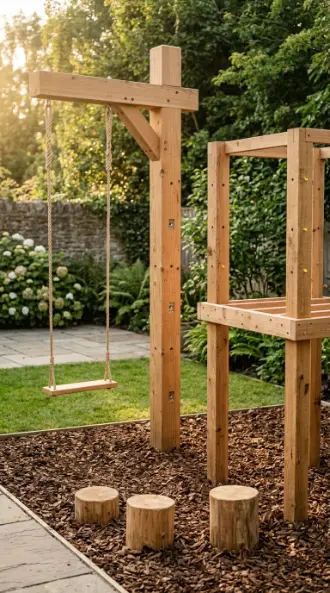
20 DIY Jungle Gym Small Space Compact Tiny Backyard
A small backyard is not a reason to skip the jungle gym. It is a reason to design one more carefully. The constraint of a small space is the best design brief a DIY playground project can have — it forces every element to earn its place, it eliminates anything that is just decoration, and it produces structures that are more ingenious, more multi-functional, and often more beautiful than their sprawling counterparts. A compact jungle gym built thoughtfully for a tiny backyard does more in two square metres than most commercial play structures do in ten.
The key principles of small-space playground design are simple: go vertical rather than horizontal, combine multiple play functions into single structures, choose materials that look like they belong in the garden rather than interrupting it, and keep the footprint tight while maximizing the play value at every height level. Cedar and natural timber are the right materials for this brief — their visual warmth means a compact structure sitting close to the house, the fence, and the garden beds will look intentional and considered rather than crowded and apologetic.
These twenty ideas solve the small backyard jungle gym problem from every angle — structural, functional, and aesthetic.
1. Vertical Cedar Climbing Wall Against Fence
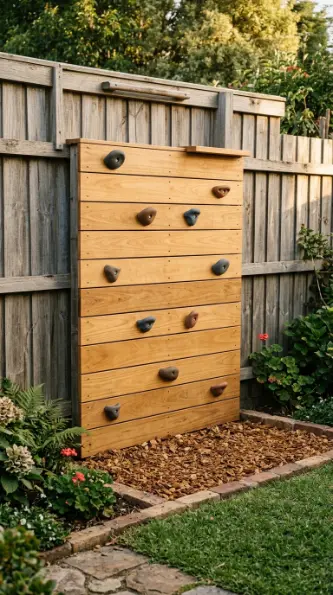
Mount a cedar climbing wall panel directly against an existing garden fence — the fence provides the structural backing, the cedar boards are fixed to the fence face, and commercial climbing holds are bolted through the boards at varied positions. The vertical climbing wall against the fence uses zero additional floor space — the entire play structure occupies only the fence line itself, leaving the backyard floor area completely free. Add a small cedar step platform at the top where the wall meets the fence cap, and a deep bark chip landing zone at the base of the wall.
2. Fold-Away Cedar Swing Frame
Build a cedar swing frame on a fold-away hinge system — the A-frame legs pivot outward from a wall-mounted cedar beam on heavy duty hinges, so that the swing set can be deployed into the backyard for play and folded flat against the wall when not in use. When folded, the entire swing frame sits within 20cm of the wall, returning the backyard floor space for other uses. Build the hinged leg assemblies from 10cm x 10cm cedar, use a wall-mounted cedar beam at the correct height, and install a simple latch system to lock the legs in the deployed position during play.
3. Corner-Mounted Cedar Play Tower
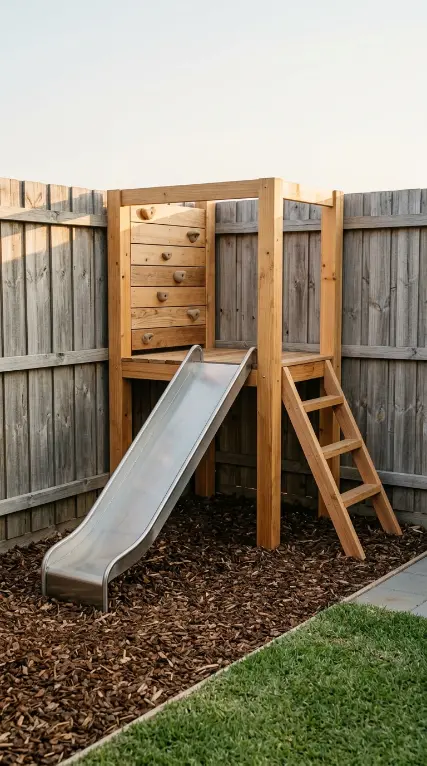
Design the cedar play tower to sit precisely in one corner of the small backyard — the tower using two existing fence lines as two of its four sides, requiring only two cedar front posts rather than four, and positioning the slide, ladder, and climbing access all within the corner footprint. A corner-mounted cedar play tower uses the most otherwise-dead garden space efficiently, reduces the number of structural posts required, and keeps the remaining open backyard area completely clear. The two existing fence lines provide natural wall backing for the tower, reducing the visual mass of the structure in the small space.
4. Compact Cedar Swing and Slide Combo — Minimal Footprint
Design a minimal-footprint swing and slide combination — a single narrow A-frame in cedar with the swing beam positioned at the minimum practical height and the slide descending directly beneath the beam end at a steep angle, the total structure footprint under 1.5 meters x 2.5 meters. Use space-saving design at every point: one swing rather than two, a steep slide angle to shorten the horizontal run, and a single post A-frame rather than a wide traditional A-frame. This is the smallest functional cedar swing-and-slide combination possible.
5. Wall-Mounted Cedar Monkey Bars
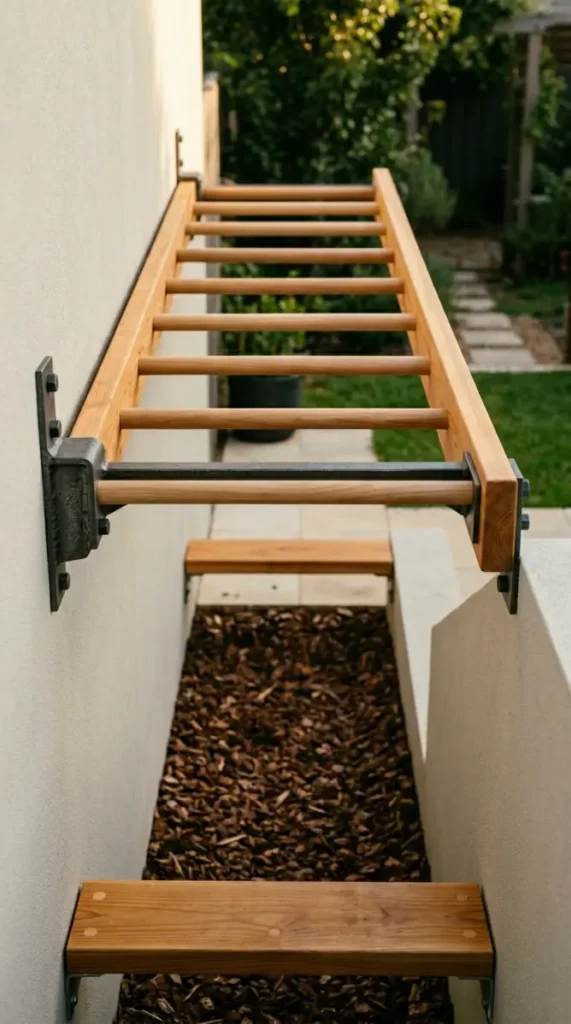
Mount a compact horizontal monkey bar run directly to a garden wall or strong fence — cedar side rails wall-mounted at both ends with large structural brackets, cedar or hardwood dowel rungs bolted between the side rails, the full monkey bar run sitting flush against the wall and extending only the width of the rungs (approximately 60cm) into the backyard space. Wall-mounted monkey bars are the most space-efficient upper body play installation possible — they use the wall as their structural anchor, require no freestanding posts, and extend only minimally into the yard.
6. Overhead Cedar Beam Across Backyard With Multiple Hanging Elements
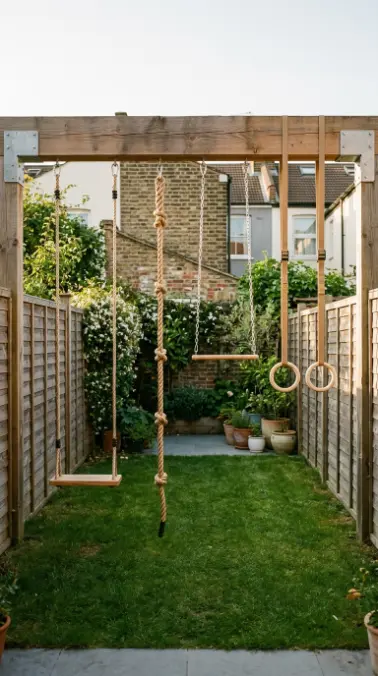
Mount a single substantial cedar beam overhead across the narrow width of a small backyard — beam ends resting in deep galvanized post brackets bolted to the top of opposing fence posts or wall surfaces on both sides of the yard — and hang multiple play elements from the beam: one swing, one climbing rope, one trapeze bar, and one set of gymnastics rings. The overhead beam turns the full width of the backyard into a play zone while using no floor space at all — every element hangs from above, the backyard floor remains completely open beneath, and the beam itself becomes an architectural element that frames the outdoor space from above.
7. Compact Cedar Tower With Understorey Storage
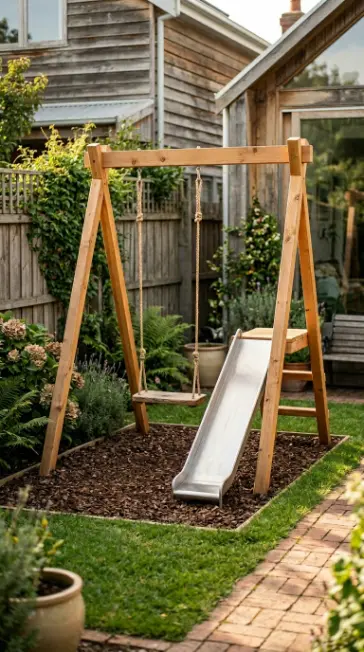
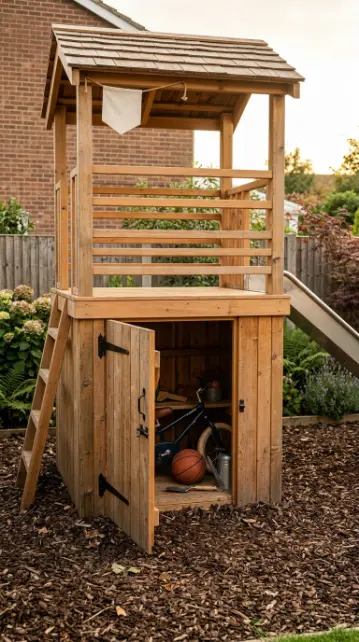
Build the cedar play tower with a fully enclosed storage area at ground level beneath the platform — the space between the four corner posts at ground level enclosed with cedar board walls and a cedar board door, creating a weatherproof storage room for bikes, balls, garden tools, or play equipment beneath the tower platform. The under storey storage cedar tower solves two problems simultaneously: it provides the elevated platform play space above and reclaims the dead space beneath as functional storage, making the total structure genuinely earn its small backyard footprint twice over.
8. Single Post Swing With No A-Frame
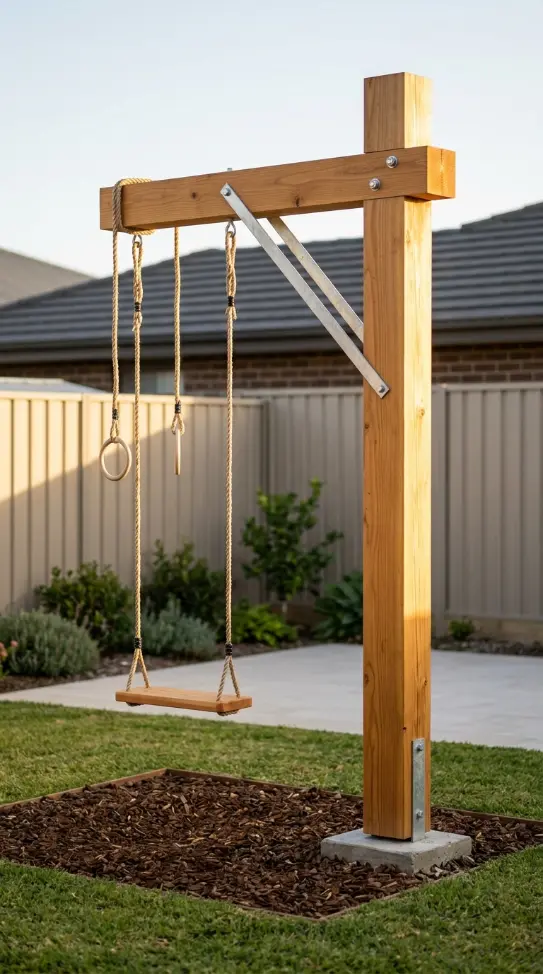
Mount a single heavy-duty cedar or hardwood post — a thick 15cm x 15cm section, set deep in concrete — and hang one or two swings from a short horizontal cedar arm bracket extending from the post top, eliminating the A-frame entirely. The single post swing occupies a fraction of the ground space of a traditional A-frame — the post base is approximately 30cm x 30cm, and the total swing zone footprint can be as small as 1 meter x 1.5 meters. Use a heavy-duty post bracket arm in galvanized steel bolted through the cedar post at approximately 200cm height to carry the swing beam section.
9. Compact Cedar Obstacle Trail Along Fence Line
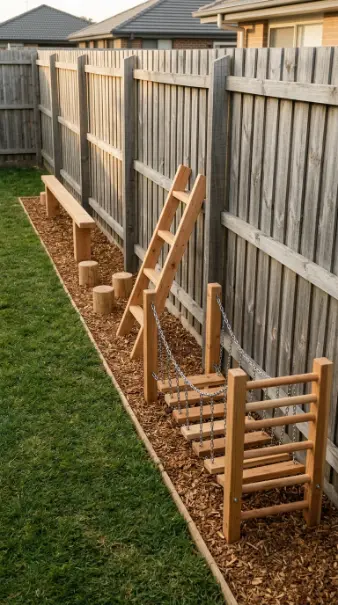
Install a compact obstacle course along an existing fence line — using the fence as the back boundary of every element, so the entire course extends only 60-80cm into the backyard. Elements from left to right along the fence: a short cedar balance beam on low cedar supports, three cedar stepping post rounds at stride intervals, a short cedar ladder section leaning against the fence, a cedar wobble bridge between two cedar end posts, and a compact cedar rung wall. The fence-line obstacle trail creates a complete physical challenge circuit using only a narrow strip of backyard space.
10. Vertical Cedar Ladder Tower — Minimal Footprint
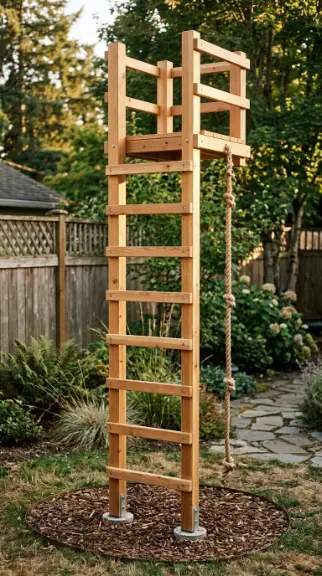
Build a vertical cedar ladder tower — a slim narrow structure of two 10cm x 10cm cedar posts set parallel approximately 50cm apart, with wide cedar rungs from ground to a small top platform, the whole structure ascending vertically with almost no horizontal footprint. The top platform is a small cedar decking section approximately 50cm x 50cm with a simple rope or cedar railing, creating an elevated lookout point. The vertical ladder tower occupies approximately 50cm x 80cm of floor space and reaches 1.8-2 meters in height — the most height per square centimeter of any playground structure possible.
11. Compact Cedar Swing Set Built Against House Wall
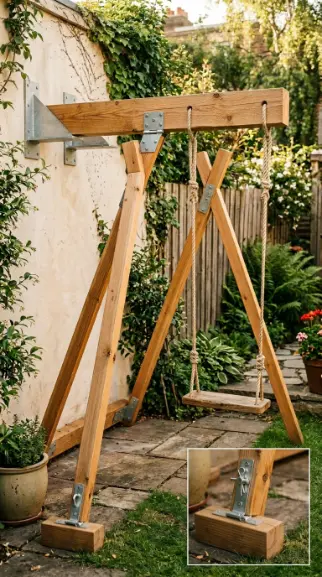
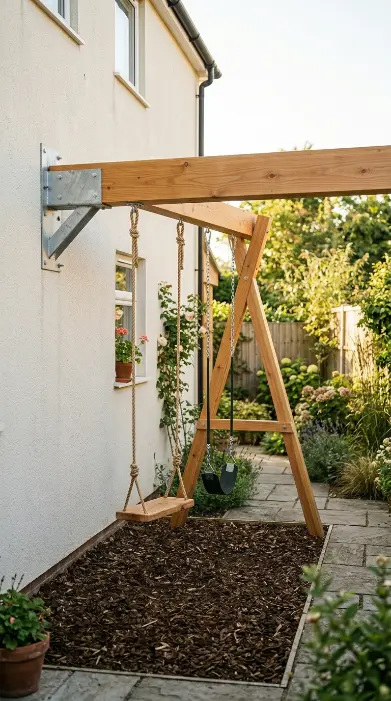
Mount the cedar swing set against the house wall — the overhead swing beam wall-mounted to the house at one end and supported by a single A-frame cedar leg assembly at the other end, eliminating half the A-frame entirely and using the house as the structural anchor. The house-wall swing set requires only one A-frame leg assembly projecting into the backyard rather than two, reducing the footprint by approximately 40% compared to a freestanding swing set. Use a large through-wall or structural wall bracket rated for swing loads to mount the beam end to the house.
12. Cedar Loft Play Platform With Slide — Raised Above Garden Storage
Build a raised cedar loft play platform at approximately 1.5 meters height, supported on four cedar posts, with a completely open ground level beneath the platform used as covered outdoor storage — bikes, toys, garden equipment. The children’s play space is entirely elevated, the ground space entirely functional. Access by cedar rung ladder, exit by stainless slide. The loft play platform above storage is the most space-efficient possible combination of play and utility — the structure occupies a single footprint and performs two entirely separate functions on two levels.
13. Compact Cedar Swing Frame for One — Minimal Width
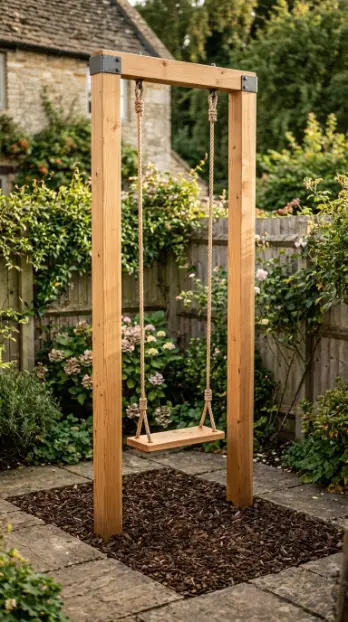
Build the narrowest possible functional cedar swing frame — a single-swing structure using two parallel cedar posts approximately 50cm apart rather than a wide A-frame, with a short cedar beam across the top, the whole frame barely wider than the swing itself. The narrow parallel-post swing frame takes up minimal visual and physical space — it sits in a small backyard with the presence of a piece of outdoor furniture rather than a piece of playground equipment, and the cedar material ensures it looks considered and intentional at every scale.
14. Multi-Level Cedar Platform System Along Fence
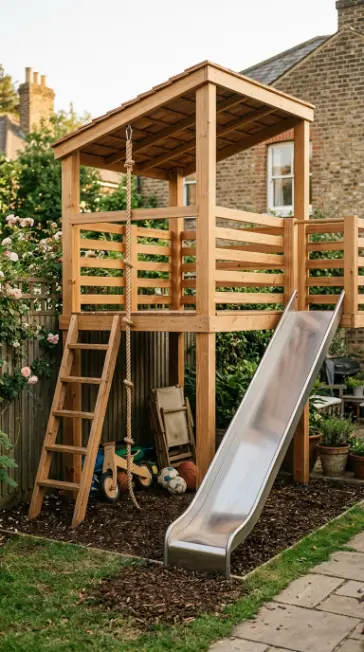
Build a stepped multi-level cedar platform system directly against a fence — three platform levels at different heights (30cm, 60cm, 100cm) arranged in a staircase pattern along the fence face, each platform approximately 60cm x 60cm, with short connecting cedar rung sections between levels, and a compact slide from the highest level to the ground. The multi-level fence platform uses only 60cm of depth into the backyard, creating a complete elevated play environment — children move up and down through the levels, slide from the top, and use each platform as a distinct play space.
15. Cedar Swing Set With Integrated Raised Garden Bed Base
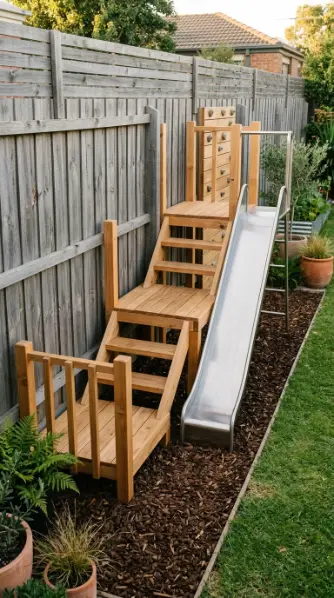
Design the cedar swing set A-frame with a deep timber raised garden bed integrated into the base of each A-frame leg — the spreading A-frame legs forming the corners of a raised garden bed on each side, the beds planted with herbs, strawberries, or flowers. The raised bed swing set turns the playground into a productive garden feature simultaneously — the structure is useful twice over (play structure and garden bed), the planted beds soften the visual presence of the swing set in the small backyard, and the integration of planting with the play structure is one of the most beautiful small-space design decisions possible.
16. Compact Cedar Balance and Agility Zone — 2m x 2m Footprint
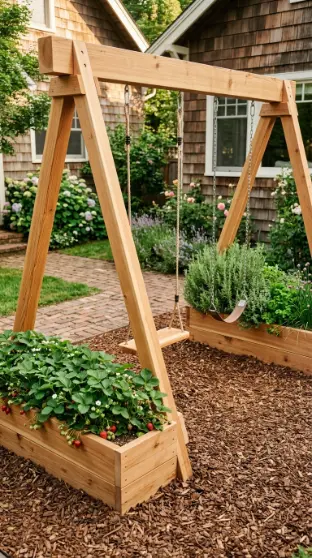
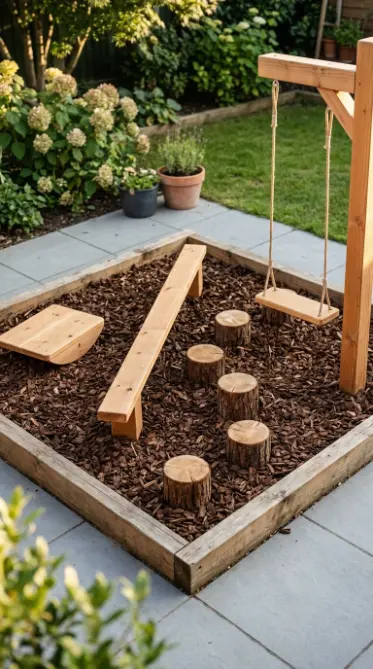
Design the entire playground as a compact agility zone within a strict 2 meter x 2 meter footprint — a cedar balance beam raised on two posts, four cedar stepping post rounds, a short cedar wobble board on a half-cylinder cedar rocker base, and a single cedar plank swing on natural rope from a short beam on two cedar posts — all within the 2 meter x 2 meter square, with deep bark chip covering the full zone. A strict footprint constraint forces every element to be minimal and purposeful, and the resulting compact agility zone is the most space-honest playground possible.
17. Cedar Swing Integrated Into Pergola Structure
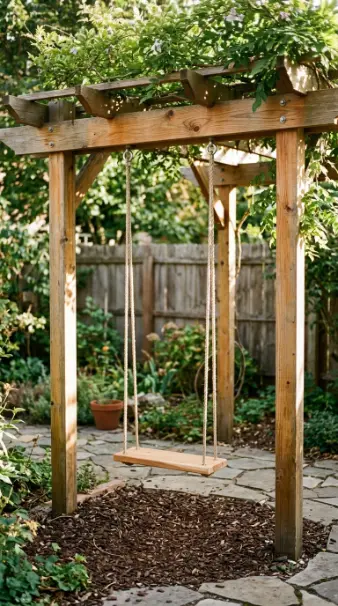
If the small backyard already has or is planned to have a cedar or timber pergola — integrate the swing directly into the pergola structure rather than building a separate swing set. Reinforce one pergola beam to swing-rated load capacity, add swing-rated eye bolts through the beam at two points, and hang a cedar plank swing on natural rope. The pergola-integrated swing uses the existing structure’s footprint to deliver a swing with zero additional floor space requirement — the pergola was already there, and the swing is simply one more function it now provides.
18. Compact Cedar Play Tower With Rooftop Deck
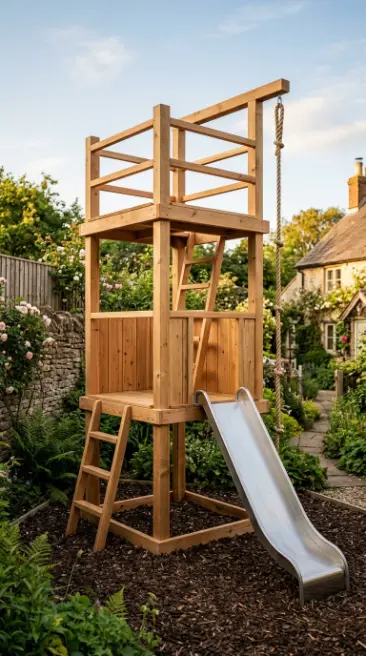
Build a compact cedar play tower with a rooftop open deck above the standard platform level — a second upper deck above the covered roofed lower platform, accessed by a short cedar rung section from the lower deck, providing two distinct play levels within a single compact tower footprint. The rooftop deck extends the play value of the structure vertically without adding any horizontal footprint — the same 1.5 metre x 1.5 metre tower now has a ground level, a main platform level, and an open rooftop deck level.
19. Complete Small Backyard Jungle Gym — Every Element Optimized
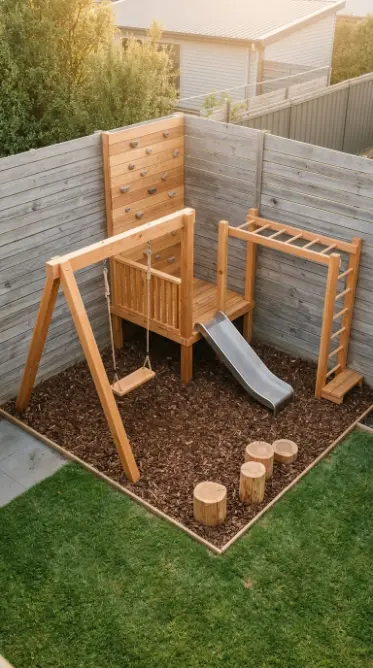
Design the complete small backyard jungle gym as a fully integrated compact play system — every element designed for minimal footprint, maximum play value. The system: a corner-mounted cedar tower using two fence lines, a compact cedar A-frame swing on one side of the tower sharing one post, a vertical cedar climbing wall on the fence behind the tower, wall-mounted monkey bars along one fence line, and a compact stump stepping trail along the other fence line — all unified by a bark chip mulch ground surface within a clearly defined zone, with the remaining backyard floor completely clear.
20. Seasonal Compact Cedar Jungle Gym — Grow-With-Child System
Design the compact cedar jungle gym as a modular grow-with-child system — starting with the simplest single post swing and a small stump stepping trail for toddler years, with planned fixing points already built into the structure for adding a climbing wall, monkey bars, and tower platform as the child grows. Every post is drilled and reinforced for future attachments. The system never has a larger footprint than the current phase requires, and it never needs to be rebuilt — only expanded. This is the most honest small-backyard jungle gym philosophy: build for the child you have today, with the fittings for the child they will be in three years.