18 Chic Pool Float Storage Ideas for a Tidy Pool
Every pool owner knows the scene. A perfect morning by the water, and then you look up and the entire deck is covered — a flamingo here, a giant donut there, pool noodles in every direction, and somewhere beneath all of it, the lounge chairs nobody can reach because a deflated unicorn is blocking the way. Pool floats are one of summer’s greatest joys and one of its greatest organizational challenges simultaneously, and the gap between a pool area that looks like a resort and one that looks like a toy store exploded is almost entirely a storage problem.
The good news is that pool float storage has evolved well beyond the plastic bin shoved in a corner. In 2026, the pool area is being treated with the same design attention as any other outdoor living space — and the storage solutions it receives are no exception. Wall-mounted racks in wicker finishes, custom-built timber float stations, rolling carts that double as serving trolleys, bungee cord grids that turn inflatables into poolside art — the options are genuinely beautiful, genuinely functional, and genuinely capable of transforming a cluttered deck into something that looks like it was styled for a magazine.
The right pool float storage does more than keep things organized. It makes cleanup effortless, extends the life of your floats by allowing them to dry properly between uses, keeps the pool deck safe by eliminating trip hazards, and creates the visual calm that turns a backyard into the outdoor sanctuary you actually wanted when you installed the pool. These 18 ideas cover every storage approach — from the simplest hook installation to the most designed built-in float station — for every pool area size, style, and budget.
1. Install Wall-Mounted Hooks on the Pool Fence
The simplest, most affordable, and most immediately effective pool float storage solution available to any pool owner is a row of large galvanized or powder-coated outdoor hooks mounted directly on the pool fence or exterior wall at the pool perimeter. Large J-hooks or deep-curve hooks — rated for outdoor use and installed at a height that allows full-size inflated floats to hang without dragging on the ground — give every float a designated spot that requires zero effort to use. You pull the float off the hook before you swim, you hang it back when you are done. No bins to open, no baskets to rummage through, no organizational system to maintain. For the hooks to look chic rather than purely utilitarian, space them evenly at regular intervals, choose a single finish — all matte black, all brushed nickel, or all aged brass — and keep the fence surface itself clean and painted so the hook row reads as an intentional installation rather than a hasty addition.

2. Use a Large Wicker or Rattan Storage Rack
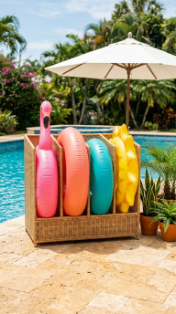
A purpose-built wicker or rattan pool float storage rack — a freestanding vertical rack with individual slots or open compartments sized for inflated floats — is the pool storage solution that looks like it was chosen by someone who cares as much about how the pool area looks as how it functions. A wicker pool float storage rack stores floaties upright to prevent clutter and allows them to air dry naturally — ideal for both function and design. The rattan or wicker finish gives the rack a warm, resort-like quality that the metal or plastic alternatives cannot match, and its freestanding format means no installation is required — it simply stands at the pool deck edge, pool house wall, or patio corner and immediately organizes the space around it. Choose a rack with an open structure that allows air circulation between stored floats so they dry between swims, and position it in a spot that receives some shade so the float material does not degrade in direct sun.
3. Build a Custom Timber Float Storage Station
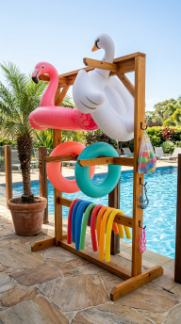
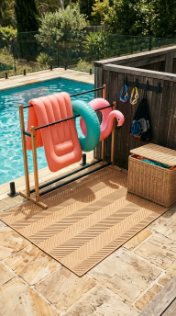
A custom-built timber pool float station — constructed from pressure-treated or naturally rot-resistant timber like cedar or teak — is the pool storage upgrade that turns a functional necessity into a genuine design feature. A simple timber frame with wide horizontal arms extending outward at varying heights creates a float station where each inflated float hangs on its own arm, displayed openly and accessibly. Built beside the pool equipment enclosure, the pool house wall, or as a freestanding structure near the pool gate, a timber float station reads as a purposeful outdoor structure rather than an afterthought. Stain it in a warm honey tone to complement natural stone and timber decking, or paint it in a crisp white or deep charcoal to match the pool coping and surrounding architecture. Adding a lower rail for pool noodles and a hook section for goggles and smaller accessories makes the station the complete pool organization hub for the entire outdoor space.
4. Use a Rolling Outdoor Cart for Mobile Pool Float Storage
A rolling cart with multiple shelves lets you corral floats, towels, sunscreen, and tools in minutes — it can double as a serving cart for snacks and keeps all essentials at hand for a spontaneous pool day. The outdoor rolling cart is the pool float storage solution for the pool area that wants both organization and flexibility simultaneously. A wide, deep rolling cart in a weather-resistant rattan, wicker, or powder-coated steel finish — with large wheels that roll smoothly across pool deck surfaces — can hold deflated or rolled pool floats on the lower shelves, towels and sunscreen on the middle shelf, and drinks and snacks on the top surface, making it the most versatile single poolside storage object available. Between swim sessions it parks beside the pool house or at the deck edge. When guests arrive it rolls to wherever it is needed. At the end of the season it wheels into the garage or storage space without any disassembly or heavy lifting.

5. Install a Pegboard Float Organizer on the Pool House Wall
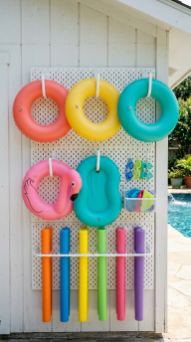
A waterproof outdoor pegboard — sealed against moisture and UV and mounted on the pool house exterior wall, garage wall, or any solid outdoor vertical surface near the pool — creates one of the most customizable and most visually organized pool float storage systems possible. The pegboard’s grid of holes accepts hooks, bins, baskets, and rails in any configuration, which means the storage system can be adapted as the float collection grows and changes season to season. Large deep hooks hold inflated ring floats and donut shapes. Wider arm hooks hold lounger floats. Small bins hold goggles and swim caps. A lower rail holds pool noodles. The entire system keeps every pool object off the deck surface and at eye level where it is immediately visible and easily grabbed. When the pegboard is organized neatly with consistent hook spacing and the floats are arranged by size, the result reads more like a display wall than a storage solution.
6. Use a Large Lidded Deck Box as Hidden Float Storage
The deck box is the pool float storage option for the pool area that prioritizes a clean, minimal visual over everything else. A large weather-resistant deck box — in natural teak, treated timber, rattan-look resin, or clean white or charcoal powder-coated steel — with a wide hinged lid that opens fully and holds the lid in place for easy access, sits on the pool deck as a piece of outdoor furniture that reveals nothing of the pool float chaos inside it when closed. Inflated floats are pressed in, deflated floats are rolled and stacked, and the lid closes to leave the pool deck looking completely clear. The deck box also doubles as poolside seating when the lid is closed, making it one of the most space-efficient pieces of outdoor furniture available. Choose a box large enough to genuinely accommodate the float collection — the most common mistake is choosing a deck box that is too small, which means floats end up outside it anyway.

7. Create a Bungee Cord Grid on the Pool Fence
A bungee cord grid on a fence is stretchy, strong, and turns floats into pool-side art — round ones, oval ones, and unusual animal shapes all slot in like puzzle pieces. A bungee cord grid — made by stretching a series of bungee cords horizontally and vertically across a fence section or a timber frame and securing the ends with hooks, creating a tensioned elastic grid — is one of the most creative, most budget-friendly, and most genuinely effective pool float storage solutions available. The elastic tension of the bungee cords holds inflated floats of any shape firmly in position without any clips or additional fastenings — ring floats, donut shapes, lounger mats, and even irregular animal float shapes all press into the grid and stay in place. The colorful floats held against the fence or timber backing by the grid create a graphic, playful display that is simultaneously functional and unexpectedly decorative. The whole installation costs the price of a bag of bungee cords and takes twenty minutes to set up.

8. Hang Floats From a Pergola or Shade Structure
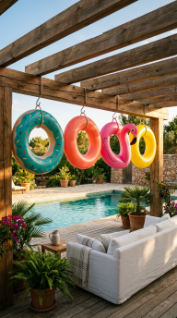
A pergola or shade structure beside the pool is typically used for its shade and its aesthetic contribution to the outdoor space — but its overhead beams and side posts also offer some of the best pool float storage real estate available in any backyard. Large S-hooks or carabiner hooks attached to the pergola’s horizontal beams allow inflated floats to hang from above, keeping them entirely off the deck surface, within easy reach, and displayed at a height that makes the pergola itself look more purposefully dressed. Ring floats and donut shapes hang particularly beautifully from overhead pergola hooks — their circular forms creating a series of colorful circles suspended in the pergola space. Alternatively, side post hooks on the pergola uprights hold flatter lounger floats and keep the overhead beams clear for other uses. The pergola float storage approach is the one that most consistently makes pool guests say they would never have thought of that.
9. Use a Large Outdoor Laundry Basket With Drainage Holes
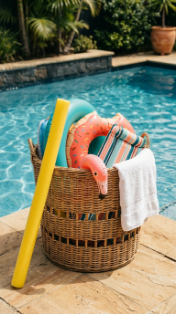
An oversized laundry basket stores more than just small floats — it can also be used as storage for towels, sunscreen, and other accessories, and it looks neat and tidy when kept in the corner of your poolside area. Use a material that can withstand the sun and other elements. A large outdoor-rated laundry basket — in natural wicker, weather-resistant rattan-look resin, or heavy-duty woven polypropylene — with drainage holes that allow water to drip out after floats are retrieved from the pool is one of the most practical and most underestimated pool float storage options available. The basket’s generous opening accepts floats quickly — no careful placement, no threading through hooks, no complicated folding — making post-swim cleanup genuinely fast. The drainage holes mean wet floats can go directly from the pool into the basket without creating a standing water problem. And in a natural wicker or woven finish, a large laundry basket beside the pool reads as a considered design object rather than a utility item.
10. Mount a Cargo Net on the Fence for Lightweight Float Storage
A cargo net — the kind of heavy-duty woven mesh used on boats, trucks, and trailers to secure loads — stretched across a fence section and secured at its corners with large hooks creates a net pocket storage system that holds multiple inflated pool floats simultaneously in a single wall-mounted installation. The net presses floats against the fence surface by its own tension, holding ring shapes, round floats, and larger inflated forms securely without any individual hooks or clips. The transparent nature of the net means all floats are visible and accessible — there is no hunting through a bin or removing other items to reach the one you want. In a dark green or black mesh, the cargo net recedes against a fence background and lets the pool float colors be the visual element. Stretched across a white or natural timber fence, the cargo net creates a bold graphic texture that makes the storage installation look deliberately designed.

11. Deflate and Store Floats in Compression Bags for Off-Season
For seasonal pool owners, the off-season float storage problem is as significant as the in-season one — and the solution that takes up the least space and causes the least float damage is compression storage bags. Large clear or mesh compression bags — the kind that zip closed and have a valve for air removal — allow even the largest inflated pool floats to be compressed into a fraction of their inflated volume, stacked neatly on a garage shelf, stored in a seasonal storage bin, or tucked into a cabinet. The transparent or mesh construction means each bag’s contents are immediately visible — no opening multiple bags to find the specific float you want. Label each bag with the float name using a waterproof marker or a small tag, stack them on a dedicated shelf in the garage or pool house, and the entire float collection occupies what was previously one shelf rather than an entire storage room.

12. Use a Repurposed Wooden Pallet as a Leaning Float Rack
Wooden pallet boxes look absolutely chic and stylish — paint or stain them to make them look more beautiful, and they make a great way to store large pool floats in an organized and stylish way. A single wooden pallet — stood upright and leaned against the pool fence or exterior wall — creates an instant free-standing float rack with almost zero cost or effort. The pallet’s horizontal slats act as natural shelves and dividers, and inflated ring floats, donut shapes, and lounger mats can lean against and between the slats, held in place by the slatted structure. Paint the pallet in a crisp white, a charcoal grey, or a weather-worn natural tone depending on the overall pool area aesthetic, add a simple coat of exterior weather sealant, and secure it to the fence with two cable ties at the top edge to prevent it from falling. The result is a rustic, characterful float display that costs nothing and looks considered — particularly beside a pool with a more relaxed, natural, or boho-inspired outdoor aesthetic.

13. Build a Poolside Float Caddy From PVC Pipe
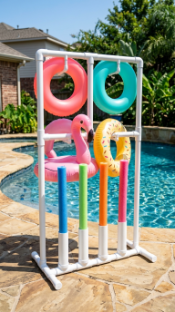
PVC pipes can be configured in so many ways to create terrific outdoor storage — they won’t rust, take the heat, and are inexpensive, making them a great source for DIY pool storage. A DIY pool float caddy built from standard PVC pipe and fittings is one of the most practical and most customizable pool storage projects available to any handy pool owner, and when given a fresh coat of exterior spray paint in a clean white, charcoal, or warm terracotta, the resulting structure reads as a purpose-built design piece rather than a DIY compromise. A basic configuration consists of a rectangular PVC frame with horizontal arms extending outward at multiple levels — each arm wide enough to hold an inflated ring float — plus vertical pipe sections at the base that anchor pool noodles in an upright position. The entire structure assembles without glue for seasonal disassembly, costs a fraction of a retail equivalent, and can be sized to exactly the float collection it needs to hold.
14. Dedicate a Small Garden Shed as a Pool Float House
A small dedicated garden shed — positioned at the pool perimeter or just beyond the pool fence — turned entirely over to pool float and pool equipment storage is the most comprehensive and most weatherproof pool storage solution available to any pool owner with the outdoor space for it. A compact lean-to or freestanding shed in a natural timber or painted cedar finish, approximately 120cm wide by 60cm deep by 210cm tall, fitted internally with custom float hangers on the back wall, noodle rail along one side wall, a shelf for chemicals and accessories, and hooks for net poles and cleaning tools, provides the organized float storage of a purpose-built pool house at a fraction of the cost. The exterior of the shed, when painted in a color that complements the pool area — a crisp white, a deep charcoal, or a warm sage green — becomes a design element in the outdoor space rather than an intrusion on it.

15. Use a Wall-Mounted Wine Rack as a Towel and Float Ring Holder
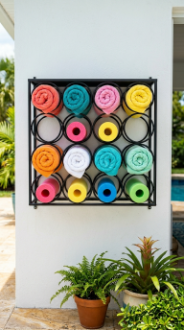
A wall-mounted wine rack transformed into a stylish holder for rolled towels is a colorful addition to your backyard decor and a fun pool organization idea — each slot gets its own item, making it easy for everyone to grab what they need. A large wall-mounted wine rack — the open-slot tubular kind with multiple individual round compartments in a grid pattern — mounted on an exterior pool house wall or pool fence serves double and triple duty in the pool area. The round openings that are sized for wine bottles are also perfectly sized for tightly rolled pool towels standing upright in each slot. They are also sized for deflated and rolled ring floats and donut shapes, and for pool noodles cut to shorter lengths and stored vertically. A wine rack repurposed this way on a pool house or fence wall creates one of the most graphic and most visually interesting pool storage displays available — the grid of colorful rolled towels or floats reading like a cheerful mosaic against the wall surface behind it.
16. Create a Designated Pool Float Drying and Storage Zone
One of the most underconsidered aspects of pool float storage is the transition between wet float and stored float — the time between getting out of the pool and putting the float away is when most pool decks become temporarily chaotic, and designing a specific poolside zone for this transition makes the entire storage system function more smoothly. A designated drying and storage zone — a defined area of the pool deck with a roll-out drying mat, a simple horizontal drying rail for floats and towels, a hook row for goggles and small accessories, and a nearby storage bin for fully dry floats — creates a self-contained pool organization station that manages the wet-to-dry-to-stored float journey without any of it spreading across the rest of the deck. The zone can be as simple as a rubber mat and a towel rail, or as considered as a full built-in poolside station with timber cladding and integrated storage.
17. Use a Decorative Outdoor Lantern Stand as a Float Display Holder
A tall decorative outdoor lantern stand — the kind with an open framework of wrought iron or powder-coated steel that holds a large lantern at the top — repurposed as a pool float holder by removing the lantern and using the vertical framework as hanging points for ring floats and donut shapes, is one of the most unexpectedly chic pool float storage solutions possible. Two or three ring floats in coordinating colors hung on the various arms of the lantern stand at staggered heights create a sculptural poolside display that reads as intentional decorative styling rather than practical storage. Beside a poolside bistro table, at the corner of the pool deck, or flanking a pool gate, the repurposed lantern stand float holder is the pool storage idea that makes guests ask where you found such a beautiful pool float display rather than noticing the float storage problem it is solving.

18. Build a Built-In Under-Deck Float Storage Compartment
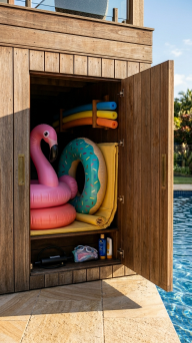
For pool areas with an elevated deck — where the space beneath the deck boards is currently wasted or enclosed behind plain boards — a built-in under-deck float storage compartment with an access door on the pool deck side is the most integrated, most architecturally considered, and most permanently satisfying pool float storage solution possible. The under-deck space, enclosed on three sides by the deck structure and fitted with a door in the front face, provides a weatherproof, shaded, out-of-sight storage zone for inflated floats, pool noodles, and pool accessories that is entirely invisible when the access door is closed. The door can be a simple flush panel in timber matching the deck boards, a louvered panel for air circulation, or a more designed door with hardware that complements the overall pool area aesthetic. When opened, the under-deck compartment reveals a deep, organized storage space that holds an entire pool float collection without occupying any deck surface area whatsoever.