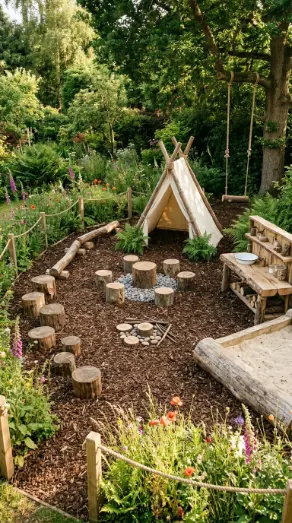
22 DIY Outside Play Area for Kids Natural Log and Stump
There is a particular quality of play that only happens in natural spaces — slower, more inventive, more genuinely absorbed. A child on a plastic slide knows exactly what it does and does exactly that. A child with a collection of stumps and logs and a pile of bark chips invents something new every single afternoon. The natural outdoor play area built from logs and stumps is not a lesser version of a commercial playground. It is a better one — more beautiful in the garden, more interesting to the child, and more honest about what outdoor play has always been.
Natural log and stump play areas work because the materials are genuinely varied — no two stumps are the same height, no two logs are the same weight, no two pieces of bark chip land the same way. That variation is the play. Children balance, jump, climb, arrange, build, and imagine with materials that have texture and weight and smell and grain, and the play they create with those materials is richer for every one of those qualities.
These twenty-two ideas use natural logs, stumps, timber poles, and bark chip as their primary materials — every idea a different expression of the same principle: that the best children’s outdoor play area looks like it belongs to the garden.
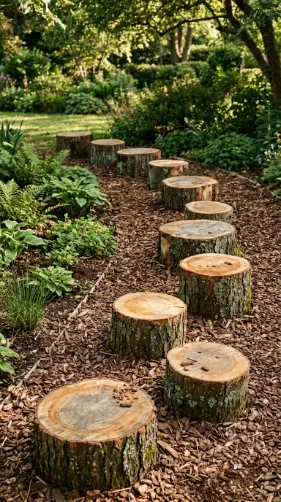
1. Natural Stump Stepping Trail
Set a collection of natural tree stumps of varied heights — ranging from 15cm to 50cm tall — in a curving trail across the play area, spacing them at a child’s jumping stride apart so that children can hop from stump to stump along the trail. The stump stepping trail is the simplest and most enduringly popular natural play installation possible — it requires only stumps, a good arrangement, and a soft landing surface of bark chip beneath. Choose stumps in varied diameters as well as varied heights so that some require careful balancing and others offer a wide flat platform to rest on. A gently curving trail is more interesting than a straight line and encourages repeated use.
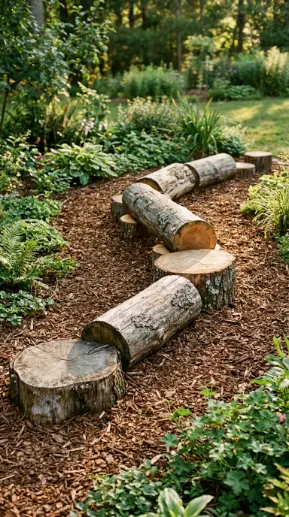
2. Log Balance Beam Trail
Lay a series of thick log sections — whole logs approximately 20-25cm diameter — end to end in a gentle curving trail, secured at ground level with simple timber pegs or partial burial so they do not roll, creating a natural log balance beam that children walk, run, and balance along. Vary the arrangement by raising some sections slightly on small log supports, angling some sections gently up and down, and including a wider flat log section as a resting platform midway. A log balance beam trail is one of the most used natural play installations in any garden — children return to it repeatedly, using it differently as they grow, and it requires no maintenance beyond an annual check that the logs are stable.
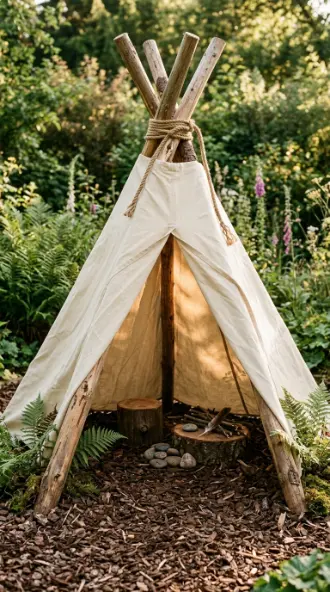
3. Natural Log Frame Den With Canvas Cover
Construct a simple den structure from four to six thick natural timber poles — larch, pine, or hazel — lashed together at the apex with natural jute rope to form an A-frame or tipi structure, then drape a simple cream or natural canvas over the frame to create a covered play den. A natural pole and canvas den in a garden play area gives children a defined indoor-outdoor space of their own — a place that is neither fully inside nor fully outside, where imaginative play concentrates itself, and where the materials are natural and beautiful enough that the den becomes a feature of the garden as well as a play structure.
4. Stump Circle Gathering Space
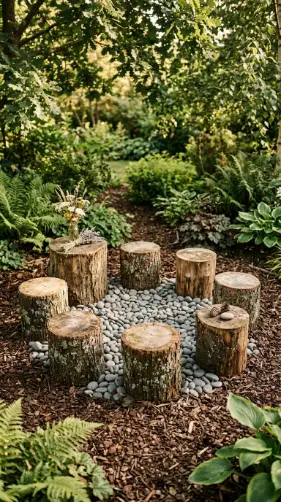
Arrange a circle of large flat-top tree stumps — six to eight stumps of similar height, approximately 35-40cm tall — in a neat circle formation around a central point, creating a natural gathering and story circle for children. Place a single wider and taller stump at one point in the circle as the “storyteller’s stump.” Fill the center of the circle with a layer of smooth river pebbles or bark chip. A stump circle is one of the most socially rich natural play installations — it creates a defined gathering place, it encourages children to sit, talk, and listen together, and it can serve as a space for imaginative play, outdoor story time, or simply a meeting point in the play area.
5. Log Mud Kitchen and Nature Kitchen
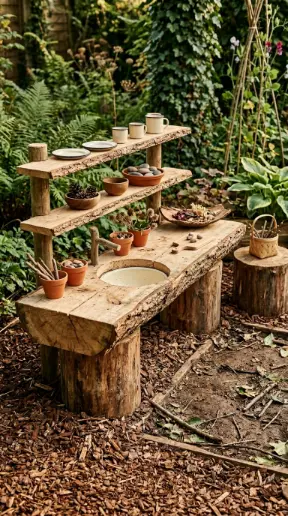
Build a simple outdoor mud kitchen from natural log and timber materials — a wide log round or split log as the counter surface, supported on two thick upright log sections as legs, with a simple round metal or enamel bowl set into the counter as the sink, and a collection of stumps and log rounds of different heights beside it as prep surfaces and shelving. Surround it with small natural material collections in simple containers — smooth pebbles, pine cones, dried seed heads, bark pieces — that serve as the kitchen’s ingredients. A natural mud kitchen is the most enduringly popular outdoor play installation for young children — the combination of cooking play, sensory exploration, and natural materials produces some of the most sustained and absorbed outdoor play that any garden installation can generate.
6. Natural Log Xylophone and Music Wall
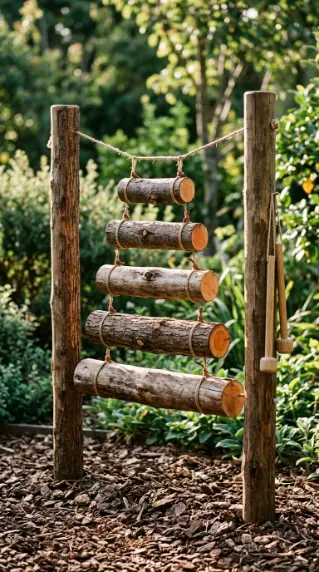
Install a natural log xylophone as a play installation — a series of thick log sections of different lengths and diameters, each suspended horizontally between two upright timber posts on natural rope or leather cord so that when struck with a simple wooden mallet, each log produces a different resonant tone. Arrange the log sections from longest at the bottom to shortest at the top, like a traditional xylophone, and hang two or three wooden mallets from the post frame on short cords. The natural log xylophone is one of the most genuinely surprising natural play installations — it introduces music-making to the outdoor play area using the most natural possible instrument, and children who discover it return to it with sustained and serious musical interest.
7. Stump and Log Obstacle Course
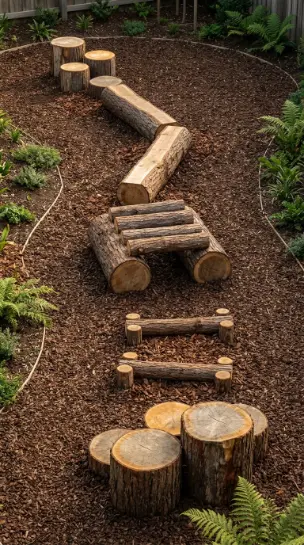
Create a natural obstacle course using logs and stumps as the primary elements — a stump stepping trail that transitions into a log balance beam, then a section where children crawl through a low natural tunnel made from two parallel log sections supporting a series of smaller logs overhead, then a series of short log hurdles to step over, finishing at a wide climbing stump cluster. Design the course so it can be completed in a continuous circuit, encouraging repeated use. A natural obstacle course gives children a structured physical challenge within the natural play area and scales naturally as children grow — the same course that is challenging for a four-year-old becomes a speed course for an eight-year-old.
8. Natural Log Sandpit Frame
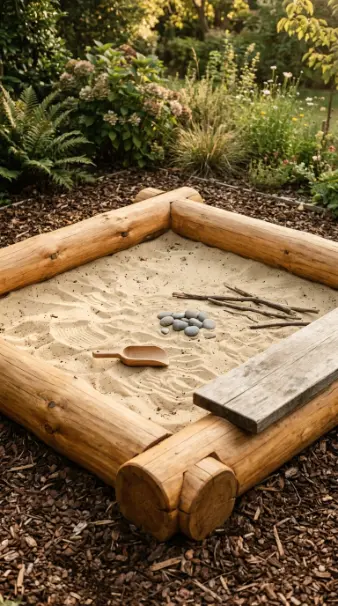
Build a sandpit with a frame constructed entirely from thick natural log sections — four large whole log sections approximately 25-30cm diameter, debarked or with bark remaining, arranged as a square log frame surrounding the sand play area. Use long log sections so each side of the sandpit is a single continuous piece of natural timber — the log frame gives the sandpit a robust, generous quality and the natural material is far more beautiful in the garden than a plastic or treated timber frame. Fill with clean play sand and add a simple log round or plank timber seat on one side.
9. Hazel and Willow Natural Play Tunnel
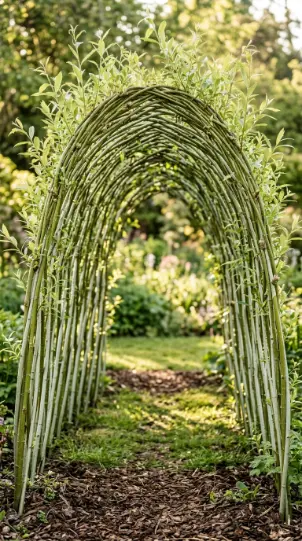
Weave a living tunnel from planted willow or hazel whips — plant two rows of young willow or hazel rods approximately 30-40cm apart in a parallel line, bend the growing tops of opposite rods toward each other and weave them together overhead to create a living arch structure, and allow the planted rods to take root and leaf out to create a green-leafed natural tunnel. Over one to two growing seasons, the living willow or hazel tunnel becomes a dense, leafy passage that children run through, pause inside, and experience as a living green room. Even before the tunnel fully leafs out, the bare woven rod structure has a beautiful architectural quality in the garden.
10. Log Section Stepping Rounds Through Garden Beds
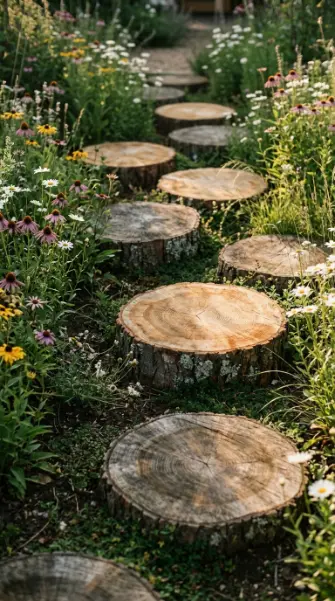
Set individual thick log cross-section rounds — slices approximately 5-8cm thick cut from a large tree trunk, approximately 30-40cm diameter — flat into the garden soil as stepping stones through a planted garden bed or meadow, spaced at a child’s walking stride. The log cross-section rounds are one of the simplest and most beautiful natural play elements — they serve simultaneously as stepping stones, as a navigation invitation through the garden, and as natural wildlife habitat for insects and ground beetles beneath. Over time, the rounds develop a beautiful surface character as lichen grows across the cut face.
11. Natural Log Swing Suspended From Tree Branch
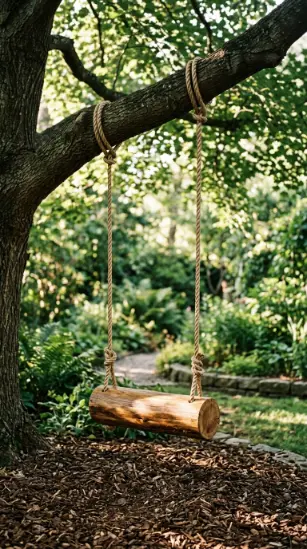
Hang a simple natural log swing from a strong established tree — a single thick natural log section approximately 50cm long and 20-25cm diameter, suspended horizontally on two lengths of thick natural rope tied through drilled holes at each end of the log, the ropes tied to a strong overhead branch. The natural log swing is one of the oldest and most beautiful children’s play objects possible — the thick natural log seat has a weight and solidity that a plank or plastic swing cannot match, it swings with a satisfying gravity, and it becomes more beautiful as it weathers and develops a smooth patina from use.
12. Natural Log Climbing Structure With Rope Net
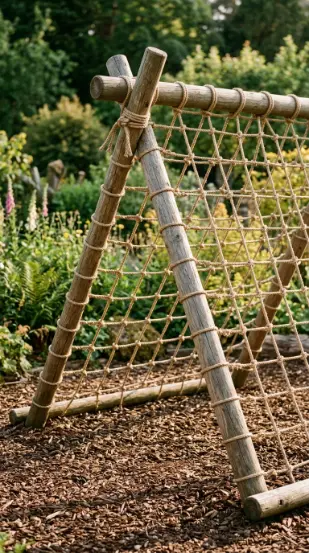
Build a simple log climbing structure — a sturdy A-frame or box frame from thick natural timber poles, approximately 1.5-2 metres tall — and stretch a natural rope cargo net across the frame so that children can climb up one side of the net and over the top of the frame. Lash the rope net to the frame with natural jute rope and use thick natural poles for the frame uprights and top bar. A natural pole and rope net climbing structure scales beautifully in a garden — the natural materials sit comfortably in a planting setting, the rope net develops an appealing patina of use, and the climbing challenge the net provides is physically demanding enough to engage older children while accessible to younger ones with supervision.
13. Fairy Tale Stump Village With Miniature Doors and Windows
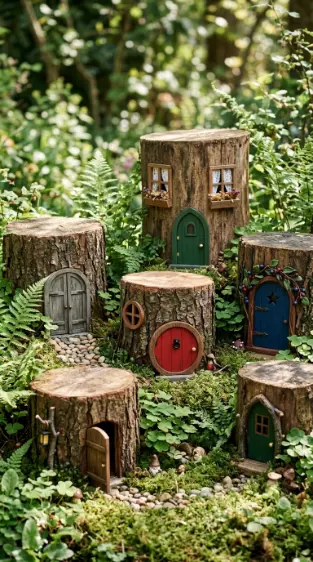
Transform a collection of large tree stumps into a miniature village by adding small hand-carved or hand-crafted wooden doors, tiny windows, and miniature window boxes to the stump faces — creating a fairy tale stump village that children can populate with small world figures and imaginative play. Fit small wooden door frames with tiny hinged doors into routed slots in the stump faces, add tiny window frames with small fabric curtains, and paint or decorate with natural materials. The fairy tale stump village is the most imaginative natural play installation possible — it transforms the natural materials into a world that children can enter through their imagination and inhabit for hours.
14. Natural Log Teeter-Totter Seesaw
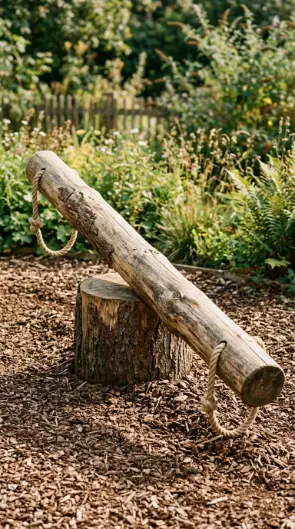
Build a simple log seesaw from a single thick natural log section as the balance beam — a long whole log approximately 2 metres long and 20cm diameter — balanced on a central fulcrum made from a short wide stump or a thick log round, with simple natural rope handles tied through drilled holes at each end. A natural log seesaw made from a single whole log has a beautiful simplicity — it is heavier and more satisfying to operate than a commercial seesaw, the natural material is beautiful in the garden, and the principle of balance it demonstrates is the same principle that the stump stepping trail, the balance beam, and every other natural play element in the area explores.
15. Natural Outdoor Art Station With Log Easel
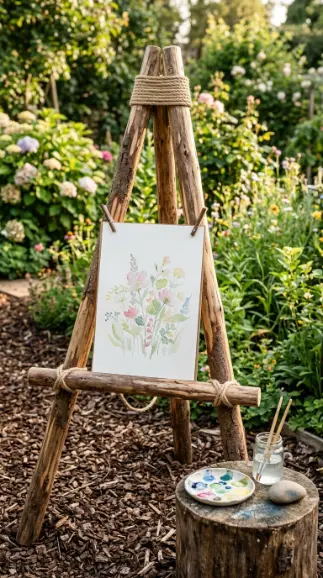
Build a simple outdoor art easel from natural timber — two thick natural timber poles leaning together and lashed at the top to form an A-frame, with a horizontal timber bar lashed between the legs as a ledge to hold a canvas or paper — and position it in the garden as a dedicated outdoor art-making station. Beside the easel: a short stump as a paint palette table, a collection of natural paint brushes in a small jar. A natural log easel outdoor art station invites children to draw and paint the garden they are playing in — the act of looking at the garden in order to represent it changes how children see it, and an outdoor art station that uses the same natural materials as the play area itself says that making and playing belong in the same space.
16. Stump and Log Loose Parts Play Area
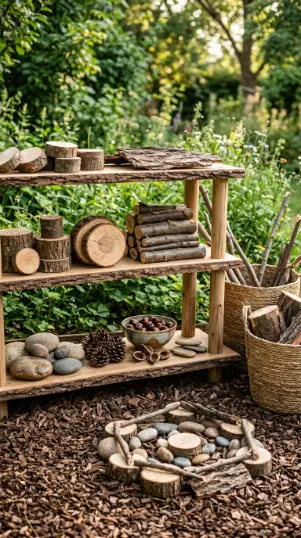
Designate a section of the outdoor play area as a loose parts zone — a generous collection of natural loose parts: log sections in varied sizes, tree stump rounds of varied heights, long straight branch sections, large flat bark pieces, smooth river pebbles of varied sizes, pine cones, conker shells, seed pods — all stored on a simple open natural shelf or in a large woven basket and available for children to move, arrange, build with, and rearrange freely. A loose parts play area with natural materials is the highest expression of natural play philosophy — it gives children open-ended building and arranging materials that have no prescribed use, and in doing so produces more varied, more creative, and more sustained play than any fixed structure can.
17. Log Water Play Channel
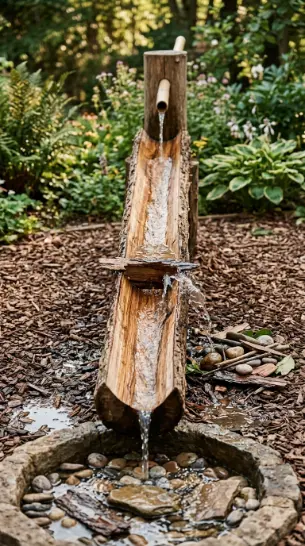
Build a simple log water play channel — a long split log with the center hollowed or a natural half-log trough section, mounted at a slight angle on two upright log supports, with a small hand pump or simple hose connection at the upper end so that water flows down the log channel and children can dam, divert, and play with the water flow. Natural log water play is among the most absorbing outdoor play possible for children — the combination of water, natural materials, and the engineering challenge of dams and diversions produces sustained, serious, collaborative play. Position the log channel to drain into a small gravel drainage area or a small shallow stone-edged pool at the base.
18. Natural Stump and Log Seating Circle for Outdoor Reading
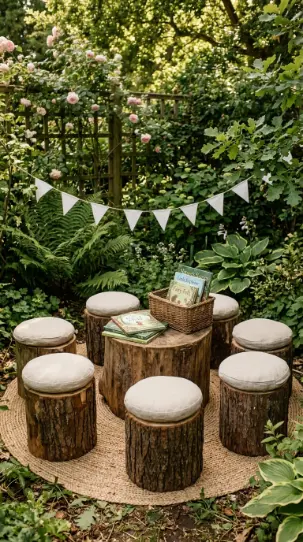
Create a quiet outdoor reading and story corner by arranging a small circle of stump seats around a central wider reading stump — the wider central stump serving as a natural bookshelf or book display surface, with a small collection of outdoor-appropriate picture books in a simple woven basket beside it. Add a simple waterproof canvas or linen cushion on each stump seat and string a few paper bunting flags between the surrounding garden plants. A natural stump reading circle gives children an outdoor destination that is specifically for quiet and imaginative activity — it balances the physical play of the obstacle course and climbing frame with a gentle, seated, story-focused space.
19. Natural Log Post and Rope Boundary With Wildflower Planting
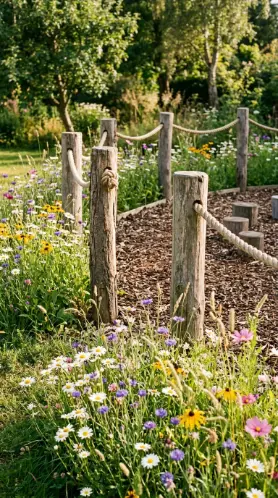
Define the border of the outdoor play area using natural log posts and rope — short natural timber posts approximately 60-70cm tall set at 1-1.5 metre intervals along the play area boundary, connected by a single or double run of thick natural rope tied through drilled holes in each post. Directly outside the rope boundary: a wildflower planting strip — a dense band of native wildflowers and grasses that forms a beautiful natural edge to the play area. The natural post and rope boundary defines the play space without enclosing it, guides children in and out through the natural rope gaps, and frames the play area with a material and planting composition that makes the play area a designed and beautiful feature of the garden rather than an afterthought.
20. Natural Tree Stump Chalkboard Activity Station
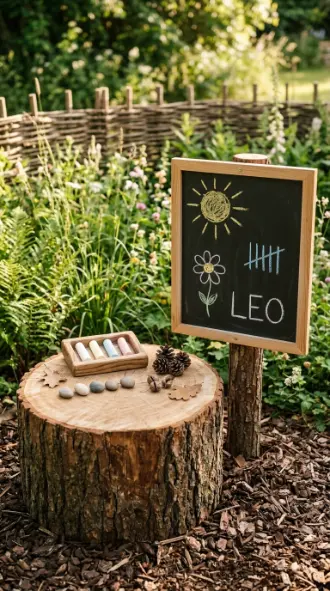
Set a large wide flat-top tree stump as the base for a simple chalkboard activity station — mount a small rectangular chalkboard panel on a short natural timber post or bark-edged timber frame beside the stump, with a small wooden tray of chalk pieces on the stump surface and a small collection of natural objects for counting, sorting, and nature study beside the chalk. A natural stump chalkboard station combines outdoor imaginative play with a simple invitation to writing, drawing, counting, and nature observation — it gives children a surface for recording their natural findings and for creating in a space that is entirely outdoors and connected to the natural play materials around them.
21. Night-Time Natural Play Area With String Lights and Lanterns
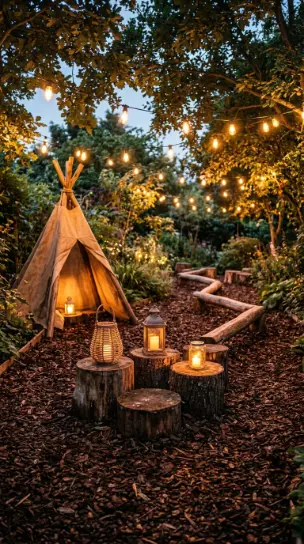
Transform the natural log and stump play area into a magical evening destination by adding warm lighting — solar-powered amber string lights woven through the surrounding garden planting and den structure, small battery-powered lanterns placed on stump tops, and a simple fire pit or outdoor candle arrangement for adult supervision. The night-time natural play area gives the garden a completely different character after dark — the stumps and logs catch the warm amber light differently, the string lights turn the garden canopy into a lit ceiling, and the den becomes a warm glowing shelter that is genuinely magical in evening light.
22. Complete Natural Log and Stump Play Area — All Elements Together
Design the complete natural log and stump play area as a fully integrated outdoor play landscape — all elements present in a single generous garden space: stump stepping trail, log balance beam, natural den, log sandpit, mud kitchen, stump gathering circle, loose parts collection, log swing from tree, and natural post and rope boundary with wildflower planting — unified by a deep bark chip mulch ground surface throughout and framed by lush natural garden planting on all sides. The complete natural play area is a self-contained outdoor world for children that uses only natural materials and looks as though it grew from the garden it inhabits.