24 Rustic Bathtub Tray Ideas with Reclaimed Farmhouse Wood
There is a particular kind of honesty contained in a bathtub tray built from reclaimed farmhouse wood — an honesty that comes from the material’s complete refusal to pretend it is anything other than what it is: salvaged timber that once held a different structural purpose, now given a second life spanning a bath. The nail holes scattered across its surface were not added for decorative effect; they are the literal physical record of the barn beam or fence rail this wood once was. The saw marks running across the grain, the silvery-grey weathering on one face and the warmer amber tone on the other, the occasional split or knot that a furniture maker working with new timber would reject outright — all of this is precisely what makes reclaimed wood the single most honest and most genuinely characterful material available for the farmhouse bathtub tray.
The farmhouse aesthetic, unlike many decorating traditions that aim for an idealized or polished version of rural life, draws its entire visual and emotional power from genuine imperfection. A reclaimed wood bathtub tray succeeds precisely because it does not try to disguise its material history — the wood is sanded only enough to be splinter-free and water-resistant, never refinished to the smooth uniform surface of new lumber. This is the central paradox of the farmhouse aesthetic: the more visibly aged, weathered, and structurally honest the wood, the more successful the design. A tray that looks brand new fails the farmhouse test regardless of how rustic its form; a tray that genuinely shows its salvaged history succeeds even with the simplest construction.
The styling that accompanies a reclaimed wood bathtub tray follows the same material honesty as the wood itself: black iron hardware rather than polished chrome, mason jars rather than crystal vessels, dried botanicals rather than hothouse florals, candles in simple holders rather than ornate candelabra. Every object placed on the reclaimed wood tray should share its essential quality of honest, unpretentious, working-material beauty — a farmhouse bathroom is, after all, an extension of the same domestic philosophy that governs the farmhouse kitchen and the farmhouse porch, where genuine materials and genuine function always take precedence over decorative artifice.
These 24 ideas show every dimension of the rustic bathtub tray with reclaimed farmhouse wood — from the foundational salvaged barn plank tray to the complete farmhouse bathroom where every element from the tray to the clawfoot tub to the smallest mason jar creates one unified vision of genuine, weathered, and deeply beautiful rustic farmhouse character.
1. The Single Wide Barn Plank — Foundational Reclaimed Material
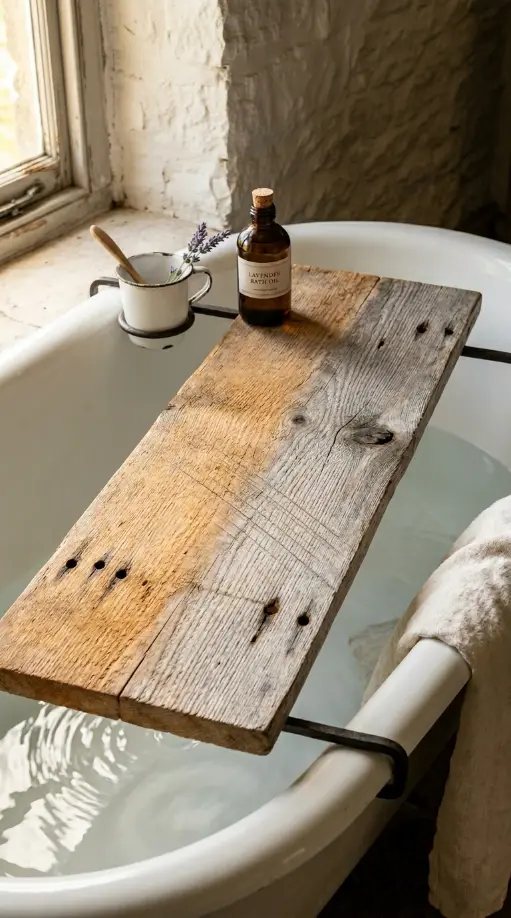
The most foundational and most materially honest reclaimed wood bathtub tray uses a single wide salvaged barn plank — rather than several narrower boards joined together — as its entire surface, the plank’s full natural width (typically twenty-five to thirty centimetres) providing a continuous, unbroken expanse of weathered timber character. A single-plank tray showcases the wood’s complete material story without any joinery interrupting the visual reading of its grain, nail holes, and weathering pattern. The single plank: one salvaged barn board approximately seventy centimetres long, its full natural width retained rather than ripped down to a standard size, simple iron or wood end supports keeping the plank elevated above the tub’s water line, the wood’s surface sanded only enough to remove splinter risk while every nail hole, saw mark, and color variation remains completely visible.
2. The Black Iron Pipe Leg Tray — Industrial Farmhouse Hybrid
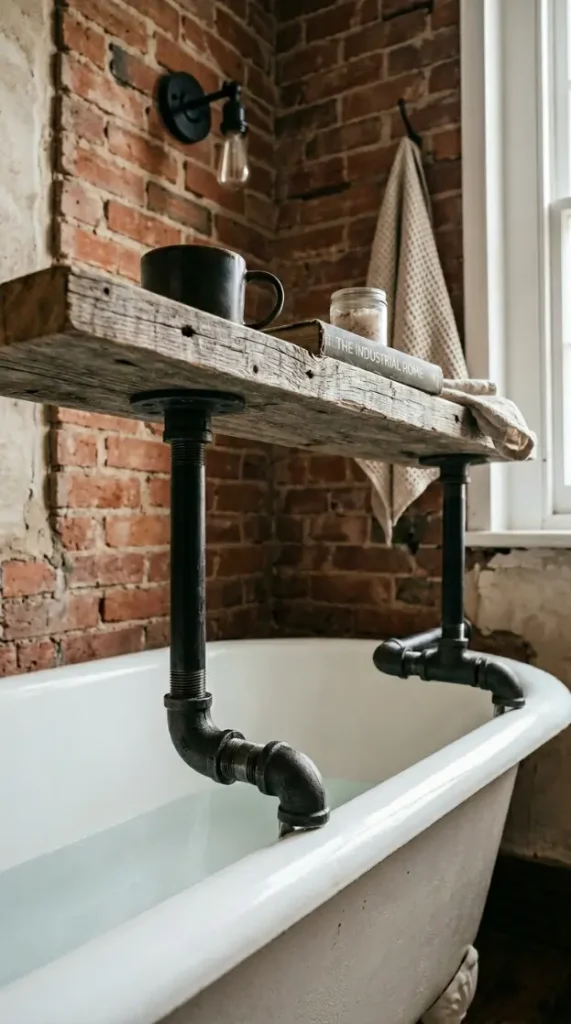
A bathtub tray combining a reclaimed wood plank top with exposed black iron pipe legs and fittings — rather than simple wood or bracket supports — creates the specifically industrial-farmhouse hybrid aesthetic that pairs salvaged timber with raw structural metalwork. The pipe leg tray: the reclaimed plank resting on a frame of black iron pipe with visible threaded fittings, flanges, and elbow joints at the connection points, the industrial hardware’s raw functional honesty matching the wood’s own unpretentious material character, the combination communicating both rural barn salvage and working industrial fabrication within the same object.
3. The Galvanized Tub Pairing — Authentic Farm Bathing Vessel
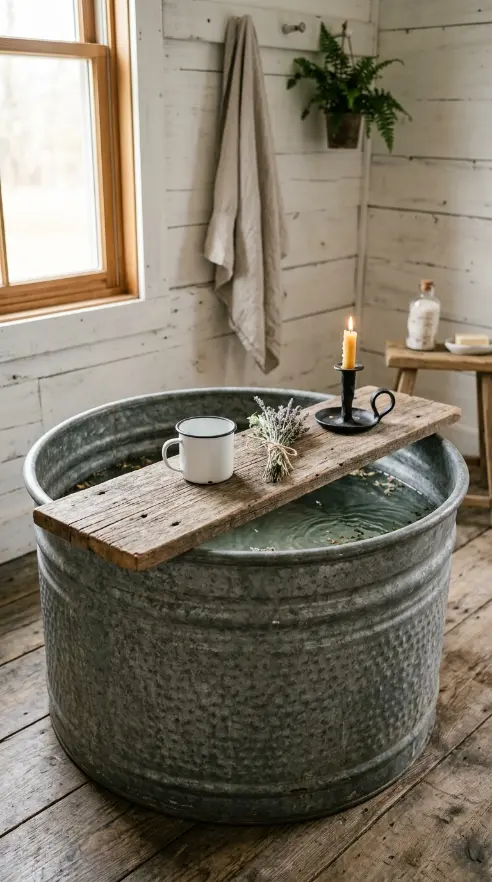
A reclaimed wood tray paired specifically with a galvanized metal stock tank or tub — the genuine farm vessel originally used for livestock watering, now repurposed as an actual bathing tub — creates the most authentically agricultural version of the rustic farmhouse bathtub scene. The galvanized tub pairing: a round or oval galvanized steel tank approximately 75cm to 90cm diameter, its surface showing the characteristic dimpled and slightly mottled metal texture of genuine galvanized steel, fitted with a reclaimed wood tray resting across its rim, the wood and the metal both sharing an honest working-material history that distinguishes this pairing from a conventional porcelain tub.
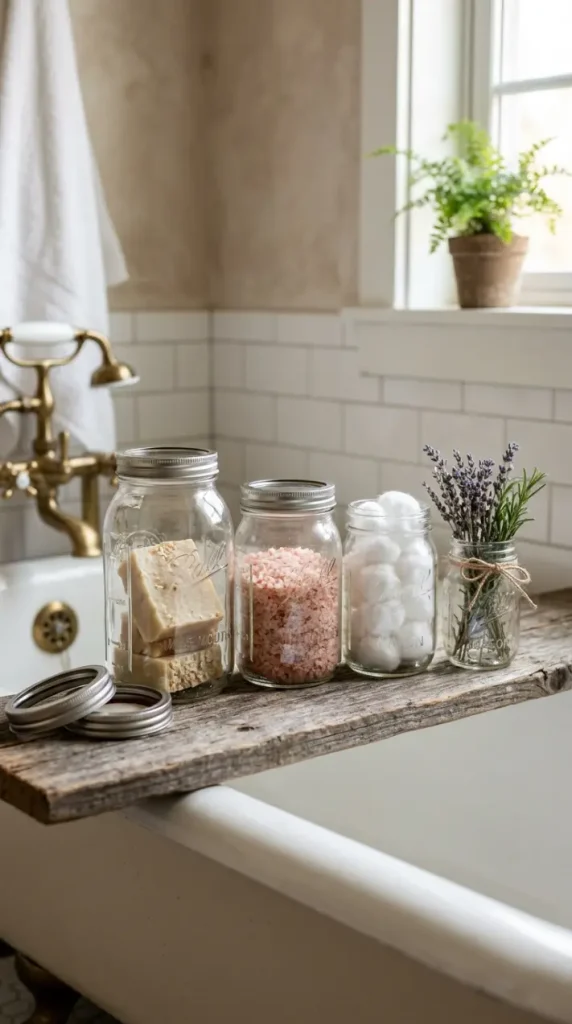
4. The Mason Jar Soap and Bath Salt Display — Functional Farmhouse Glass
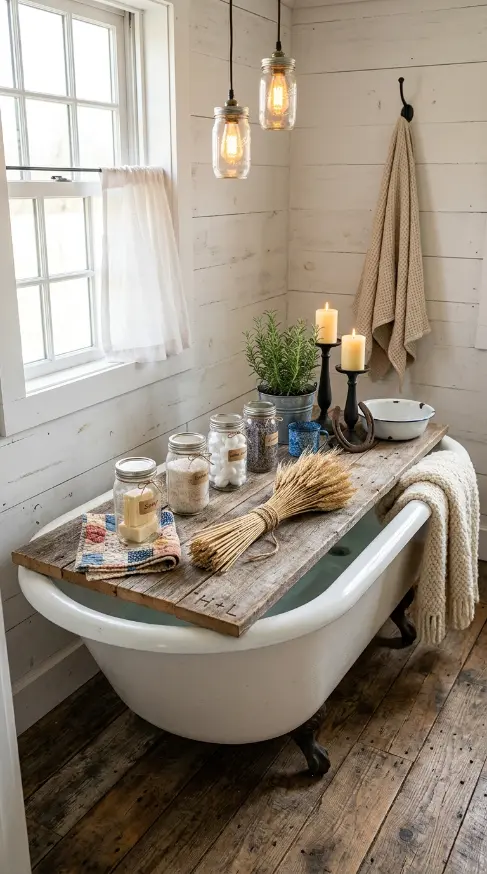
A row of three or four mason jars in graduated sizes, each holding a different bathing supply — bar soap, bath salts, cotton balls, dried herb bundles — lined up along the reclaimed wood tray creates the most recognizably farmhouse functional storage solution, the mason jar’s specific historical association with home canning and food preservation lending genuine rural authenticity to its repurposed bathroom function. The mason jar row: classic wide-mouth glass jars with their characteristic ribbed glass texture and metal screw-band lids (lids removed or set aside for active use), each jar holding a different bath supply, arranged in a simple row along the tray’s length, the glass jars’ transparency allowing every stored item to remain visible.
5. The Black Iron Hook and Hanging Towel Detail — Vertical Farmhouse Storage
A reclaimed wood tray fitted with simple black iron hooks at one end — from which a folded waffle-weave or linen towel hangs vertically rather than lying flat on the tray surface — adds a vertical storage dimension that echoes the iron hooks commonly found on farmhouse mudroom walls and tack room equipment racks. The hook and hanging towel detail: two small black iron hooks (the same simple curved form used for coats or tools) mounted into the underside or end edge of the tray, a single waffle-weave towel in natural undyed cotton draped and hanging from the hooks, the vertical drape adding visual height and textural softness against the tray’s flat horizontal wood surface.

6. The Dried Wildflower and Wheat Sheaf Bundle — Harvest Botanical Styling
A generous bundle of dried wheat stalks, dried wildflowers, and dried grasses, tied together with natural jute twine and laid across one end of the reclaimed wood tray, brings the specific visual reference of an autumn harvest sheaf to the rustic farmhouse bathtub styling. The wheat sheaf bundle: a substantial bundle approximately 35cm long combining golden dried wheat stalks, dried baby’s breath, dried lavender, and a few stems of dried grass seed heads, bound together with rough natural jute twine in a simple wrapped knot, the bundle laid diagonally across the wood tray’s surface rather than standing upright in a vessel, its golden-tan color palette echoing the wood’s own warm undertones.

7. The Reclaimed Wood with Rope Handle Detail — Nautical Farmhouse Crossover
A reclaimed wood tray fitted with thick natural rope handles at each end — rather than wood or metal handles — threaded through simple drilled holes and knotted securely on the underside, brings a specifically nautical-farmhouse crossover detail that suggests dockside or boathouse salvage alongside the barn wood reference. The rope handle tray: thick natural sisal or jute rope, approximately 2cm diameter, threaded through two holes drilled near each end of the plank and secured with a simple overhand knot on the underside, the rope’s natural fiber texture and slightly frayed ends adding another layer of genuine working-material character to the tray’s overall composition.
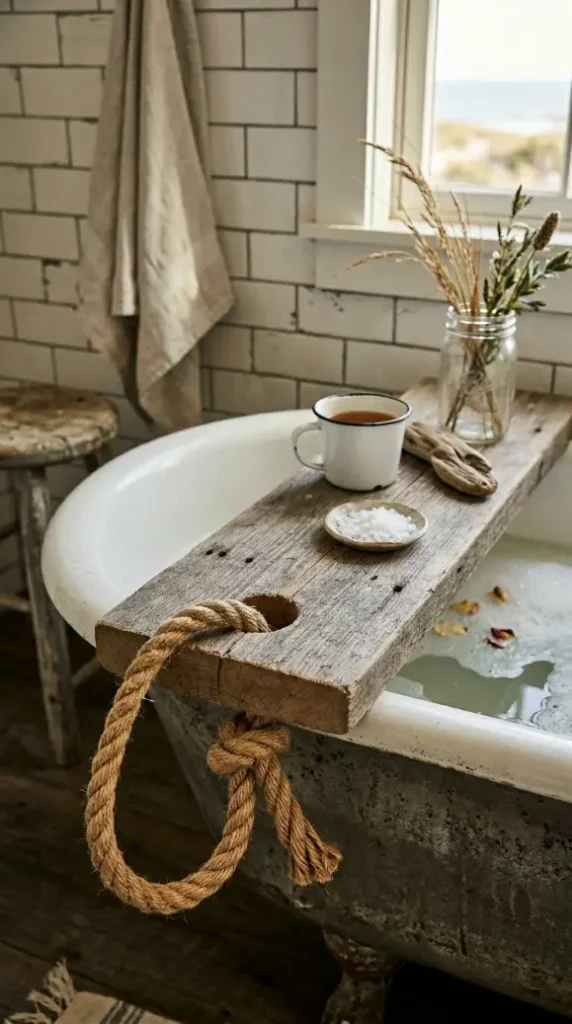
8. The Vintage Enamelware Collection — Chipped White and Blue Speckle
A small collection of vintage enamelware — a chipped white enamel basin, a blue-speckled enamel cup, a small enamel soap dish — arranged on the reclaimed wood tray brings the specific material tradition most associated with early American and European farmhouse kitchenware directly into the bathroom styling. The enamelware collection: genuine or genuine-style enamel pieces showing the characteristic small chips revealing the dark metal base beneath the white or blue-speckled enamel coating, each piece slightly mismatched in form and exact color rather than a uniform purchased set, communicating the same collected-over-time quality that defines authentic farmhouse object curation.

9. The Antler and Natural Found Object Accent — Woodland Farmhouse Detail
A small shed deer antler or a piece of interesting weathered driftwood, positioned among the more conventional bath accessories on the reclaimed wood tray, brings a specifically woodland and found-object dimension to the rustic farmhouse aesthetic that distinguishes it from purely domestic farmhouse styling. The antler accent: one small, naturally shed antler (never harvested from an animal, always a naturally found shed piece) approximately 20cm long, its texture showing the characteristic ridged, slightly porous bone surface, positioned simply on the tray as a found natural object rather than a hunting trophy reference, its pale bone-grey tone complementing the wood’s own weathered grey undertones.

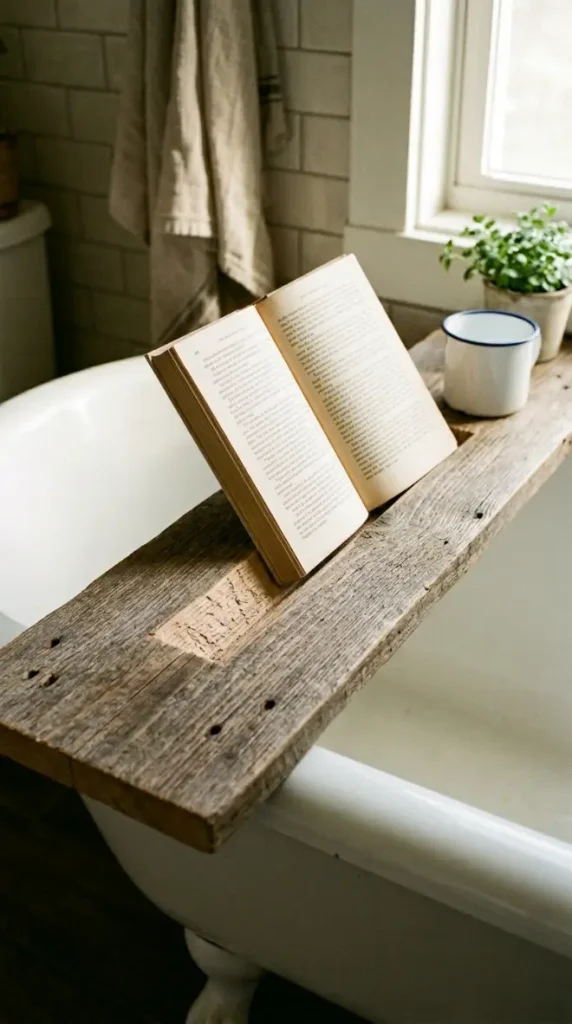
10. The Reclaimed Wood Tray with Built-In Book Stand — Functional Notch Detail
A reclaimed wood tray featuring a simple notch or carved groove cut directly into the plank’s surface — designed specifically to hold a book or magazine open at a slight angle — demonstrates the farmhouse aesthetic’s preference for functional integration over applied decorative hardware. The built-in notch: a shallow groove approximately 15cm long cut at a slight angle into one section of the weathered plank, sized to cradle a paperback book’s spine or hold a magazine open to a specific page, the notch itself left with the same unfinished, slightly rough-textured surface as the rest of the reclaimed wood, the functional modification appearing as integral to the original salvaged material rather than a separate applied feature.
11. The Wide Plank Floor and Tray Material Continuity — Whole-Room Wood Story
A bathroom where the reclaimed wood bathtub tray uses the identical salvaged timber species and finish as the room’s wide plank wood floor, creates a deliberate material continuity that extends the tray’s reclaimed character into a whole-room design statement rather than treating the tray as an isolated decorative object. The material continuity bathroom: the floor laid in wide reclaimed oak or pine planks with the same weathered grey-brown coloring and visible nail holes as the bathtub tray above it, the two surfaces — one horizontal at floor level, one horizontal at tub level — reading as a unified material story that suggests the entire bathroom was built from the same salvaged timber source.

12. The Reclaimed Wood Tray with Galvanized Bucket Plant — Indoor-Outdoor Crossover
A reclaimed wood tray styled with a small galvanized metal bucket (rather than a ceramic pot) holding a simple potted herb or small fern, creates an indoor-outdoor material crossover that echoes the same farm-vessel logic seen in the galvanized stock tank tub pairing, applied here at the smaller scale of a single plant container. The galvanized bucket plant: a small galvanized metal pail approximately 12cm tall, its dimpled metal surface showing the same characteristic farm-hardware texture, holding a simple potted herb (rosemary, thyme, or a small fern), positioned at one end of the reclaimed wood tray where its cool metallic grey tone provides a complementary contrast against the wood’s warmer weathered brown.

13. The Branded Cattle Tag and Vintage Farm Tool Accent — Working Farm Memorabilia
A small piece of genuine or genuine-style vintage farm memorabilia — an old metal cattle ear tag, a small hand tool like a worn wooden-handled paring knife or a vintage seed packet tin — placed among the bath accessories on the reclaimed wood tray adds a layer of specifically working-farm historical reference distinct from purely aesthetic rustic styling. The farm memorabilia accent: one small genuine vintage object (a numbered metal cattle tag, a small wooden-handled tool, an old tin seed container with faded printed graphics), positioned simply among the tray’s other objects, its specific historical and functional farm association lending an additional layer of genuine narrative depth to the overall composition.

14. The Reclaimed Wood and Copper Tub Pairing — Warm Metal Material Dialogue
A reclaimed wood tray paired with a copper bathtub — the warm reddish-orange patina of aged copper providing a rich material dialogue against the wood’s own warm and cool weathered tones — creates a more luxurious but still genuinely rustic version of the farmhouse bathtub pairing. The copper tub pairing: a hand-hammered copper tub showing its natural aged patina (darker bronze-brown tones in the recessed hammered texture, lighter warm copper-orange on the raised surfaces), a reclaimed wood tray spanning its rim, the two materials’ warm tonal range — copper’s orange-bronze and wood’s honey-grey — creating a rich and cohesive warm material story distinct from the cooler white porcelain or galvanized metal pairings.

15. The Reclaimed Wood Tray for a Small Apartment Bathroom — Compact Farmhouse Adaptation
A reclaimed wood tray scaled and adapted specifically for a small apartment bathroom — a narrower, shorter version of the standard farmhouse tray, designed to fit a compact standard-sized tub rather than the larger clawfoot or stock-tank vessels typical of full farmhouse renovations — demonstrates that the rustic farmhouse aesthetic can be successfully adapted to urban small-space living without losing its essential material honesty. The compact apartment tray: a salvaged wood plank cut to a more modest 55cm to 60cm length appropriate for a standard apartment tub width, the wood’s full weathered character and visible nail holes retained even at this smaller scale, styled with a correspondingly reduced number of accessories appropriate to the more limited surface area.

16. The Winter Farmhouse Bath — Wool Throw and Pine Bough Styling
A reclaimed wood bathtub tray styled for the specific atmosphere of a winter farmhouse evening — a chunky wool throw draped over the tub’s edge, a small bundle of fresh pine boughs adding both visual green and fragrance, a steaming mug of hot cider or mulled wine in the tray’s simple cup placement, and multiple lit candles providing extra warmth and light against the season’s early darkness — creates the most atmospherically cozy seasonal version of the rustic farmhouse bath tray styling. The winter styling: pine boughs tucked alongside the dried wheat or in their own simple vessel, a heavy cream or oatmeal wool throw draped generously over the tub’s far edge, two or three candles rather than one, and a warm spiced drink replacing any cold beverage.

17. The Reclaimed Wood Tray with Horseshoe Hardware — Equestrian Farmhouse Detail
A reclaimed wood tray incorporating an actual or genuine-style horseshoe — used either as a small decorative accent leaning against the tray’s edge or, more functionally, as a simple hook from which a small towel or cloth hangs — brings a specifically equestrian farmhouse detail to the rustic styling, the horseshoe’s traditional folk association with luck and rural working life adding genuine regional character. The horseshoe detail: a single weathered iron horseshoe, its surface showing genuine rust and wear from actual use rather than a polished decorative reproduction, positioned simply leaning against the candle or vessel at one end of the tray, or alternatively mounted to function as a hanging hook.

18. The Reclaimed Wood and Mason Jar Pendant Light Pairing — Coordinated Fixture Detail
A bathroom where the overhead or wall-mounted light fixture uses the same mason jar material as the bathtub tray’s storage jars — a simple pendant or sconce fixture housing the bulb within an actual mason jar shade — creates architectural lighting that directly coordinates with the tray’s styling rather than existing as an unrelated fixture choice. The coordinated fixture: one or two mason jar pendant lights hanging above or beside the tub, their glass matching the same ribbed texture as the storage jars on the tray below, the warm bulb glow visible through the jar glass echoing the warm light qualities established by the tray’s candles, creating complete material and lighting coordination throughout the small bathroom.

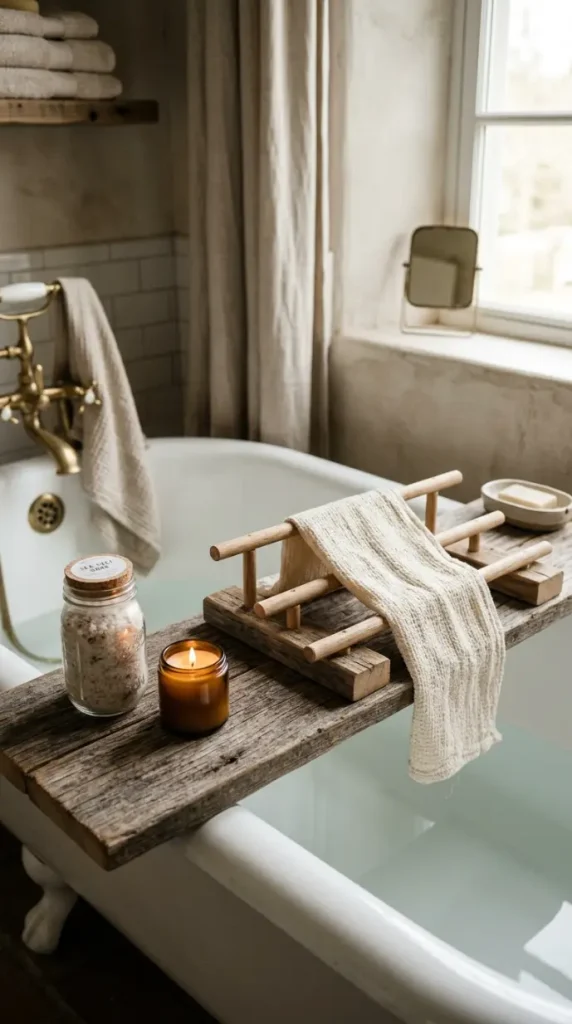
19. The Reclaimed Wood Tray Drying Rack Combination — Multi-Function Bath Furniture
A reclaimed wood bathtub tray designed with an integrated small drying rack section — a few simple wood dowels or a small section of the tray raised on short legs to allow airflow beneath, specifically for drying a washcloth or small items between uses — demonstrates farmhouse furniture’s traditional preference for genuinely multi-functional pieces over purely single-purpose objects. The drying rack combination: one end of the tray featuring three or four simple wood dowels spaced a few centimetres apart, raised slightly above the main tray surface, allowing a damp washcloth to be draped over them for air circulation and faster drying, this practical addition integrated into the tray’s overall form rather than appearing as a separate accessory.
20. The Reclaimed Wood Tray for a Bunkhouse or Cabin Bath — Spartan Working Aesthetic
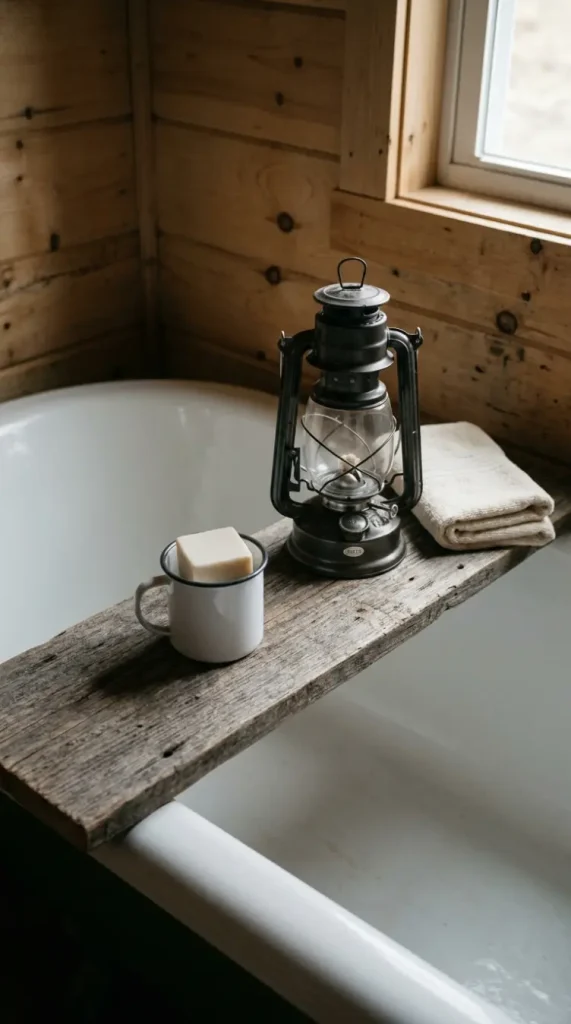
A reclaimed wood tray styled with deliberate sparseness for a working cabin or bunkhouse bathroom context — fewer decorative objects, more purely functional items, the wood’s weathering itself doing most of the visual work without elaborate styling additions — creates the most genuinely spartan and most working-utilitarian version of the rustic farmhouse aesthetic, appropriate to a hunting cabin, a working ranch bunkhouse, or any context where decorative abundance would feel inappropriate to the space’s genuine working purpose. The spartan cabin tray: one simple bar of soap, one enamel cup, perhaps one small kerosene lantern rather than a decorative candle, the tray’s wood surface left almost entirely uncluttered, the styling philosophy here being restraint and genuine utility rather than curated abundance.
21. The Reclaimed Wood Tray with Quilted Patchwork Liner — Textile Heritage Detail
A small section of vintage or vintage-style quilted patchwork fabric, folded and placed beneath the bathtub tray’s accessories as a soft textile base layer, brings the specific American farmhouse quilting tradition directly into the rustic styling. The patchwork liner: a small square of genuine or genuine-style hand-pieced patchwork quilt fabric, approximately 30cm square, in a simple traditional pattern (log cabin, nine-patch, or a basic square pattern) using faded calico prints in muted reds, blues, and creams, folded with natural soft creases and placed on the reclaimed wood tray to provide a textile base for the soap dish or candle, its handmade quilting stitches visible along the seams.

22. The Reclaimed Wood Tray Over a Sunken or In-Floor Tub — Architectural Integration
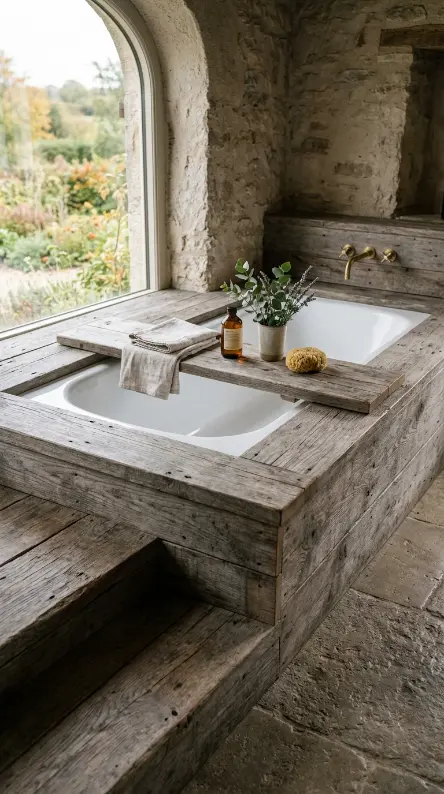
A reclaimed wood tray adapted to span a sunken or partially in-floor farmhouse tub — where the tub itself is set into a raised wood platform or recessed into the floor rather than standing as a freestanding fixture — requires the tray to be specifically fitted to this less common architectural configuration, the wood platform surrounding the sunken tub often constructed from the same reclaimed timber species as the tray itself for complete material continuity. The sunken tub tray: a reclaimed wood tray spanning a tub set into a raised wood platform deck, the platform’s surrounding wood matching the tray’s own weathered character, creating a continuous reclaimed wood architectural surface from the platform deck to the tray spanning the recessed tub.
23. The Reclaimed Wood Tray with Hand-Carved Initials or Date — Personal Heirloom Marking
A reclaimed wood bathtub tray featuring small hand-carved initials, a date, or a simple word carved directly into one corner of the plank — either an authentic carving discovered on the original salvaged timber or a deliberately added personal marking that follows the same folk tradition of carving names and dates into farmhouse furniture and structural beams — creates the most personally meaningful and most genuinely heirloom-quality version of the rustic farmhouse tray. The carved initial detail: small hand-carved letters or numbers, approximately 2cm tall, positioned discreetly in one corner of the tray’s underside or a less prominent surface area, the carving’s slightly irregular hand-done quality (rather than machine-precise lettering) confirming its genuine handmade origin.

24. The Complete Reclaimed Farmhouse Bathroom — Every Element Together
The fully realized rustic farmhouse bathroom where every element — the single wide barn plank tray with its mason jar row, the black iron hardware throughout, the dried wheat sheaf, the galvanized or copper tub, the matching reclaimed wood floor, the vintage enamelware, the hand-carved heirloom marking, and the warm natural and candlelight — works together as one completely unified, genuinely honest, and deeply characterful vision of weathered farmhouse material beauty.