14 Living Room Decor Color Schemes Sage Green Warm White
Sage green and warm white is one of those color pairings that resolves itself before you have finished thinking about it. The two tones belong to the same atmospheric family — both are muted, both carry warmth without loudness, and both have the particular quality of looking different at every hour of the day and in every quality of light. In morning light, sage green reads almost grey. In afternoon light it becomes unmistakably botanical. By lamplight it deepens into something approaching olive. Warm white, beside it, shifts from cream to ivory to the palest yellow-gold depending on the light source, and never reads as the clinical flat white of a painted box. Together they produce a living room that feels resolved without being rigid, considered without being cold, and botanical without a single plant being necessary — though plants, in a sage and warm white room, are entirely at home.
The color scheme works because sage green and warm white occupy adjacent positions on the warm neutral spectrum. Sage is not a saturated green — it carries grey and white in its base, which is why it reads as sophisticated rather than verdant. Warm white carries beige and yellow in its base, which is why it reads as welcoming rather than stark. The relationship between them is not contrast but harmony — they agree on warmth, they agree on restraint, and the room built from them agrees on both. What varies is the proportion: a room that is predominantly warm white with sage green as a considered accent reads completely differently from a room that reverses the ratio, and both are entirely valid expressions of the same color intelligence.
These 14 ideas explore every dimension of the sage green and warm white living room color scheme — from wall treatments and cabinet choices to upholstery, textiles, plants, and the complete room compositions that bring the full palette together.
1. Sage Green Walls With Warm White Trim and Ceiling
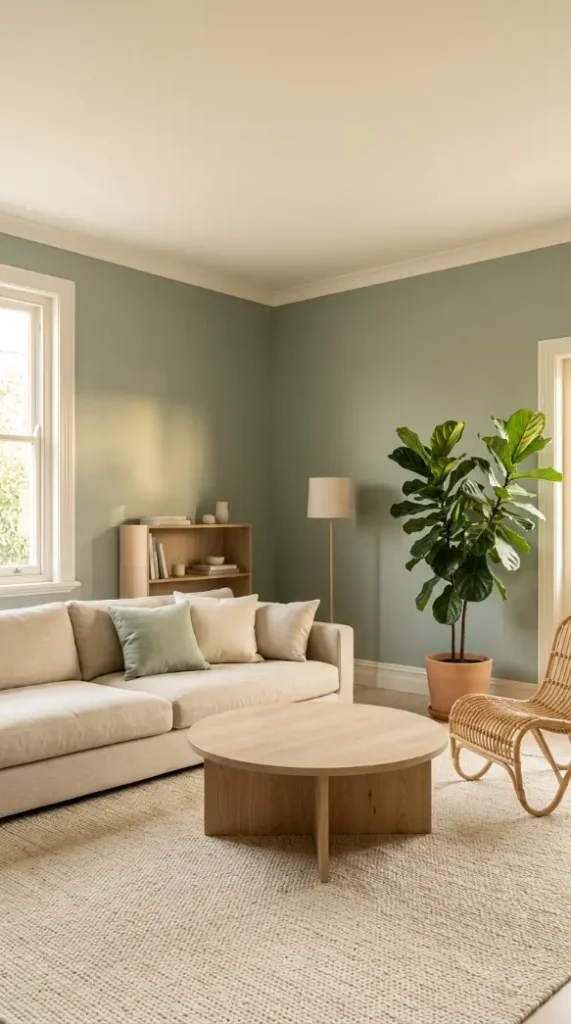
Paint the living room walls in a soft muted sage green — a sage with enough grey and white in its base to prevent it reading as a garden or kitchen paint, but enough botanical warmth to read as genuinely green — with the ceiling and all trim in warm white, the contrast between the sage walls and the warm white ceiling and trim providing a clean architectural definition that an all-over drench would not. Sage green walls with warm white ceiling and trim is the most classically resolved expression of the pairing — it respects the traditional logic of a room’s architectural hierarchy while filling the most prominent surface with the more characterful of the two tones.
2. Warm White Walls With Sage Green Sofa as Statement Piece
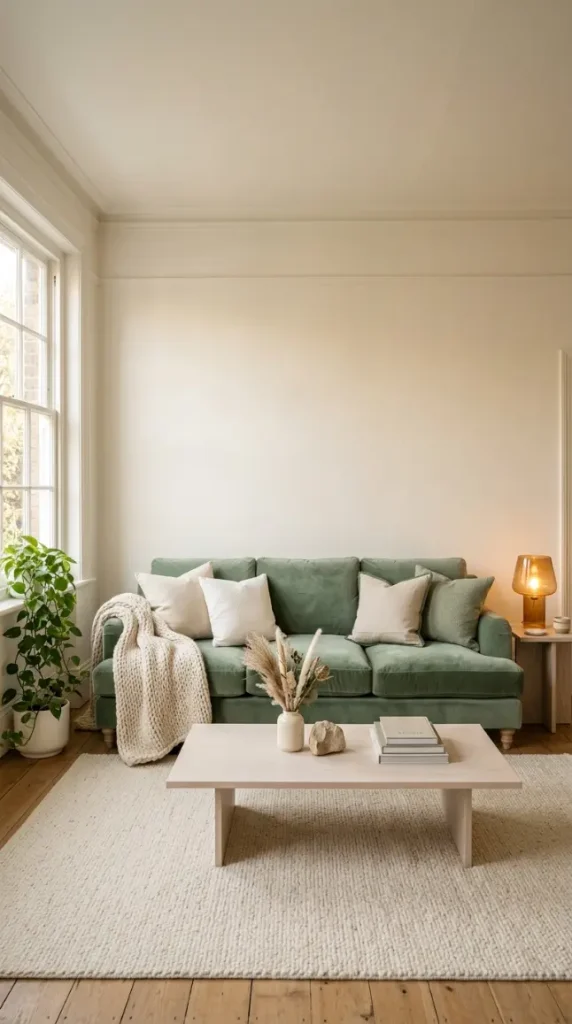
Reverse the dominant color and keep the walls, ceiling, and trim in warm white throughout — clean, warm, enveloping — while introducing a wide, deep sage green sofa as the room’s primary color statement. A sage green sofa against a warm white room is a completely different proposition from sage green walls: the color is contained within a single object, it becomes a piece of furniture first and a color second, and the warm white room around it gives the sage green every possible advantage of surrounding light and space. Choose a sage green velvet or textured linen sofa for maximum material and visual impact against the warm white backdrop.
3. Sage Green and Warm White Through Painted Cabinetry and Shelving
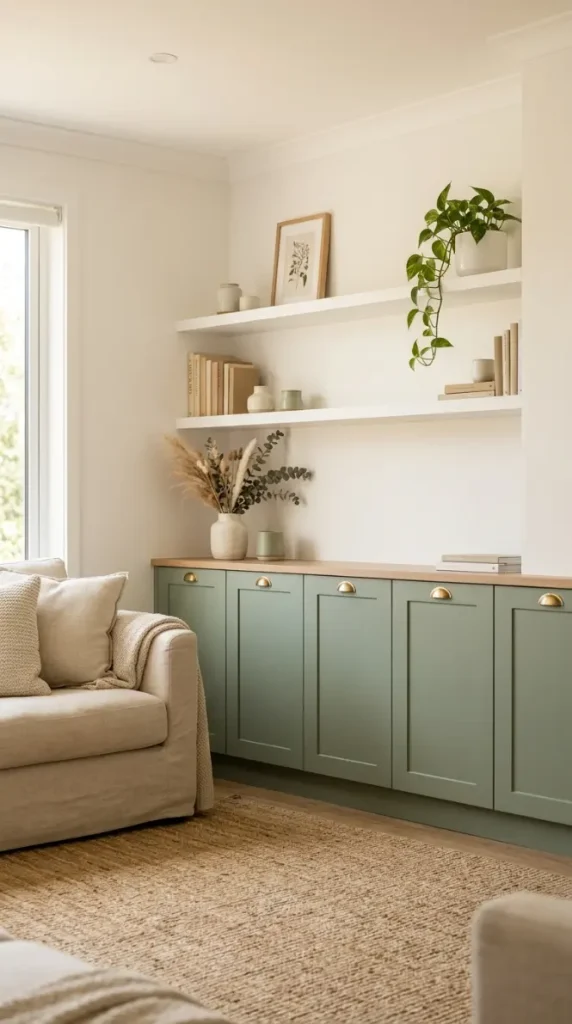
Introduce the sage green and warm white scheme through the living room’s built-in or freestanding cabinetry — painted sage green lower cabinet units or a built-in media cabinet in sage green, with upper open shelving in warm white, or a full-height bookcase with the back panel painted sage green and the shelving unit frame and shelves in warm white. The sage green and warm white cabinet-and-shelf composition is the most controlled and architectural way to introduce the color pairing — the two tones sit in a direct structural relationship, the sage green receding as the back panel gives depth to the shelving display, and the warm white frame bringing every object on the shelves forward with clarity.
4. Sage Green Velvet Cushions on Warm White Sofa
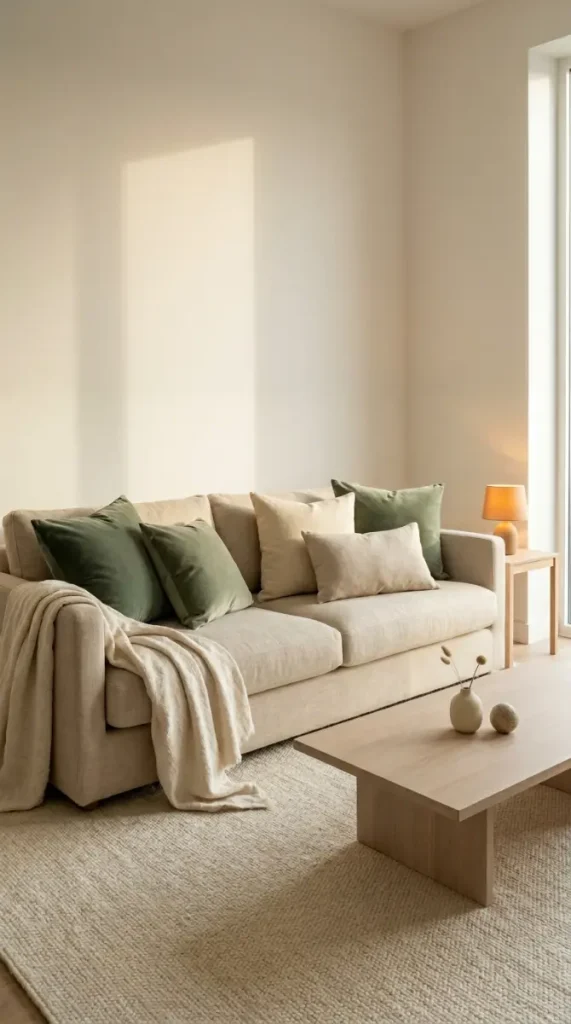
Keep the sofa warm white or natural cream — a wide linen or textured fabric sofa in warm white or warm ecru — and introduce the sage green entirely through the scatter cushion arrangement: three or four sage green velvet scatter cushions of varied sizes alongside warm white and natural linen cushions, the sage green velvet cushions providing the color interest while the warm white sofa body anchors the piece in the room’s warm white background. Sage green velvet cushions on a warm white sofa is the most effortless and easily adjusted entry point for the sage and warm white scheme — the cushions can be added or changed without any commitment to painted surfaces or upholstered furniture, and the sage green velvet in warm afternoon light is one of the most beautiful small textile objects a living room can contain.
5. Sage Green Painted Feature Wall With Warm White Remaining Walls
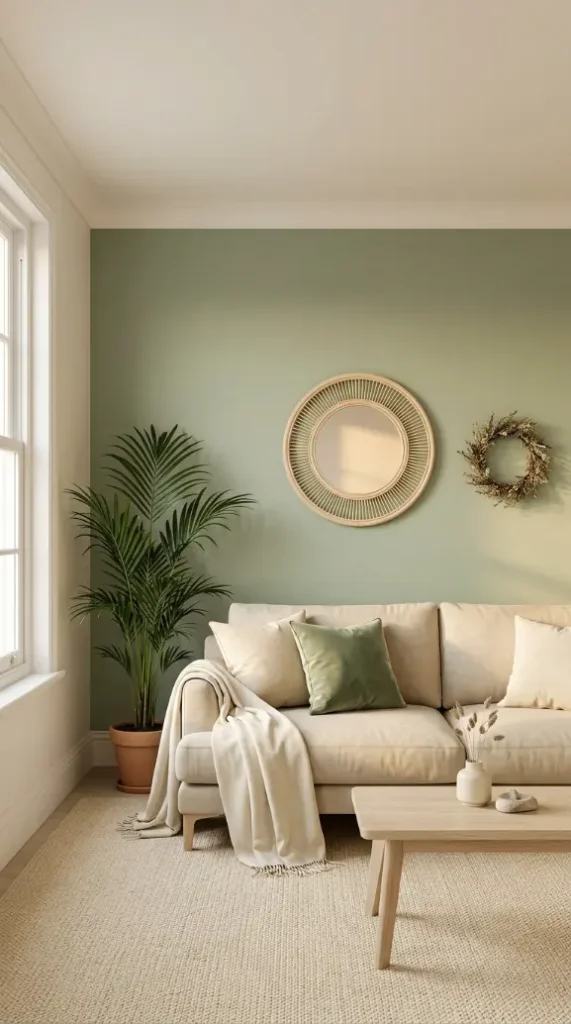
Paint a single feature wall in sage green — the wall behind the sofa or the primary focal wall of the living room — and keep the remaining three walls, ceiling, and trim in warm white, creating a one-wall color statement that provides the sage green atmosphere without committing the full room to it. The sage green feature wall with warm white surroundings is the most compositionally controlled use of the pairing — it establishes a clear axis of visual focus in the room, it gives the sage green a defined stage, and the warm white walls on the remaining three sides keep the room open, light, and airy around the single color accent wall.
6. Sage Green and Warm White With Natural Rattan and Timber Accents
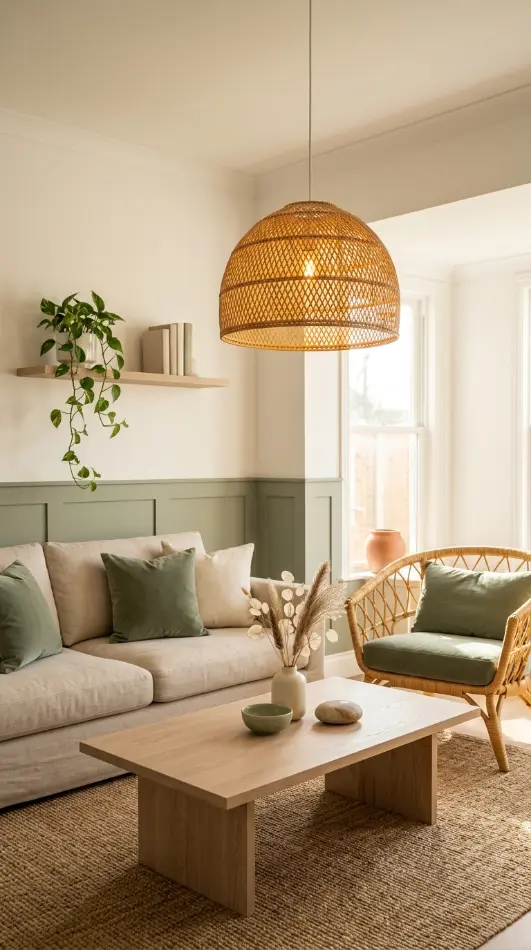
Layer natural rattan and warm timber accents through the sage green and warm white living room — a rattan armchair, a woven rattan pendant light, a bleached oak coffee table, natural timber side tables, a woven seagrass or jute rug — so that the organic material palette of natural rattan and timber connects the botanical quality of the sage green with the warmth of the warm white, all three tones belonging to the same natural, organic, sunlit world. The sage and warm white room with rattan and timber accents is the most naturally cohesive living room composition available — it references the color and material palette of warm climates, light-filled rooms, and the particular aesthetic that is equally at home in a coastal cottage or a Scandinavian apartment.
7. Sage Green Painted Panelled Wall With Warm White Upper Wall
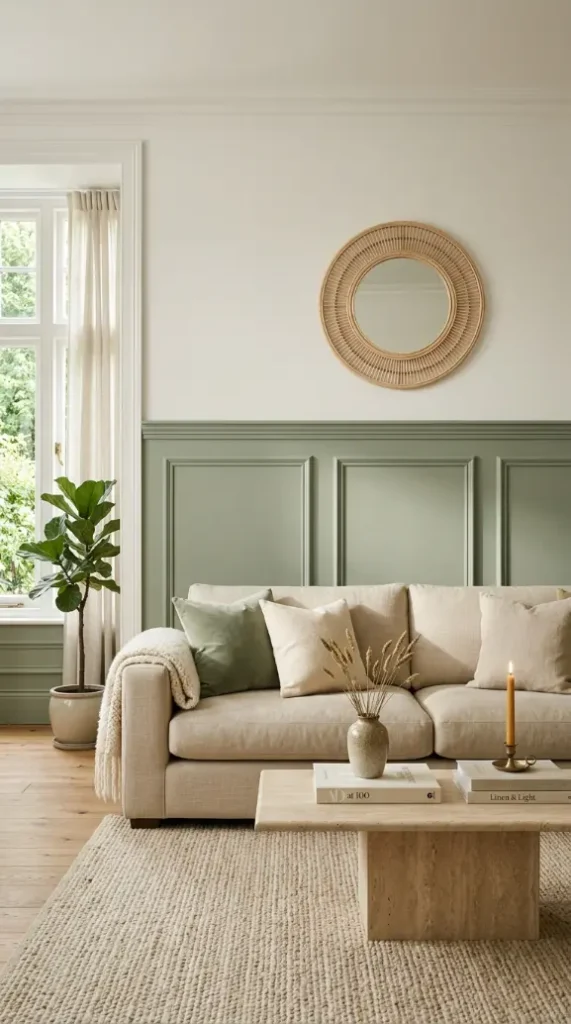
Install or paint wall panelling — either built-in timber panelling, picture-rail moulding, or a simple applied timber batten grid — on the lower portion of the main living room wall to approximately 90cm-110cm height, paint the panelling in sage green, and paint the upper wall above the panel rail in warm white, creating a classical two-tone wall treatment that uses the sage green and warm white in their most architecturally considered relationship. The sage green panelled wall with warm white upper wall is one of the most elegant ways to introduce the color scheme — the lower sage panel provides warmth and groundedness, the warm white upper wall keeps the room airy and light above, and the horizontal line of the panel top creates a visual datum that makes the room’s proportions feel considered and intentional.
8. Sage Green and Warm White Through Plant Styling
Build the sage green element of the color scheme entirely through lush indoor plant styling — without any sage green paint, fabric, or object — filling a warm white living room with a generous, intentional collection of green indoor plants in warm white, terracotta, and natural ceramic vessels: a large Fiddle Leaf Fig, a trailing Pothos, a wide Monstera, a small Olive tree, a collection of succulents on a floating shelf — the natural greens of the plant foliage providing the room’s entire green palette, the sage quality coming from the muted botanical light the plants cast rather than from any dyed or painted surface. The all-plant sage green approach is the most organically honest version of the color scheme — the green it provides is always living, always slightly different day to day, and entirely coherent with the warm white, natural timber, and linen palette around it.

9. Sage Green and Warm White in a Maximalist Living Room
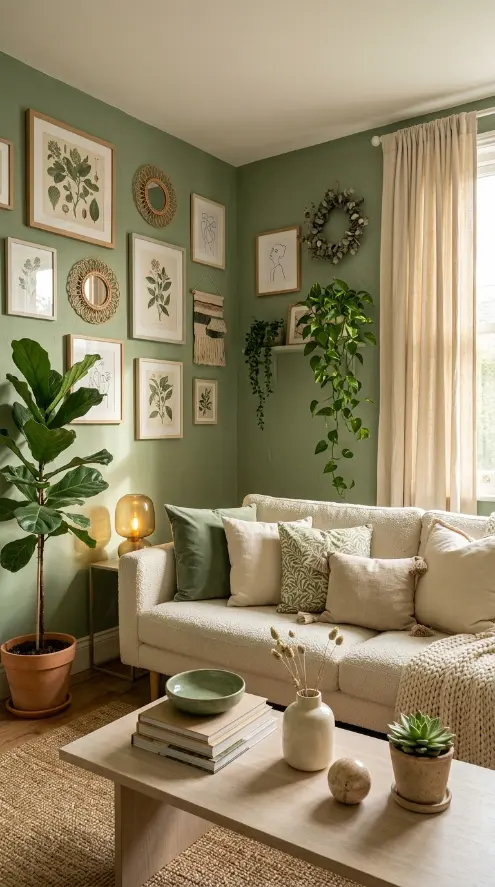
Apply the sage green and warm white scheme not in a minimalist or restrained context but in a maximalist living room — sage green walls full of a rich gallery arrangement of framed prints and mirrors, a warm white sofa dressed in a generous layered cushion arrangement of sage green velvet, warm cream linen, sage-and-cream botanical prints, and soft warm white textured fabrics, a coffee table layered with books, ceramics, and botanical objects, abundant plant styling, woven textiles, and natural rattan accents. The maximalist sage green and warm white room proves that the color scheme is not limited to calm Scandinavian restraint — when surrounded by warmth, layering, and accumulated beautiful objects, sage green and warm white become the calmest and most resolved backdrop to maximalism available.
10. Sage Green Kitchen Open to Warm White Living Room
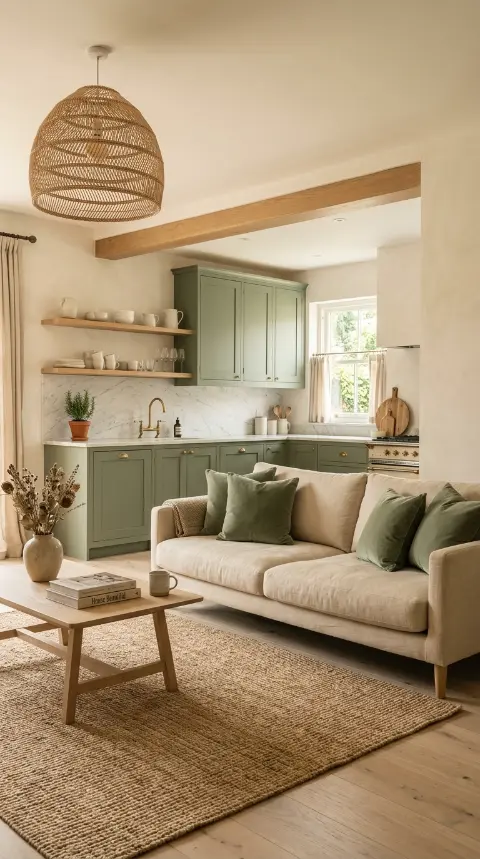
Design the kitchen cabinetry in sage green — full sage green painted shaker cabinet doors throughout the kitchen — opening directly into or visible from a warm white living room, so that the sage green kitchen cabinets and warm white living room walls together form a single continuous open-plan color composition. The sage green kitchen opening to a warm white living room is one of the most satisfying open-plan color decisions possible — the sage kitchen cabinets become visible from the living room as a wall of calm botanical color, the warm white living room provides the breathing space around them, and the two zones together say that a home can be both considered and generous simultaneously.
11. Sage Green and Warm White With Warm Brass Accents Throughout
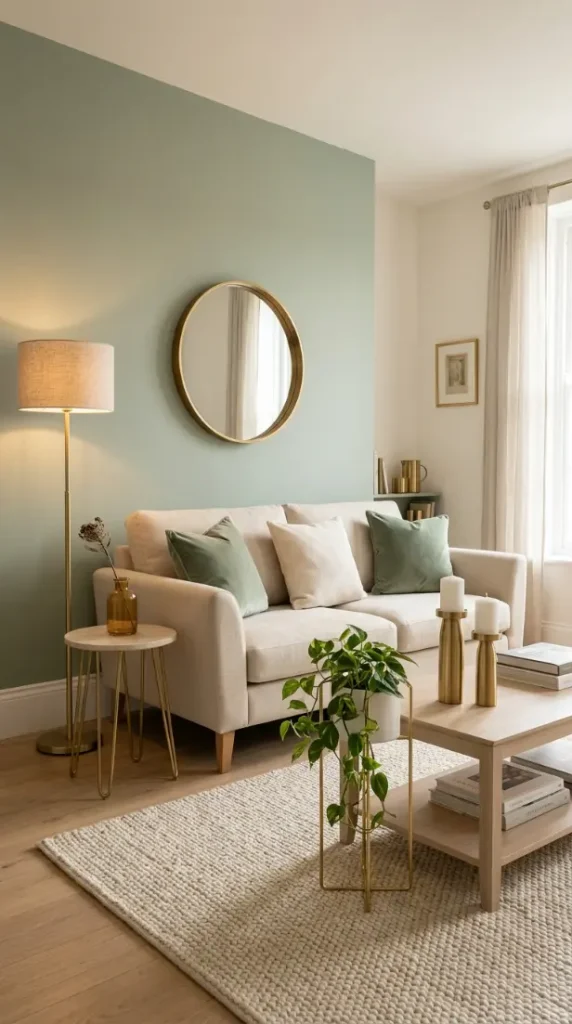
Run warm brushed brass as the accent metal through the full sage green and warm white living room — warm brass floor lamp, warm brass side table legs, brass picture hanging hardware, a brass-rimmed round mirror, brass plant pot stands, brass candle holders on the coffee table — so that the three-tone palette of sage green, warm white, and warm brass creates the room’s complete material composition. Warm brass is the perfect accent metal for the sage and warm white scheme because it carries the warmth that both tones already express, adds a material richness without introducing a fourth color, and connects the botanical quality of the sage green with the precious-material quality that transforms a restrained palette into a luxurious one.
12. Sage Green and Warm White With Warm Cream Linen Curtains
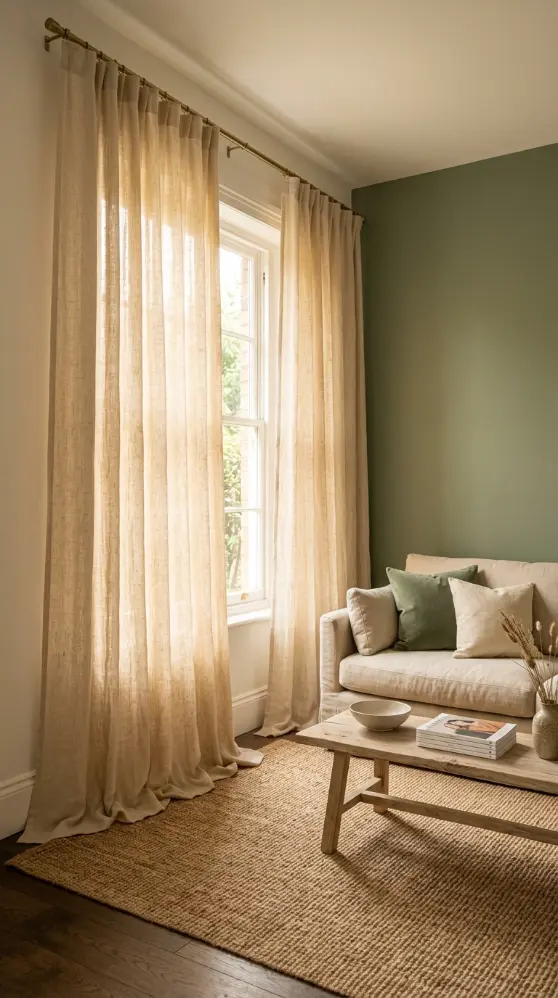
Hang long floor-to-ceiling curtains in warm cream or natural linen fabric — unlined or lightly lined so the afternoon light filters through giving the fabric a warm translucent glow — at the living room windows, the warm cream curtains pooling very slightly on the floor and framing the windows in the warm white and sage green room. Long natural linen floor-to-ceiling curtains are one of the single most impactful additions to a sage and warm white living room — they add vertical scale, they soften the hard edges of the window frame, they move in gentle air currents creating a living quality, and in afternoon light their warm translucent glow is among the most beautiful light effects available to a domestic interior.
13. Sage Green and Warm White Living Room With Hygge Winter Styling
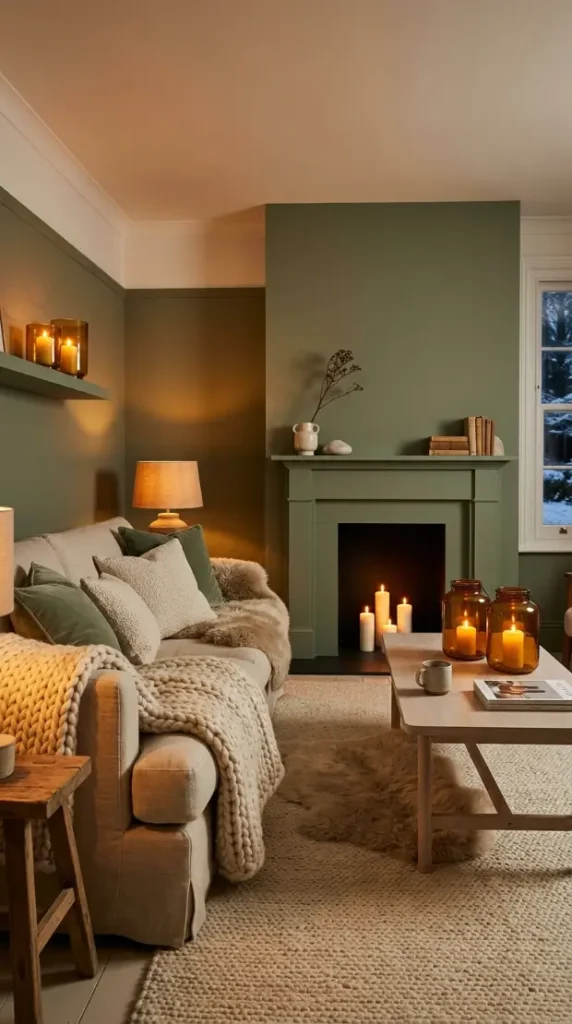
Style the sage green and warm white living room specifically for winter — maximum textile layering, warm amber candlelight from multiple sources, a warm woven throw on every seat, a deep-pile or sheepskin rug layered over the natural wool rug, warm amber glass candle lanterns on the coffee table and side surfaces, and a warm fire in the fireplace with the fireplace surround painted in the same sage green as the walls. The winter hygge sage green and warm white room is the most intimate and enveloping version of the color scheme — in winter light and candlelight, the sage green walls shift toward a deeper, more complex tone, the warm whites of the textiles glow warmly around the candles, and the room becomes the most persuasive argument for staying home.
14. Complete Sage Green and Warm White Living Room — All Elements Together
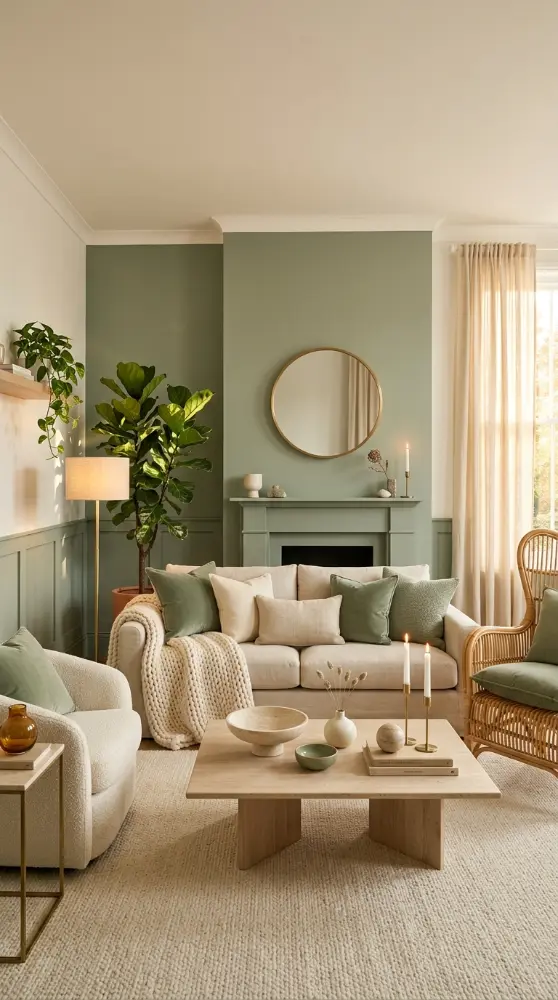
Design the most complete sage green and warm white living room as a single fully cohesive composition — every element simultaneously present: sage green matte painted main feature wall and fireplace surround with warm white remaining walls, ceiling and trim, full sage green lower wall panelling with warm white upper wall on the side walls, a wide natural linen sofa with a maximalist layered cushion arrangement of sage green velvet, warm cream linen and sage-toned textured fabrics, a large cream chunky-knit throw, a wide cream bouclé armchair, a large natural rattan armchair with sage green cushion, long warm cream natural linen floor-to-ceiling curtains at the windows, a large honed travertine or bleached oak coffee table with sage green ceramic and cream ceramic and dried botanical styling, warm brushed brass throughout — floor lamp, round mirror on sage wall, side table legs, candle holders — large Fiddle Leaf Fig in terracotta corner casting leaf shadows on the sage green wall, a large natural undyed wool rug below, warm cream linen curtains in warm afternoon light — the full color scheme in its complete and most generous expression.